Guide
Making one yourself
Strand count and pitch, cord choice, the bead order on paper, stringing, knotting, fixing to a dowel — and the hour count.
Open the reference
Guide · DIY
A panel whose cord has failed is not rubbish, it is several thousand beads in a known palette. The cord is the consumable; the beads almost never are.
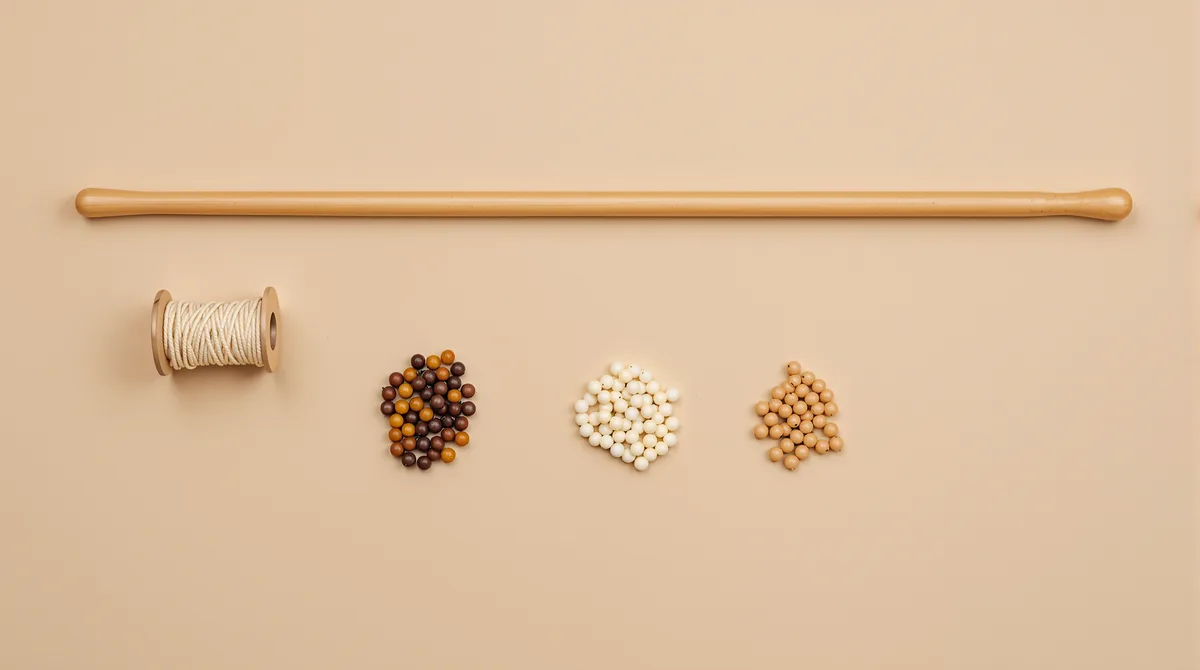
Beads stripped from an old panel sorted into heaps by material — turned wood, pressed glass, moulded acrylic, glazed ceramic and faceted crystal — with the emptied frayed cord…
Strip the panel one strand at a time into labelled trays, keeping each strand's sequence intact until you are sure you do not need it. Sort by material, then size, then colour. Glass and faux capiz are indefinitely reusable; cord is not. The beads then serve as repair stock for other pieces, or as material for a shorter build.

Releasing strands at the header, emptying each one into a tray, and sorting. The decision that shapes all of it is whether you are keeping sequences or keeping beads.
Keeping sequences means one tray per strand, laid out in order, which preserves the ability to rebuild the panel or to make a replacement strand for an identical one. Keeping beads means sorting by material, size and colour, which gives you a usable supply and permanently discards the design.
Decide that before the first strand comes off.
Trays with lips, enough of them. A sorting dish per material. Good light, because a chipped drill hole is visible and a chipped drill hole matters.
And a clear reason. Stripping a panel that is genuinely finished is sensible; stripping one that needs a single strand re-strung is destroying an object to avoid an hour's work.
When the cord has failed as a material rather than at a point. A panel with one parted strand is damaged and repairable. A panel whose cord has gone brittle across its whole width — after prolonged damp, or years of strong sun on the cord itself — is finished, because every strand is a future failure and re-stringing all of them is rebuilding the panel.
The other case: a panel that no longer suits its room and has no other opening to go to. That is a reuse decision rather than a failure one, and it is a legitimate one.
Material first, because materials are not interchangeable and mixing them loses the distinction irretrievably. Then size, because size decides what a bead can be rebuilt into and because a bead one millimetre out of a strand's sequence shows at the hem. Then colour.
The hidden fourth sort is drill-hole size. Beads of the same diameter from different runs do not necessarily take the same cord, and a sorted tray of visually identical beads with two hole sizes in it is a slow discovery.
| Component | Reusable | Best second use | Note |
|---|---|---|---|
| Glass beads | Yes, indefinitely | Repairs, a shorter build | Check each for chips at the drill hole |
| Acrylic beads | Yes | Repairs, a children's piece | Does not shatter; the most robust |
| Wood beads | Usually | A natural-palette build | Discard any that have been damp |
| Bamboo beads | If dry | A natural-palette build | Marked bamboo does not recover |
| Faux capiz discs | Yes | A linked-disc piece | Check edges for chips |
| Cotton cord | No | — | The consumable; do not reuse |
| Turned dowel | Yes | The next panel's header | Hardest component to replace well |
| Beads in a dense 90 × 200 cm panel | — | — | About 11,800, published |
Three things, in descending order of usefulness.
Repair stock for other panels of the same design, which is the highest-value use and the one most often overlooked. A shorter build: a valance, a café-width piece, a window dressing, or strands for a lamp or mirror surround. And small flat work — a beaded coaster or an embroidered patch — if the beads are small enough, though bead embroidery wants seed beads rather than the larger beads most hanging panels are built from.
For scale: a densely patterned 90 × 200 cm panel can hold about 11,800 beads, and render figures put a sparser build at the same size near 3,100. Even the sparse case is a substantial supply.
Stripping into a bucket. Mixing materials. Reusing the cord. And discarding the dowel, which is the component hardest to replace well — a turned dowel of the right diameter and finish is not a dowel from a builders' merchant.
The fifth: stripping a panel that still had an intact strand worth keeping as a spare. An intact strand is worth more than the beads in it.
Never cut strands off at the header in a single pass, because you lose the ability to change your mind. Never sort by colour before sorting by size. Never reuse cord. And never strip a piece of bead embroidery to salvage the beads — the couching thread holds each bead individually and unpicking it damages more beads than it recovers.
An evening for a valance, several evenings for a full-length panel, and almost all of it is sorting. A 40-strand panel with a few hundred beads per strand is a genuine quantity of small objects.
The realistic approach is to strip in sessions, one group of strands at a time, with the sorting done as you go rather than left as a pile.
Keeps a library rather than a pile. Our own bead library is deep enough to give a brand a bead nobody else is using: glass in every form — hand-made lampwork, pressed and seed — plus acrylic, wood, bone, horn, ceramic, shell, capiz and metal, each kind sorted by material, size and hole.
The relevant discipline for a home strip-down is what makes a library a library: beads sorted by material and size, with the hole dimension known, so a design can be built from stock rather than from whatever is to hand. A sorted tray is a library; a jar is a souvenir.
You cannot rebuild a patterned panel from mixed beads, and you cannot make a longer piece out of a shorter one. What you can do is make a shorter, simpler piece, or keep a design alive by repairing it.
And the old panel has one more use that costs nothing: the photograph. Beads can be matched to a Pantone reference or a physical chip and confirmed on a sample, so a design you liked can be rebuilt properly later from an image, at the drop and width the new opening actually needs. That is a better outcome than a jar of beads, and it starts with taking the picture before the panel comes down.
Good to know
If you kept each strand's sequence in a labelled tray, yes in principle — you would be rebuilding it onto fresh cord, which is what a full re-string is anyway. Once the beads are mixed, no. That is the whole reason to strip into trays rather than into a bag.
Shallow trays with lips, fine cutters, a tray or sorting dish per material, and good light. A bead sorting tray with compartments is the one piece of kit genuinely worth buying if you are stripping a full-length panel.
Yes, and it is the one thing not to reuse. The cord on a panel that has reached the end of its life has lost strength at every drill hole it passes through, and it has usually had years of light and dust. New cord costs very little against the hours of re-stringing it carries.
Glass is the material most worth salvaging and the one that needs checking. Inspect each bead at the drill hole: a chip there is where cord abrades, so a chipped bead will cut the new cord. Glass also chips where beads knock, so a panel that has been walked through hard will have some casualties.
Yes, and it is a sensible use for a panel that has been on display long enough to fade on one side. The shaded strands are often perfect, and their beads become repair stock for the same design — which is worth more to a shop than the faded panel is.
Keep it intact. An intact strand is worth more than its beads, because it is a ready-made replacement strand for another panel of the same design. Coil it loosely, label it, and only strip it if you need the beads.
An evening for a valance, several for a full-length panel. The time is in sorting rather than in stripping, which is why deciding what you are sorting for — repairs, or a new build — before you start saves most of it.
Keep exploring
Guide
Strand count and pitch, cord choice, the bead order on paper, stringing, knotting, fixing to a dowel — and the hour count.
Open the referenceGuides
One guide per question that arrives often enough to be worth answering properly.
Read moreGuide
How to draw the strand grid, how a diagonal actually reads, and why a repeat costs less than a gradient.
Read the guideGuide
The typical contents list, the two items usually left out, and how to check a kit holds enough beads for the panel it promises.
Compare the optionsGuide
The three realistic options, how each behaves under bead weight, and the end finish each one needs.
Specs and sizesGuide
Identify what failed, re-string that strand, re-knot it at the header, and match the bead from the spares specified with the order.
Open the reference
Start a conversation
Send a reference, a colour chip or a sketch. Minimums are set per design and confirmed per quote; sampling is quoted separately and usually runs 16 to 20 days from an agreed brief.