Pillar
Bead curtain formats
Door curtains, portals, café lengths and valances: the standard sizes, the strand counts and the one question each format answers.
Read more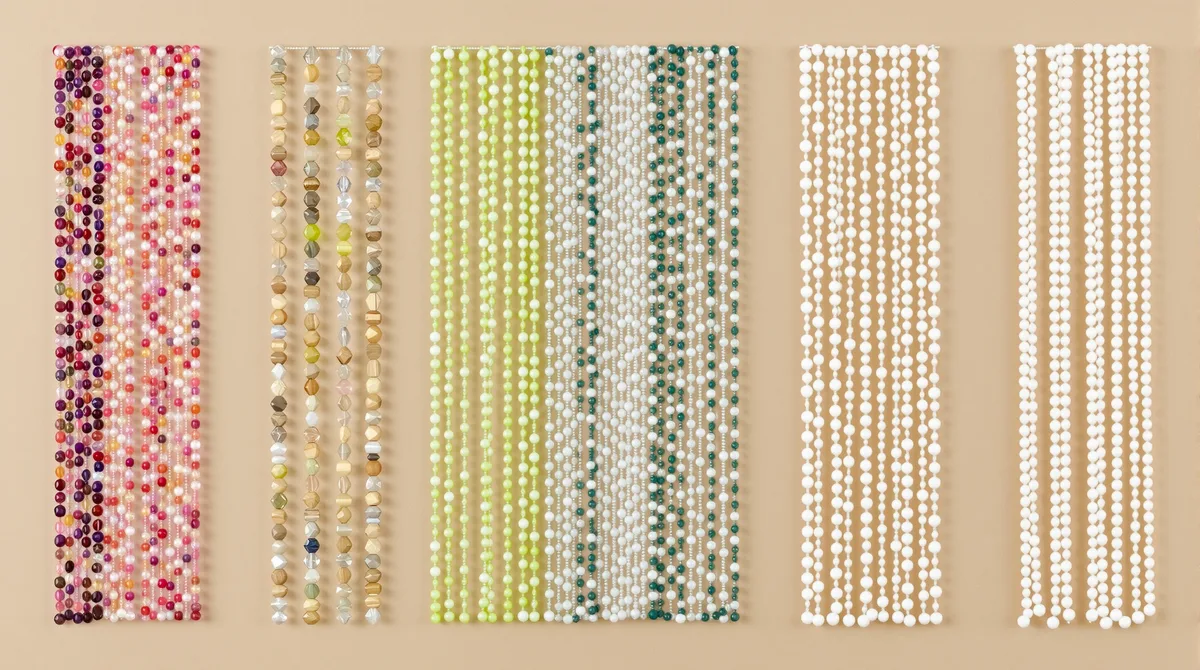
Guide · Buying
Six decisions, and they are not independent. Taken in the right order each one narrows the next; taken in the wrong order you end up re-choosing the bead because of the hem.
Six narrow beaded sample panels hung side by side at the same length — translucent acrylic multi, lime seed bead with spaced forest-green rounds, dotted oval pressed glass…
Decide in this order: where the panel hangs and what it has to do there; the bead material; the strand density; the drop; the hem shape; and how it fixes to the opening. Each decision constrains the next. Colour comes last, because a colourway can be rebuilt on any construction and a construction cannot be rebuilt from a colourway.
Where it hangs. Which bead material. How dense the strands are. How long the drop is. Which hem shape. How it fixes. Then colour.
The order is not stylistic. Material decides weight; weight decides the fixing; density and drop decide the bead count, which is where almost all the cost sits; the hem shape depends on knowing the drop. Choose colour first and you have chosen nothing, because every colour story we hold can be built on almost any construction.
A bead panel does one of three jobs. It dresses an opening without closing it — the doorway portal case, where the panel is meant to be walked through. It screens a sightline, in which case density matters more than looks. Or it decorates a plane: a window, a wall, an alcove.
Say which of those it is before anything else, because they pull in different directions. A panel that must be walked through many times a day wants fewer, heavier strands that part cleanly. A panel that is screening a view wants more strands, closer together, and never has to recover its shape.
Material is the decision that sets weight, sound and colour range at once, which is why it comes second.
Glass is drawn and hand-strung in our own glass works at Firozabad: the heaviest option, the brightest sound, and the only family that includes genuinely specialty beads — dotted ovals, Venetian-style feature beads, irregular frosted sea-glass. Acrylic is moulded and dyed to your colour, and to our own dies where a design needs a bead that does not exist yet; it is light, will not shatter, and takes the widest colour range. Wood is turned, warm and quiet, and its dowels come from our own wood factory at Saharanpur. Faux capiz is cast resin or dyed cut acrylic finished to imitate capiz shell — an engineered imitation, deliberately, which is what gives it consistent colour.
Density is strand pitch — the centre-to-centre distance between neighbouring strands — and it is the second largest cost driver after bead size, because it multiplies the bead count.
In our 2027 design renders a 90 cm panel carries 40 strands at roughly 2.25 cm pitch, and a 120 cm panel carries 60 strands at roughly 2 cm. What they illustrate is the range: the same width can read as an open fringe or a near-solid wall depending on pitch alone.
Density also sets how much a panel can depict. A pattern needs strands close enough that the eye joins them into a field; a plain colour does not.
The published standard for a full-length door curtain is about 90 × 200 cm, roughly 35 × 79 in. Portals in the design library run 76 × 140 cm, and there is a 90 × 67 cm format that works either as a wall hanging or as a short door portal.
Height is a real cost lever, because it is beads per strand. Dropping a few centimetres off a 30-strand panel removes beads thirty times over. It is also the decision most often got wrong at home, because people measure the door and forget to decide the gap at the floor.
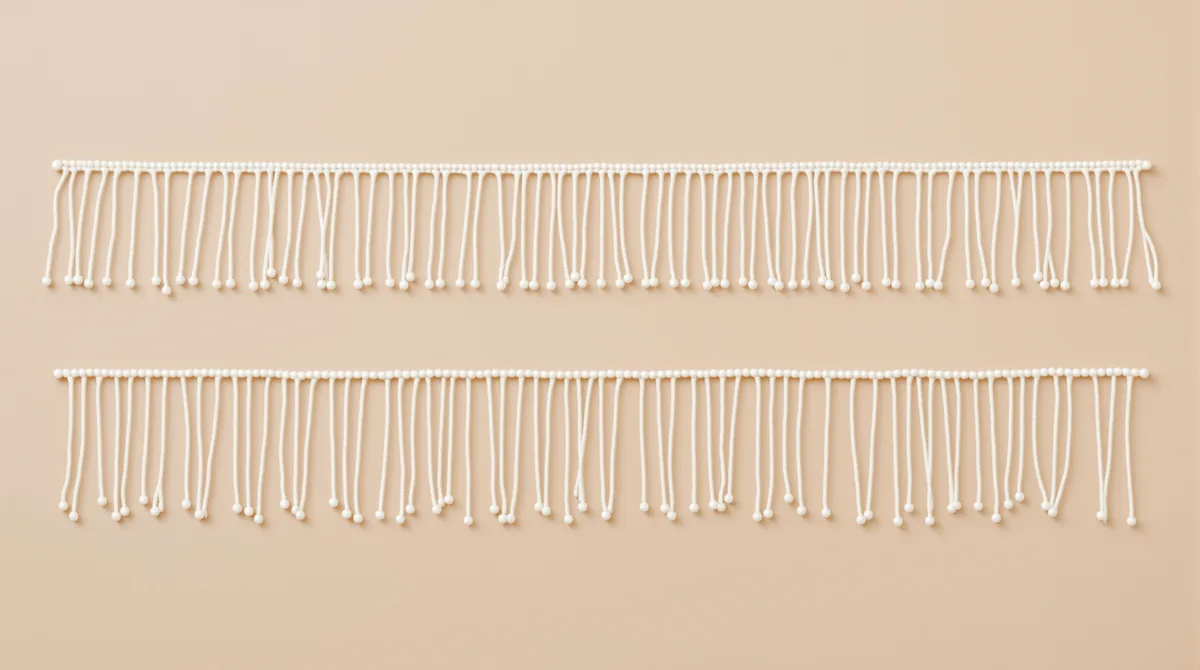
The hem is the cheapest way to make a panel look designed rather than bought. Straight is the default. A scalloped arch sweeps up at the centre and is fullest at the sides. A V-point or inverted-V reads more graphic. An arched-cut drop removes the centre entirely so the panel frames a walk-through rather than covering it.
Every shaped hem is just a list of strand lengths, which is why a shape costs nothing extra in material and something in planning. On one frosted sea-glass valance construction the longest strand runs 24 in and the shortest 10 in across the same 30-strand header.
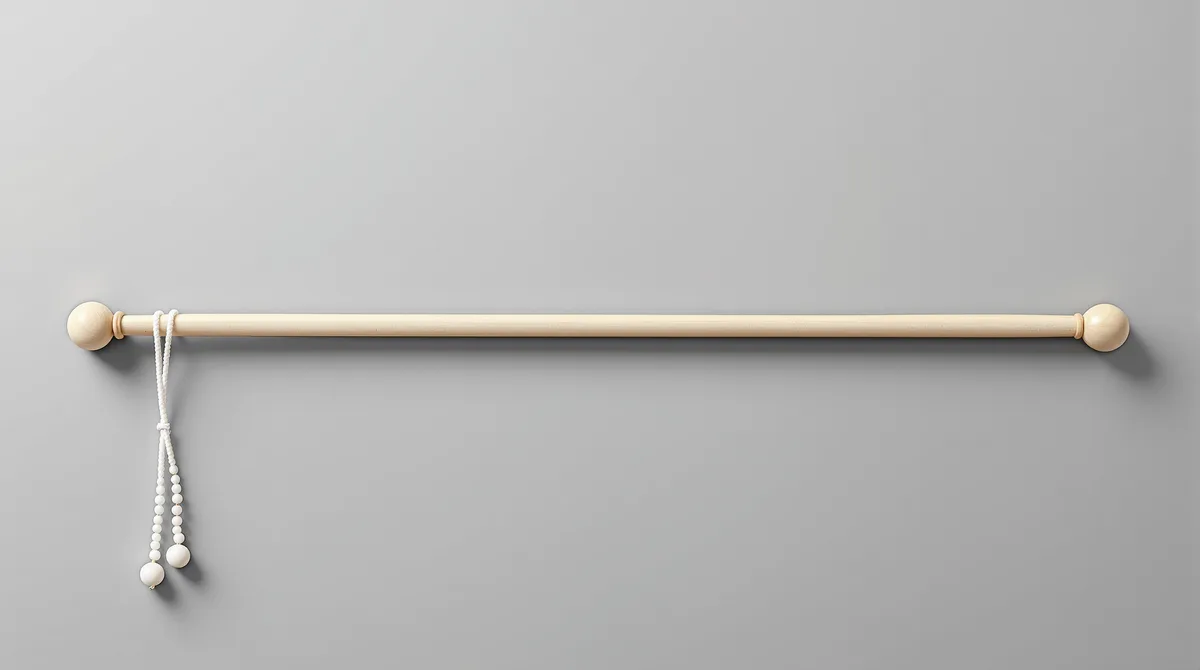
Four fixings, in ascending order of what they will carry. A tension rod inside the reveal, which drills nothing and holds light panels only. Cup or screw hooks in the frame, which are simple and strong. A rod on brackets, which is the answer for glass and for wide openings. Ceiling hooks or track, for a panel hung away from a wall and fixed into a joist.
This is where the material decision comes back. A tension rod that holds an acrylic panel will slip under glass, and nothing about the panel tells you that until it is on the floor.
Because colour is the only one of the seven that can be changed without redesigning anything. Beads are matched to a Pantone reference or a physical chip and confirmed on the sample, so a construction that works can be re-coloured at will; a colourway that works cannot rescue a construction that is too light for its opening.
There is one exception worth knowing. If the design is a gradient rather than a motif, the grade can be carried by bead size instead of by dye — the honey ombre approach, where the smallest beads sit at the top and the largest at the hem. That makes colour and construction the same decision, and it has to be settled early.
Light: almost all of it, and in a specific way. Translucent and faceted glass refracts rather than blocks, so the panel casts moving bead-shadows instead of a flat shade. Opaque beads read as a screen of dots. This is the reason a bead panel is usually the wrong answer to a glare problem and the right answer to a flat, dead doorway.
Privacy: partial. A dense panel breaks up a sightline and defeats a casual glance. It does not make a room private, it does not stop sound, and no density we build makes it do either. Specify it as a sightline break and it will not disappoint anybody.
Glass chimes, acrylic clicks, wood knocks softly, bamboo rattles dryly. In a doorway walked through all day, that sound is a feature or a problem depending on the room — it is a reliable charm in a shop doorway and an irritation outside a bedroom.
Bead size changes it as much as material. Large beads on a light cord are the loudest combination; small beads strung close are almost silent because they cannot swing far enough to strike.
Cost, in the order it actually moves: bead size and material first, then construction — strand count and how tightly each strand is strung — then strand spacing, then the dowel and the packing, then height. A densely patterned 90 × 200 cm curtain can hold about 11,800 beads, every one placed by hand, which is why bead count and not dimensions is the number that sets the price.
Lifespan divides the same way every time. The beads outlast the room; the cord is the service item. Published production timing for beaded décor is 40 to 60 days after sample approval, with sampling usually 16 to 20 days from an agreed brief, so a considered panel is a planned purchase rather than an impulse one.
Extractable data
| Material | Weight and drape | Sound | Colour range | Durability |
|---|---|---|---|---|
| Glass | Heaviest; hangs straight and settles fast | Bright chime | Wide, with tints and specialty beads | Can chip or crack if knocked hard |
| Acrylic | Light; moves more, needs design to hang straight | Light click | Widest; moulded and dyed to your colour | Does not shatter |
| Wood | Light; soft movement | Soft knock | Natural grain, or a colour finish | Rarely breaks; avoid damp |
| Bamboo | Very light | Dry rattle | Natural texture, limited colour | Keep dry; marks in damp |
| Faux capiz | Light discs, broad face | Soft clatter | Dyed to colour, consistent lot to lot | Cast resin or dyed cut acrylic, not shell |
Good to know
Yes, and that is the format it was developed for — a doorway panel is walked through several times a day. Daily use is a density and fixing question rather than a material one: strands have to be spaced enough to part and fall back, and the header has to be fixed to something that takes the weight rather than friction alone.
No weight is published per design, because it follows from bead material, bead size and bead count rather than from the format. The useful ranking is fixed, though: glass is the heaviest option by a wide margin, acrylic and wood are much lighter, and bamboo is lighter again. Weight is confirmed on the approved sample.
Yes. Width, drop and strand count are set per order, which is why nothing is held in stock — every beaded door curtain is made to order. A non-standard width changes the strand count rather than the construction, so an unusual opening is a specification question, not a special case.
It tangles when it is lifted by the strands instead of the header, when it is shaken out of its packing, or when it is stored folded. Handled by the dowel and settled after hanging, a strung panel holds its order, because the strands are fixed to the header in a set sequence.
On a tension rod inside the frame, which suits light acrylic, wood and bamboo panels and is the usual answer for a rented flat. It is a friction fixing, so it is not the right choice for glass. A heavier panel needs hooks or brackets fixed into the frame or the wall.
Treat it as furniture rather than as a toy. The two things worth checking are the height the lowest beads sit at and whether a detached bead would be a small part for the age in that house. Bead attachment is testable and we test it to a buyer's protocol; it is not something to take on trust.
Keep exploring
Pillar
Door curtains, portals, café lengths and valances: the standard sizes, the strand counts and the one question each format answers.
Read moreGuides
One guide per question that arrives often enough to be worth answering properly.
Open the referenceGuide
Knot finish, strand length consistency, bead alignment, drill quality, header fixing, dye evenness, spares and packing.
Specs and sizesGuide
Width at three heights, the floor gap, the header depth — and the two decisions that come before any of them.
Read the guideGuide
Which four numbers decide the product, which words mean less than they appear to, and what a missing strand count tells you.
Read the guideGuide
Colour consistency, durability, paperwork and the two production routes faux capiz actually uses — cast resin, or dyed cut acrylic.
Read the guideGuide
Round against tube: what the geometry changes about texture, direction, coverage and how fast thread wears.
Read the guideGuide
Weight, sound, behaviour when cut and damp tolerance — and why the wood route is turned, drilled and finished in our own factory.
Compare the options
Start a conversation
Send a reference, a colour chip or a sketch. Minimums are set per design and confirmed per quote; sampling is quoted separately and usually runs 16 to 20 days from an agreed brief.