Pillar
Brief to cartons
Brief, rough cost sheet, colour match, sample, production, packing — the six stages with the real published timings.
See the detail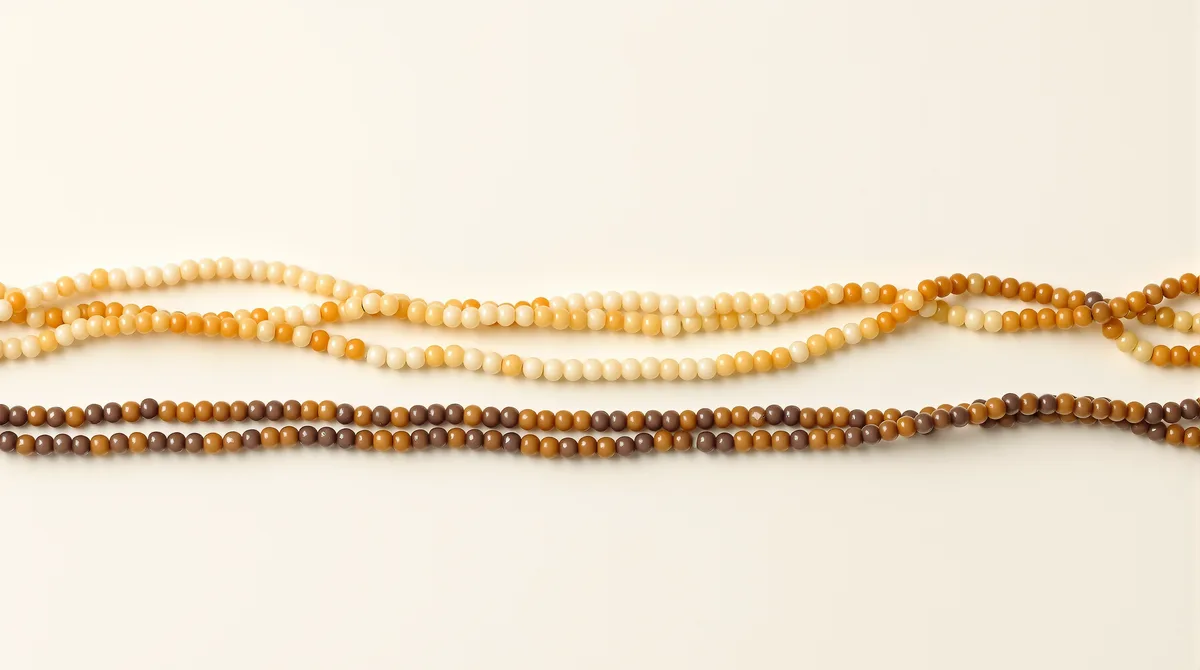
Manufacturing · Repeat orders
Hand-strung work drifts unless something holds it. Four things do: the approved sample, the colour-count sheet, the dye-lot record and first-article inspection on every run.
Three hand-strung bead strands laid out one above another, all three strung to the same honey, cream and chocolate repeat.
A beaded design holds across reorders because four things are held: the approved sample, which production is measured against; the colour-count sheet, which fixes every bead position; the dye-lot record for any dyed bead; and first-article inspection on each run. Without those, hand-strung work drifts season to season.

A design approved once and manufactured repeatedly. The construction is unchanged from any other made-to-order piece: a bead map, cord sized to the smallest drill hole, hand-strung strands gathered on a dowel or into a sewn rod pocket, hem cut to shape by strand length.
What is different is that the first run is not the only run, and that changes which documents matter. A one-off piece is held together by the approved sample. A repeating programme is held together by four things, and the sample is only one of them.
Because every bead is placed by hand and most of the inputs have natural variation.
A densely patterned 90 × 200 cm curtain holds about 11,800 beads, each placed individually. Wood grain varies bead to bead. Dyed beads come from lots. Glass colours are matched rather than printed. A frosted or sea-glass bead is irregular by definition.
None of that is a defect; it is the material. But it means that without something holding the design, a fourth run can differ visibly from the first — and on a shelf, four runs of one SKU sitting side by side is exactly where that shows.
Four controls, and they do different jobs.
The approved sample. Production is measured against the sample, not against the original colour reference or a rendering. It is the standard.
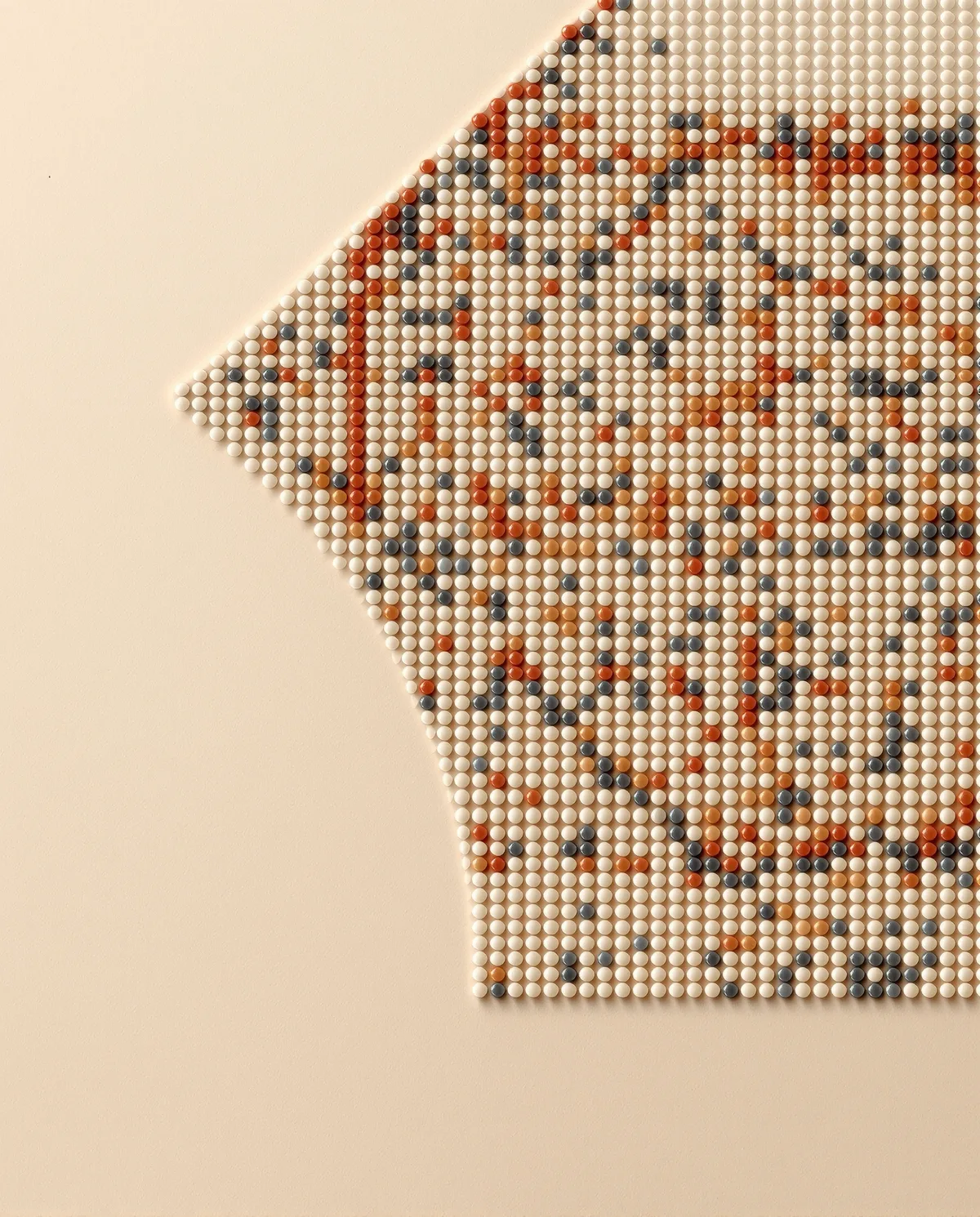
The bead map. Every bead position, fixed strand by strand before anyone threads a needle. This is what makes a scattered accent land scattered on every run rather than drifting into rows.
The colour-count sheet. The bead-by-bead plan for every strand, which makes a pattern repeat exactly across a production run and keeps strand lengths identical.
The dye-lot record. Where a dyed base or accent bead is in the build, the lot is noted so a later run can be checked against it rather than against someone's memory of the colour.
A first article before bulk, confirming that this run matches the approved sample, and lot AQL inspection on the run itself. Both are carried out in our own quality-control and packaging house at Greater Noida, which also handles assembly and kitting, export packing and labelling, and consignment consolidation.
Across the network, product issue rates run at a fraction of a percent. Quality is a system, not an inspection — the first article is the gate, and the controls above are what make passing it repeatable.
No, where the design is unchanged. The approved sample stays the standard and each run is checked against it with a first article.
Re-sampling is for a change: a new colourway, a new size, a different bead, a different hem. Those are development loops with their own sampling time — usually 16 to 20 days from an agreed brief, quoted separately — rather than repeats.
Production itself runs 40 to 60 days after sample approval on every run, which is the figure a replenishment schedule has to be built on.
There is none, and this is the most important planning fact on the page. We do not run a stock programme for beaded décor: every run is made to order.
So a replenishment schedule has to carry the production time rather than assume a buffer. Every run is made to order. Plan the replenishment against the production time rather than against a buffer, because that is what the calendar will actually do.
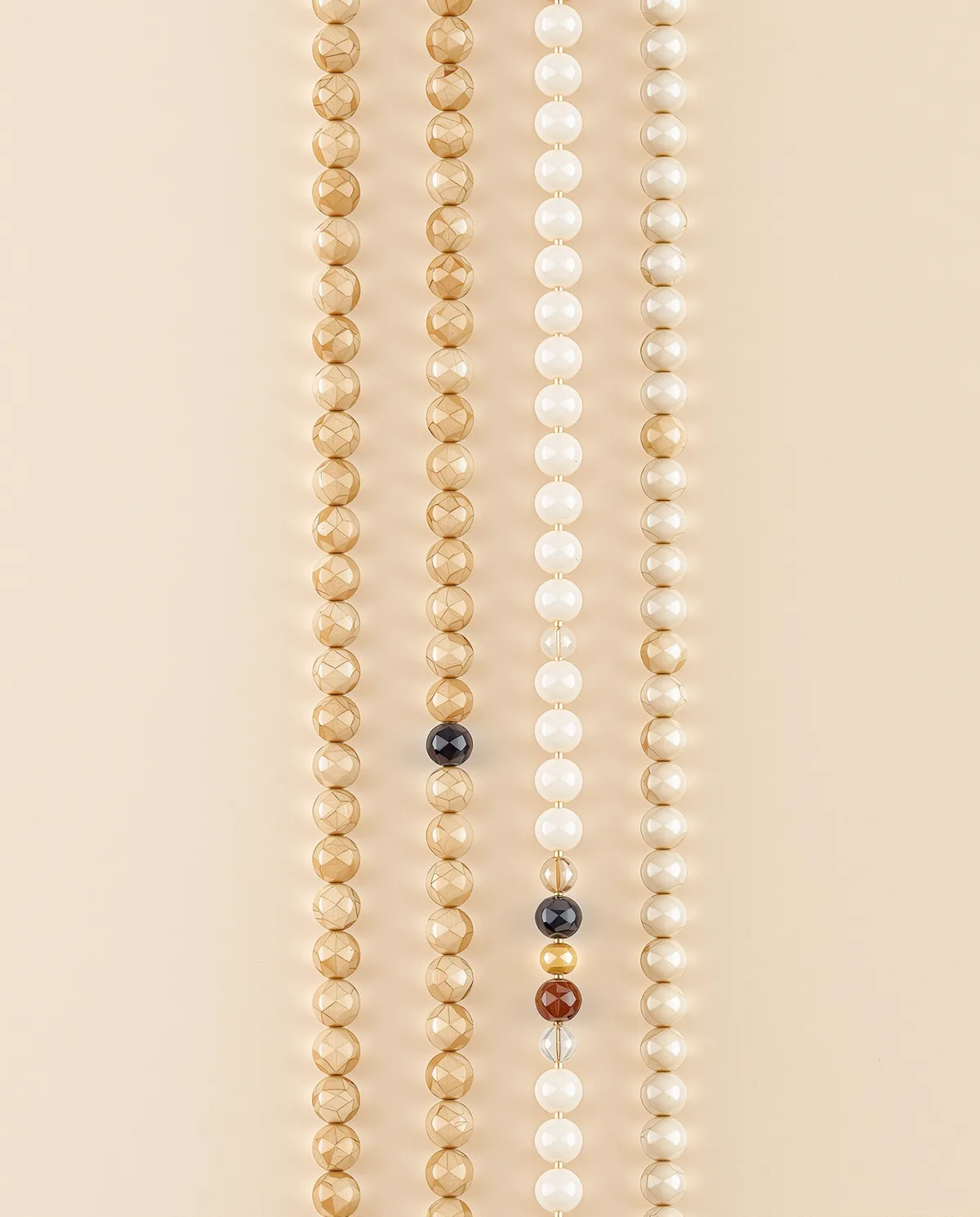
Held: bead position, bead size, strand count, strand pitch, strand lengths and hem profile, colour sequence, top fixing, packing specification. All of those are documented and reproducible.
Accepted within a range: natural material variation. Wood grain varies, so the tone range is approved on the sample and production held to that range rather than to an exact match. Frosted and sea-glass beads are irregular by nature. Hand-made lampwork and Venetian-style beads differ bead to bead, which is the point of them.
If exact repeatability matters more than natural character, acrylic — moulded and dyed to a named colour — is the recommendation, and saying so is more useful than promising wood will match.
Usually very little, and the levers are the same ones. Bead size and material first, then construction, then strand spacing, then the dowel and packing, then height.
What a repeat programme does add is an opportunity: a design in its second or third season is the one where de-densifying an infill or moving to two bead sizes in one strand can be considered with real sell-through behind the decision. Cost engineering on a known seller is a much better conversation than cost engineering on a guess.
In the same plant as the first run, which is the whole mechanism behind a replenishment programme. A glass colour re-melted at our own Firozabad works from the same recipe lands closer to the original than a second batch bought against a colour name ever will, and the same is true of a dyed acrylic, a dowel turned at Saharanpur, a glaze fired at Khurja and a finding plated at Moradabad.
Continuity is a manufacturing property rather than a paperwork one. The bead library, the dies and the colour recipes stay with us between runs, so run four is held to the sample approved for run one. We own the network; we are not a sourcing office.
Retailers and e-commerce sellers running a design across more than one season. Brands manufacturing under their own label with a replenishment line. Hospitality and contract buyers who need a second or third phase of an install to match the first.
Our lead portal style reorders season after season, held to one approved sample throughout. That is what a replenishment programme is for: the second order is cheaper to run than the first because nothing about it has to be decided again.
Graphic bead patterns covers the bead map in detail, and bead colour matching covers the dye and chip side of it. The order process sets out how a run is placed, and private label beadwork covers the packaging consistency that matters as much as the beadwork.
Extractable data
| Control | What it fixes | When it is used |
|---|---|---|
| Approved sample | The standard production is measured against | Approved once; referenced on every run |
| Bead map | Every bead position, strand by strand | Written before the first bead; reused on reorder |
| Colour-count sheet | The bead-by-bead plan and every strand length | Reused on reorder; reissued if the design changes |
| Dye-lot record | The lot a dyed bead came from | Checked where a dyed base or accent is in the build |
| First article | That this run matches the approved sample | Every run, before bulk |
| Lot AQL inspection | That the run holds to standard | Every run, Greater Noida |
| Production time | 40–60 days after sample approval | Every run |
| Re-sampling | Not required where the design is unchanged | Only on a change |
| Packing specification | Carton, labels, inner packing | Held across runs unless changed |
Good to know
No, where the design is unchanged. The approved sample remains the standard and each run is checked against it with a first article before bulk production. Re-sampling is for a change — a new colourway, a new size, a different bead — not for a repeat of something already approved.
No. Minimums are set per design and confirmed per quote, because a plain-strand curtain and a fully patterned one use very different amounts of material and stringing time. On a repeat programme the minimum is part of the quote conversation each time rather than a standing number.
No. There is no stock programme for beaded décor — every run is made to order. Every run is made to order, so a replenishment schedule has to allow for the production time rather than assume a buffer.
They are matched once and then held. Beads are matched to a colour reference or a physical chip and confirmed on the sample; on every subsequent run the approved sample is the reference. Where a dyed bead is in the build, the dye lot is recorded so a later run can be checked against it rather than against a memory.
Yes, and it is treated as a change rather than a repeat. Strand and bead counts are recalculated, the colour-count sheet is reissued, and we confirm the pattern still reads at the new scale — a motif that works at 90 cm can lose its reading at 120 cm.
To your carton, label and packaging specification, held across runs unless you change it. On a repeat programme that consistency is worth as much as the beadwork consistency: a shelf of pieces from four different runs should look like one range in the box as well as out of it.
Glass beads are drawn and hand-strung in our own Firozabad glass works; wood, including curtain dowels, is turned in our own Saharanpur factory; ceramic is glazed and fired in Khurja; metal is finished and plated in Moradabad. Acrylic and resin beads are moulded and dyed to our colour. Inspection and export packing run through our own Greater Noida house.
Keep exploring
Pillar
Brief, rough cost sheet, colour match, sample, production, packing — the six stages with the real published timings.
See the detailReference
Specification sheets and definitions — the pages to send a designer before they draw.
How it is madeManufacturing
Brief, rough cost sheet, colour match, sample, production, packing — the route from a sketch to a packed carton, in plants we own.
How it is madeManufacturing
Artwork to bead map, the resolution limit set by bead size, and why a scattered accent costs a fraction of a graphic.
Read the guideManufacturing
Draw the bead, cut the die, mould and dye it: what a custom bead shape costs, what it needs from a buyer, and when it pays.
Compare the optionsManufacturing
Your label, your packaging, your SKU structure, built in plants we own — and we never compete with our clients at retail.
Compare the options
Start a conversation
Send a reference, a colour chip or a sketch. Minimums are set per design and confirmed per quote; sampling is quoted separately and usually runs 16 to 20 days from an agreed brief.