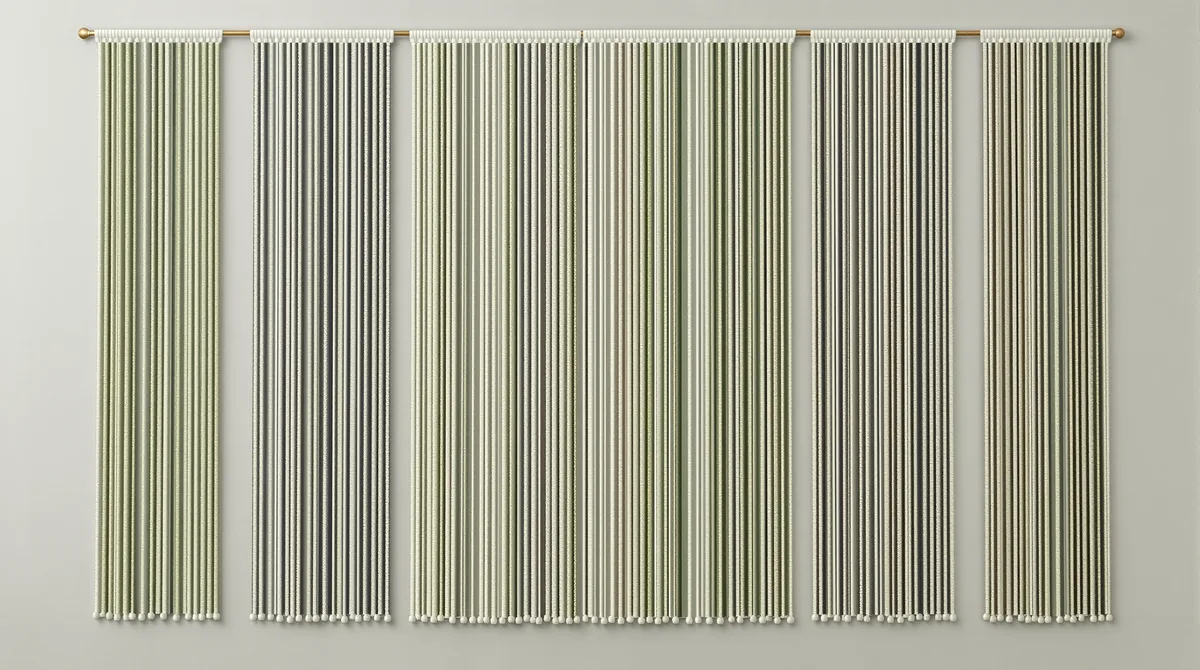
Guide
Beaded fly screens
Air moves through, insects are discouraged rather than excluded, and strand pitch is the only lever that changes either.
Read moreSpecification · Performance
Air passes freely. Insects are discouraged, not excluded. Both of those are specification statements, and only one of them is what the brief usually assumes.
A bead panel lets air through essentially unimpeded, which is why it is used at open doorways at all. It discourages flying insects through movement and interruption rather than excluding them, and it cannot be specified as an insect barrier. Strand pitch is the only lever that changes either property.
Whether a ventilated screen is what the brief needs. A bead panel is the rare interior element that divides a space while leaving air completely free to move, which is precisely why it has been hung in hot-climate doorways for generations.
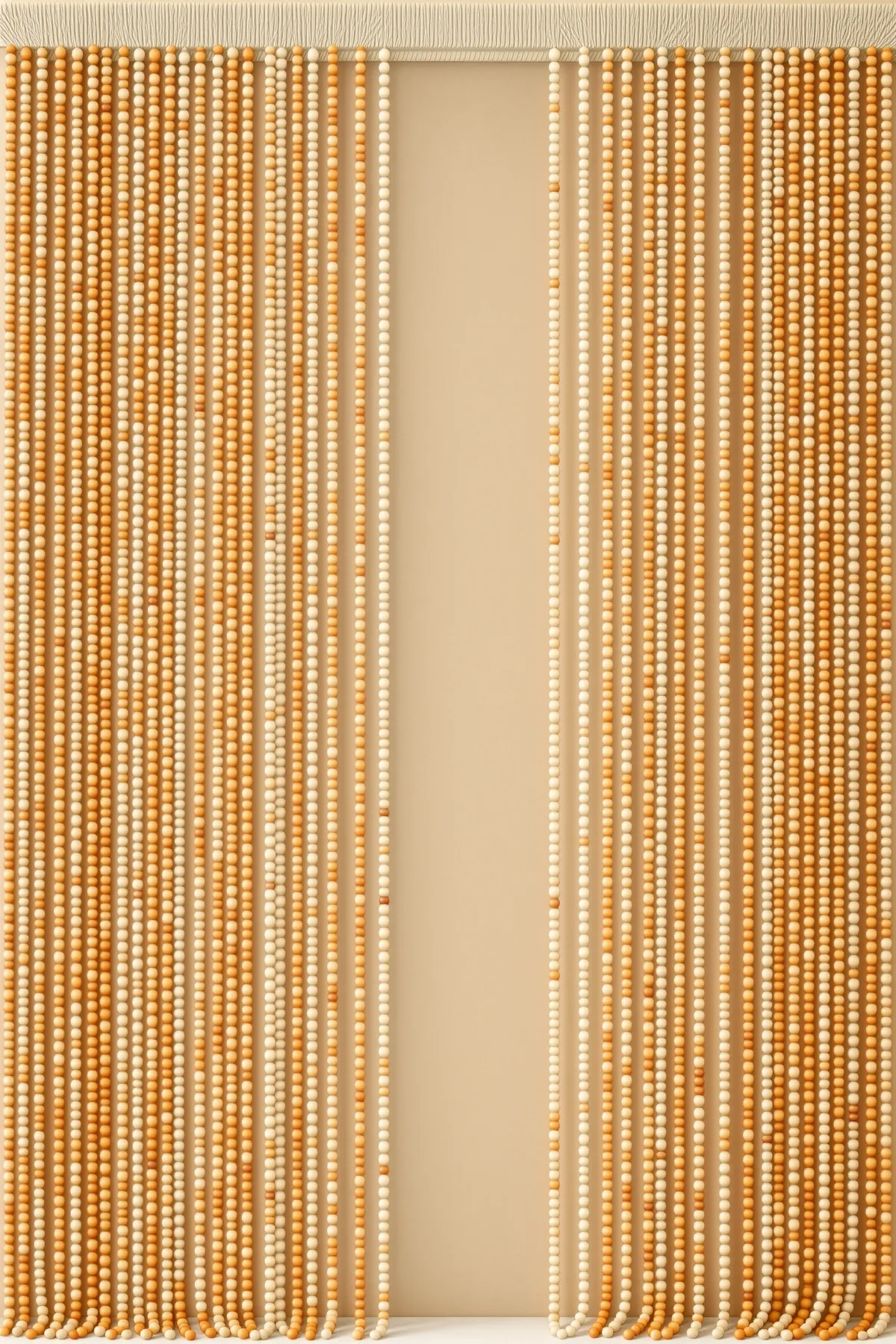
What is not being decided is insect exclusion. That is a separate requirement with a separate product, and conflating the two is the main risk on this page.
| Value | Unit or option | Note |
|---|---|---|
| Strand pitch | mm, centre to centre | The only lever over both airflow and discouragement |
| Bead outside diameter | mm | With pitch, gives the calculated open area |
| Open area, calculated | Per cent | Geometry; not an air permeability figure |
| Air permeability | Open by construction | A strung panel is almost entirely open area |
| Insect exclusion | None claimed | A bead panel is not an insect barrier |
| Where exclusion is required | Mesh screen, specified separately | Beadwork can hang in front of it |
| End-bead weight | Per design | Heavier ends hold the panel in a draught; light ends blow about |
| Setting | Internal or sheltered external, stated | Wood and bamboo mark in rain and constant damp |
Pitch, bead diameter, the setting, and the end-bead specification. The setting matters because wood and bamboo mark in rain or constant damp and should be kept to internal or well-sheltered positions.
The end-bead line is the one specifiers omit. In a doorway with air moving through it, the end bead is what keeps a strand in its pitch, and a light strand with a light end bead will not stay in line.
Establish whether insect exclusion is a requirement. If it is — a commercial kitchen, a food servery, anywhere with a hygiene standard — specify a mesh screen and treat the beadwork as what people see in front of it.
If it is not, set the pitch from the airflow and appearance you want, specify the end bead for the draught the position actually has, and confirm the setting so the material can be chosen to survive it.
Insects are discouraged, not excluded. A moving bead panel interrupts a flight path and makes an opening look busy, which does reduce casual entry. A determined fly goes between the strands, and so does everything smaller.
A bead panel is almost entirely open area, so airflow is the thing it does best and insect exclusion is the thing it does not do at all. It discourages insects; a screen excludes them.
That the use case is market-specific. Fly screen is the vocabulary in the United Kingdom and Australia, where a bead curtain at a back door is understood as a functional object. In North America the same product is bought as décor.
That difference changes the brief rather than the construction. A panel specified as a fly screen is usually wanted at a tighter pitch, in a material that tolerates a semi-external position, with heavier end beads.
A statement that no insect exclusion is claimed, the pitch as built, and the setting. Where mesh was installed as well, it belongs in the pack as its own item.
Material life depends on the setting more than on anything else recorded, so a panel in a sheltered external position should be documented as such with the cleaning interval to match.
It decides whether the panel survives the position. Glass and acrylic are indifferent to damp. Wood needs to be dusted or wiped dry and kept away from constant steam. Bamboo marks in rain or persistent damp and is an indoor material in practice, whatever the look suggests.
Weight matters too: glass strands hold their line in moving air where light acrylic, wood and bamboo strands need deliberate end-bead weight to do the same.
Pitch and diameter as usual, and nothing on the performance, because neither airflow nor exclusion is measured.
The variable that actually needs resolving is end-bead mass in a draught, and it is settled on a hung sample rather than by a number. End-bead mass is set per design and confirmed on the sample.
Through the screen, if there is one. Mesh wants the reveal; the bead panel is comfortable hung over the face of the opening. Both fixings are decided together on a section drawing, and the mesh leads because it is the one with a functional requirement.
Door swings are the other coordination item. A bead panel in the arc of an inward-opening door is a maintenance problem from the first week.
The schedule carries the panel per opening with its setting noted. The specification carries the pitch, the bead references, the end-bead specification and the statement about insect exclusion.
If mesh is specified, it is a separate schedule item. Two items, two specifications, no combined performance claim.
In doorways with more air movement than anyone expected. A panel at the end of a corridor, or opposite an openable window, lifts and swings in a way a sample in a studio never did.
The fix is heavier end beads or a tighter pitch, and both are cheaper to decide before the panel is strung than after.
A hung section in the actual draught. If the position is exposed, that single test tells you more than every other sample on the project, because it is the only one that shows the panel behaving rather than hanging still.
Good to know
An external or semi-external panel collects far more than an internal one, and a tighter pitch holds it. Where a panel is at a kitchen or a terrace doorway, the cleaning interval is short and the material choice should favour something that can be wiped rather than dusted.
Insects are not excluded. A bead panel interrupts a flight path and the movement discourages approach, which is why the format has been used at open doorways for a century. It is not a barrier, and a kitchen with a food-safety requirement needs mesh.
The specifier, and if mesh is also specified the mesh fixing leads. The usual arrangement is a mesh screen in the reveal and the bead panel hung over the face of the opening, which keeps both functional and lets the beadwork be the thing people see.
A statement that no insect exclusion is claimed, the pitch as built, and the setting — internal, sheltered external or exposed. Material life in a semi-external position depends entirely on that last one.
Pitch, bead diameter, the setting, and the end-bead specification. In a draughty doorway the end bead is doing real work: a light strand with a light end bead will blow out of line every time the door opposite opens.
The usual pitch and diameter tolerances. Nothing on airflow or exclusion, since neither is measured. Where a panel is in a draught the tolerance that matters is on end-bead mass, and that is settled on a hung sample rather than specified numerically.
A hung section in a draught, if the location has one. A panel that behaves perfectly indoors can be unusable in a doorway with a cross-breeze, and the only way to find out is to hang it where the air moves.
Keep exploring
Guide
Air moves through, insects are discouraged rather than excluded, and strand pitch is the only lever that changes either.
Read moreSpecification
The dimensions, strand values, fixings and performance limits a drawing and schedule have to carry.
Read moreSpecification
How transmission, refraction and cast bead-shadows behave through the day — and where glare control fails.
How it is madeSpecification
A hanging bead panel scatters a little high frequency and reduces nothing meaningfully — and what to specify instead.
Compare the optionsSpecification
How pitch, diameter and opacity combine into a sightline — and the distance at which concealment stops working.
Compare the options
Start a conversation
Send a reference, a colour chip or a sketch. Minimums are set per design and confirmed per quote; sampling is quoted separately and usually runs 16 to 20 days from an agreed brief.