Specification
Panel density
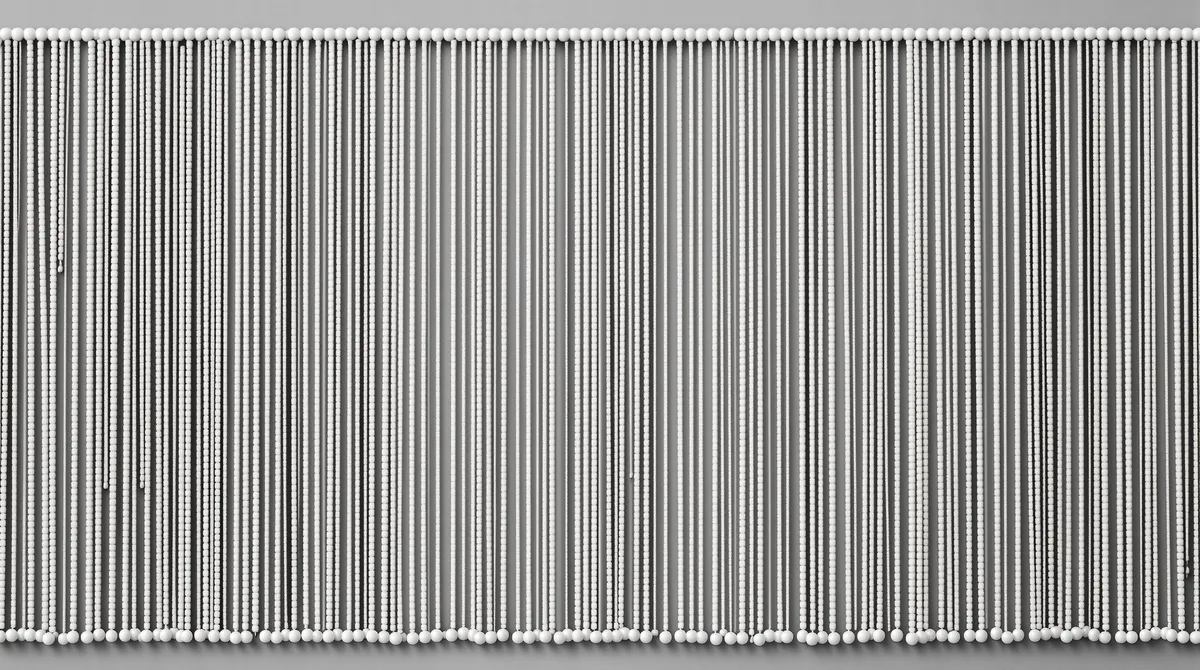
Width divided by pitch gives the strand count — the value that sets density, weight, view-through and cost together.
View the rangeSpecification · Density
The one decision that moves everything else. Density sets weight, cost, privacy and light transmission together, and no other value on the drawing does that.
Density is strand pitch and bead diameter together. Open area is roughly one minus the bead diameter divided by the pitch, so a 3 mm bead at 20 mm pitch leaves about 85 per cent open and a 13 mm oval at the same pitch leaves about 35 per cent. Density moves weight, cost, privacy and light transmission in one decision.
How much of the opening is bead and how much is air. That is density, and it is set by two values at once: the strand pitch and the bead diameter.
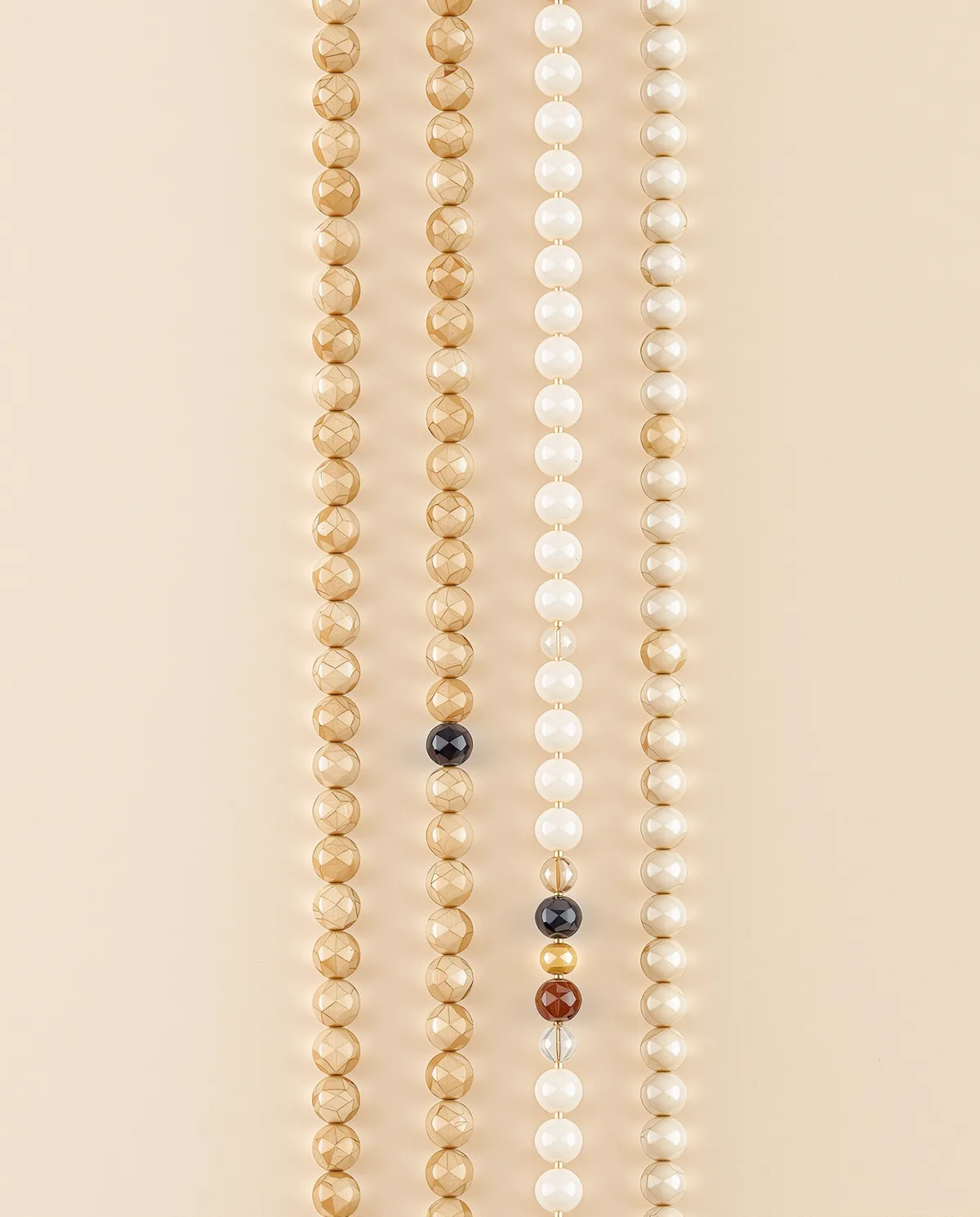
Specifying a pitch alone does not settle it. Twenty-millimetre pitch with a 3 mm seed bead is a nearly transparent panel; the same pitch with a 13 mm oval is a mostly solid one. The relationship between the two is the specification.
| Value | Unit | Realistic tolerance or note |
|---|---|---|
| Strand pitch | mm, centre to centre at the header | Per-strand closely; state a cumulative width limit too |
| Bead outside diameter | mm, per bead in the strand | Pressed and moulded closely; hand-formed varies |
| Open area, calculated | Per cent | Geometry only — not a measured transmission figure |
| 3 mm bead at 20 mm pitch | About 85 per cent open | A very transparent panel |
| 5 mm bead at 20 mm pitch | About 75 per cent open | Frosted sea-glass scale |
| 13 mm oval at 20 mm pitch | About 35 per cent open | Accent scale; used scattered, not as a field |
| Shipped build, 90 cm panel | 30 strands, about 3 cm pitch | Record |
| Library build, 90 cm panel | 40 strands, about 2.25 cm pitch | Library |
| Library build, 120 cm panel | 60 strands, about 2 cm pitch | Library |
Pitch in millimetres against a stated width, bead outside diameter for every bead in the strand, and — if it is being used as an acceptance criterion — the calculated open area.
Open area is approximately one minus the bead diameter divided by the pitch. It is geometry rather than a measured transmission figure, and it should be written on a drawing as open area so nobody mistakes it for test data.
Start from what the panel is for. A doorway people walk through wants to read as open and recover its pitch after being pushed aside. A screen in front of a window wants to read as a field. A decorative wall panel can be as dense as the design wants, because nothing passes through it.
Then pick the bead, because the bead sets the scale. Then set the pitch to give the open area the brief needs. Then check the weight that results, and only then design the fixing.
Two tolerances: per-strand pitch and cumulative width across the header. The per-strand figure holds comfortably in hand work; the cumulative one is what stops small repeated errors adding up to a visible shift at the last strand.
Bead diameter tolerance follows the process. Pressed and moulded beads hold closely. Hand-formed beads vary by nature, and a density specification built on hand-formed beads has to allow for it.
By settling density before the fixing is designed, not after. Density drives bead count, bead count drives weight, and weight drives the fixing and the substrate requirement.
A density change late in design is therefore a structural change, which is not how it is usually presented in a design review. Saying so early is the useful contribution.
The specification carries the pitch, the bead diameters and the open-area basis, because they are common to the whole package. The schedule carries anything that varies per opening — and density should not, if the package is to read as one installation.
Where density does vary deliberately, as between a doorway and a window in the same room, it belongs in the schedule with a note saying it is intentional.
When density was judged from a photograph. A panel photographed against a bright background reads much more open than the same panel against a dark one, and a sample approved from an image regularly surprises people on site.
The second failure is density chosen for appearance and then found to be too heavy for the fixing that was already drawn.
A section at the specified pitch, hung at full drop, in front of the background it will actually sit against. Not flat, not photographed, and not against a studio wall.
Full drop matters because the strands settle and separate under their own weight, and a short sample does not show that.
A dense panel is harder to clean. A brush or a damp cloth has to reach between strands, and at a tight pitch it cannot. On a commercial installation with a cleaning schedule that is a recurring labour cost attached to a design decision.
Where density is high and access is poor, the maintenance schedule has to say so rather than pretending the panel will be cleaned as often as a looser one.
A strand panel never becomes a continuous surface. Even at a pitch close to the bead diameter, the strands move, the gaps open, and someone standing beside the panel can see through it.
If the brief needs a continuous surface — for privacy, for light blocking, for acoustic separation — beadwork is the wrong product. Saying that at concept stage is more useful than specifying a density that cannot deliver it.
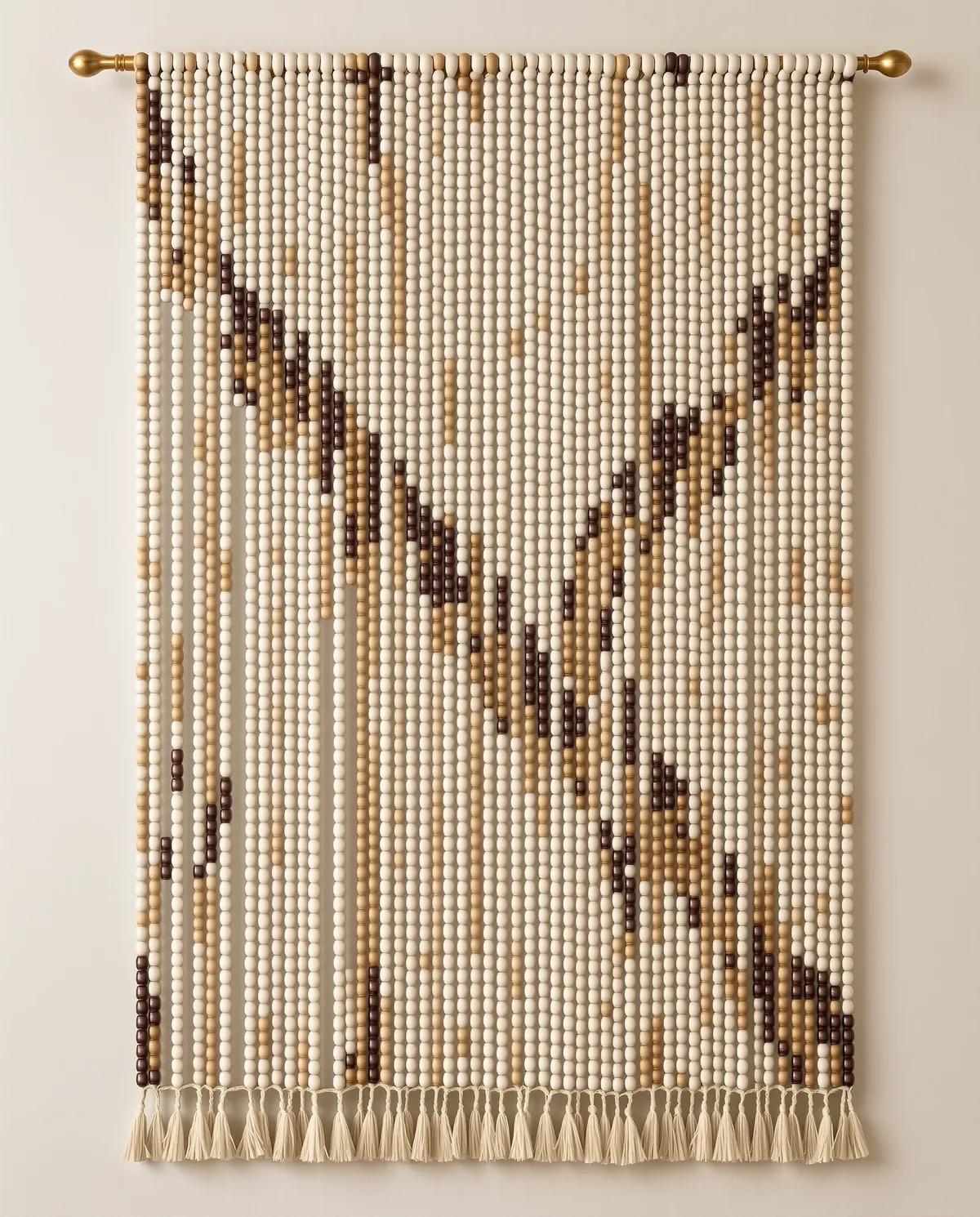
Two different densities, both real. The shipped build at around 90 by 200 cm is thirty hand-strung strands on a single wooden dowel, which is roughly three centimetres of pitch. The 2027 design library draws denser: forty strands at about 2.25 cm on a 90 cm panel, sixty at about 2 cm on 120 cm.
The library pitches are read off renders. Both answers are legitimate; they are different design intents, and a specifier should know which one a reference image came from.
The pitch and bead diameters as built, and the colour-count sheet, which records both strand by strand. The calculated open area is worth recording alongside, because a second phase will be matched from a number rather than from a description.
It changes the weight at a given density and the way the panel reads at a given open area. Glass at around 2.5 grams per cubic centimetre against acrylic at about 1.2 means the same density in glass is roughly twice the load.
Opacity differs too. A translucent bead at 35 per cent open area still passes light through the bead itself; an opaque bead at the same open area does not. Where the record carries both — a dotted portal was made in translucent and opaque versions of the same construction — the two read as different panels at identical density.
Good to know
Strand pitch in millimetres against the stated width, the bead outside diameter for every bead in the strand, and the calculated open area if you are using it as an acceptance criterion. A strand count alone is not a density specification, because it becomes wrong when the width changes.
A per-strand pitch tolerance and a cumulative width tolerance across the header. The second one is the important one: a pitch a millimetre tight on every strand across sixty strands moves the last strand sixty millimetres.
A section of panel at the specified pitch, hung at full drop, against the background it will actually sit in front of. Density read against a white studio wall and density read against a dark restaurant interior are different experiences of the same panel.
A denser panel is harder to clean, because a brush or cloth cannot reach between strands that are close together. On a commercial installation with a real cleaning schedule, density is also a labour decision.
There is no density at which a strand panel becomes a solid surface. Even at a pitch equal to the bead diameter, the strands move and the gaps open. If the brief requires a continuous surface, beadwork is the wrong product and a panel or a textile is the right one.
The specifier, because density drives weight and weight drives the fixing. A density decision taken after the fixing has been designed is the commonest way a bead panel ends up on an inadequate bracket.
The pitch and bead diameters as built, and the colour-count sheet, which records them strand by strand. Open area as calculated is worth recording too, because a future specifier matching a second phase will want the number rather than the adjective.
Keep exploring
Specification
Width divided by pitch gives the strand count — the value that sets density, weight, view-through and cost together.
View the rangeSpecification
How pitch, diameter and opacity combine into a sightline — and the distance at which concealment stops working.
Open the referenceSpecification
The dimensions, strand values, fixings and performance limits a drawing and schedule have to carry.
Open the referenceSpecification
A cleaning interval by setting, the method per material, who can reach the panel, and the spares held on site.
Specs and sizesSpecification
Spare beads by colour, pre-made replacement strands, the cord spec, and who re-strings a strand on site.
Specs and sizes
Start a conversation
Send a reference, a colour chip or a sketch. Minimums are set per design and confirmed per quote; sampling is quoted separately and usually runs 16 to 20 days from an agreed brief.