Specification
Airflow and insect screening
Air passes, insects are discouraged rather than excluded, and pitch is the only lever that changes either.
See the detail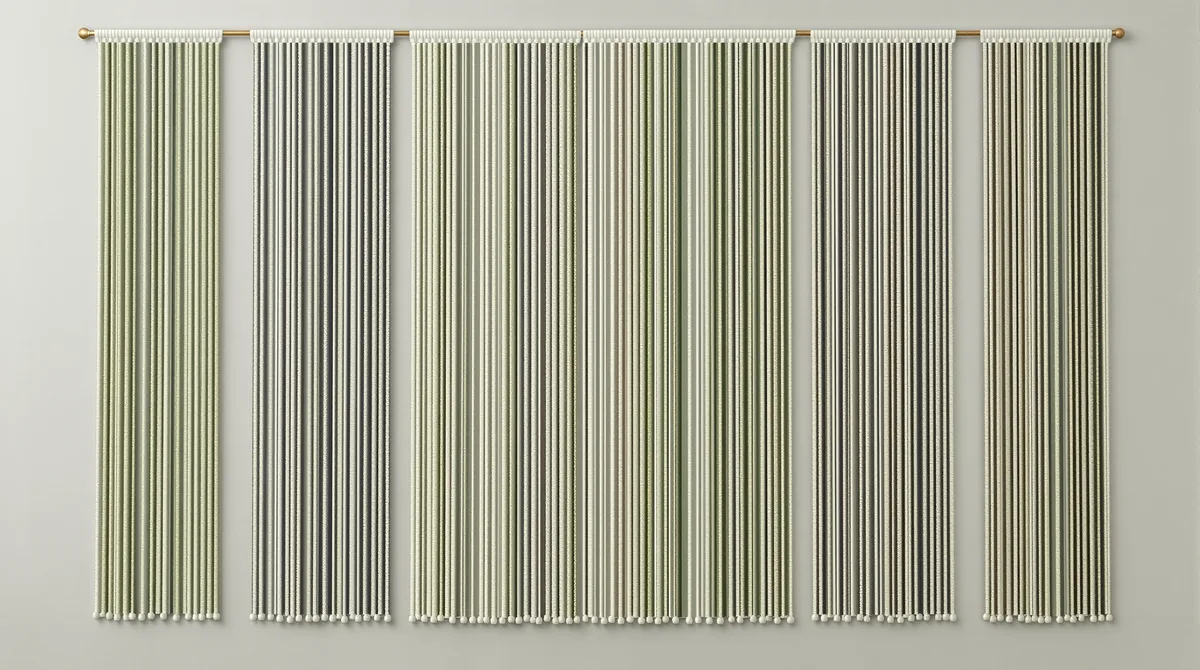
Guide · Performance
A bead panel discourages insects. It does not exclude them, and no specification should say otherwise. Whether discouragement is enough depends entirely on what is flying at your back door.
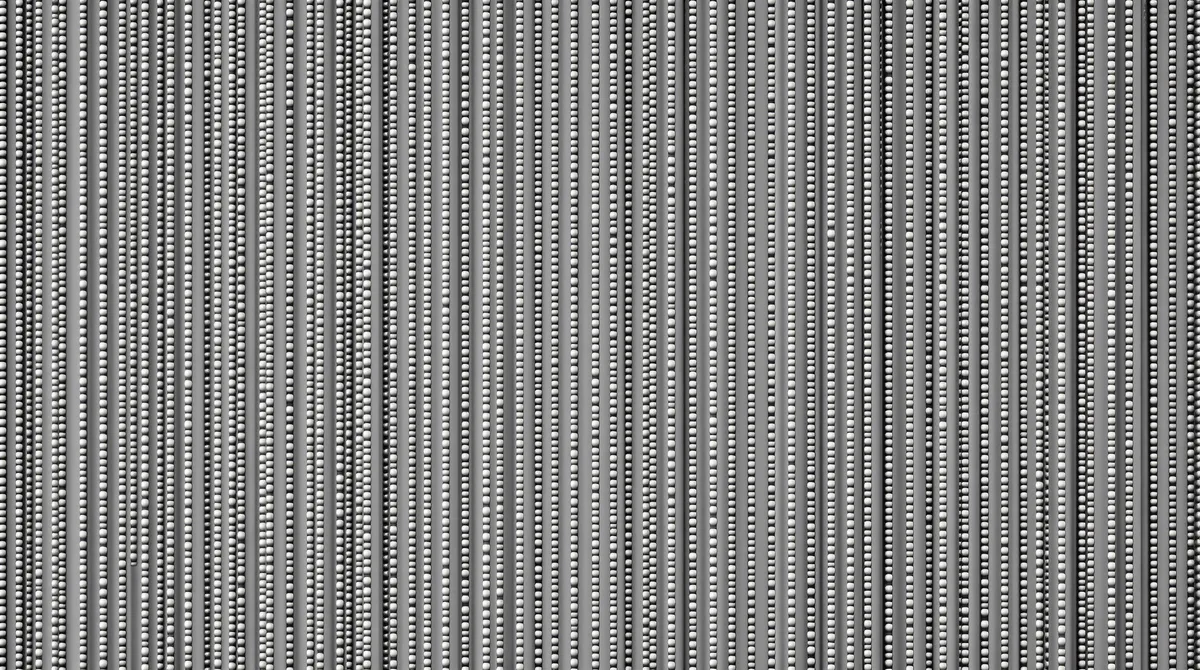
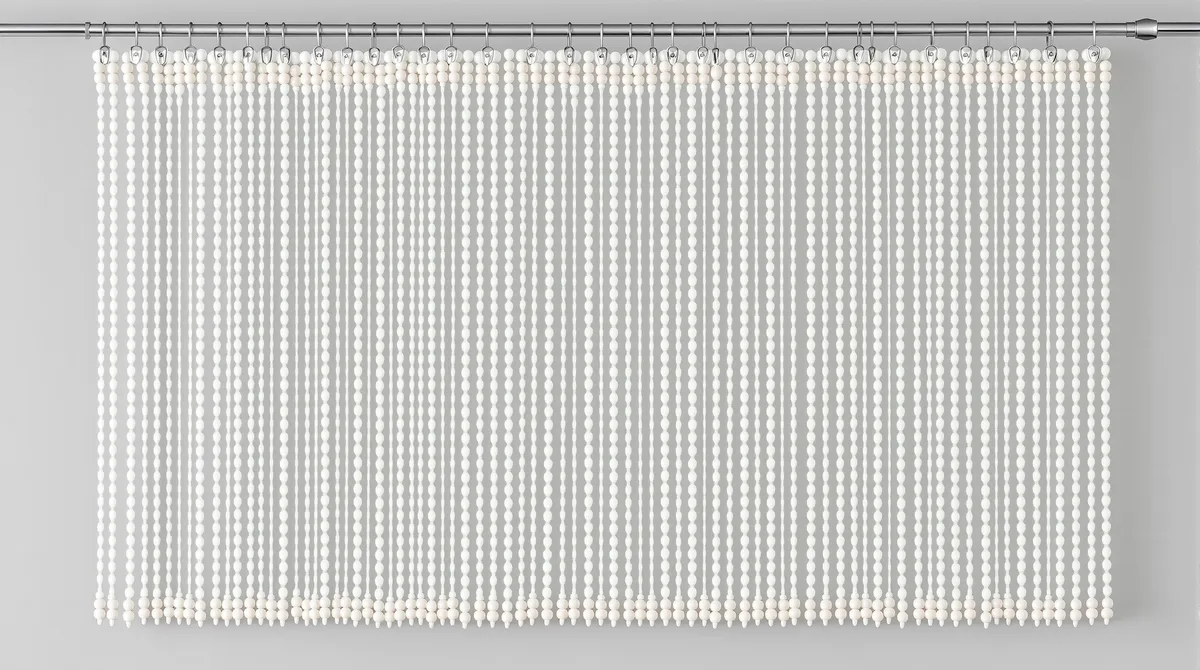
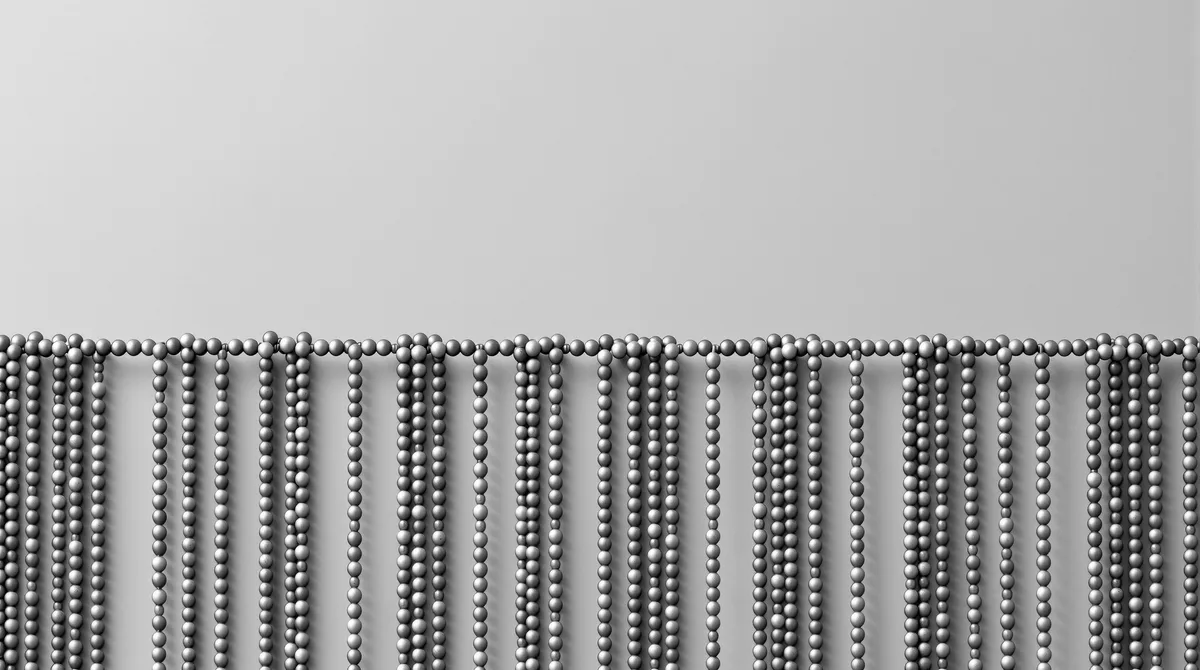
Six narrow panels of the same sage, moss and oatmeal glass seed beads hung side by side, each one set at its own strand pitch.
A beaded panel is not an insect screen. It discourages flying insects by breaking the open plane of a doorway with moving, reflective strands, and it lets air through freely, but there is no mesh, so nothing is excluded. The only lever is strand pitch: a tighter pitch discourages more and restricts airflow less than a mesh would.

It is an ordinary hand-strung bead panel hung on a door that stays open, specified at a tighter strand pitch than a decorative one. It is not a screen in the engineering sense: there is no mesh, no frame and no seal, and the gaps between strands are many times larger than any insect you are worried about.
What it does is break up the open plane of a doorway with objects that move and reflect. A great deal of casual insect traffic does not get past that. A determined mosquito does.
Stating that clearly is more useful than selling it as a screen, because the people for whom discouragement is enough are a large group, and the people who need exclusion will be disappointed by anything else.
Two mechanisms. Movement: a hanging strand responds to the slightest air current, and a plane full of independently moving verticals is read by a flying insect as an obstacle rather than as a gap. Reflection: broken, glinting light across a doorway disrupts the visual cue an insect uses to identify an opening.
Both get stronger in a draught, which is convenient, because a back door in summer is exactly where the draught is.
Neither works on anything small and slow. A midge is unaffected. A wasp is strongly affected.
Strand pitch — the centre-to-centre spacing across the header. Everything else about a bead panel is irrelevant to insect traffic.
The reference arithmetic: a 90 cm panel at 40 strands runs a pitch of roughly 2.25 cm; a 120 cm panel at 60 strands runs roughly 2 cm. A decorative panel sits at or above those figures. A panel specified for insect discouragement should be below them.
The cost consequence is immediate, because pitch sets strand count and strand count multiplies bead count. A fly-screen-pitch panel is a materially more expensive panel than a decorative one of the same dimensions.
Far better, and this is the real advantage rather than a consolation. A mesh screen is a continuous surface with a measurable pressure drop across it; a bead panel is mostly air. On a hot afternoon with a kitchen door open, the difference in how much air actually moves through the opening is not subtle.
A mesh screen also needs a frame, which means a door that has to be opened and closed, which means it is shut half the time. A bead panel is permanently open and permanently passable, so it is in use whenever the door is.
Glass. It is the heaviest, which means it hangs straightest and returns to position fastest after each passage; it is the most reflective, which supplies the visual disruption; and it is unaffected by weather at a back door.
Acrylic is the budget answer and works adequately — it moves more, which helps, and reflects less, which does not. Wood and bamboo are the wrong choice here on two counts: matte surfaces supply no reflection, and a back door is the one location where humidity and rain will reach the panel, which marks wood and ruins bamboo.
On the inside of the opening, where it is protected from direct rain, and clear of the door itself so the door can still be shut without fouling the strands.
Leave the hem clear of the threshold. A back-door threshold collects grit and water, and a hem resting in it both wicks moisture into the cord and gets trodden on every time someone comes in with shopping.
Heavier than the equivalent decorative panel, by roughly the ratio of the strand counts. That matters for the fixing: a close-pitched glass panel on a 90 cm back door is at the heavy end of what this category produces, and it needs a rod on brackets screwed into the frame or wall, not a tension rod.
As a physical guide, glass is near 2.5 g/cm³ against acrylic at about 1.2. Specifying glass at a tight pitch stacks both multipliers, which is the right engineering decision and the one that most needs a proper fixing behind it.
More than a decorative panel, because more beads are struck per passage. On glass at a close pitch, every entry through a kitchen door is an audible event.
In a family house in summer that is mostly a feature — you know when someone has come in. If the door is next to a bedroom, specify acrylic and accept slightly less reflection.
An insect-exclusion rating. A bead panel discourages insects rather than excluding them, which is the specification point that matters. The same discipline applies to fire: performance is tested on the specified build, and a rating given without naming the test and the exact build — bead, cord, header, mount — is a guess.
If a specification genuinely requires a tested figure, it has to be tested against that build and quoted separately. That is true whoever makes the panel.
Yes, if the problem is wasps and larger flies at a door you want to leave open, and you value the airflow. No, if the problem is mosquitoes, or if anything in the space requires actual exclusion.
The comparison is not between a bead panel and a fly screen. It is between a bead panel and leaving the door open with nothing in it, and against that benchmark it performs well.
Privacy from a bead panel is the companion page, because the two performance questions are answered by the same two levers and both have a low ceiling. The limits page states what a bead panel cannot do in full. Glass bead curtains is the material page behind the recommendation here, since movement and reflection are what do the discouraging. Panel weight matters because a close pitch stacks the bead count, and panel headers covers the fixing that follows. Steam and beadwork is worth a look if the door in question is a kitchen one.
Good to know
It will reduce how many come in and it will not keep them out. There is no mesh in the construction — a bead panel is a set of parallel strands with gaps between them, and the gaps are far bigger than a fly. What it does is break up the open plane of a doorway with moving, reflecting objects, which discourages a great deal of casual insect traffic.
Tighter than a decorative panel and nowhere near tight enough to exclude anything. A 90 cm panel at 40 strands is a pitch of roughly 2.25 cm; bringing that down increases the discouragement effect and the bead count together. Below about a centimetre you are paying for a great many beads to achieve something a mesh does properly.
At excluding insects, no — not close. At moving air, yes, by a wide margin, and at being walked through freely, yes. A mesh screen needs a frame and a door; a bead panel needs neither. They are different products solving overlapping problems, and the comparison is against leaving the door open, not against a screen.
The one that moves and reflects most, which is glass. Flying insects respond to movement and to broken light, and a glass panel delivers both; a matte wood panel delivers only movement. Any panel does better in a draught than in still air, for the same reason.
No. No exclusion rating exists for these panels and we will not imply one. A number would have to be tested against a specific build — bead, pitch, drop and opening together — and nobody has done that. A supplier quoting you a figure without naming the test is guessing.
Less well than for flies. Mosquitoes are small, fly slowly and are not deterred by much, so a bead panel makes little difference to them. If mosquitoes are the problem, a proper mesh screen is the answer and a bead panel is a decorative addition in front of it.
This is where a bead panel earns its place. Wasps and larger flies are strongly deterred by a moving, reflective barrier, so a close-pitched glass panel on a kitchen door genuinely reduces the traffic — while letting you keep the door open all afternoon, which a mesh screen on a frame does not.
Keep exploring
Specification
Air passes, insects are discouraged rather than excluded, and pitch is the only lever that changes either.
See the detailPillar
Door curtains, portals, café lengths and valances: the standard sizes, the strand counts and the one question each format answers.
Specs and sizesGuide
Opaque beads at a tight pitch screen movement and never detail — and nothing in this category works from close up.
See the detailGuide
Three predictable failures — soaked cord, lime scale, no containment — and the two things people usually want instead.
Read the guideGuide
Why there is no single weight figure, the density ratios that matter, and which fixing each weight class needs.
Specs and sizesGuide
No soundproofing, no blackout, no insulation, no insect exclusion, no close-range privacy — and why none of them is fixable.
Specs and sizesGuide
Breaking light rather than blocking it: what a bead panel does to daylight through the day, and which beads come closest to shade.
Specs and sizes
Start a conversation
Send a reference, a colour chip or a sketch. Minimums are set per design and confirmed per quote; sampling is quoted separately and usually runs 16 to 20 days from an agreed brief.