Guide
Extra wide beaded curtain
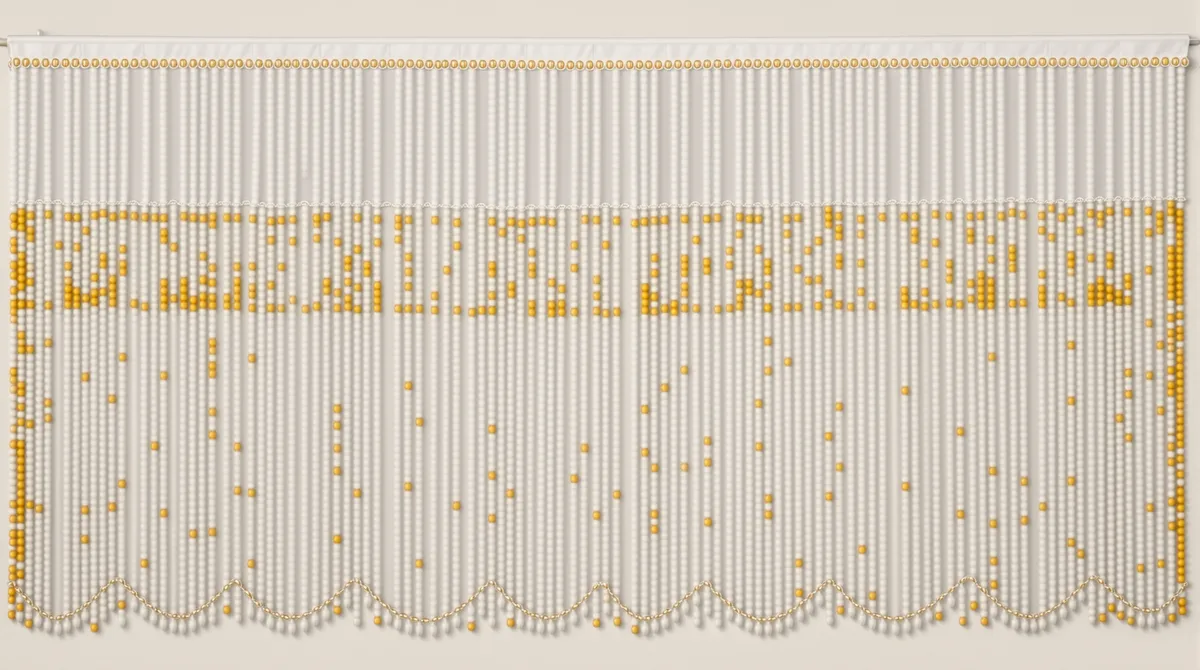
Dowel deflection, mid-span support and the case for modules: why a very wide opening is a header problem first.
Read the guide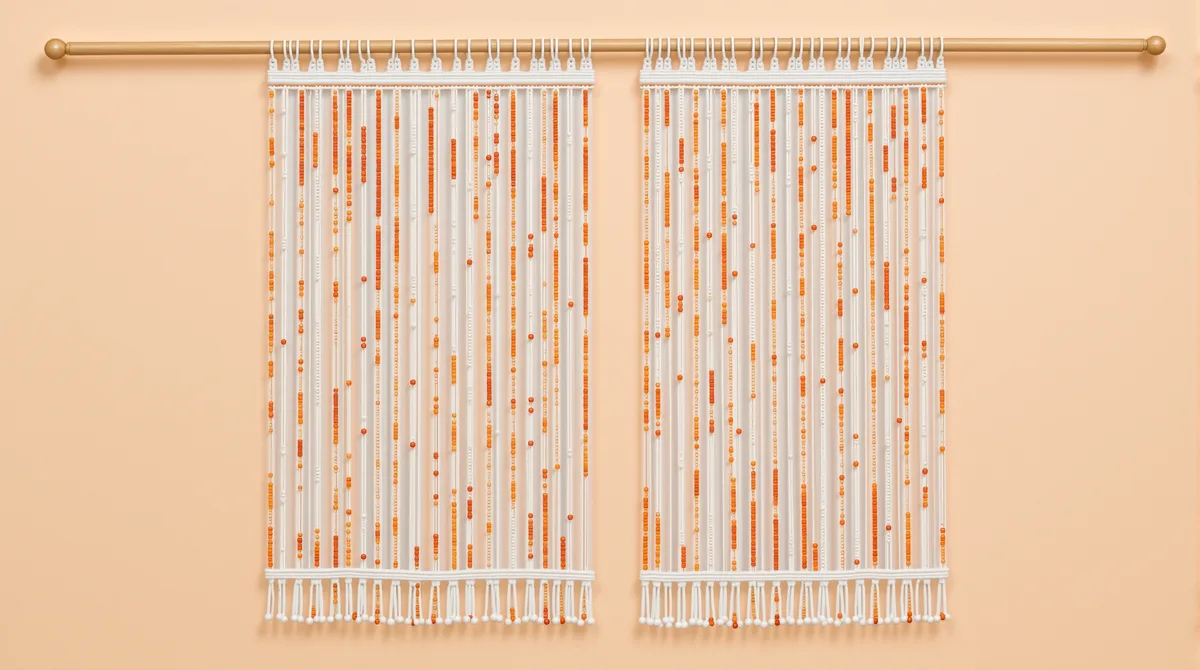
Guide · Format
A wide doorway is not a bigger version of a narrow one. It is a route people walk through, which means the gap in the middle is the thing to design first.
Two beaded panels hung side by side from a single turned wooden dowel at one height, their inner edges meeting over a wide opening.
A doorway over about a metre wide is covered either by one wide panel or, more often better, by a pair that part at the centre. The published fit guidance: a 90 cm panel covers most interior doors of 28 to 36 in; from 36 in upwards use 120 cm. Past 1.5 m, design the walk-through gap rather than leaving one.

Anything the standard panel does not cover. The published fit guidance is simple: North American interior doors are commonly 28 to 36 in wide, and a 90 cm panel — about 35 in — covers most of them. From 36 in upwards, the panel moves to 120 cm, about 47 in.
So "wide" starts at about 36 in and becomes a genuine design problem past about a metre and a half, where the header stops being a dowel and starts being a beam.
An eight-foot opening — roughly 240 cm — is firmly in the second category. It is two 120 cm panels, not one 240 cm panel.
Two reasons, and the second is the one people miss.
The header is a beam. A dowel carrying sixty or more strands sags in the middle, and on a bead panel a dipped header shows as a soft top line — which in turn makes a correctly cut hem look uneven.
It is a route. A wide doorway is almost always an opening people walk through regularly, often carrying something. On a narrow door the strands part around you and close behind. On a wide one, where you walk matters, and if nobody has designed the gap then everybody walks through the same arbitrary part of the panel and that part wears first.
A pair, for anything over about 1.5 m.
Two panels, each on its own header, halve the span — which more than halves the deflection — remove the need for a mid-span bracket, and let a damaged module be re-strung or replaced on its own rather than taking the whole installation down.
And in a doorway the centre part is a feature. The join becomes the route, which is exactly where you want it.
The beadwork costs about the same either way, because bead count follows the area covered rather than how it is divided. What a pair adds is hardware and fixing points; what it removes is the structural risk.
On the centre line, in a doorway. Then there are two good executions and one bad one.
Overlap by about one strand pitch. The strands of each panel interleave visually, no line of daylight shows, and the join disappears while still being the route through. This is the right answer in a doorway.
Leave a deliberate gap. Twenty centimetres or more of clear opening, which reads as an intentional aperture.
The join is the decision. Either the panels meet, with the strand pitch carried across the gap so the join disappears, or they are deliberately separated by enough width to read as two panels. The accidental middle case is the one to avoid.
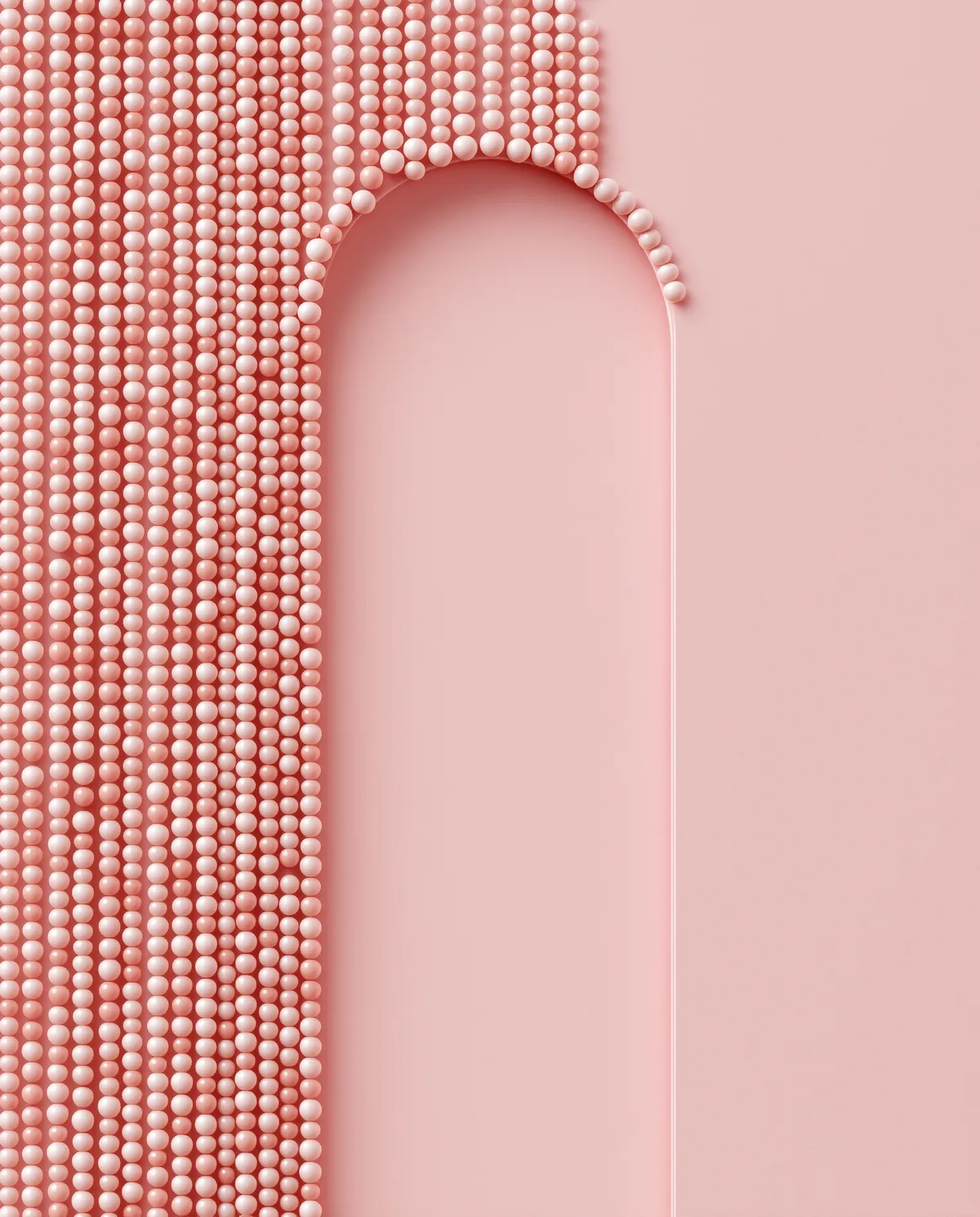
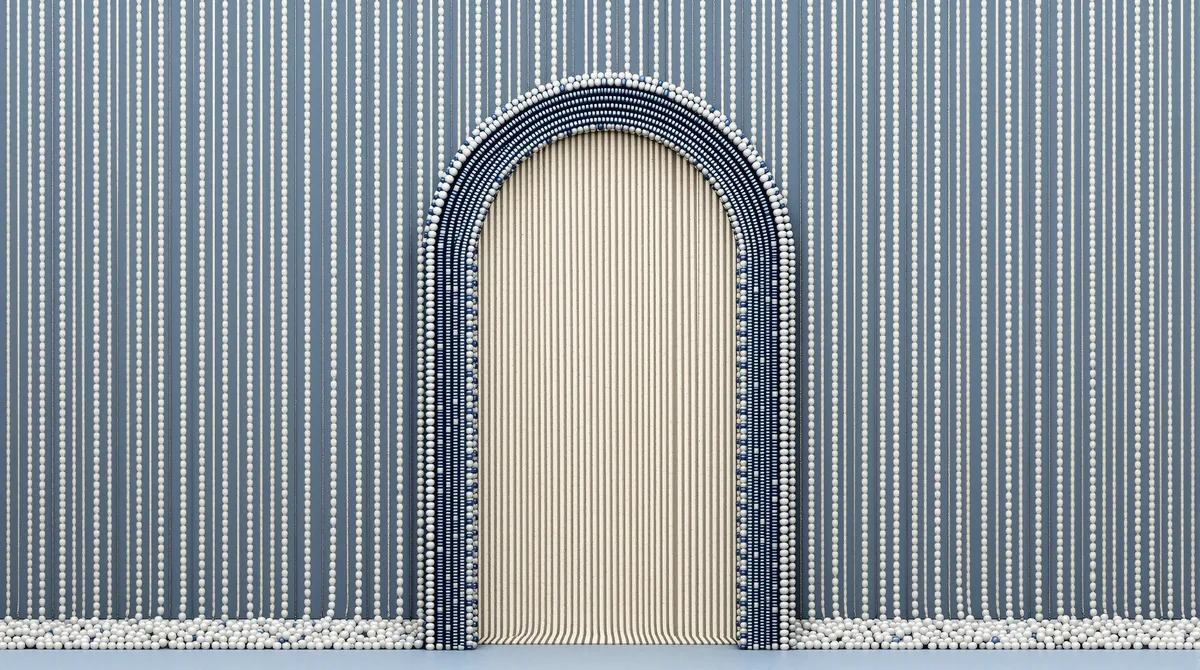
Often, on a wide opening. A portal frames the doorway and leaves the centre clear — not by parting two panels, but by varying strand lengths so the opening is cut into the beads.
That is a real, repeatedly reordered build rather than a concept: our Fallon beaded door uses an arched-cut drop with an arched centre opening to frame a walk-through, and our Naia curtain uses the same construction at 76 × 140 cm.
On a wide, well-used opening the portal is frequently the better object, because the walk-through is designed rather than relied upon, and because the frame reads as architecture rather than as a curtain that has been pushed aside.
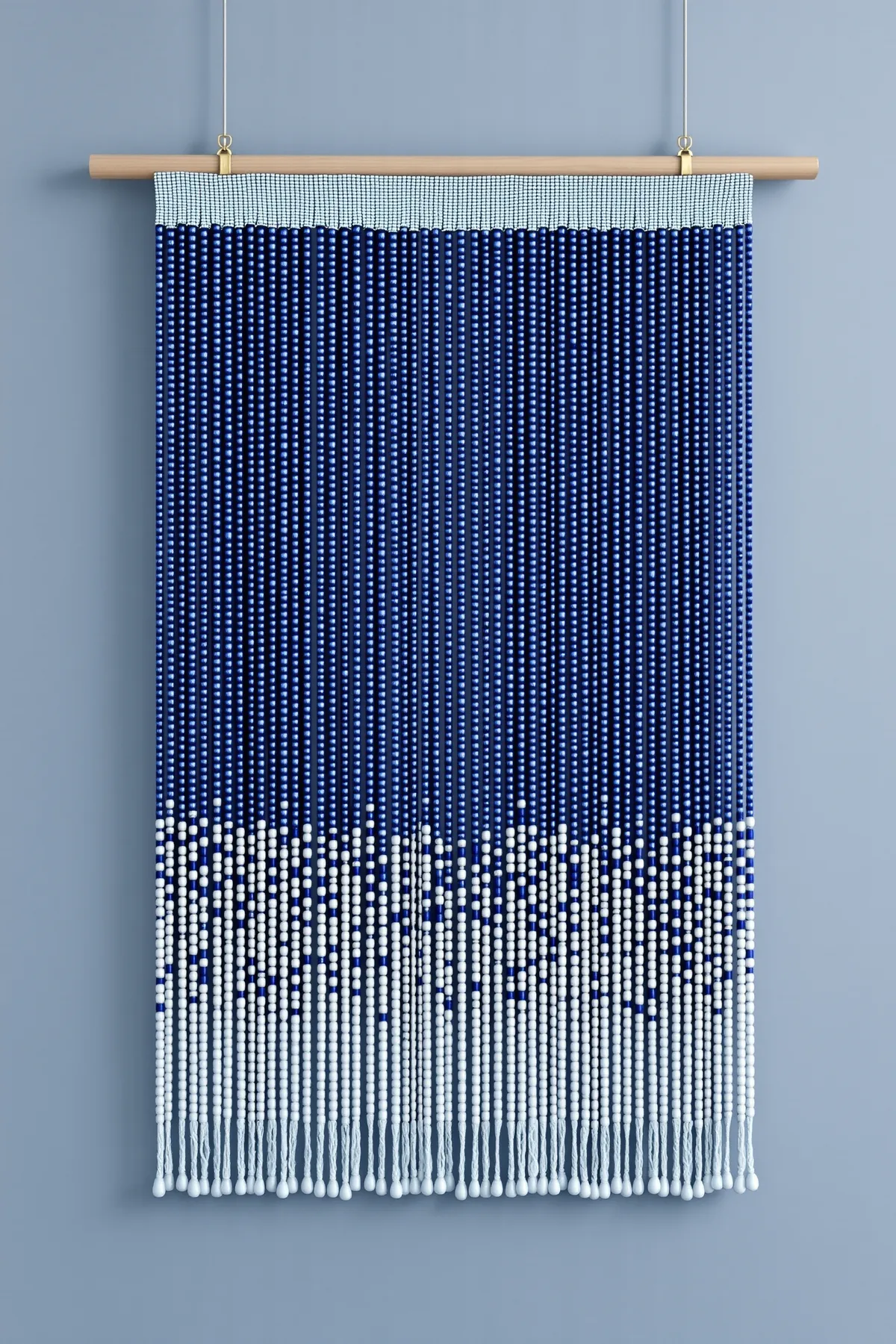
At the published pitches, roughly 40 strands on 90 cm and 60 on 120 cm — about 2.25 cm and 2 cm pitch respectively.
Those strand counts come from the 2027 design library rather than from measured sampled pieces, so treat them as design intent. The real figures that are production facts are the sizes themselves: 90 × 200 cm as the standard, with 120 × 200 cm and 120 × 180 cm both in the record.
A rod on brackets fixed into solid timber or masonry, with a mid-span bracket if the span demands one. The load per bracket matters, and the header's deflection over the span matters more.
The material is the cheapest lever here. Glass sits near 2.5 g/cm³ against acrylic at about 1.2 and most woods below 1, so the same wide design in acrylic loads its header at roughly half the weight. On a very wide opening, choosing acrylic can be the difference between needing a mid-span bracket and not.
It should be considered more carefully, because a wide straight hem has further to go wrong. Any discrepancy between the hem line and the floor line is more visible over 2 m than over 90 cm, and old buildings rarely have level floors across a wide opening.
A shaped hem — scalloped, staggered or deliberately uneven — removes the comparison the eye wants to make. And because hem shape is set by strand lengths on the stringing sheet, it costs nothing: the beadworker is reading a column of numbers either way.
The opening width, measured at the point the panel will hang rather than at the widest point. Then the header decision: one panel, two, or three, and where the join falls. Then pitch, because pitch times width is the strand count and the strand count is the load.
Width, drop and strand count are set per order against an approved sample, so there is no standard range to work around. Saying up front whether you want one panel or a pair is the fastest route to a first sample that behaves.
An extra-wide bead curtain covers the structural side of the same span — the deflection, the mid-span bracket and the case for modules. Panel runs sets out how modules are sized and combined, and panel headers covers the rail itself. A beaded portal is often the better object on a wide, well-used opening, because the walk-through is cut into the beadwork. Panel weight is the load the span has to carry, and a window bead panel covers the other wide opening most houses have.
Good to know
North American interior doors are commonly 28 to 36 in wide, and a 90 cm panel — about 35 in — covers most of them. From 36 in upwards, move to 120 cm, about 47 in. Those are the published fit figures and they are the right starting point before any design discussion.
With panels rather than a panel. An eight-foot span is roughly 240 cm, which is two 120 cm panels side by side. One continuous panel at that width would need a mid-span bracket or a stiffer rail, because the header is a beam and a long beam deflects in the middle.
A pair, for anything over about a metre and a half. Two headers halve the span and remove the deflection problem; a damaged module can be replaced on its own; and in a doorway a centre part is useful rather than merely acceptable. The beadwork costs about the same either way.
On the centre line of the opening, in a doorway — because that is where people walk and the join becomes the route rather than a flaw. Either overlap the panels by about one strand pitch so no daylight shows, or leave a gap wide enough to read as deliberate. A one-centimetre sliver looks like a mistake.
A portal frames the opening and leaves the centre clear, with the gap cut into the beads by varying strand lengths rather than by parting two panels. On a wide, well-used opening it is often the better answer, because the walk-through is designed in rather than relied upon.
It needs a longer one, which is a different problem. The load per bracket is what matters, and the header's deflection over the span matters more. A rod on brackets into solid timber, with a mid-span bracket if the span demands it, is the standard answer for a wide glass panel.
At the published pitches, roughly 40 strands on a 90 cm panel and 60 on a 120 cm one — about 2.25 cm and 2 cm pitch respectively. Those strand counts come from the 2027 design library rather than measured on sampled pieces, so read them as the design intent they are.
Keep exploring
Guide
Dowel deflection, mid-span support and the case for modules: why a very wide opening is a header problem first.
Read the guidePillar
Door curtains, portals, café lengths and valances: the standard sizes, the strand counts and the one question each format answers.
See the detailGuide
Valance, café length and half drop: three short formats, what each one does, and how bead count falls with height.
Read moreGuide
Backlit all day: why body-coloured glass belongs at a window, how length is measured from the sill, and what fades.
How it is madeGuide
Where to put the join, how to match pitch across it, and how to get two headers level with each other.
Specs and sizesManufacturing
Strands that frame an opening and leave a clear walk-through: arched and inverted-V drops, built to order on a turned dowel or a stained rail.
Read the guide
Start a conversation
Send a reference, a colour chip or a sketch. Minimums are set per design and confirmed per quote; sampling is quoted separately and usually runs 16 to 20 days from an agreed brief.