Compliance
The children’s product question
The children’s-product determination for décor, the four factors it rests on, and what the 100 ppm limit actually covers.
See the detail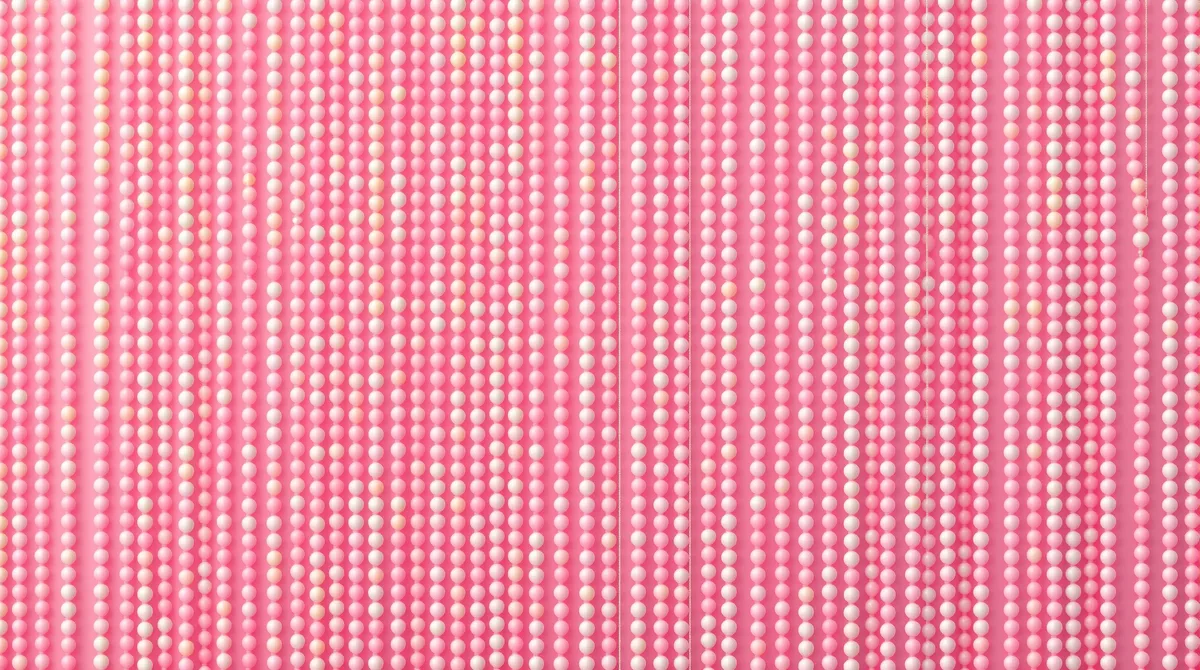
Application · Nursery
This is the one setting where the compliance question comes before the design question. Whether a bead panel is a children’s product is a legal determination, and it changes everything downstream of it.
A beaded panel of large round beads in candy pink, rose and chalk white, the big beads plainly separate down every cord.
Before a bead panel goes into a nursery, two things must be settled: whether the piece falls inside the children's-product definition, which is a legal determination its buyer makes, and whether the physical hazards — detachable small parts and a cord within reach of a crib — have been designed out. Inside that definition, the certificate is issued off third-party testing at a CPSC-accepted laboratory.

Usually a soft, playful threshold — colour at the door of a child's room instead of a slab of white joinery. It is a genuinely popular request, and the search demand behind it is real.
It is also the brief where we are most likely to say no, or to change the format. Not because beadwork cannot be made safely for a child's room, but because the legal and physical questions have to be answered before the design, and in a lot of cases they move the answer away from a hanging panel entirely.
A settled scope question. Is this piece a children's product in law, or a décor item that happens to be in a child's room? The determination rests on how it is marketed, packaged and intended to be used, and it belongs to whoever is selling it.
No sheddable small parts. A strand that releases loose beads when pulled is a choking hazard for a young child.
No cord within reach of a crib. This is non-negotiable in our view and it is a positioning rule, not a material one.
A surface that does not come off. Body-coloured beads, not surface-dyed ones.
Material: body-coloured pressed glass where the panel is out of reach, and moulded acrylic where it is not — acrylic does not shatter, which is the single strongest argument for it in a child's room, and it is moulded and dyed to colour so there is no surface finish to shed. Our record includes acrylic bead developments made in both translucent and opaque versions, and a seed-bead pillow development where plastic beads replaced glass specifically for production.
Format, by age. Over about three: a door curtain or portal at the threshold, hung high, hem well clear of the floor. Under three: a wall-mounted piece, out of reach — or nothing. Nothing in any format within reach of a crib, cot or changing table.
The strand, because a child pulls it. That is the use case rather than a defect, so the question is what happens next.
A good nursery build either does not shed beads when a strand parts, or keeps them captive with an end stop and a knot pattern that holds. A build that drops a handful of 4 mm beads on the floor is unsuitable, and we will say so at sample review rather than ship it and put a warning on the box.
Sampling 16 to 20 days from an agreed brief, photographs approved first; production 40 to 60 days after sample approval. For anything going into children's retail, there is a third phase and it is the one that moves dates. If the piece sits inside the children's-product definition, third-party testing at a CPSC-accepted laboratory must be completed before shipment, along with the certificate and the tracking labels. That is quoted and scheduled separately, and it should start at sample approval, not at purchase-order hand-off.
Start with the scope statement: who the piece is marketed to, what age grading the buyer is assigning, and therefore which test regime applies. Everything else follows from that line.
Then position and hem height above finished floor, with the distance from any crib or cot stated. Then finished width and drop, strand count or pitch, bead material and size with hole diameter, bead captivity detail at the strand end, colour as Pantone references or physical chips, header type and length, and the testing and labelling requirements as a named clause.
Nursery pieces are small, so the beadwork is among the cheapest in this cluster. The cost that surprises buyers is the testing, and it is not a bead cost at all.
Beadwork levers in order: bead size and material, then strand count and tightness, then pitch, then dowel and packing, then height. Testing is a separate line, quoted per programme, and on a small first order it can be a meaningful share of the landed cost — which is an argument for deciding the scope question early rather than testing twice. Minimums and pricing are set per design and confirmed with your quote.
Beadwork for the younger end of a home range, at volume: translucent and opaque acrylic developments, and plastic seed beads specified over glass for the production run. That is manufacturing experience in exactly the materials a nursery piece uses.
The compliance work sits alongside it. The Children's Product Certificate is obtained against the approved sample as part of the programme, and it belongs in the schedule from the day that sample is approved.
Any hanging panel within reach of a crib, cot or changing table. Surface-dyed beads in a child's room. Small beads in a build that sheds when pulled. A long cord loop of any kind in a sleeping area.
We would also advise against the shortcut of adding a warning label instead of changing the design. A warning is appropriate for a residual risk; it is not a substitute for designing out a hazard that inspection can see.
The buyer's compliance team, before the designer. That is the correct order and it is unusual among the settings on this site.
Then the retailer's quality function, who will specify the laboratory and the test package; then the designer; then us, on the sample. Photographs are approved before the sample ships, the physical sample is approved before production, and production is held to the approved sample through first-article and lot inspection.
High, into solid substrate, with a fixing stronger than the panel's weight requires — because a child will hang on it, and the failure mode to avoid is the bracket leaving the wall rather than the strand parting.
The hem is deliberately short where the design allows, so the lowest beads sit above easy reach. Brackets and hooks are the project's; we make the panel and its wooden dowel or header rail, and we supply the measured weight of the approved sample so the fixing can be sized to a real number.
If the piece is a children's product, the CPSIA regime applies in the US: total lead content at 100 parts per million, lead in surface coatings at 90 ppm, phthalate limits, third-party testing at a CPSC-accepted laboratory, a Children's Product Certificate, and permanent tracking labels. Equivalent regimes exist in the UK, EU and Australia.
All of that is obtained against the approved sample, as part of the programme. Toy-standard testing under ASTM F963, small-parts testing and any cord-safety or window-covering requirement are arranged through your nominated laboratory and scheduled with the sample rather than after it. The age grade is assigned by the buyer, for its own market.
Alongside it: California Proposition 65 lead testing is covered as standard on our retail programmes, and child safety warnings are applied where a buyer specifies them. Our audited credentials are Sedex SMETA, FSC for wood, C-TPAT and Omega social compliance. Those sit beside the children's-product certificate rather than in place of it.
The bead materials, the hand-strung construction and the routine care a nursery panel needs each have their own reference.
Extractable data
| Requirement | How it is met | Note |
|---|---|---|
| Children's-product determination | The buyer's call, not ours | Based on marketing, packaging and intended use |
| CPSIA total lead content (100 ppm) | Built to the limit and tested through the buyer's nominated laboratory, against the approved sample | Quoted with the programme |
| CPSIA lead in surface coating (90 ppm) | Tested on the coated or painted bead against the 90 ppm limit | Relevant to any coated or painted bead |
| CPSIA phthalates | Tested on the plasticised components named in the specification | Relevant to plasticised components |
| Children's Product Certificate (CPC) | Issued off third-party testing at a CPSC-accepted laboratory, arranged with the programme | The buyer is the certifier of record |
| ASTM F963 toy safety | Tested on the specified build where a range is age-graded for children | A decorative panel is not marketed as a toy |
| Small-parts testing (under-3 use) | Tested on the specified build where a range is age-graded for children | Attachment is engineered in: spacer and locking beads, locked terminal knots |
| Tracking label requirement | Applied if the buyer specifies it | Mandatory on children's products |
| Cord-safety / window-covering certification | Designed out: the hem is set short and no loop is left in a cord | Tested to the buyer's protocol where a programme requires it |
| California Proposition 65 lead testing | Covered as standard on retail programmes | A chemical-content step, not a children's-product certificate |
| Flammability | Tested on the specified build and quoted with the project | NFPA 701 or the local equivalent |
| Age grading | Assigned by the buyer | Marketing, packaging and intended use decide it |
| Sampling | 16–20 days from an agreed brief | Photographs approved before the sample ships |
| Production | 40–60 days after sample approval | Published lead time for beaded décor |
Good to know
Dry dusting down each strand, header to hem, and a damp spot-clean of the beads with a cloth wrung nearly dry. The nursery-specific point is what must not be used: no solvent, no bleach, no disinfectant wipe. Those strip a surface dye, and in a child's room a shedding surface finish is a hazard rather than a cosmetic problem. Specify a body-coloured bead and the question largely disappears.
Sampling is 16 to 20 days from an agreed brief and production is 40 to 60 days after sample approval. For anything going into children's retail, add the testing programme: if the piece is inside the children's-product definition, third-party testing at a CPSC-accepted laboratory has to be completed before shipment, and that is quoted and scheduled separately from production.
The strand, because a child pulls it. That is not a defect; it is the use case. What matters is what happens when it parts: a well-designed nursery build either does not shed loose beads at all, or has an end stop and a knot pattern that keeps the beads on the cord. A build that releases a handful of small beads when pulled should not be in a child's room, and we will say so at sample review.
We have made children's-market beadwork — including acrylic bead developments in translucent and opaque versions, and seed-bead pillows where plastic beads replaced glass for production — so the manufacturing experience of building for a younger market is real. The children's-product certificate is obtained against the approved sample, through your nominated laboratory, as part of the programme.
For a child over about three, a door curtain or portal at the room threshold, hung high, with a hem well clear of the floor. For a room used by a child under three, our recommendation is a wall-mounted piece out of reach, or nothing at all. Nothing should hang within reach of a crib, a cot or a changing table, in any format, at any age.
Fixed high, into solid substrate, with the hem deliberately short so the lowest beads sit above a toddler's reach where the design allows it. The fixing should be stronger than the panel needs, because a child will hang on it. Brackets and hooks are the project's; we make the panel and the wooden dowel or header rail. The panel is weighed on the approved sample and the fixing is sized to that weight.
If the piece is a children's product, CPSIA governs: total lead content at 100 ppm, lead in surface coatings at 90 ppm, phthalate limits, third-party testing at a CPSC-accepted laboratory, a Children's Product Certificate, and tracking labels. We build to that requirement and test through the buyer's nominated laboratory, quoted with the programme, and ASTM F963 and small-parts testing are arranged the same way. California Proposition 65 lead testing is already covered as standard on our retail programmes — a chemical-content step alongside the certificate rather than a substitute for it.
Keep exploring
Compliance
The children’s-product determination for décor, the four factors it rests on, and what the 100 ppm limit actually covers.
See the detailManufacturing
The CPSIA scope question, small-parts and cord risk, age grading, and the builds we will and will not make for children's retail.
See the detailPillar
Twenty settings, from a closet front to a hotel lobby, each with the format that suits it, the fixing it needs and the standard that applies.
Read the guideSpecification
Period accuracy for a seventies build, how beads behave under tungsten and LED, noise on a live take, and rigging that strikes in minutes.
See the detailSpecification
Cord creep, cumulative strand weight, splicing, mid-span stabilising, and how a long drop is engineered as segments on a carrier.
See the detail
Start a conversation
Send a reference, a colour chip or a sketch. Minimums are set per design and confirmed per quote; sampling is quoted separately and usually runs 16 to 20 days from an agreed brief.