Pillar
Beaded curtains: the formats, and what each one is for
Door curtains, portals, café lengths and valances: the standard sizes, the strand counts and the one question each format answers.
Open the reference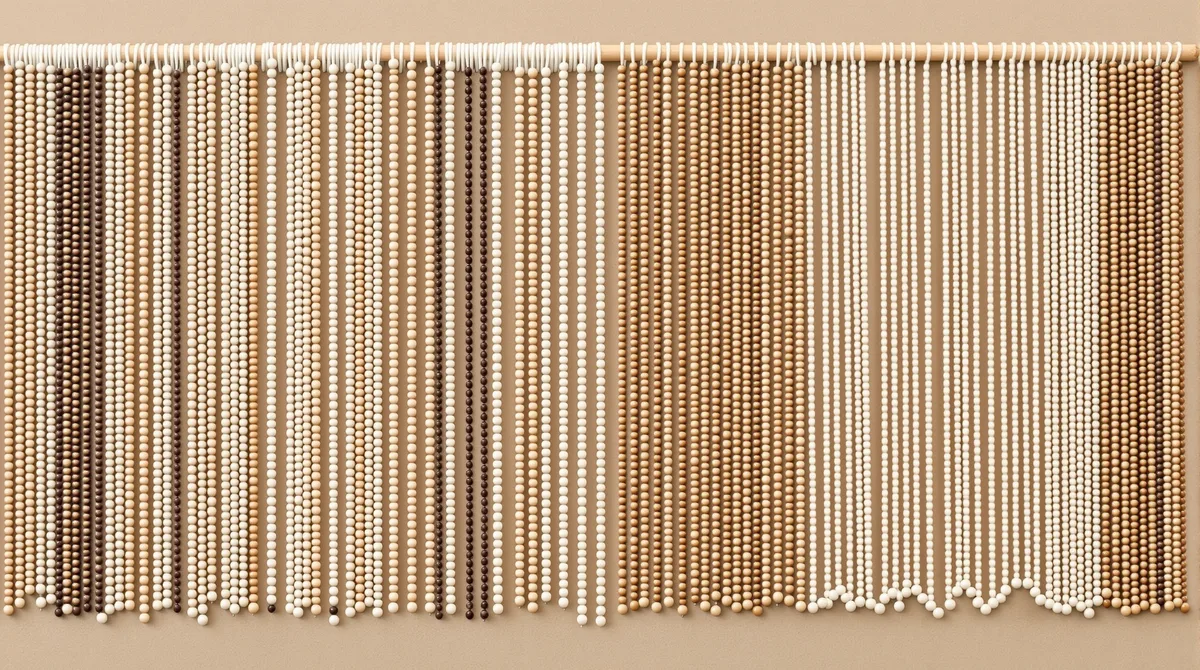
Trend · 2027
Portals, curtains, café curtains, valances and wall hangings, in continuous production. This is what the format mix inside that programme looks like, and why.
A wide beaded panel of close hand-strung strands in oat, chocolate, honey and cream glass, the strand ends stepping to an uneven hem.
Portals lead. The beaded programme has run continuously across portals, curtains, café curtains, valances and wall hangings, and the lead portal is reordered season after season. Café curtains and wall hangings follow as repeat categories, and valances are actively wanted in short drops, where a quarter of a full drop's bead count has to reach the same look.
The centre of the category has moved from the full-length door curtain to the portal. A portal frames an opening and leaves a clear way through the middle, usually with an arched cut in the hem, where a door curtain simply hangs across. That shift is not aesthetic. A portal is lighter, easier to walk through, easier to photograph in a room, and it reads as a design object rather than as a fitting — and it is the format that gets reordered.
Production, not a brief flow. Our beaded programme has run continuously across beaded portals, curtains, café curtains, valances and wall hangings, with the lead portal reordered season after season and fresh styles entering production for the December-to-March window. This is retail product manufacturing, at volume, out of plants we own.
Lead with a portal, support it with a café length and a wall piece, and settle the valance drop before designing it. That order reflects both demand and construction: a portal justifies development because it reorders, a café length is the cheapest way to carry a design into a second format, and a wall piece sells through a different part of a store. The valance is the format where the fewest beads have to do the most work.
A home-and-lifestyle retail channel. This read comes from retail product manufacturing rather than from contract installation, so it describes what that channel is buying: portals, café lengths, wall pieces and valances at retail sizes, in repeat. A specifier working on a hospitality fit-out or an independent buyer building a first range should expect a different format mix, and the sizes on this page are the ones to brief against.
Format preferences last longer than palette preferences, because they are tied to how a person uses the object. The practical consequence is that format development is a safer place to spend than palette development: a portal construction will still be the right construction in three years, where a palette may not be the right palette.
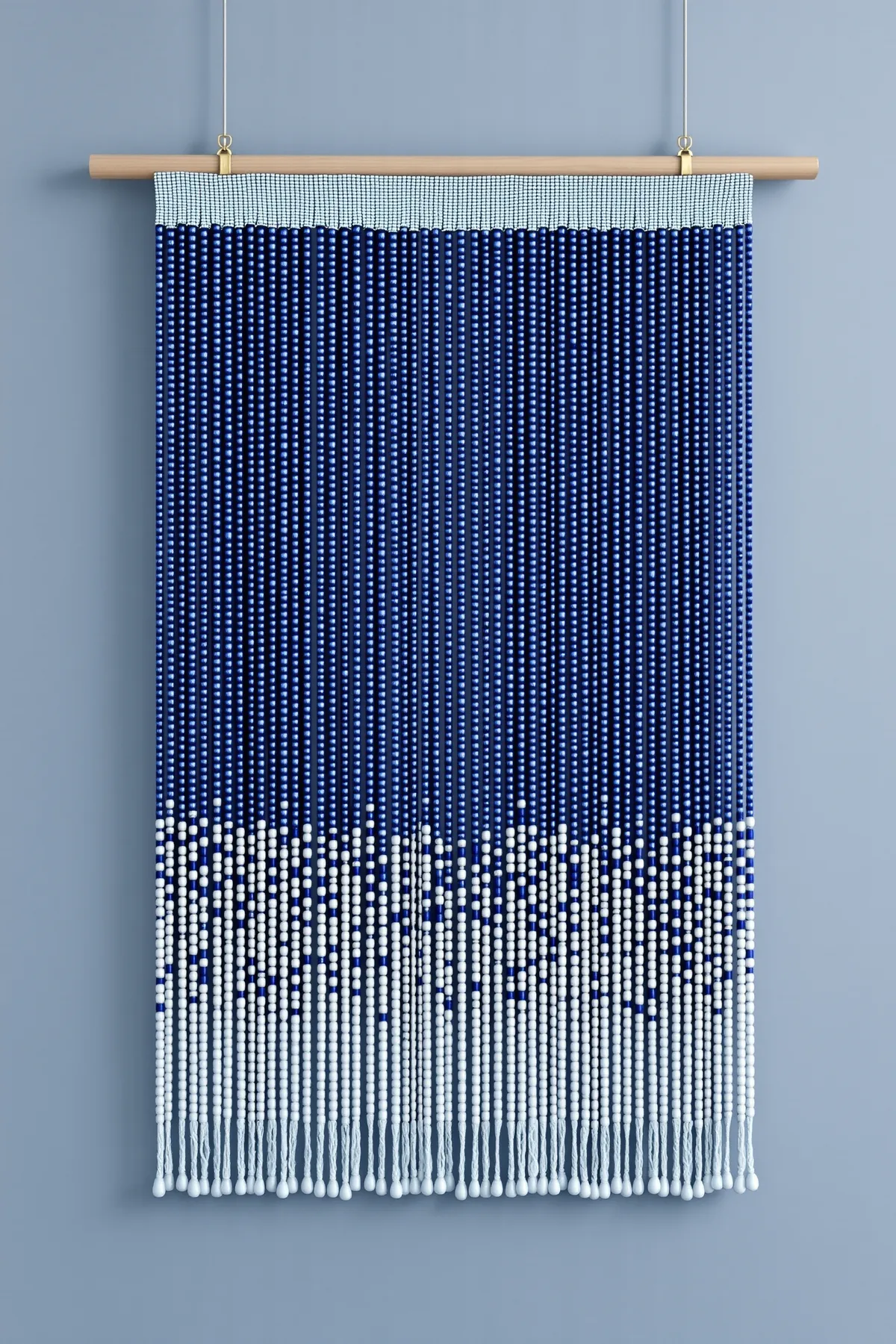
Posted: the full-length beaded doorway, floor to ceiling, as a nostalgic object. Bought: the portal, the café length and the wall piece. The full-length curtain is what people picture when they picture this category, and it is not the format that reorders. For a buyer building a first range, that single mismatch is the most valuable thing on this page.
One construction, three formats, from a single colour-count sheet. A design developed as a portal can be recut as a café curtain and as a wall hanging without changing the bead specification, because the only variables are the strand count and the drop. That is how a three-piece set gets to market on one development cycle, and it is also how a valance and a door curtain can be sold as a coordinated pair.
Format drives cost more directly than pattern does, because bead count scales with area. A documented doorway curtain at 90 by 200 centimetres on forty strands runs around 3,100 beads in a spaced design; a valance at 120 by 30 to 40 centimetres on fifty-six to sixty strands runs around 900 to 2,000; a café curtain around 76 centimetres square runs near 1,800. Lead times are the same across all of them: 40 to 60 days after sample approval, with sampling usually 16 to 20 days from an agreed brief.
The design library is organised by format for exactly this reason. Doorway curtains run 90 by 200 to 120 by 210 centimetres on forty to sixty strands. Portals run 76 by 140 on twenty-seven to forty strands, with a dual wall-and-portal format at 90 by 67. Valances run 120 by 30 to 40 on fifty-six to sixty strands. Wall hangings run 50 by 90 to 60 by 100. Those are the drawn specifications for the 2027 library, confirmed on the sample when a design is developed.
Formats that sit outside the current range. A beaded room divider and a beaded garland are both available to develop — drawn, and discussed here as craft categories — rather than lines to order off a range sheet. Both start with a brief and a sample.
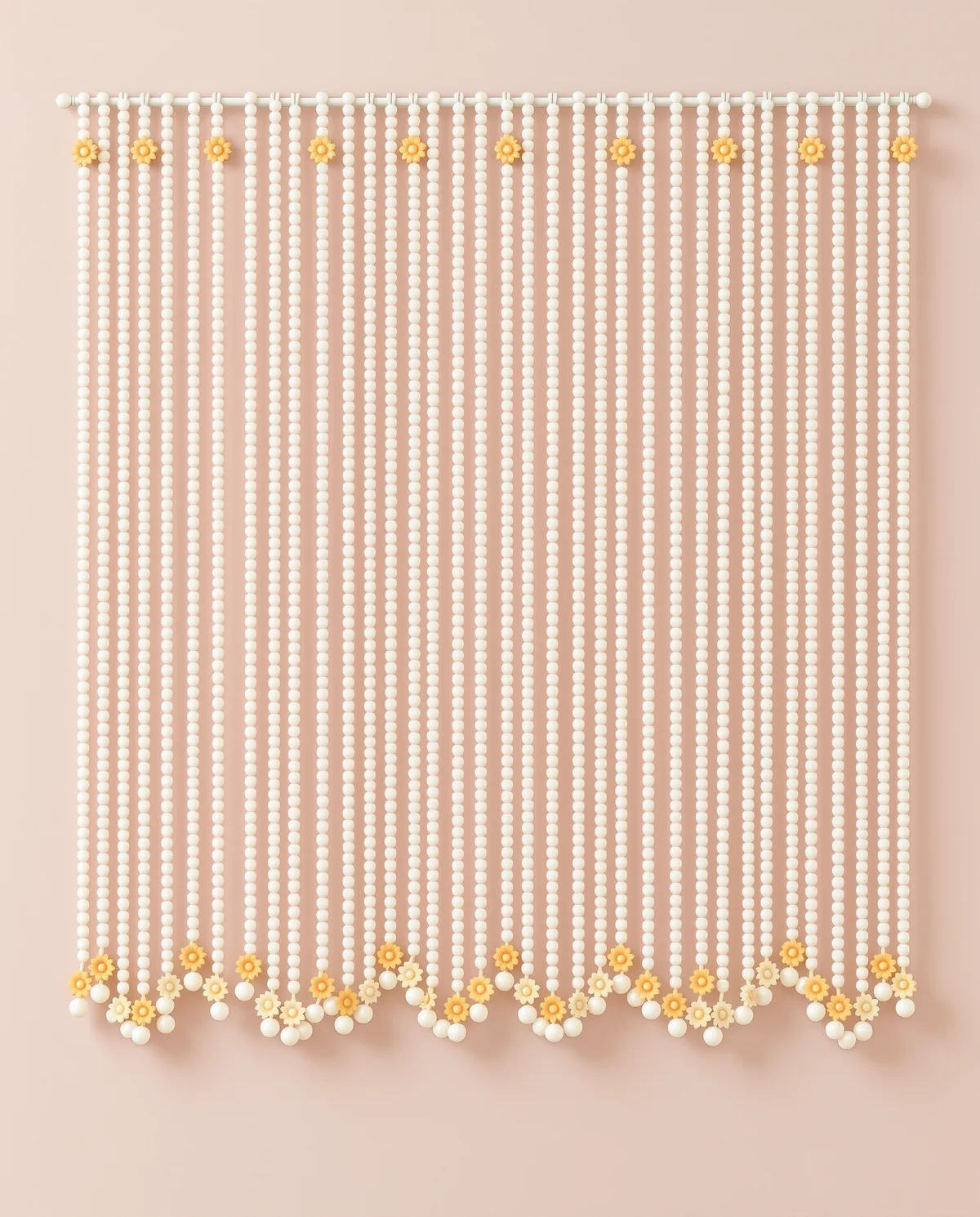
Warm and dotted. The format-relevant point is the pairing rule: a palette whose mechanism depends on the drop — a size-graded ombre, a long gradient — will not transfer to a short format, where it compresses into stripes. Short formats want blocked colour, a scattered accent, or a single material. Getting that pairing right at the brief stage removes most of the risk from a multi-format range.
Portals lead, because they reorder. Café lengths carry a design into a second format for the cost of a recut, which is why they follow so closely. Wall pieces have become a repeat category rather than a one-off, and they sell through a different part of a store. Valances are wanted in short drops, where a quarter of a full drop of beads has to reach the same look. The full-length curtain — the format everybody pictures — is the one briefed least often.
Partly taste and partly a manufacturing fact worth knowing. In our 2025 development programme a seed-bead curtain on a fabric ground was originally briefed as a full curtain and converted to a café size, because flat bead embroidery is worked on a frame and the frame sets the practical maximum for that construction; above that size the format becomes a strung one. The commercial result was a format buyers liked and reordered; the cause was the craft rather than a change of mind at the drawing board. It is a good illustration of why format conversations belong with the people who run the floor.
Good to know
What is on our own floor, and what is arriving in briefs. The beaded programme has run continuously across portals, curtains, café curtains, valances and wall hangings, with fresh styles entering production for the December-to-March window and the lead portal reordered season after season.
A format preference outlasts a palette preference, in our experience, because it is tied to how people live with the object rather than to how it looks.
Warm and dotted. For format purposes the more useful point is the interaction: a graded tonal palette needs drop to read, so it belongs on a portal or a wall piece, and a short format needs a blocked or a scattered palette instead.
Portals lead, café lengths carry a design into a second format, and wall pieces have become a repeat category. Valances are wanted too, in short drops, which is the harder brief: a short format reaches its look on roughly a quarter of the bead count of a full drop.
A home-and-lifestyle retail channel. This read comes from retail product manufacturing rather than from contract installation, so it describes what that channel is buying — portals, café lengths, wall pieces and valances at retail sizes, in repeat — and a specifier working on a hospitality fit-out should expect a different format mix.
Doorway curtains and portals at 90 by 200 and 76 by 140 centimetres, valances at 120 by 30 to 40, café curtains around 76 by 76, and wall hangings from 50 by 90 to 60 by 100. Those are the documented standard bead formats in the design library.
Keep exploring
Pillar
Door curtains, portals, café lengths and valances: the standard sizes, the strand counts and the one question each format answers.
Open the referenceIndex
Eleven trend reads on beaded décor for 2027, from the floor the movements land on first.
How it is madeTrend read
Where beadwork beats plaster and tile on texture, where it loses on durability, and what a contract specification has to carry.
Specs and sizesTrend read
Dense pattern multiplies bead count and picking operations — and the version that actually gets ordered is the scattered accent.
Read the guideTrend read
Motif-led, iridescent-ground and reordering fast: the one construction that carries a rotating icon set.
Compare the options
Start a conversation
Send a reference, a colour chip or a sketch. Minimums are set per design and confirmed per quote; sampling is quoted separately and usually runs 16 to 20 days from an agreed brief.