Manufacturing
Beaded valances
Short strung panels at 120 × 35 cm and other formats, 56 to 60 strands, with scalloped, fan-arch, V-point and straight hems — and why height is the cost lever.
Open the reference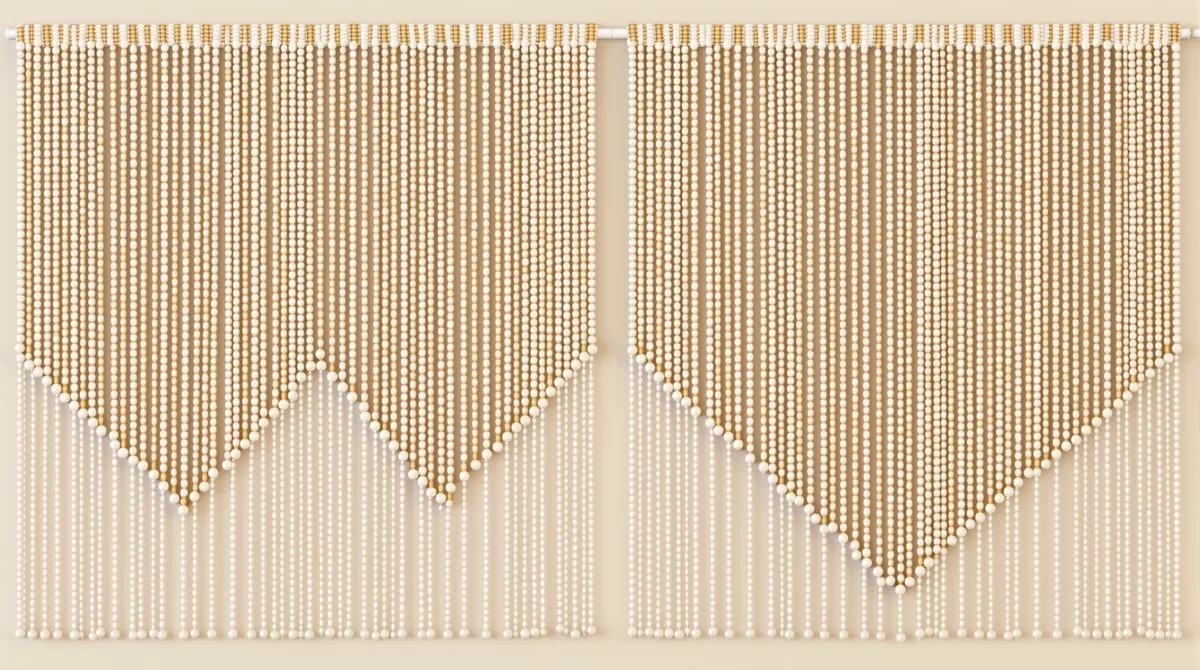
Trend · 2027
A valance puts a whole colour story over an opening on roughly a quarter of the beads of a full drop. The hem is the design, because there is nowhere else for the design to go.
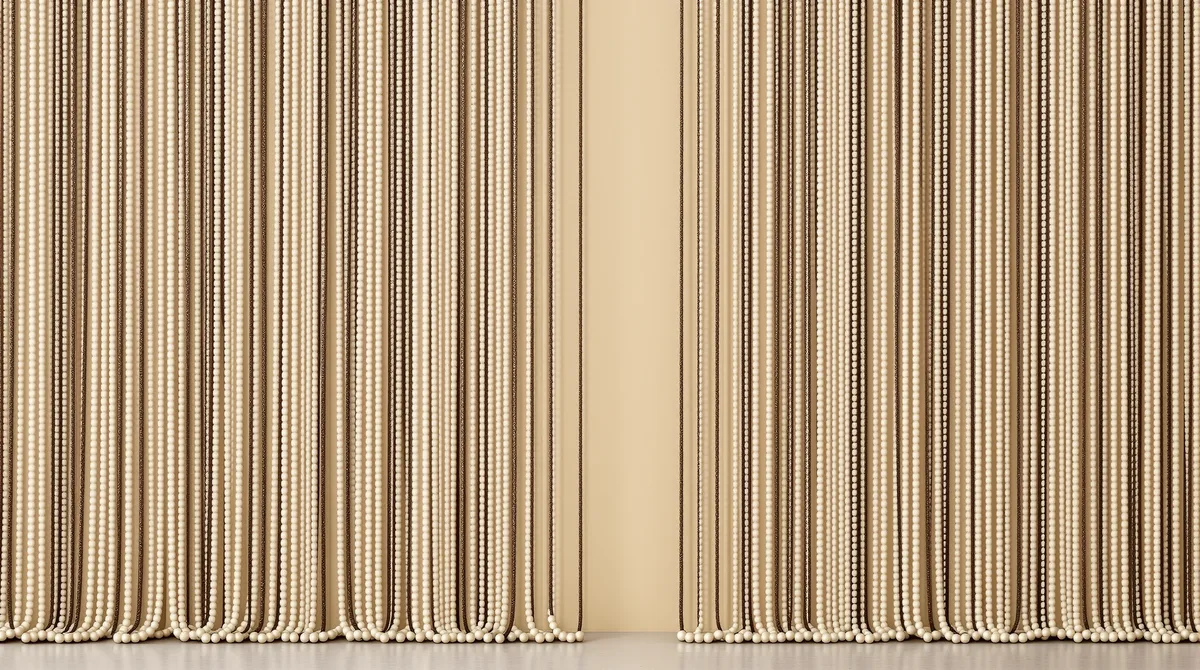
Two short beaded valances side by side in oat, honey and chalk white glass, each cut to a wide inverted-V hem, the strand ends stepping bead by bead to draw the shape.
Pelmets are returning in interiors press, and the beaded version offers a way to put a whole colour story over an opening at roughly a quarter of the bead count of a full curtain — around 900 to 2,000 beads against 3,100 to 5,600. The constraint is physical: fewer beads on an unchanged pitch, so the shaped hem carries the design and drop is the lever closest to hand.
Window dressing above the glass has come back into interiors conversation after two decades of being treated as dated. The press version of that is the pelmet — a rigid or upholstered box across the window head — and the soft version is the valance. For beadwork the interesting part is that the bead valance was never really away: it exists because a lot of openings physically cannot take a full-length panel, and the press cycle changes how the format is talked about rather than whether it is needed.
Press and production, pulling the same way. Interiors titles have flagged pelmets as returning for 2026, which is a signal about language and merchandising. On our own floor the valance is one of the beaded formats in continuous production, and the library valances have been developed and sampled. The format's real sensitivity is physical — a short drop carried on an unchanged pitch — which is why drop is the first thing to settle in a brief.
Use the valance as the test rather than the hero. The arithmetic is the whole argument: a valance at 120 by 30 to 40 centimetres carries around 900 to 2,000 beads where a full doorway curtain at 90 by 200 carries 3,100 to 5,600. So a buyer can put a complete colour story over an opening, see how it sells, and only then commit to the door panel. That sequencing reduces the risk on every palette decision a range makes.
Warm and dotted, with one format-specific constraint. A short drop cannot carry a mechanism that needs height: a size-graded ombre on a thirty-centimetre valance arrives as three stripes, not as a gradient. The palettes that work at this depth are blocked colour, a scattered accent on a plain ground, or a single material carrying the whole piece. Choose the mechanism to the drop and the format stops disappointing.
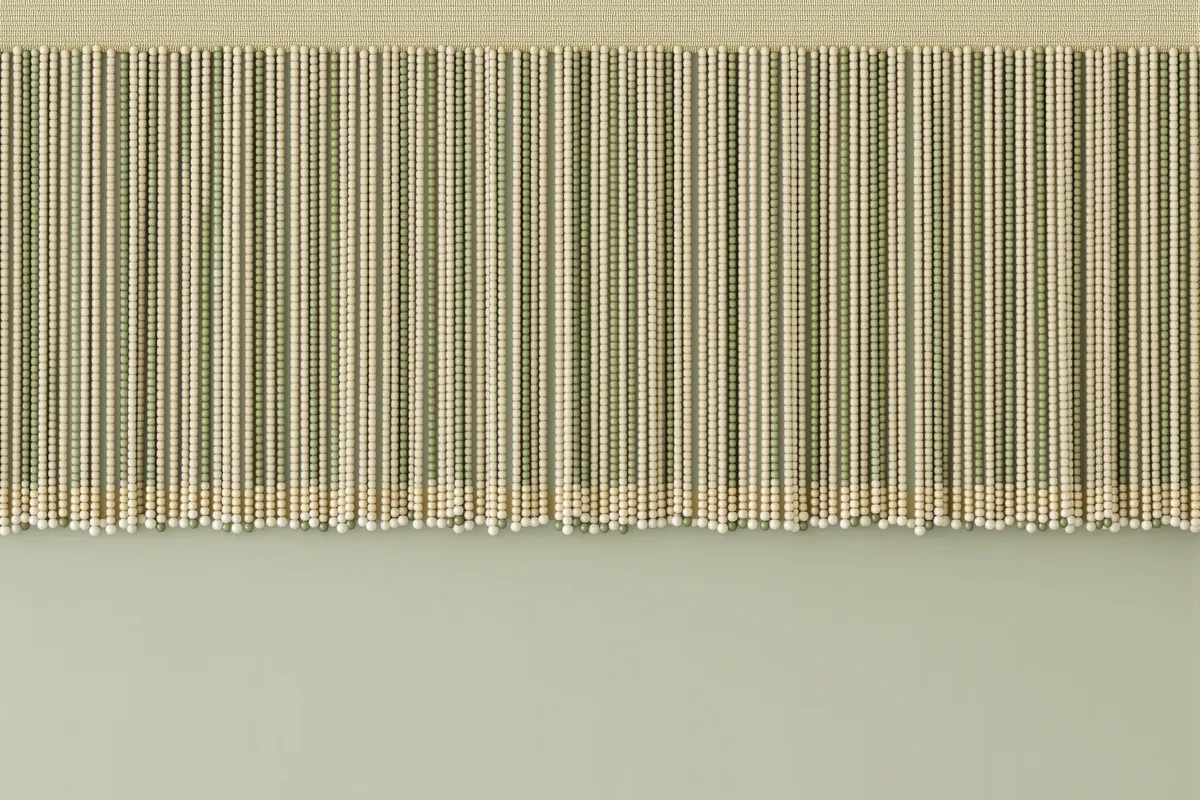
Short drops with a strongly shaped hem. Fan arch, sunburst, scalloped arch and pearl scallop are the profiles being requested, and that is logical: in a format with almost no vertical room, the hem is the only place design can happen. A straight-cut valance is a band of colour and very little else, which is why the shaped hem is not a decoration here but the product.
Everything about how the design has to work. A short format carries roughly a quarter of the bead count of a full drop, so a valance has to reach its look on fewer beads, while the hand time at the header and across the shaped hem does not fall in the same proportion. Drop is therefore the lever closest to hand — every centimetre is multiplied by the strand count — and it belongs in the brief rather than in a late correction at sampling.
Unknown as a measured figure. The format itself is not trend-dependent, which is the useful structural point: openings that cannot take a full-length panel will keep existing. What the press cycle affects is whether a retailer merchandises the format as a pelmet, as a valance or as a window topper, and that is a naming decision rather than a product one.
Posted: the full upholstered pelmet, in a fabric scheme, as a maximalist window statement. Bought: a short beaded panel with a shaped hem, carried on a quarter of the beads. The gap here is wider than on any other page in this section, because the press version of the trend is a joinery item and the thing that gets ordered is a bead object that merely shares a position in the room.
Develop the valance alongside the door panel from the same count sheet, not after it. Both can be drawn from one colour-count sheet so they match and sell as a set, which is also how a single development cycle covers the pair. Developing a valance on its own is the slow way round.
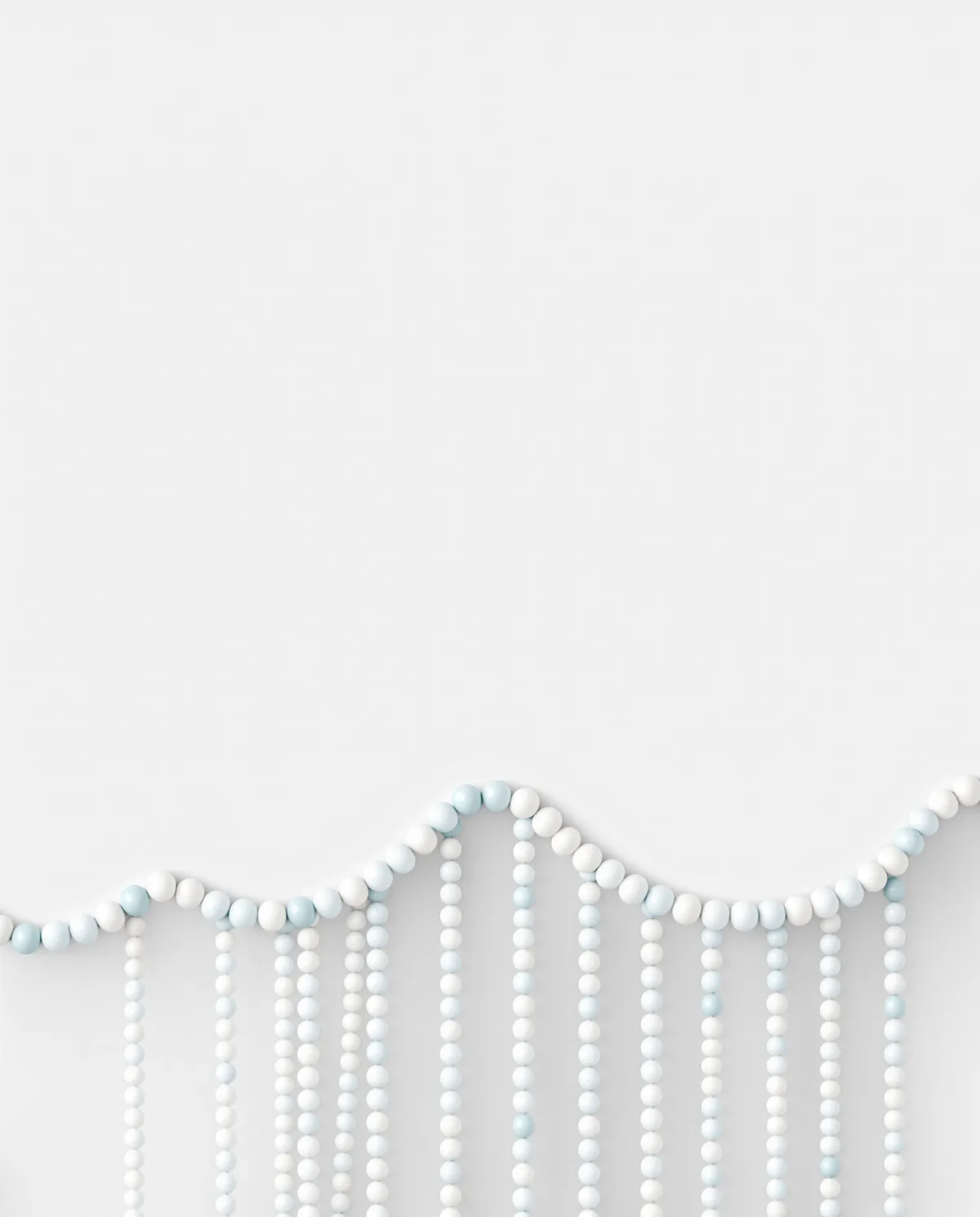
Lead time is unchanged at 40 to 60 days after sample approval. Labour behaves counter-intuitively. A valance has a short drop but a tight pitch — fifty-six to sixty strands across 120 centimetres, roughly a two-centimetre spacing — so the strand count stays as high as a full curtain's while the bead count falls. That means the per-piece hand time does not fall in proportion to the beads, and taking height out does less than a buyer expects. The hem is where the hand time concentrates, and the hem is also where the design is.
The 2027 library runs: Lapis Hour Café Valance, Sorbet Parade Awning Valance, Fan Arch Valance, Olive Press Grove Valance, Café Society Café Valance, Seventies Sunroom Sunburst Valance, Sunny Side Up Valance, Pearl Scallop Valance and Wiggle Valance, with a Polka Dot café curtain alongside them at around 76 centimetres square and 1,800 beads. All are drawn to size for the library and confirmed on the sample when a design is developed.
The boxed pelmet. It is a joinery product, made in timber and fabric, and it is not something we manufacture. Where a brief genuinely wants a rigid head treatment with beadwork below it, the answer is that the beadwork is ours and the box is somebody else's, and settling that at brief stage is better than discovering it at sampling.
Good to know
The valance group in the design library: Lapis Hour Café Valance, Sorbet Parade Awning Valance, Fan Arch Valance, Olive Press Grove Valance, Café Society Café Valance, Seventies Sunroom Sunburst Valance, Sunny Side Up Valance, Pearl Scallop Valance and Wiggle Valance. All are drawn to size for the 2027 library and confirmed on the sample when a design is developed.
A boxed or upholstered pelmet. The press trend is partly about a joinery item — a rigid box over a window head — and that is not a bead object and not something we make. We build the beaded valance, which does a related job and is a different product.
Press has flagged pelmets as returning for 2026, and the valance is one of the beaded formats running in our own continuous production, with the library designs developed and sampled. The format's real sensitivity is physical — a short drop on an unchanged pitch — which is why drop is the first thing to settle.
The structural point for this format is that the valance is not really trend-dependent — it exists because some openings cannot take a full-length panel — so the press cycle changes how it is described rather than whether it is wanted.
Warm and dotted, and for this format the pairing rule matters: a short drop cannot carry a graded or gradient palette, which compresses into stripes. Blocked colour, a scattered accent or a single frosted material are the palettes that work at valance depth.
Short drops with a shaped hem, at a window head or over an opening. Fan arch and sunburst profiles are the most requested, because the hem is doing all the design work in a format that has no room for anything else.
Keep exploring
Manufacturing
Short strung panels at 120 × 35 cm and other formats, 56 to 60 strands, with scalloped, fan-arch, V-point and straight hems — and why height is the cost lever.
Open the referenceIndex
Eleven trend reads on beaded décor for 2027, from the floor the movements land on first.
Read the guideTrend read
What changes when beadwork is specified as a material: dimensions, adjacencies, dye-lot behaviour and a maintenance owner.
Specs and sizesTrend read
Where the open threshold works, the three cases where a door should stay, and the construction a walk-through panel needs.
Specs and sizesTrend read
Measured demand, warm and dotted in production, and the point where the look tips into pastiche.
Open the reference
Start a conversation
Send a reference, a colour chip or a sketch. Minimums are set per design and confirmed per quote; sampling is quoted separately and usually runs 16 to 20 days from an agreed brief.