Guide
Making a bead curtain
Strand count and pitch, cord choice, the bead order on paper, stringing, knotting, fixing to a dowel — and the hour count.
See the detail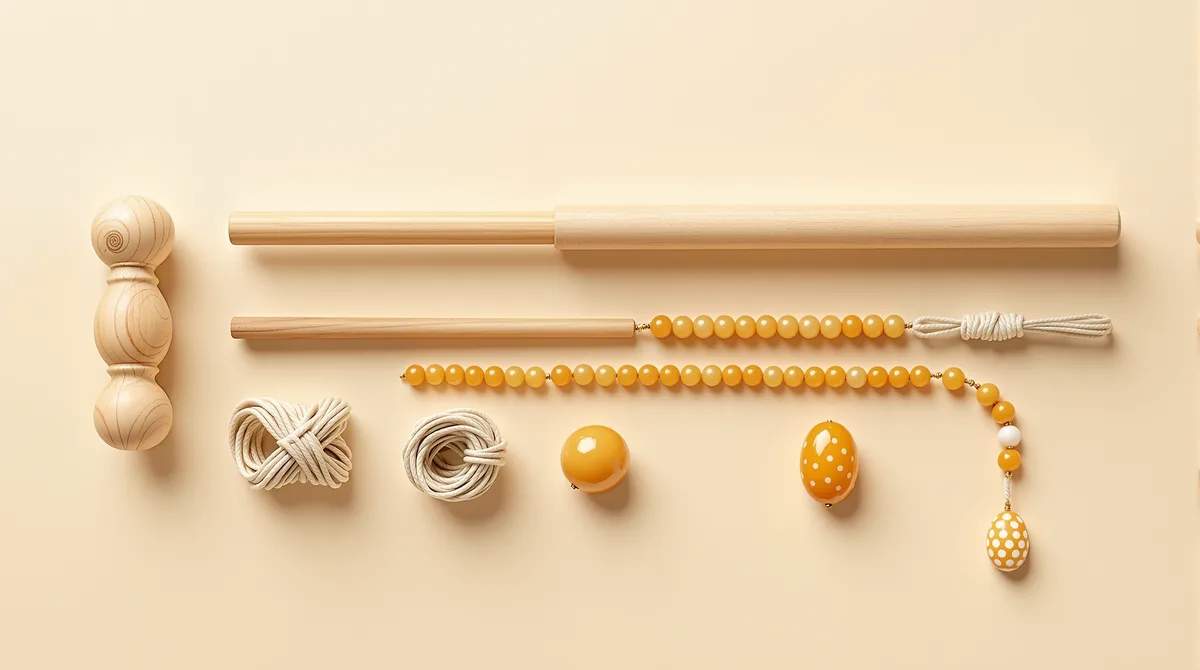
Guide · Components
Six components, and only one of them is beads. If you are buying parts rather than a finished panel, this is the list — and the order in which the decisions have to be made.
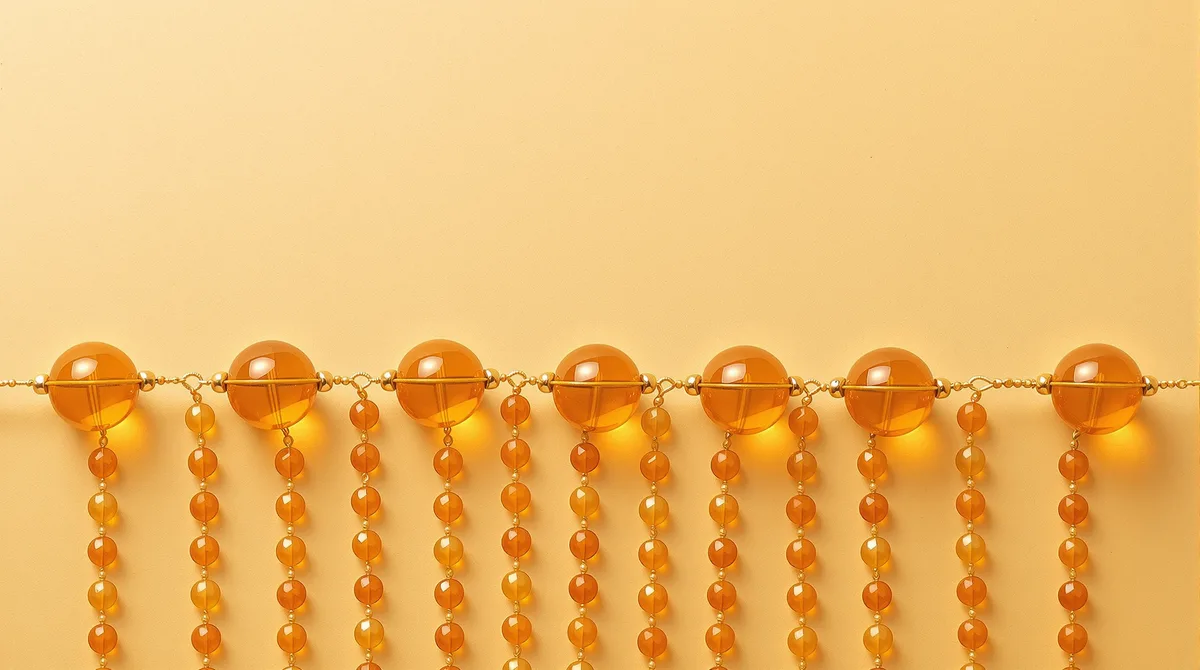
A beaded curtain's parts laid out separately: turned finials, two header rails, coils of braided stringing cord, a hand-strung bead strand and loose amber glass beads.
A bead curtain is six components: the beads, the cord they are strung on, the dowel or rod pocket they hang from, an end bead or stopper on each strand, the fixings that carry the header, and the bead map that fixes every position. The governing dimension is the drill hole, because cord is chosen from the smallest hole in the build.
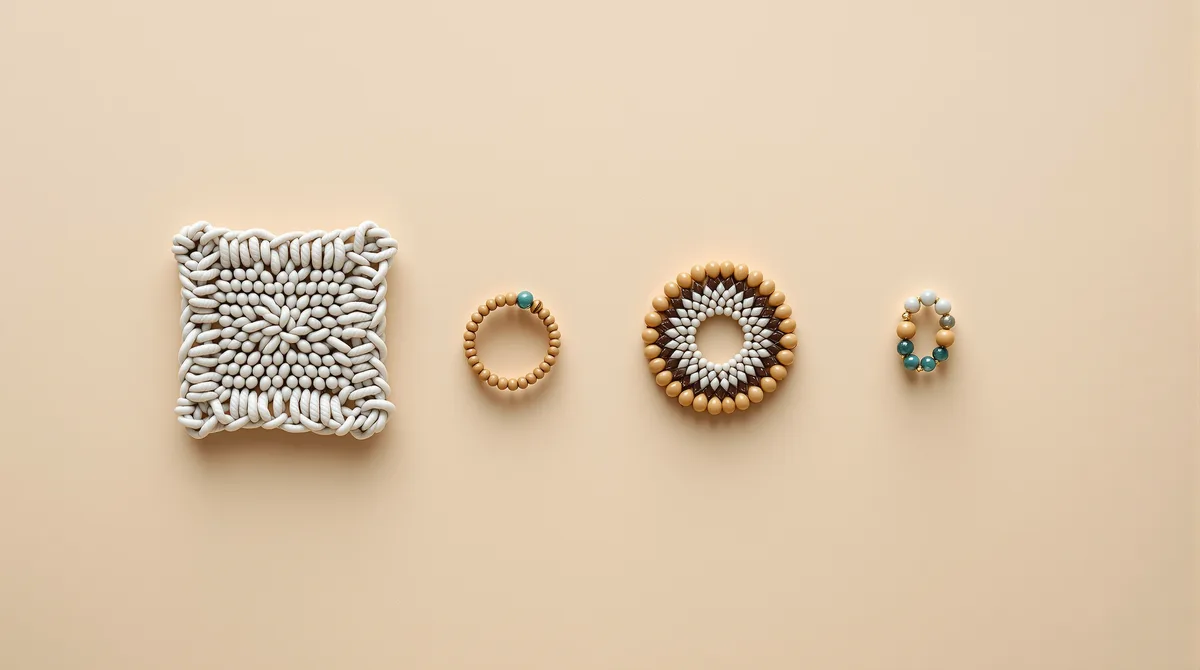
Six components. Beads, cord, a header, an end bead on each strand, fixings, and a bead map. People assume the first is the project and the rest are details; in practice the beads are the easy part and three of the other five are where panels fail.
The order in which they have to be decided is not the order you would guess either. The drill hole comes before the bead. The cord comes before the pattern. The map comes before anything is threaded.

Because cord is chosen from the smallest hole in the build, not from the look of the panel. A design can mix a 20 mm feature bead with 2 mm seed beads quite happily, but the cord has to pass the seed bead, and that means the cord is sized by the smallest component.
The hole is the component nobody draws and everybody assumes. It has to pass the cord, and the cord has to carry the strand, so the smallest hole in a build sets the cord for the whole panel — which is why it is specified per bead rather than once per design.
Get this wrong and the panel is not expensive, it is impossible: the cord will not pass the bead and the build stops.
By material, shape, outside size and hole. All four, every time.
Nine material families are in regular use: glass, acrylic, wood, bone, horn, ceramic, shell, capiz and metal. Each behaves differently as a component — a wood bead forgives a loose cord, a faceted glass bead does not — which is why the material line in a brief is a construction decision and not only a look.
Shape vocabulary matters more than people expect, because it is how a design is communicated: rondelle, bicone, pony, tile, coin drop, trapezoid, oval, tube, disc, teardrop, cabochon. A cabochon is the exception that proves the rule — it has no hole at all, so it cannot be strung and must be glued to a seat.
Cord. On the hanging panels documented here, it is a waxed cotton cord sized as above, and it is the component that eventually ends a panel's life: wet or abraded cord slackens, discolours and parts at a drill hole.
Wire exists in beadwork but in different constructions. Brass wire carries wire-wrapped beadwork over a shaped armature. Nylon-coated steel carries fringe strands and edge loops on a rigid core, crimped at each end. Neither is what a hanging curtain strand uses, and conflating them is a common specification error.
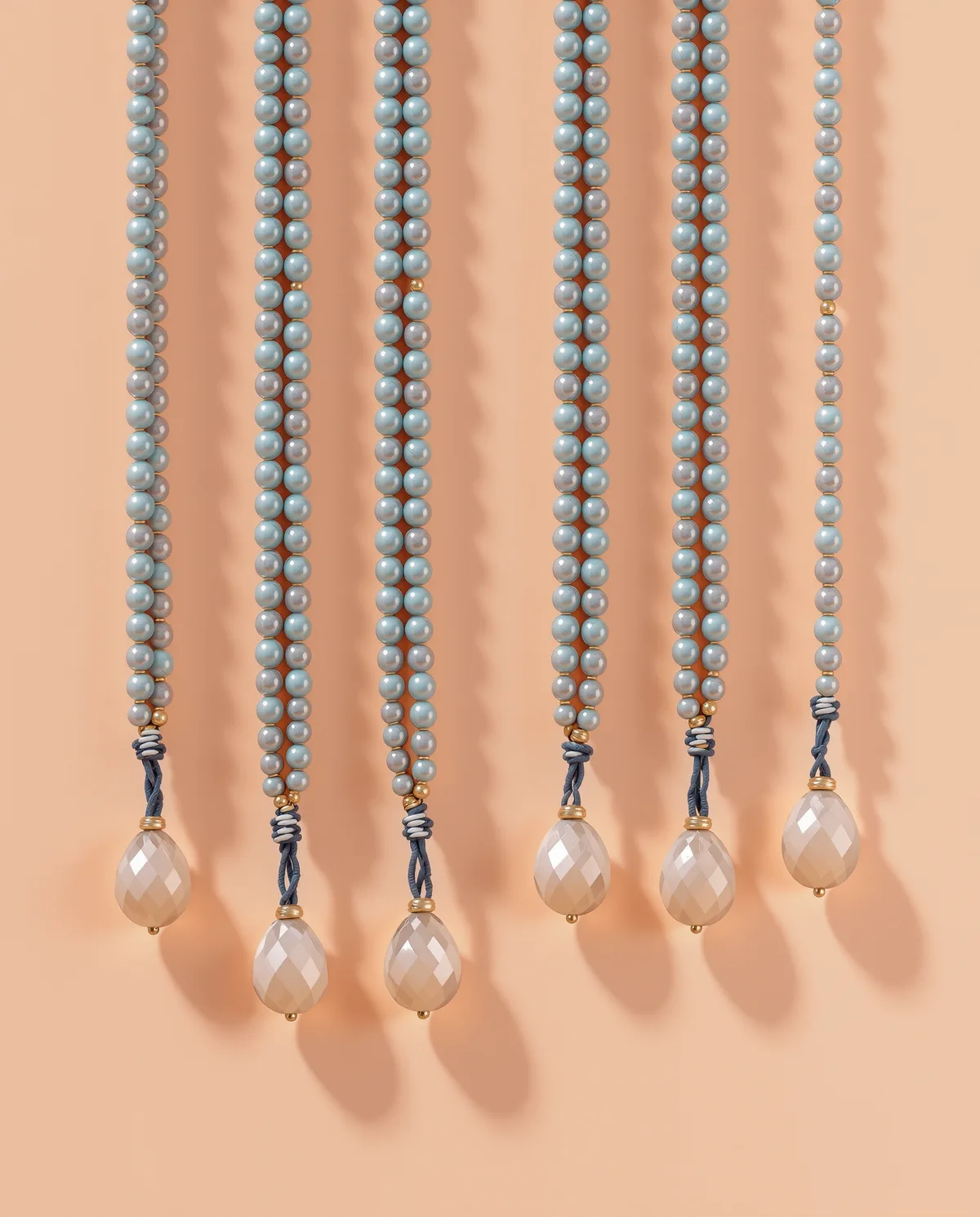
Two jobs. It stops the strand — something has to hold the beads on — and it weights it, which is what makes a light strand hang straight rather than drift.
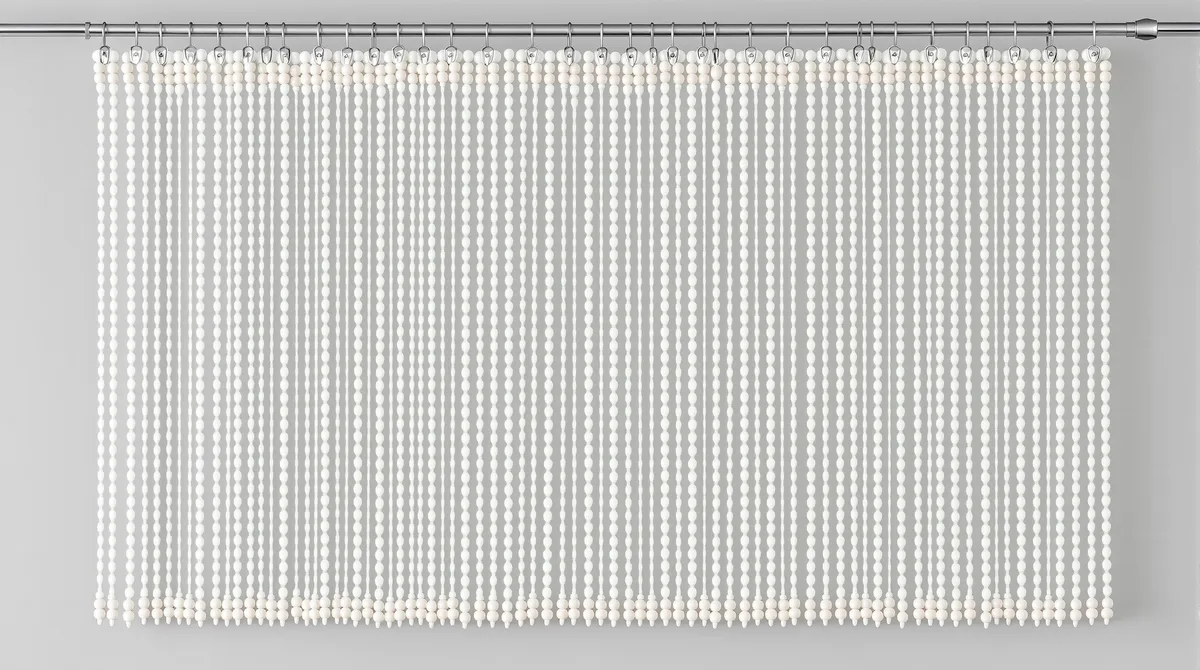
On a light material the weighted end bead is the standard fix for a drifting panel: acrylic, wood and bamboo strands all benefit from a heavier final bead. On the frosted sea-glass valance we developed through 2026, larger plastic drop beads sat at the strand ends for exactly this reason, with the hem graded from a 24 in longest strand to a 10 in shortest.
It is also the most visible bead on the whole panel, because it sits at eye level on a short piece and at the hem on a long one.
Three, and the choice is as much visual as structural.
A single turned wooden dowel is the standard: strands knotted over it, dowels turned in our own Saharanpur wood factory. A stained wooden header rail is the same idea treated as a visible component — our Chiara portal uses a rectangular stained rail rather than a round dowel, and the profile reads differently. A sewn rod pocket is the fabric route: a three-inch pocket on a cotton or canvas header band, which is how café curtains and fabric-mounted portals hang, and how a panel gets onto a standard window rod.
End suspension loops are the fourth answer, and they are the flexible one: loops knotted at the strand tops let a single panel hang level from a door fixing or a wall mount without being rebuilt.
Whatever is rated for the weight, and that is a material question. For a light acrylic, bamboo or wood panel, a tension rod inside the frame is adequate and needs no drilling. Cup hooks or screw hooks are the simple strong answer and hold a dowel or its loops directly. A curtain rod on brackets is what a heavier glass panel or a wide opening needs.
A ceiling hook or track belongs to hanging work away from a wall, and should go into a joist rather than into plasterboard.
We do not manufacture or supply curtain hardware. Saying so is more useful than implying a kit that does not exist.
Because without it the panel cannot be made twice, and most of the time it cannot be made once.
A bead map fixes every bead position before stringing starts: strand by strand, position by position, with accents deliberately offset so no two land level on neighbouring strands. It is what makes a pattern repeat identically across a production run and what keeps strand lengths equal.
One design in our 2026 programme had to be pattern-mapped by hand from a reference image because no artwork file existed, and the cost of that panel reflected it. The map is not paperwork; it is the most load-bearing document in the build.
Six parts, and every one is specified separately. The bead or beads, by material, shape, size and drill hole. The cord or thread they are strung on. The header — a turned dowel, a stained rail or a sewn pocket. The terminations: the knot and the end bead at each strand tip. The pattern, written as a colour-count sheet. And the packing that keeps the strands in order between the plant and the shelf.
Two of the six are the ones briefs omit. The drill hole, without which the panel cannot be assembled. The strand count, without which it cannot be costed.
Stringing specifications is the page to read next: it holds the hole, cord and strand-length relationships that this list only names. Choosing a bead size turns the parts list into a design decision, and bead materials sets out what each of the nine families gives you. Panel headers covers the dowel, rail and rod-pocket options in detail. A bead map is the component nobody counts as one, and the page on graphic bead patterns shows what it actually does. If the parts are heading into somebody else's product rather than a finished panel, component beadwork is the relevant page.
Good to know
Four to five millimetres is the usual specification for cord-strung work, and it is what customers developing beads with us ask for by name. The hole matters more than the outside diameter, because cord is chosen from the smallest hole in the build: if the cord will not pass the smallest bead, the build stops.
It depends entirely on the design. A densely patterned 90 by 200 cm panel can hold about 11,800 beads. An open-pattern panel the same size may hold around 3,100, a figure taken from the current design library. Bead size is the variable that moves it most.
Cord, on the panels documented here: a waxed cotton cord sized to the smallest drill hole. Wire is used in different constructions — brass wire for wire-wrapped beadwork over an armature, coated steel for fringe strands on a rigid core — but a hanging curtain strand is cord, and the cord is the part that eventually needs replacing.
Yes. Something has to stop the beads coming off, and the end bead does two jobs at once: it finishes the hem visually and it adds the weight that makes a light strand hang straight. On light materials like acrylic or bamboo, a deliberately heavier end bead is the standard answer to a drifting strand.
A single turned wooden dowel is the standard. The alternative is a sewn rod pocket in fabric — a three-inch pocket on a cotton or canvas header band, which is how café curtains and fabric-mounted portals are built. A stained wooden header rail is a third option, used where the top of the panel should read as a visible component.
It is the drawing that fixes every bead position before stringing starts, and yes — without it the panel cannot be made twice. It is what keeps a pattern identical across a production run, keeps strand lengths equal, and keeps a scattered accent genuinely scattered rather than accidentally in rows.
We manufacture to specification rather than running a retail counter, so a hobby quantity is not something we are set up to supply. What this page is for is the opposite problem: knowing which parts exist and which dimension governs which, so a brief or a shopping list is complete before you commit to it.
Keep exploring
Guide
Strand count and pitch, cord choice, the bead order on paper, stringing, knotting, fixing to a dowel — and the hour count.
See the detailSpecification
Rondelle, bicone, pony, tile, coin drop, trapezoid, teardrop and cabochon — what each shape does in a strand.
See the detailPillar
Door curtains, portals, café lengths and valances: the standard sizes, the strand counts and the one question each format answers.
Compare the optionsGuide
Panels as modules: standard widths, where a join reads, and how a run is set out across a wall rather than an opening.
Specs and sizesGuide
Three predictable failures — soaked cord, lime scale, no containment — and the two things people usually want instead.
Specs and sizesGuide
Resolution, weight, hang and hours — the four things one number decides, and how to trade between them.
Read the guideSpecification
Diameters, drill holes, cord selection, strand counts and format dimensions — the sheet to copy into a tech pack.
Specs and sizesTechnique
The bead map, the cord, thirty strands on a dowel, hem shapes, suspension loops — and the three levers that move the cost.
Specs and sizes
Start a conversation
Send a reference, a colour chip or a sketch. Minimums are set per design and confirmed per quote; sampling is quoted separately and usually runs 16 to 20 days from an agreed brief.