Pillar
Beaded curtains
Door curtains, portals, café lengths and valances: the standard sizes, the strand counts and the one question each format answers.
How it is made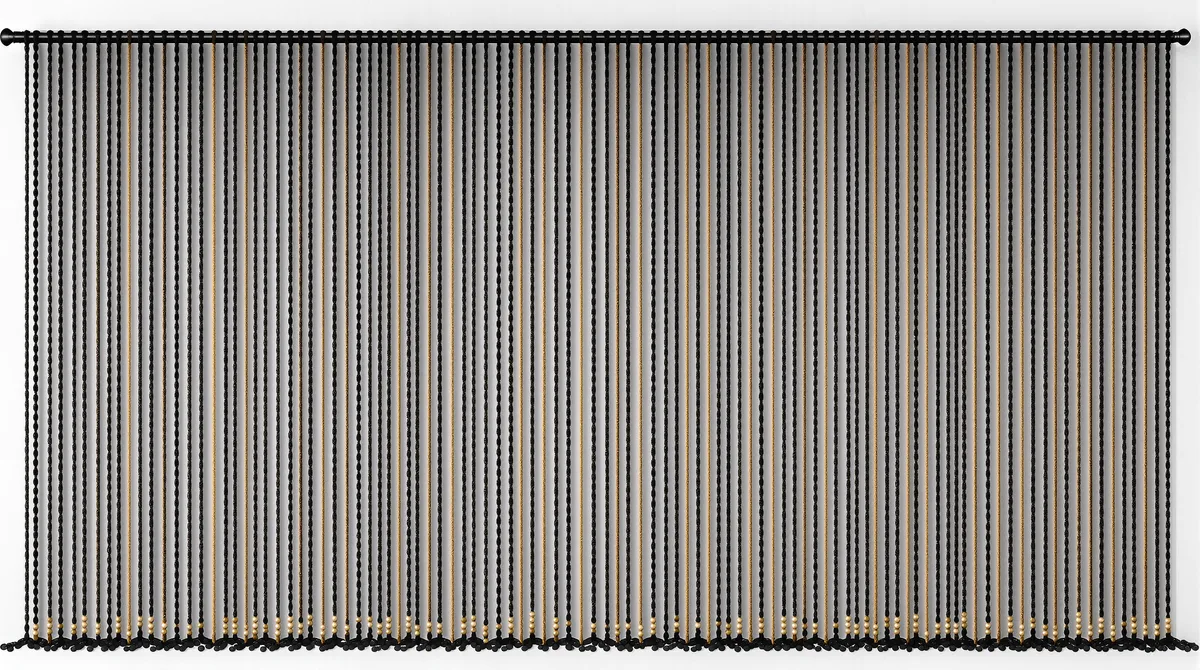
Guide · Format
Length is the one dimension that cannot be divided into modules. Every extra centimetre of drop hangs off the same knot at the top, and past about two metres that starts to matter.
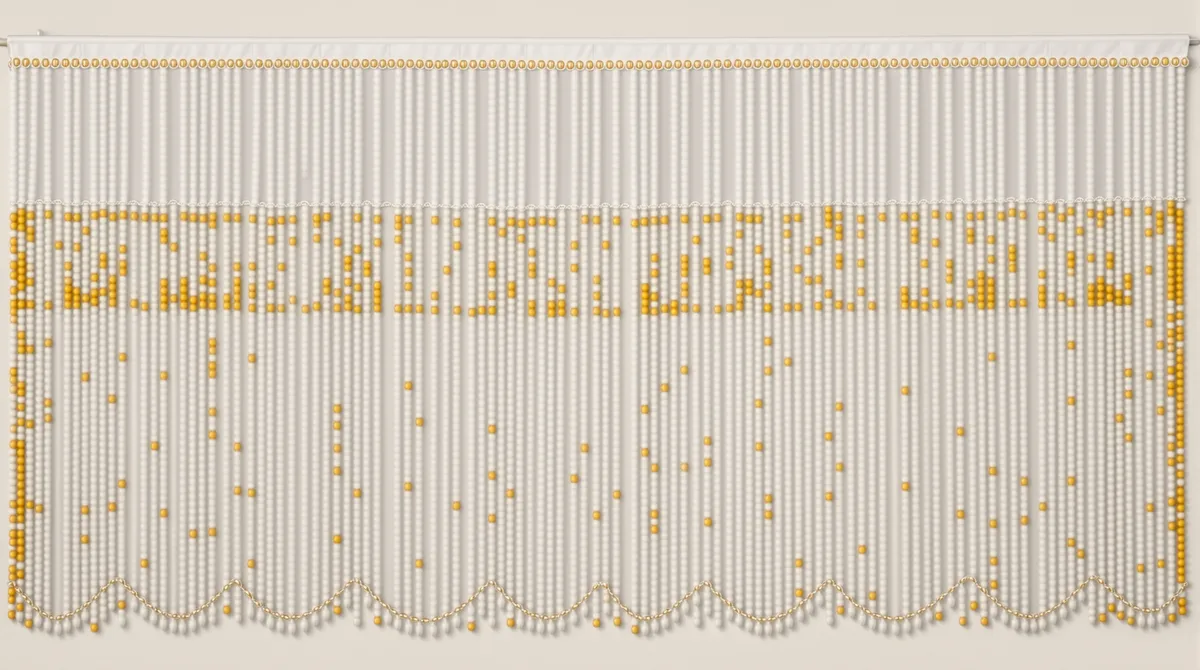
A long beaded drop in jet black, smoke crystal and antique gold, the bead diameter stepping down three times toward the hem so the lower third of every cord carries the lightest…
Past about two metres a bead panel changes character. Every bead on a strand hangs from the same knot at the header, so load at the top grows with the drop, cord stretches more over its length, and the hem has to be cut true at a height nobody can reach easily. The design library runs door panels to 200 cm and drops to 210 cm.

Four things, and only the first is obvious.
Bead count rises roughly in proportion to the drop. Load at the header rises with it, concentrated at one knot per strand. Cord creep becomes measurable, because cotton cord under sustained load stretches slightly over its length. And cutting the hem true becomes a genuine production problem, because a 2 m panel cannot be assessed at a glance from floor level.
A 90 × 200 cm panel sits right at the edge of ordinary. Past that, each of the four starts to need a decision.
Because width is a number of independent strands and length is the job each strand has to do.
A 2.4 m opening can be covered by two 120 cm panels, each on its own header, each carrying half the strands. The load is shared, the hardware is shared, and a damaged module can be replaced on its own. That is the whole argument for panels as modules.
A 2.4 m drop cannot be split. Every strand still carries its own full length, from its own knot, through its own topmost drill holes. There is no modular answer to height.
At the knot and the first few drill holes.
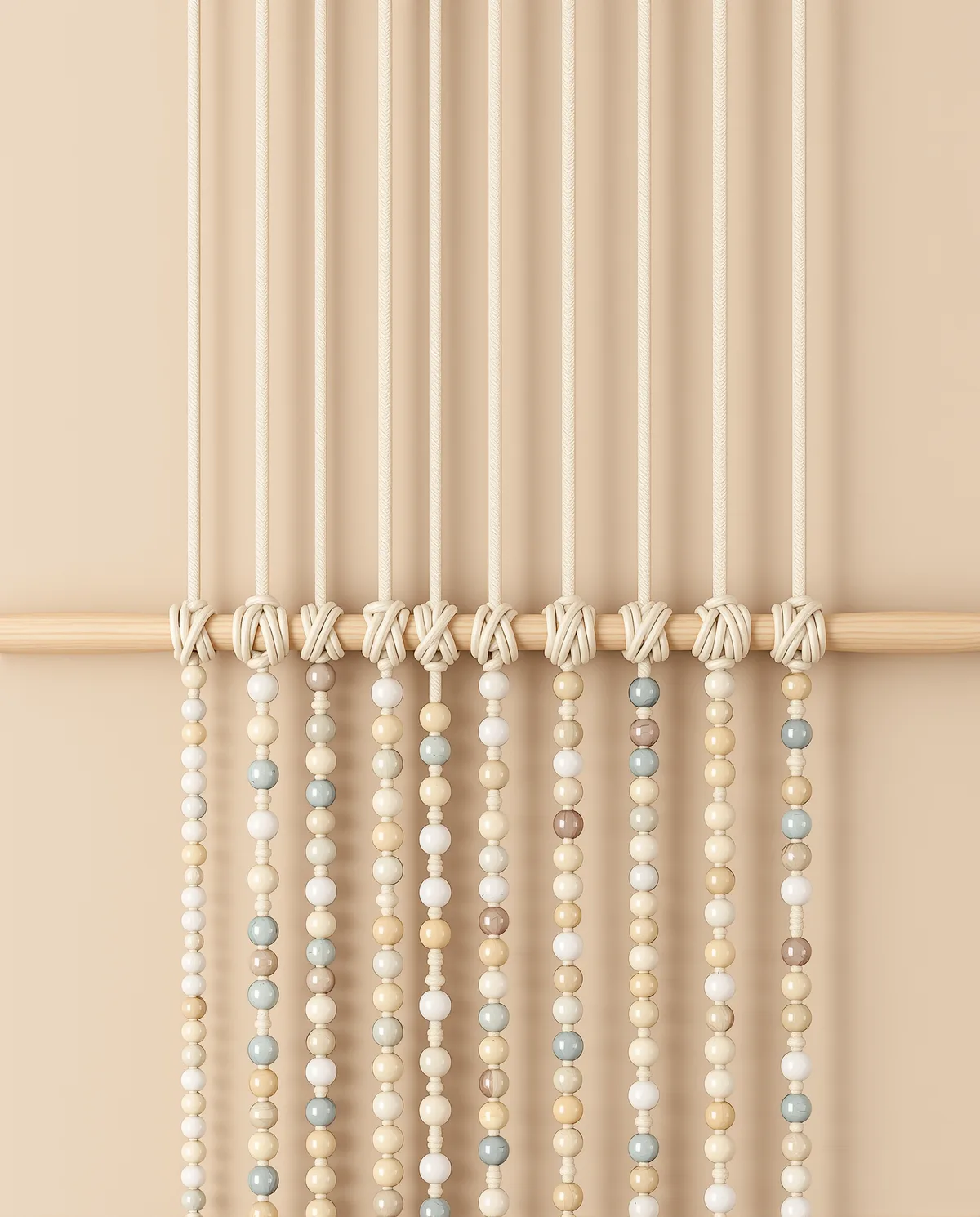
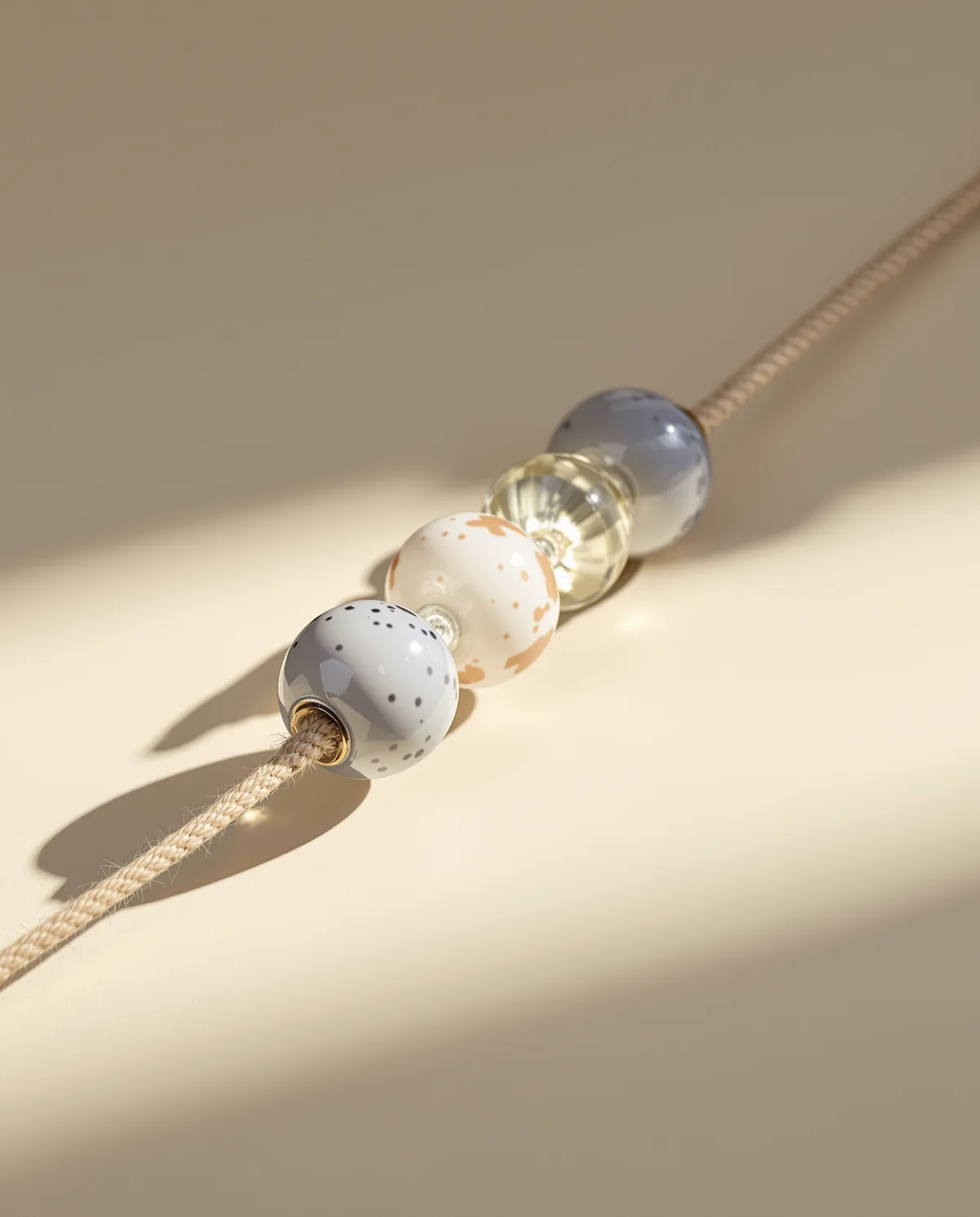
The knot at the header carries everything below it. The cord then bears against the drill hole of each of the topmost beads, under the full weight of the strand, continuously, for years. On a short panel that load is trivial. On a 2 m drop in glass it is not.
Specifying generously at that point means a cord sized with margin rather than to the minimum that will pass the smallest bead, and beads at the top of the strand whose drill holes are smooth and whose material is not brittle.
Lighter beads at the top, heavier at the hem. It does three useful things at once.
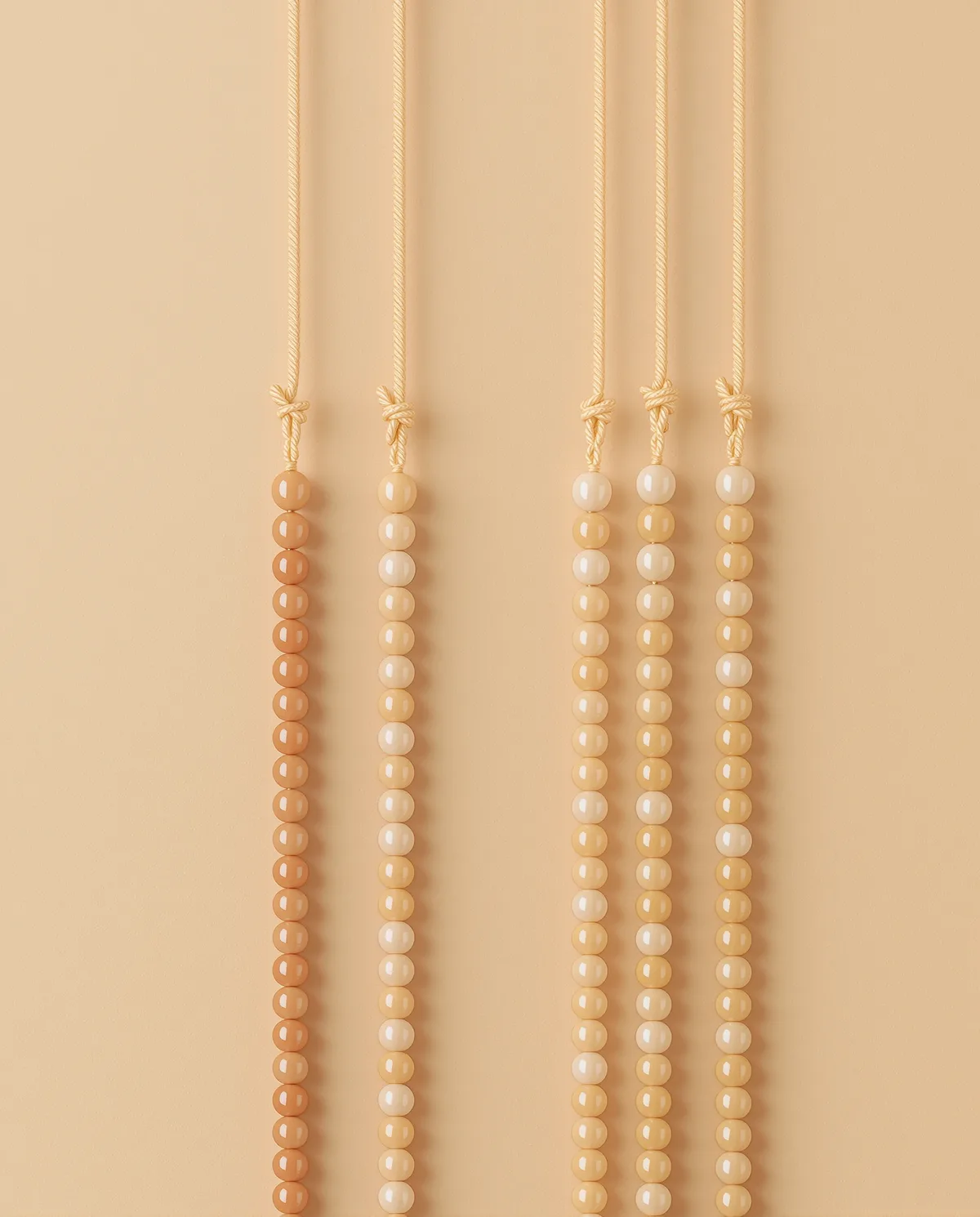
It reduces the load at the header, where load concentrates. It puts the weight where it works, pulling the strand straight from the bottom rather than compressing it from the top. And it produces a graded panel, which is the same principle as grading by bead size for a colour effect: our honey ombre colourway runs smallest beads at the top and largest at the hem, and the physics and the aesthetics point the same way.
On a long panel this stops being an aesthetic option and becomes the sensible engineering default.
Enough to change the order of operations. Cotton cord under sustained load creeps slightly, and on a long drop that shows up as strands sitting a centimetre or so lower than they did when first hung.
It settles rather than continuing indefinitely. The practical consequence is that a long panel should be hung and left to settle before any hem is trimmed or assessed — and that a long panel measured to finish exactly at the floor will probably end up touching it.
Specify a long panel to finish a clear margin above the floor for this reason, not just to keep the hem out of the dust.
A rod on brackets, fixed into solid timber or masonry, rated well above the panel's own weight. This is not the place for a tension rod, and on a double-height drop it is not really the place for a hardware-shop bracket either.
The weight comes from the material as much as the length. Glass sits near 2.5 g/cm³ against acrylic at about 1.2 and most woods below 1, so a long glass panel is the heaviest object this cluster describes and a long acrylic one is less than half of it. If the fixing is the constraint, the material is the lever.
By strand length on the stringing sheet rather than by eye, which is the only way it can be done.
Every strand's length is a number on the colour-count sheet, and the hem shape is the pattern those numbers make. That is what lets a production run of long panels match each other, and it is why a documented bead map matters more on a long panel than on a short one: nobody is going to hang a 2.1 m panel and trim it.
A shaped hem is also more forgiving at length than a straight one, because a straight hem invites comparison with the floor line and a long panel amplifies any discrepancy.
The standard door curtain is about 90 × 200 cm, roughly 35 × 79 in. The design library's full-length doorway range runs from 90 × 200 cm up to 120 × 210 cm, with 40 to 60 strands — those strand figures come from the 2027 design library.
Beyond 210 cm, a drop is a development rather than a standard. Width, drop and strand count are set per order in any case, because every piece is made to order against an approved sample, so an unusual drop is a conversation rather than an obstacle.
Roughly in proportion. Bead count follows drop almost linearly, so 20% more height is about 20% more beads and about 20% more stringing time.
That is why height sits last among the cost levers — bead size, construction, strand spacing, the dowel and packing all come first, because they multiply rather than scale. On a long panel it is still the largest absolute number on the sheet, which means the other four levers are where a long panel gets brought to budget.
Panel weight is the page that matters most, because a long drop concentrates its load at the header knot. Panel headers covers the rail and the fixing that have to carry it. Choosing a bead size explains the lighter-at-the-top grading that a long panel should use, and a short bead panel is the opposite end of the same decision. Where beadwork is specified covers double-height and stairwell settings. For the strand-length arithmetic a long hem is cut from, stringing specifications holds the figures.
Good to know
The published door standard is about 200 cm and the design library runs drops to 210 cm. Longer is possible as a development rather than a standard, and the limiting factors are cumulative strand weight, cord stretch over the length, and the practical problem of cutting a hem true at a height nobody can reach from the floor.
Because width divides into modules and length does not. A wide opening can be covered by two or three panels side by side, each with its own header; a long drop is carried by each individual strand along its whole length. There is no way to share that load.
At the header knot and the topmost drill holes. Every bead on a strand hangs from that one knot, and the cord bears against the drill hole of the first few beads under the full weight of everything below. Those are the points to specify generously on a long drop.
Over a long drop, measurably. Cotton cord under sustained load creeps slightly, which on a 2 m panel shows up as strands sitting a little longer than they did when hung. It settles rather than continuing indefinitely, but a long panel should be hung and allowed to settle before any hem adjustment.
Lighter at the top and heavier at the hem, which is the standard long-drop answer. It reduces the load at the header where it concentrates, keeps the weight where it does useful work pulling the strand straight, and produces a graded panel — the same principle as grading by bead size for colour.
A rod on brackets fixed into solid timber or masonry, rated well above the panel's own weight. A long glass panel is the heaviest thing this category produces, and a tension rod is not adequate. On a double-height drop the fixing should be an engineered decision, not a hardware-shop one.
Roughly, yes — bead count follows drop almost linearly, so 20% more height is about 20% more beads. That is why height sits last in the cost levers: it scales, where bead size and pattern density multiply. On a long panel it is still the largest absolute number on the sheet.
Keep exploring
Pillar
Door curtains, portals, café lengths and valances: the standard sizes, the strand counts and the one question each format answers.
How it is madeGuide
Valance, café length and half drop: three short formats, what each one does, and how bead count falls with height.
Open the referenceGuide
Backlit all day: why body-coloured glass belongs at a window, how length is measured from the sill, and what fades.
Compare the optionsGuide
Dowel deflection, mid-span support and the case for modules: why a very wide opening is a header problem first.
Specs and sizesSpecification
Cord creep, cumulative strand weight, splicing, mid-span stabilising, and how a long drop is engineered as segments on a carrier.
Read the guideSpecification
What a beaded panel weighs by material and density, and which fixings suit light acrylic against heavy glass.
Read the guide
Start a conversation
Send a reference, a colour chip or a sketch. Minimums are set per design and confirmed per quote; sampling is quoted separately and usually runs 16 to 20 days from an agreed brief.