Manufacturing
Valance beadwork
Short strung panels at 120 × 35 cm and other formats, 56 to 60 strands, with scalloped, fan-arch, V-point and straight hems — and why height is the cost lever.
Specs and sizes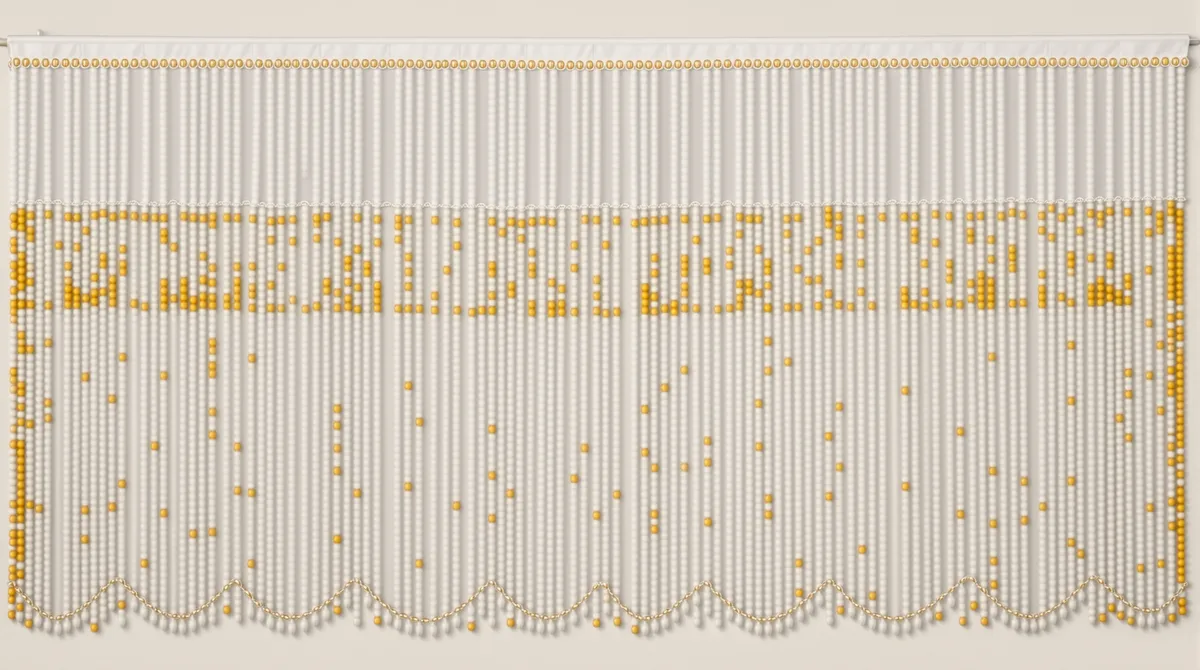
Guide · Format
There are three short drops, not one, and they do completely different jobs. Knowing which one you are asking for is the difference between a flourish and a curtain.
A short beaded cafe drop: a cotton header band with a three-inch rod pocket, a beaded top trim band, and short strands of chalk-white and canary glass to a scalloped chevron hem.
A short beaded curtain is anything from a valance up to about half the height of the opening. Three drops cover it: a valance at 30 to 40 cm dressing only the top, a café length covering the lower or upper half of a window, and a half drop in a doorway. Bead count falls almost in proportion to the height.
Anything from a valance up to about half the height of the opening. That is the published definition and it is a useful one, because it is relative to the opening rather than absolute.
Underneath that band sit three genuinely different formats that get called "short" interchangeably and should not be. They hang from different headers, do different jobs and cost very different amounts.
A valance dresses only the top of an opening. It hangs from a dowel, and a published format is 120 × 30–40 cm. Its job is decorative: it marks the opening and does nothing else.
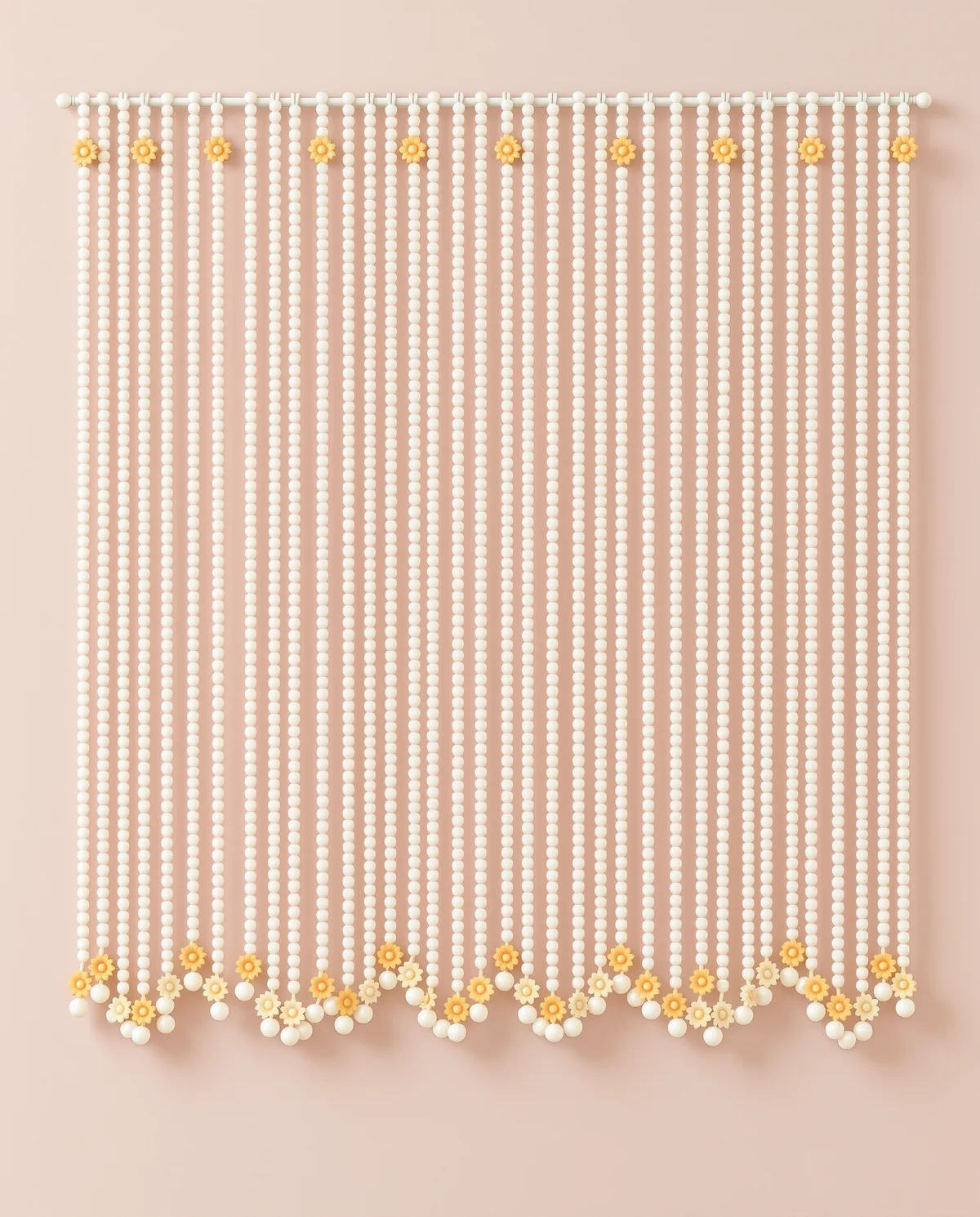
A café curtain covers part of a window, usually the lower half, and hangs from a fabric header band with a rod pocket rather than from a dowel. Our pink daisy café curtain is 24 × 30 in plus a three-inch rod pocket, on a 100% cotton header.
A half drop is a door or window panel cut to roughly half the opening's height. It hangs like a full curtain and sits at the top of the opening, screening the upper half while leaving the lower half clear.
This is the detail that actually separates them. A valance and a half drop hang from a turned wooden dowel — strands knotted over it, the standard beaded-curtain header.
A café curtain hangs from a three-inch rod pocket sewn into a cotton or canvas header band, so it threads onto an ordinary curtain rod. That makes it the most portable format in the category: it fits whatever rod is already at the window, which matters enormously in a rental.
Our daisy café curtain is built exactly this way: cotton header band, a three-inch rod pocket, a beaded top trim, moulded daisy connector beads, strands running down to a scalloped chevron hem.
Materially cheaper, and almost exactly in proportion. Bead count follows the drop close to linearly, so halving the height halves the beads and halves the stringing hours.
Height sits last among the five cost levers — bead size and material, construction, strand spacing, the dowel and packing, then height — but that ranking is about which levers multiply. In absolute terms, on a given design, cutting the drop is the biggest single number you can change.
That is why a short panel is the cheapest way to buy the same effect in a room, and why a valance over a bed or a doorway is so often the right answer on a budget.
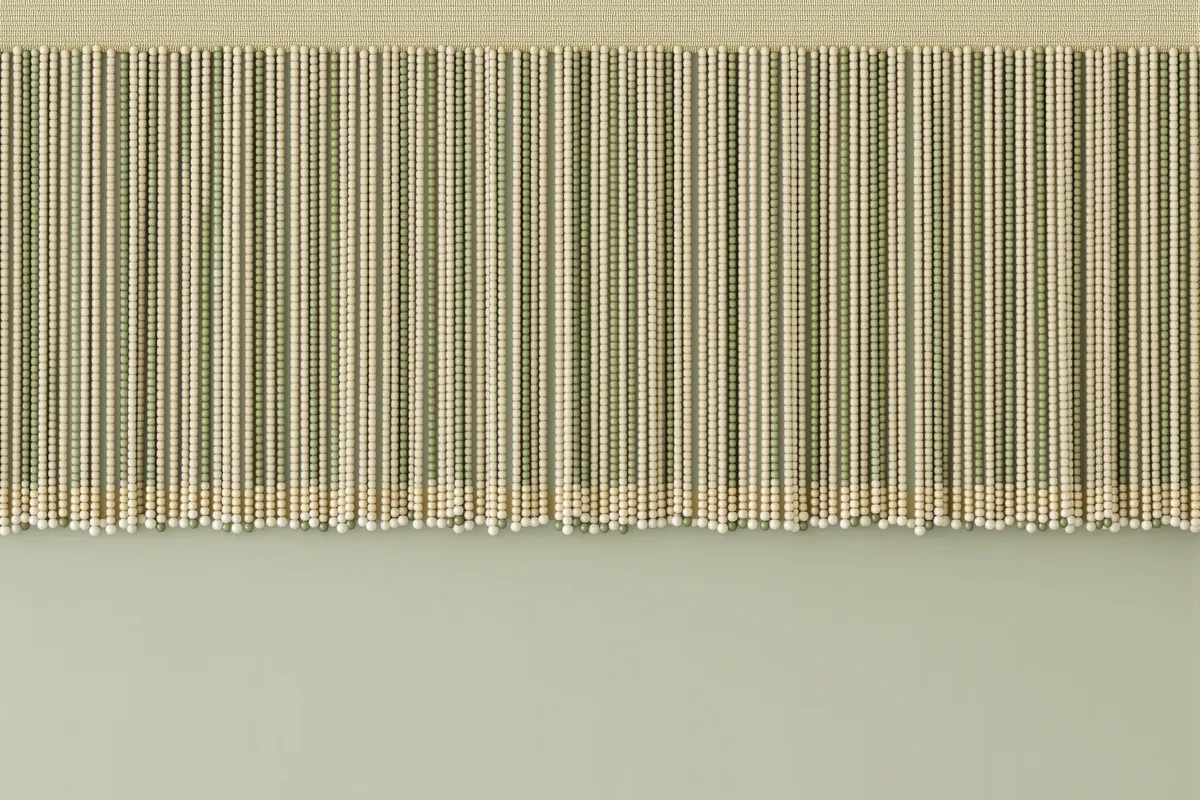
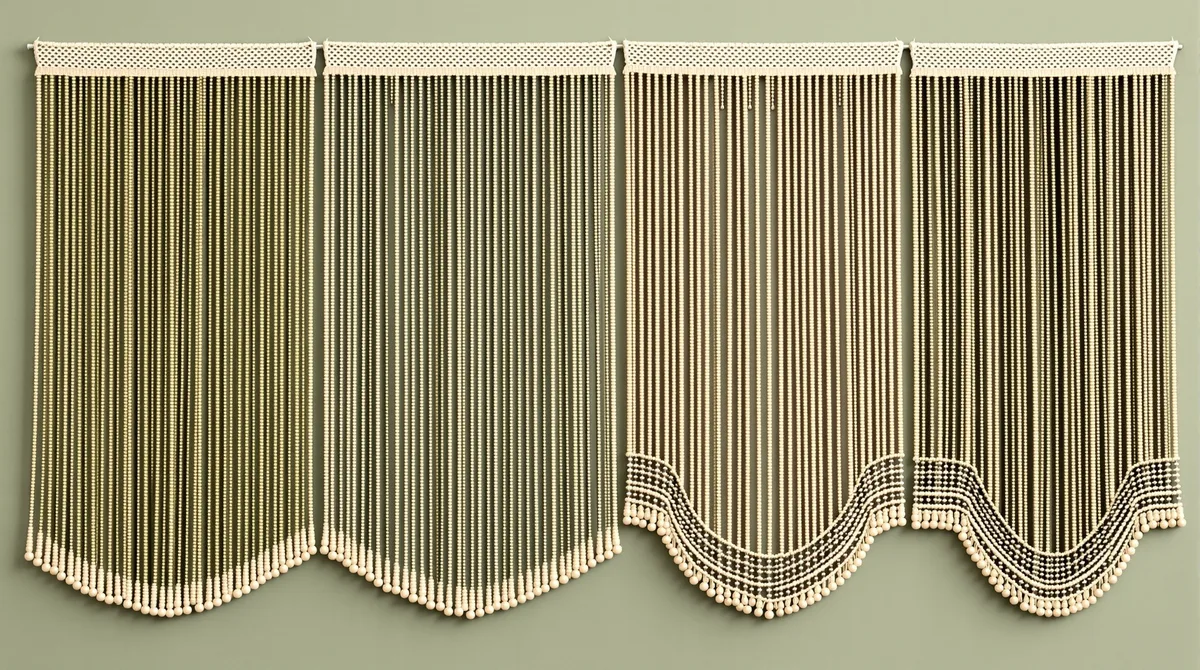
A shaped one, almost always. A short straight cut reads as unfinished, because there is not enough drop for the eye to read it as a deliberate line.
Scalloped, chevron and V-point all work well. They also remove beads, which suits a format that has to reach its look on fewer of them — so this is one case where the better-looking option is the leaner one.
Our frosted sea-glass valance ran from a 24 in longest strand down to a 10 in shortest on a scalloped arch, at a finished 30 × 24 in, with larger plastic drop beads at the strand ends to pull each strand straight.
Yes, and they are frequently developed as a pair from one colour-count sheet so they sell as a set.
The 2027 Seventies Sunroom collection is the clearest example: a 120 × 200 cm door curtain, a 120 × 35 cm sunburst valance and a 60 × 100 cm wall hanging, all in one colour story of glossy orange and canary glass with chocolate brown and cream soda.
Developing them together matters practically as well as commercially: the bead sequence on the valance is a truncation of the curtain's, so the two genuinely match rather than merely coordinating.
Over a bed, as a headboard substitute. Over a window, as a café length or a valance. Across a kitchenette or alcove threshold, where a full drop would be in the way. In a child's doorway, where a short panel keeps the hem out of reach entirely. And in a rental, because a light short panel is well within what a tension rod carries.
They are also the right answer in any opening people carry things through constantly, because there is nothing at hand height to catch.
A short format carries about a quarter of the bead count of a full drop, so it has to reach its look on fewer beads. Height is the lever closest to hand.
On the frosted sea-glass valance above, the height went from 30 in to 26 in specifically to take bead count out. That is the normal shape of a short-format development, because bead count follows the drop almost exactly.
That is not a reason to avoid the format. It is a reason to design for it: a short panel should be specified with a larger base bead and a scattered accent rather than a dense covered build, because the format cannot carry seed-bead labour.
Which of the three formats it is. The window or opening width. The longest and shortest drop, because short panels nearly always have shaped hems. The header: dowel, or fabric band with a rod pocket, and the rod diameter if it is the latter.
Width, drop and strand count are set per order against an approved sample, so an unusual short size is routine. Naming the format rather than the measurement is what gets the first sample right.
Beaded valances is the format page for the shortest drop, and an extra-long panel is the opposite end of the same decision. Choosing a hem matters more here than on any full-length panel, because a short straight cut reads as unfinished. Bead curtain pricing explains why height is the lever closest to hand on a short piece, and choosing a bead size explains which lever to pull instead. A window bead panel and a bathroom doorway are the two openings short formats suit best.
Good to know
Anything from a valance up to about half the height of the opening. Below that band you are in valance territory, where the panel dresses the top of an opening and nothing more; above it you are into a full-length curtain. The useful distinction is what the panel is covering rather than how many centimetres it measures.
Position and header. A valance dresses the top of an opening and hangs from a dowel; a published format is 120 × 30 to 40 cm. A café curtain covers part of a window — usually the lower half — and hangs from a fabric header band with a rod pocket, so it threads onto a rod rather than sitting on a dowel.
Yes. Give the window width and the drop you want and we propose a design. Our pink daisy café curtain is 24 by 30 in plus a three-inch rod pocket, on a 100% cotton header with moulded daisy connectors and a scalloped chevron hem — that is the shape of answer a kitchen window usually gets.
Materially, yes, because bead count follows the drop almost linearly. Height sits last among the cost levers only because the others multiply rather than scale; in absolute terms, halving the drop is the fastest way to halve the beads. It is the cheapest route to the same effect in a room.
Yes, and they are often developed as a pair from one colour-count sheet so they sell as a set. The 2027 Seventies Sunroom collection does exactly this: a 120 by 200 cm door curtain, a 120 by 35 cm sunburst valance and a 60 by 100 cm wall hanging in one colour story.
A shaped one, almost always. A short straight cut reads as unfinished. Scalloped, chevron and V-point all work, and they also remove beads, which suits a format that has to reach its look on fewer of them. Our sea-glass valance ran a 24 in longest strand to a 10 in shortest on a scalloped arch.
A short format carries about a quarter of the bead count of a full drop, so it has to reach its look on fewer beads. On a frosted sea-glass valance we developed through 2026, the height went from 30 to 26 inches specifically to take bead count out — on a short format, height is the lever closest to hand.
Keep exploring
Manufacturing
Short strung panels at 120 × 35 cm and other formats, 56 to 60 strands, with scalloped, fan-arch, V-point and straight hems — and why height is the cost lever.
Specs and sizesManufacturing
Built on a cotton or organza header with a three-inch rod pocket: the band, the strands, the hem and the sizes we have shipped.
Specs and sizesPillar
Door curtains, portals, café lengths and valances: the standard sizes, the strand counts and the one question each format answers.
Open the referenceGuide
Which materials tolerate steam, which mark permanently, and why the cord rather than the bead sets the lifespan.
Compare the optionsGuide
Cumulative strand weight, cord creep and header load: what changes when a bead panel goes past two metres.
Compare the optionsGuide
Nine profiles, what each one suits, and why a shaped hem costs no more than a straight cut.
Read the guide
Start a conversation
Send a reference, a colour chip or a sketch. Minimums are set per design and confirmed per quote; sampling is quoted separately and usually runs 16 to 20 days from an agreed brief.