Guide
Choosing a bead curtain
Where it hangs, which material, how dense, how long, which hem, how it fixes — and why colour is the last decision, not the first.
See the detail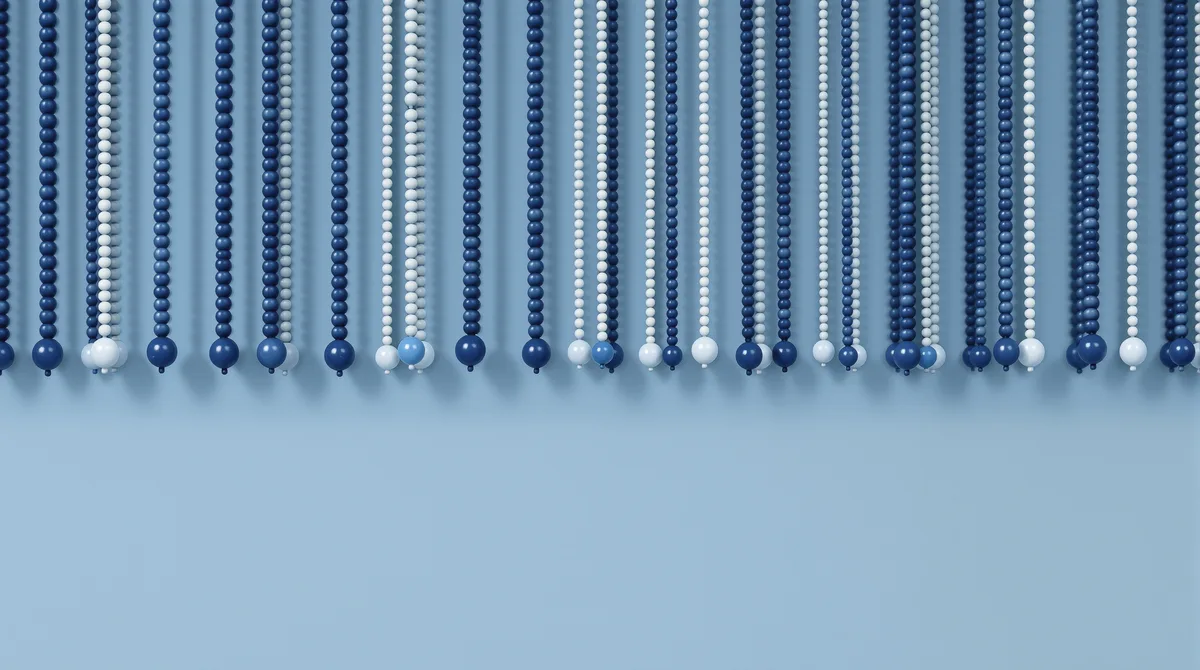
Guide · Buying
Both columns are real. The useful thing about beadwork is that almost every entry in the second column is a design decision, and almost every entry in the first one is not.
Hand-strung strands of cobalt, pale sky and chalk-white glass beads, the cords finishing at an uneven hem above a wide band of clear ground.
In favour: a bead panel passes air, breaks light attractively, needs no swing space, gives a room character out of proportion to its cost, and can be repaired strand by strand. Against: it makes a noise, collects dust, gives only partial privacy, can tangle, and does nothing at all for sound or temperature separation.

It covers an opening without closing it. This is the whole proposition and everything else is secondary. Air keeps moving, borrowed daylight keeps passing from one room to the next, and the opening is still an opening.
It needs no swing space. A door needs clearance; a bead panel needs none. In a small flat that is floor area returned.
It breaks light rather than blocking it. A glass panel refracts, throwing bright points onto the opposite wall that move through the day. No fabric does this.
It gives a room disproportionate character. One panel reads as a decision about a whole room.
It can be repaired. A parted strand is re-strung in bead-map order and re-knotted at the header. That is genuinely rare in soft furnishing.
It makes a noise. Every passage through is audible.
It collects visible dust. Less total surface than fabric, but every bead has an upward face and the dust sits where you see it.
It gives partial privacy at best. Movement, not detail, and nothing from close up.
It can tangle. Light strands, a tight pitch and careless handling are the three causes.
It does nothing for sound, temperature or insects. No separation of any kind.
This is the part that actually helps. The first column is mostly inherent — any bead panel passes air, breaks light and needs no swing space.
The second column is mostly adjustable. Noise is a material choice. Dust is a bead-size and pitch choice. Tangling is a strand-weight, pitch and handling matter. Privacy improves markedly with opaque beads at a tight pitch, though it never becomes good.
Only the last entry is genuinely immovable: no bead panel will ever give acoustic, thermal or insect separation, because it is an open construction and those properties require a closed one.
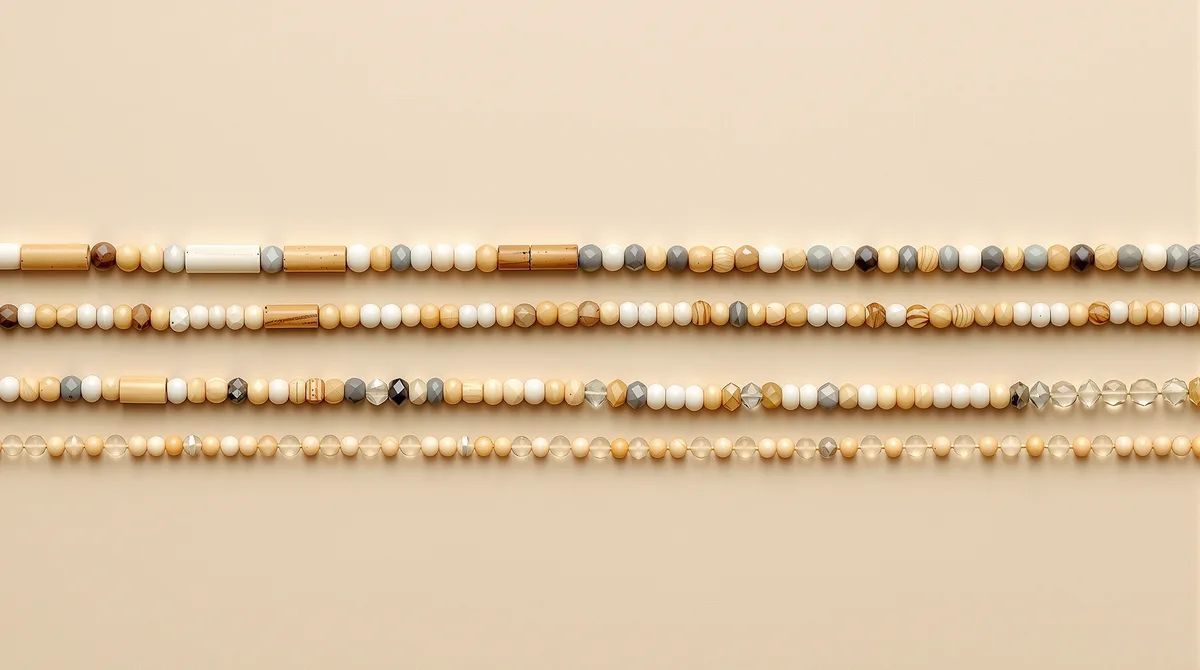
Substantially. Glass hangs straightest and settles fastest, which means the least tangling; it also chimes the loudest and weighs the most, roughly 2.5 g/cm³ against acrylic's 1.2 and wood's below 1. Acrylic is quietest of the hard beads and does not shatter, but drifts in a draught. Wood is warm, matte and quiet, and cannot go anywhere damp. Bamboo is lightest, driest-sounding, and the least tolerant of humidity.
There is no material that wins every column, which is why mixed strands are so common: a few glass beads for the light, on lighter beads for the weight and the cost.
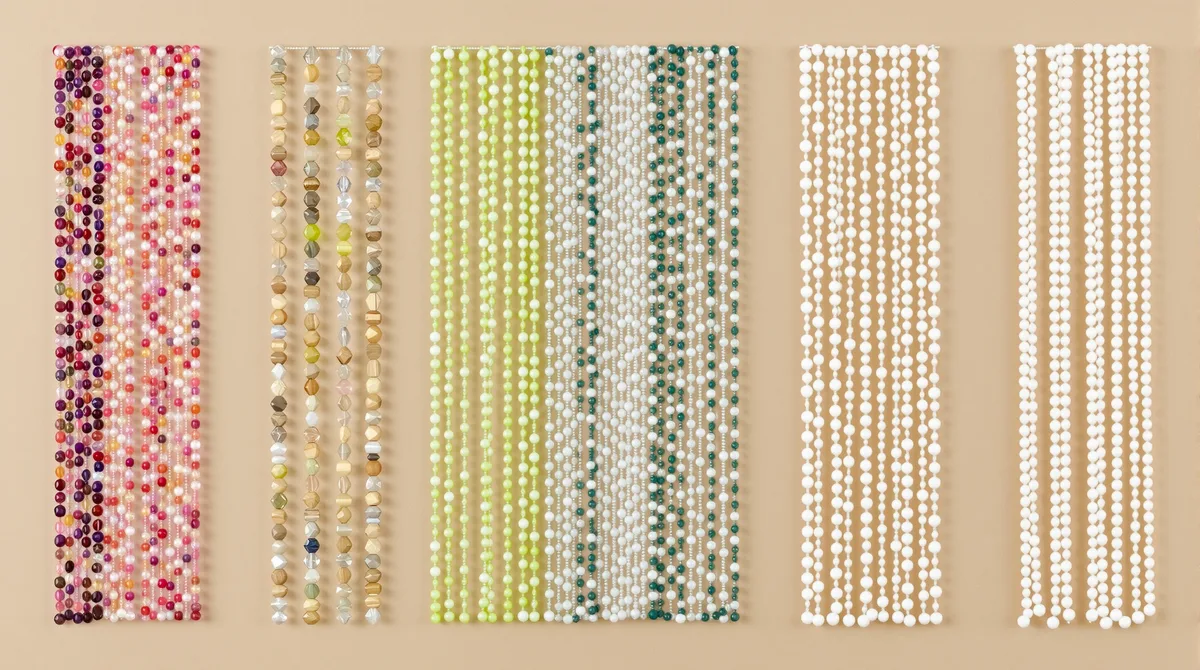
More than people expect and less than it should. The cost is bead count and stringing hours, and the counts are high: about 11,800 beads in a densely patterned 90 × 200 cm panel, each threaded by hand in a fixed order from a bead map.
Against a decorative object that fills an entire opening and is re-strung rather than replaced, that is good value. Against a fabric curtain of the same dimensions, it is not cheap, and anyone telling you beadwork is a budget option is selling you a thinner one.
Against a door: beadwork wins on space and light, loses on sound, privacy and the ability to shut. Against a fabric curtain: beadwork wins on airflow, light quality and repairability, loses on privacy and washing. Against nothing at all: beadwork wins on definition and character, loses on cost and on the noise. Against a folding or sliding door: beadwork wins on cost, maintenance and space, and loses on every functional criterion.
Most real decisions are the second or fourth of those, and the second is the one where beadwork is genuinely the better object rather than merely the more interesting one.
Three failure patterns, repeatedly. Someone buys for privacy and gets screening. Someone hangs a glass panel on a friction fixing and it comes down. Someone chooses a tight pitch in light acrylic for a doorway in constant use, and spends a year untangling it.
All three are expectation or specification failures. None of them is the beadwork failing to be beadwork.
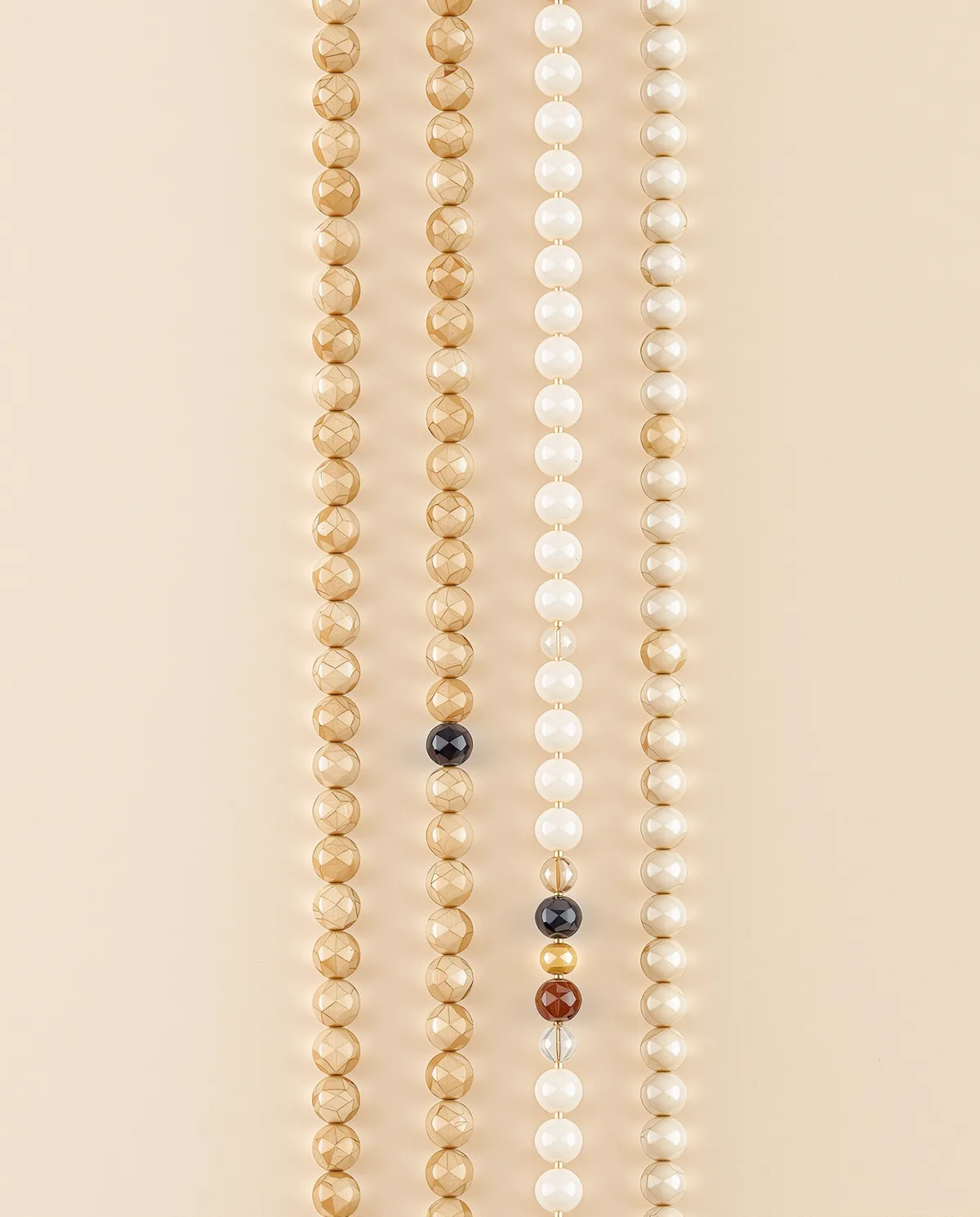
It does, because the repairability entry depends on it. A panel strung to a documented bead map — every bead position fixed on paper before anyone threads a needle — can be re-strung identically years later. A panel assembled by eye cannot.
Thirty hand-strung strands on a single turned dowel is the standard construction for a 90 × 200 cm piece. Spare beads can be built into the same production run if the order asks for them. Those two facts are what move "can be repaired" from a claim to a plan.
Buy if you want to define an opening without closing it, if you like the sound and the movement, if the room is dry, and if you have somewhere solid to fix a rod.
Do not buy if you need sound separation, blackout, insulation, insect exclusion or close-range privacy; if the opening is in a wet area; or if you will want to shut it. Those are not criticisms of beadwork. They are the five jobs it does not do.
The limits page states the five hard no's in detail and is the fastest way to rule beadwork out if it is wrong for you. Bead curtain pricing answers the value question, and bead materials answers the character one. Light and beadwork and privacy from a bead panel are the two performance pages where expectations most often part company with reality. If the answer turns out to be yes, made to order beadwork explains how a panel actually gets specified and made, and routine care sets out what living with one involves.
Good to know
It covers an opening without closing it. Air keeps moving, borrowed light keeps passing through, and nothing needs clearance to swing. In a small flat that combination is not a decorative benefit, it is a spatial one — you get the suggestion of a door back without giving up the floor it would need.
That it is not a privacy product. People buy a bead panel for a bedroom or bathroom doorway expecting concealment and find that it screens movement rather than detail, and nothing at all from close up. That expectation gap causes more disappointment than every other property combined.
They collect visible dust, which is different from a lot. There is far less surface area than a fabric curtain, but every bead has an upward-facing side and the dust sits where you can see it. Large-bead panels show it more than seed-bead panels, for the straightforward reason that there is more flat surface pointing up.
They make a sound every time someone passes through, and the sound is a material property: glass chimes brightly, acrylic clicks lightly, wood gives a soft knock, bamboo a dry rattle. In a hallway that is charm. Outside a bedroom door at two in the morning it is not, so choose the material for the location.
They cost what their bead count costs, and the bead counts are higher than people expect — a densely patterned 90 by 200 cm panel can hold about 11,800 beads, each placed by hand. Against a decorative object that fills a whole opening, they are good value. Against a fabric curtain of the same size, they are not cheap.
The beads outlast fabric comfortably — glass in particular is effectively permanent in domestic use. The cord does not, and the cord is the service item. The difference is that a worn bead panel is re-strung and a worn fabric curtain is thrown away.
Anyone who needs sound separation, blackout, insulation, insect exclusion or close-range privacy. Anyone hanging it in a wet area. And anyone who wants an opening they can actually shut. Those are five clear no's, and they are worth knowing before rather than after.
Keep exploring
Guide
Where it hangs, which material, how dense, how long, which hem, how it fixes — and why colour is the last decision, not the first.
See the detailPillar
Door curtains, portals, café lengths and valances: the standard sizes, the strand counts and the one question each format answers.
Open the referenceGuide
Bead count first, bead size second, pattern density third: the five levers that actually move the cost of a bead panel, in order.
See the detailGuide
A coated surface rather than a body colour: why pearl beads scuff where others dull, and where they are still the right answer.
Specs and sizesGuide
Hundreds of beads to a strand: the finest colour resolution in beadwork, and the longest stringing time in the category.
Specs and sizesGuide
No soundproofing, no blackout, no insulation, no insect exclusion, no close-range privacy — and why none of them is fixable.
See the detailGuide
Strand weight, pitch, handling and packing: the four variables that decide whether a panel knots, and the three set at the brief.
Read the guideGuide
Glass chimes, acrylic clicks, wood knocks, bamboo rattles, discs clatter: the sound of each material and how to choose one.
See the detail
Start a conversation
Send a reference, a colour chip or a sketch. Minimums are set per design and confirmed per quote; sampling is quoted separately and usually runs 16 to 20 days from an agreed brief.