Design
Portal and divider designs
Portals at 76 × 140 cm and hanging divisions at 90 × 180 and 120 × 180 cm, documented by strand count and opening shape.
Open the reference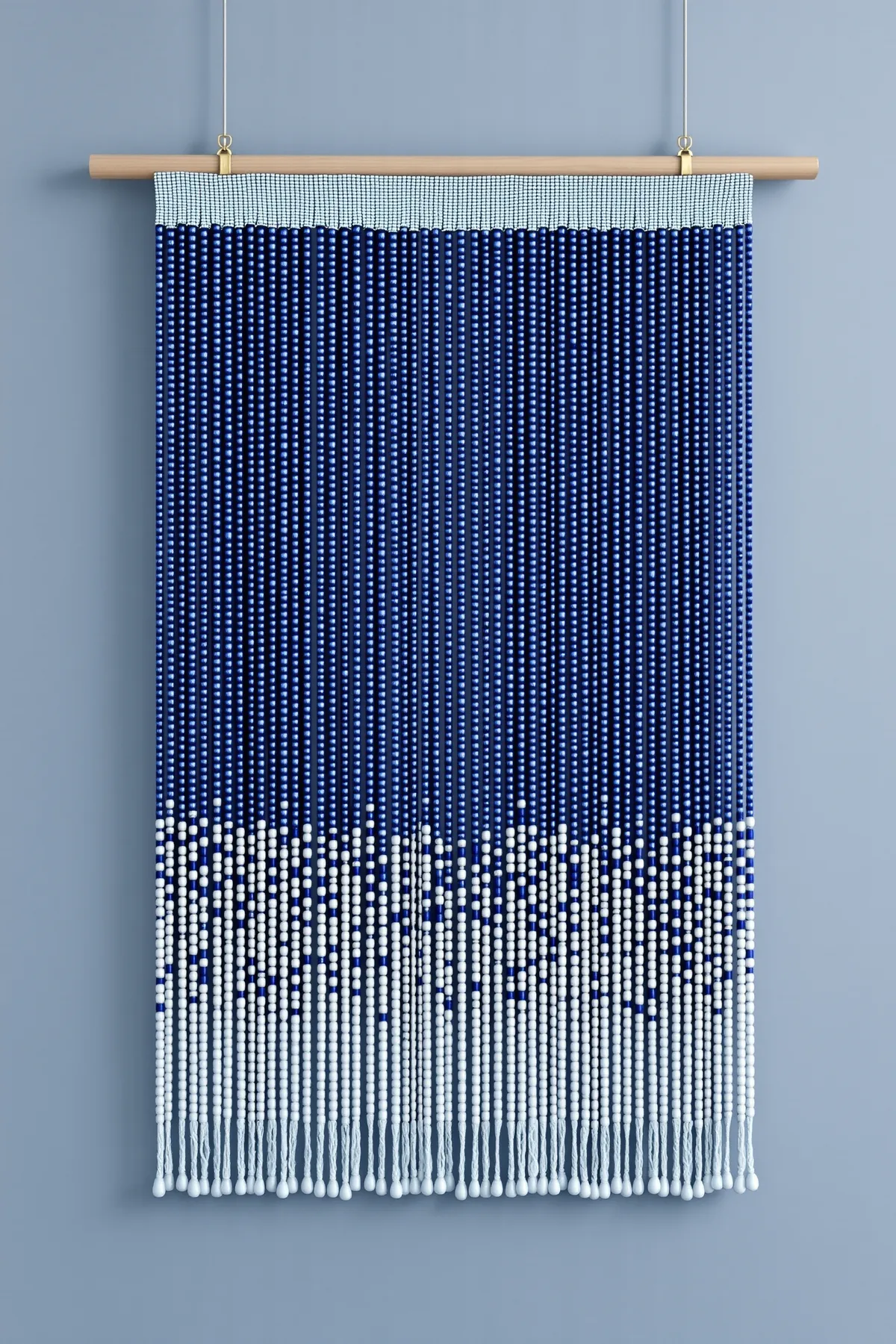
Design · Fallon Beaded Door
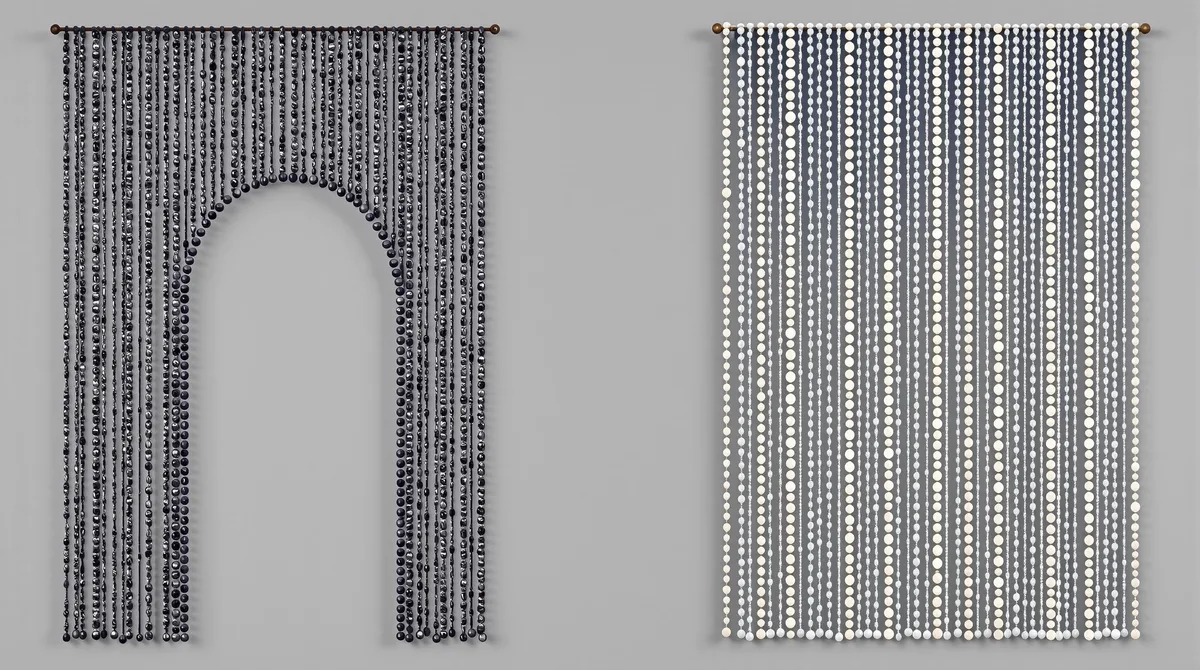
Five jewel tones and one arch. The arch is not woven or shaped — it exists only as a list of strand lengths on the count sheet.
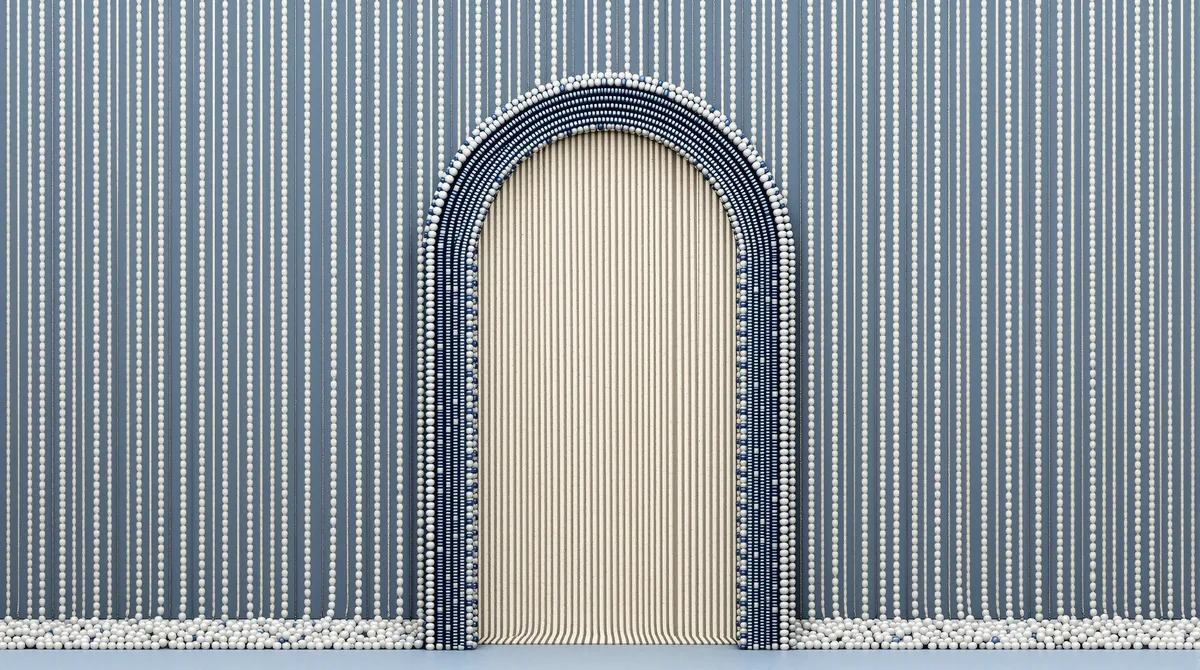
A beaded doorway portal seen flat on: close hand-strung strands graded from deep cobalt at the top down to chalk white at the hem, gathered on a plain wooden header rail.
Fallon is a 90 × 200 cm beaded door in mixed translucent jewel-tone beads — ruby, cobalt, emerald, amber and lilac — hand-strung on cord and gathered on a stained wooden header rail. Its defining feature is an arched-cut drop: the centre strands are made shorter on the count sheet so the middle of the panel opens into a walk-through.
Fallon is a beaded door at 90 × 200 cm in mixed translucent jewel-tone beads — ruby, cobalt, emerald, amber and lilac — hand-strung on cord and gathered on a stained wooden header rail.
It is a catalogued wholesale style, and it is the clearest example in the library of the one construction decision that separates a portal from a curtain: the arched-cut drop.
Each strand is a mixed sequence of the five jewel tones, written onto the colour-count sheet so that every strand on every piece carries the same beads in the same order.
The arch is layered on top of that as a second list: a strand length for every strand position, shortest at the centre, longest at the two edges. Those two lists together are the whole design. There is no third document.
The arch turns one figure into two. A single height does not describe this panel: the longest and shortest drop are both specification items, and the carton sizes follow the longest strand rather than the nominal drop. The header rail carries an uneven load, with more weight at its ends than at its centre, so the fixings go near the ends.
| Specification | Value |
|---|---|
| Finished size | 90 × 200 cm |
| Format | Beaded door with an arched-cut drop |
| Bead material | Mixed translucent beads, jewel tones |
| Palette | Ruby, cobalt, emerald, amber, lilac |
| Hem shape | Arched cut — centre strands shortened |
| Header | Stained wooden header rail |
| Strand build | Mixed sequence written on the colour-count sheet |
| Catalogue status | A catalogued wholesale style |
| Production | 40 to 60 days after sample approval |
None of the named 2027 stories. Fallon's colourway is described as a multi jewel and belongs to the production catalogue rather than to the design-render library.
As a palette it is the saturated counterpart to the translucent multi on our lead portal: the same translucency, pushed from a bright primary mix into a deeper jewel register.
Translucency does, more than any individual colour. A jewel tone only reads as a jewel when light passes through it; the same palette in opaque beads is simply five strong colours and reads as a toy rather than as a gem.
Which means the lighting position matters at specification stage. Fallon in a backlit doorway is the design as intended; Fallon on an internal wall with no light behind it loses most of its character.
Cut on the count sheet, strand by strand, which is why an arch costs nothing extra in material and something real in sheet-writing. The profile exists only as a column of lengths.
Three practical consequences follow and all three belong in a quote. The bead count falls, because the shortest strands carry fewer beads. The carton height is set by the longest strand, not the average. And the piece settles unevenly after hanging, because strands of different lengths have different weights pulling on them, so the sample should be hung for a few days before approval.
A stained wooden header rail. The load is asymmetric, which is the detail an installer needs. Two long strands at each edge and short ones in the middle means more weight at the ends of the rail than at its centre, so the fixings go near the ends.
Both. Recolouring is cheap because the palette is independent of the geometry. Resizing means redrawing the arch rather than scaling it, for the reason above: the arch is lengths, not a curve, and a curve scaled by proportion will look shallow at a larger width.
Retailers and own-label brands, and interior specifiers working on spaces where the opening has to stay usable — salons, spas, small restaurant interiors, treatment rooms. The arch is the feature that makes a beaded screen practical in a working doorway rather than decorative beside it.
Event and display companies use the same geometry as a photo entrance.
That an arch is a specification problem, not a craft one. The temptation is to draw an outline and let the bench interpolate; the result is that every piece has a slightly different arch and the set does not match on a shop floor.
Written as a list of strand lengths, the arch is exact, repeatable, and quotable. It also becomes adjustable — raising the arch by 10 cm is a change to 30 numbers, not a redesign.
Carton height follows the longest strand rather than the nominal drop, which is a small thing that catches people out on arched designs.
Good to know
Yes. A sketch, photo or artwork with size, materials, colours and quantity becomes a colour-count sheet, and an arch is quoted from the strand-length map rather than from the outline. A rough cost sheet is produced before any sample is made.
Yes. The design is an arch geometry with a palette on top, and the palette is the cheapest thing in it to change. Beads are matched to a physical chip or a colour reference and confirmed on the sample.
Yes, with the arch redrawn rather than scaled. An arch that reads correctly at 90 cm wide looks shallow at 120 cm unless the centre strands are shortened further, because the arch is a set of lengths and not a curve.
Mixed translucent beads in five jewel tones on cord. Translucency is the operative property — a jewel tone only reads as a jewel when light passes through it, so an opaque version of this palette is a different design.
Exclusivity is a commercial decision taken per programme rather than a property of the design. Name it in the brief and it is quoted alongside the piece.
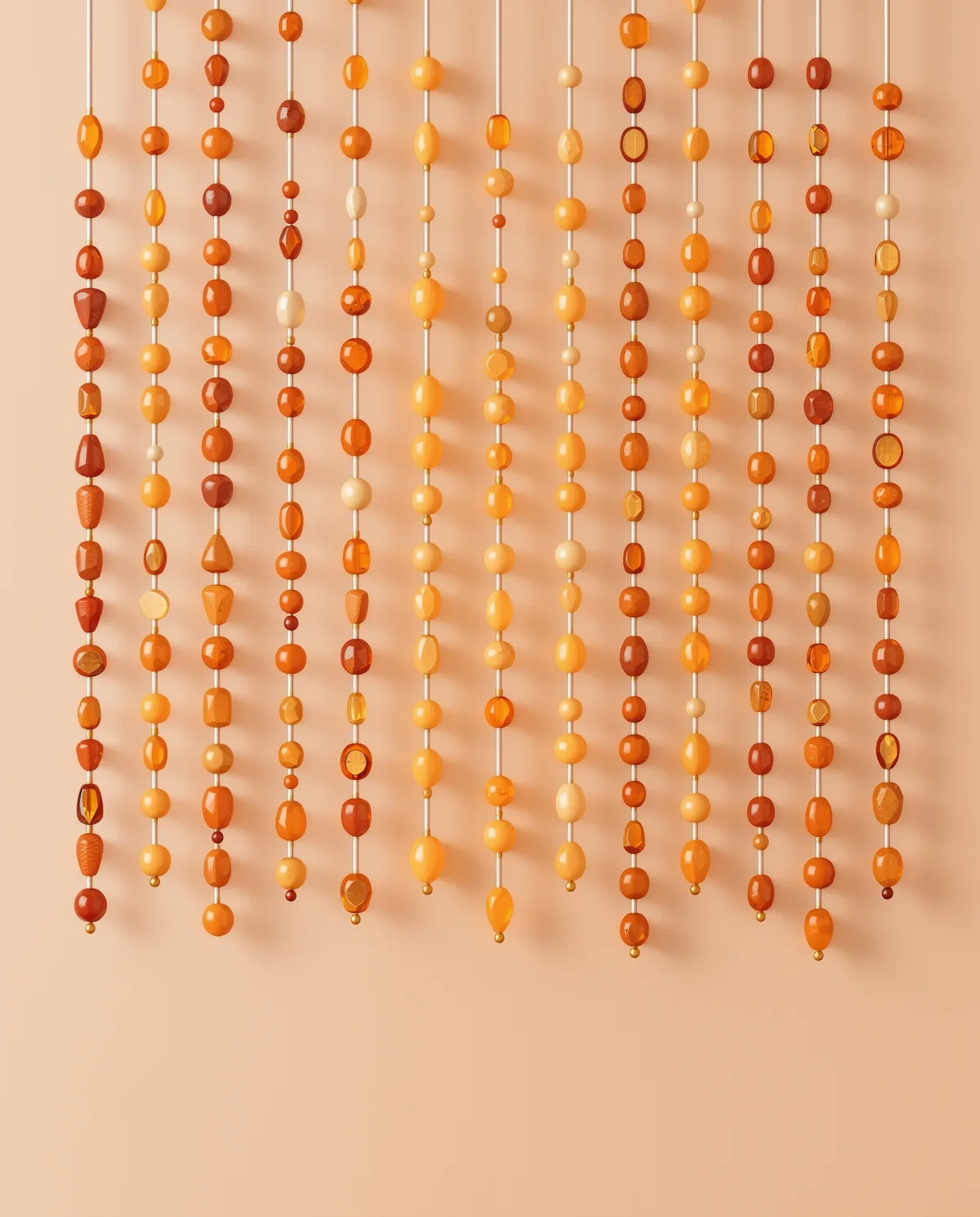
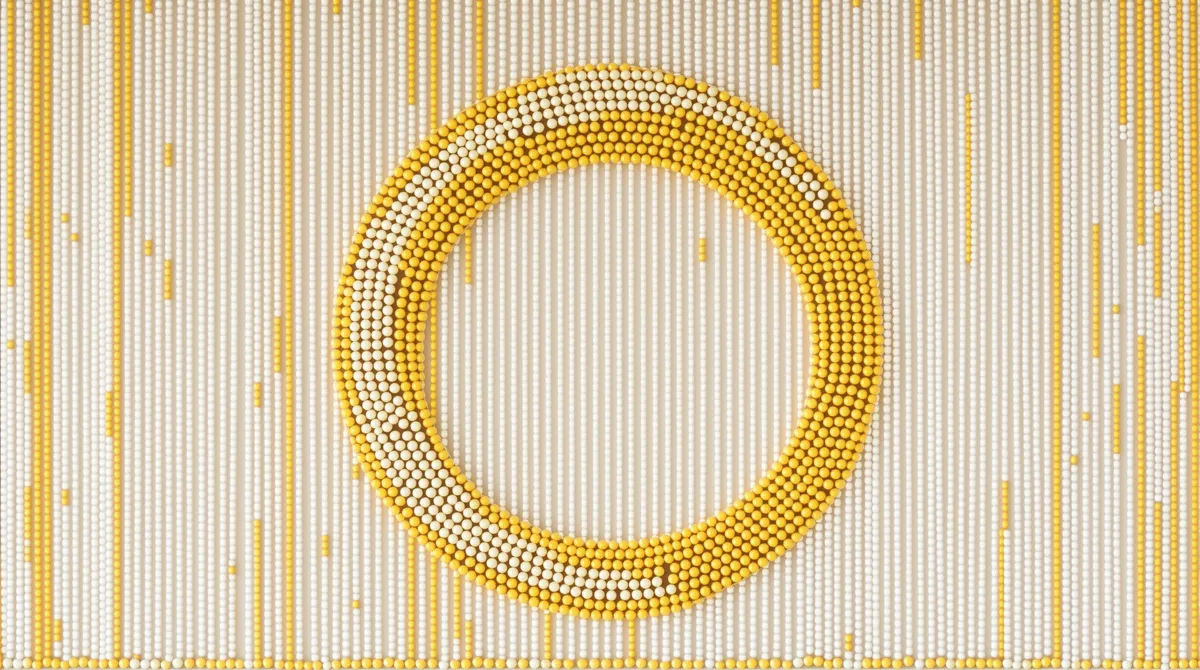
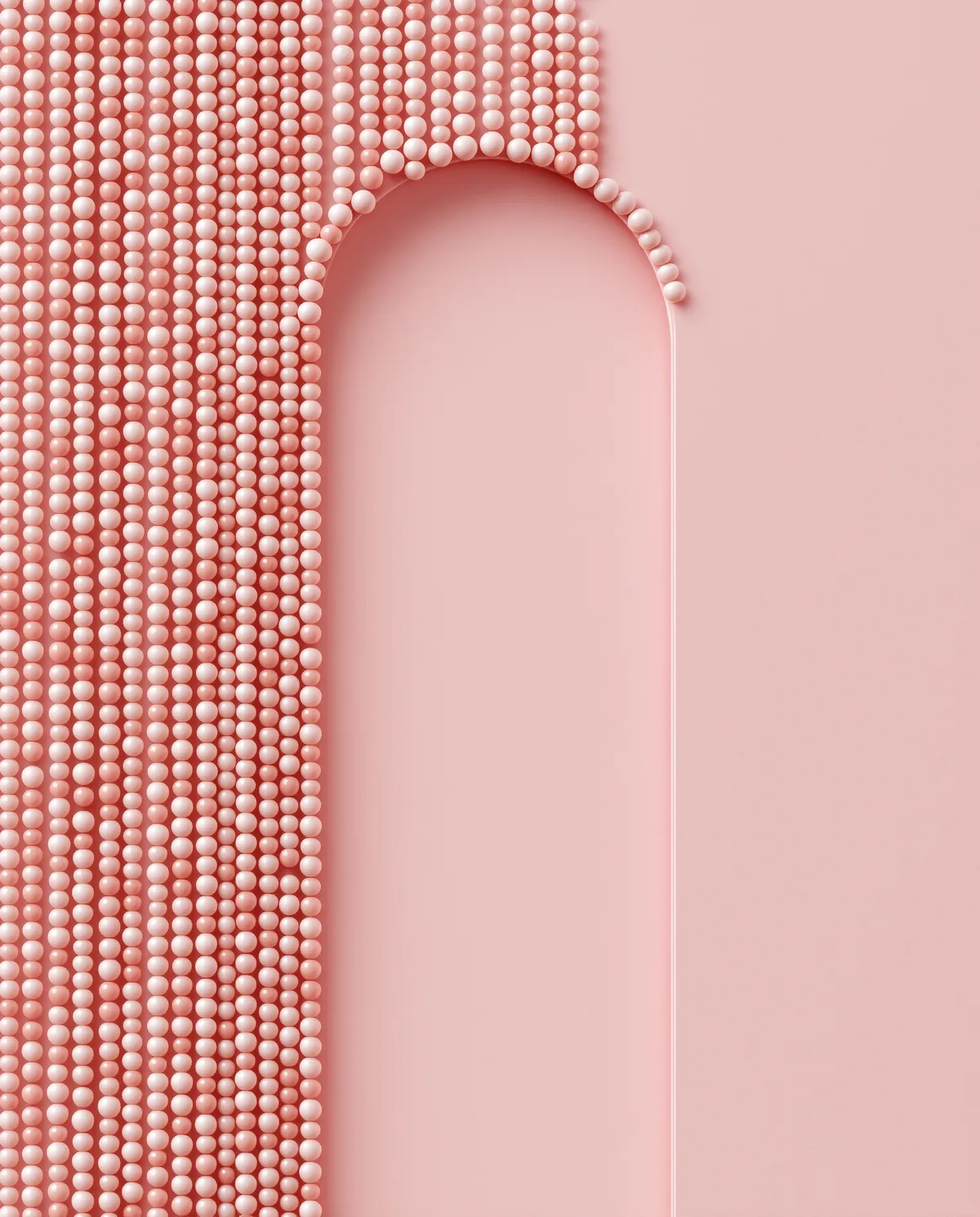
The imagery on this page is editorial. It shows the arched-opening construction and how light passes through a translucent strand, not the specific piece a buyer receives, and it is not captioned as if it were.
Keep exploring
Design
Portals at 76 × 140 cm and hanging divisions at 90 × 180 and 120 × 180 cm, documented by strand count and opening shape.
Open the referenceManufacturing
Strands that frame an opening and leave a clear walk-through: arched and inverted-V drops, built to order on a turned dowel or a stained rail.
Open the referenceDesign
Wood, bone and amber glass on one strand at 90 × 180 and 120 × 180 cm — a design available to develop, not a current line.
Read the guideDesign
A legible motif carried across a 76 × 140 cm portal, where bead diameter against strand pitch decides whether the image reads.
Specs and sizesDesign
A scattered accent field on an arched portal, where the arch profile and the scatter map are drawn as one document.
Specs and sizesDesign
Thirty hand-strung strands of translucent acrylic at 90 × 200 cm on a stained header rail, recoloured season after season on one construction.
How it is made
Start a conversation
Send a reference, a colour chip or a sketch. Minimums are set per design and confirmed per quote; sampling is quoted separately and usually runs 16 to 20 days from an agreed brief.