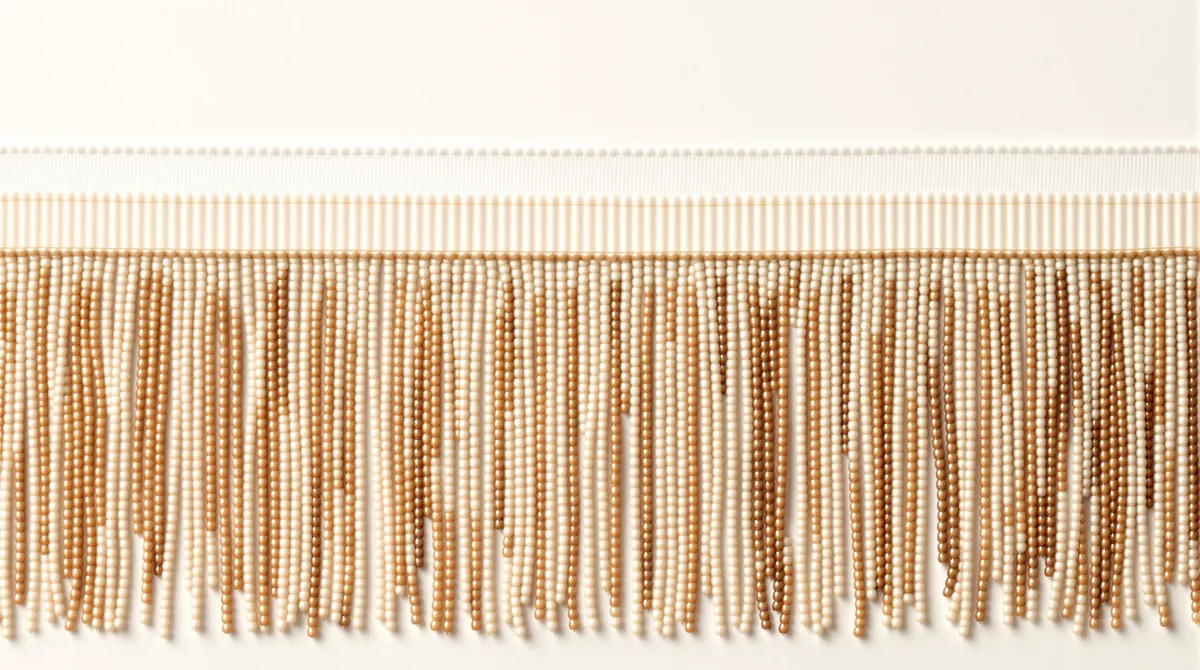
Manufacturing
Beaded trim
The header tape, the drop, the repeat length and the tolerances — how beaded fringe is built and quoted when it is a component in somebody else's product.
See the detailManufacturing · By the metre
Every other beaded format is quoted as a finished piece. Trim is quoted as a running length, and that single change moves the minimum, the tolerance, the packing and what inspection is even looking at.
Beaded trim is quoted by length because the unit a buyer consumes is a running metre, not a piece. The price is built from bead count per metre and the stringing hours behind it, and the repeat length is the governing dimension. Minimums, cut tolerance, roll packing and dye-lot continuity all behave differently from piece work.
Trim by the metre is the same construction as any other beaded fringe — a header carrying repeated bead drops, each drop strung on cord to a count sheet. What differs is the commercial unit. Every other beaded format we make is quoted as a finished piece with a width and a drop. Trim is quoted as a running length, because a running metre is what the buyer consumes.
That is not a pricing convention. It changes the specification, the tolerance, the packing and the inspection, and each of those is a separate paragraph below.
Because the receiving product sets the length and nobody knows it in advance. A lampshade maker needs the circumference of a ring. A cushion maker needs a perimeter minus a seam. A pelmet needs a board length. None of those is a piece we could define, and any piece we did define would be the wrong length for most of them.
So the quote is built per metre and the order is placed in metres. The cost per metre comes from the bead count in a metre and the stringing hours behind it, plus the header, plus the end bead.
Everything about the drop is changeable, but on metreage one field governs the rest: the repeat length. It sets how a cut lands, how much is wasted at each end of a run, and therefore what a metre actually costs.
Fixed: a drop lands on a bead boundary, so drop tolerance is one bead and never one millimetre. A cut lands on a repeat, so cut tolerance is one repeat. Cord is sized to the smallest drill hole in the build. And the repeat, once approved, governs production — it cannot drift on the floor without the count sheet being redrawn.
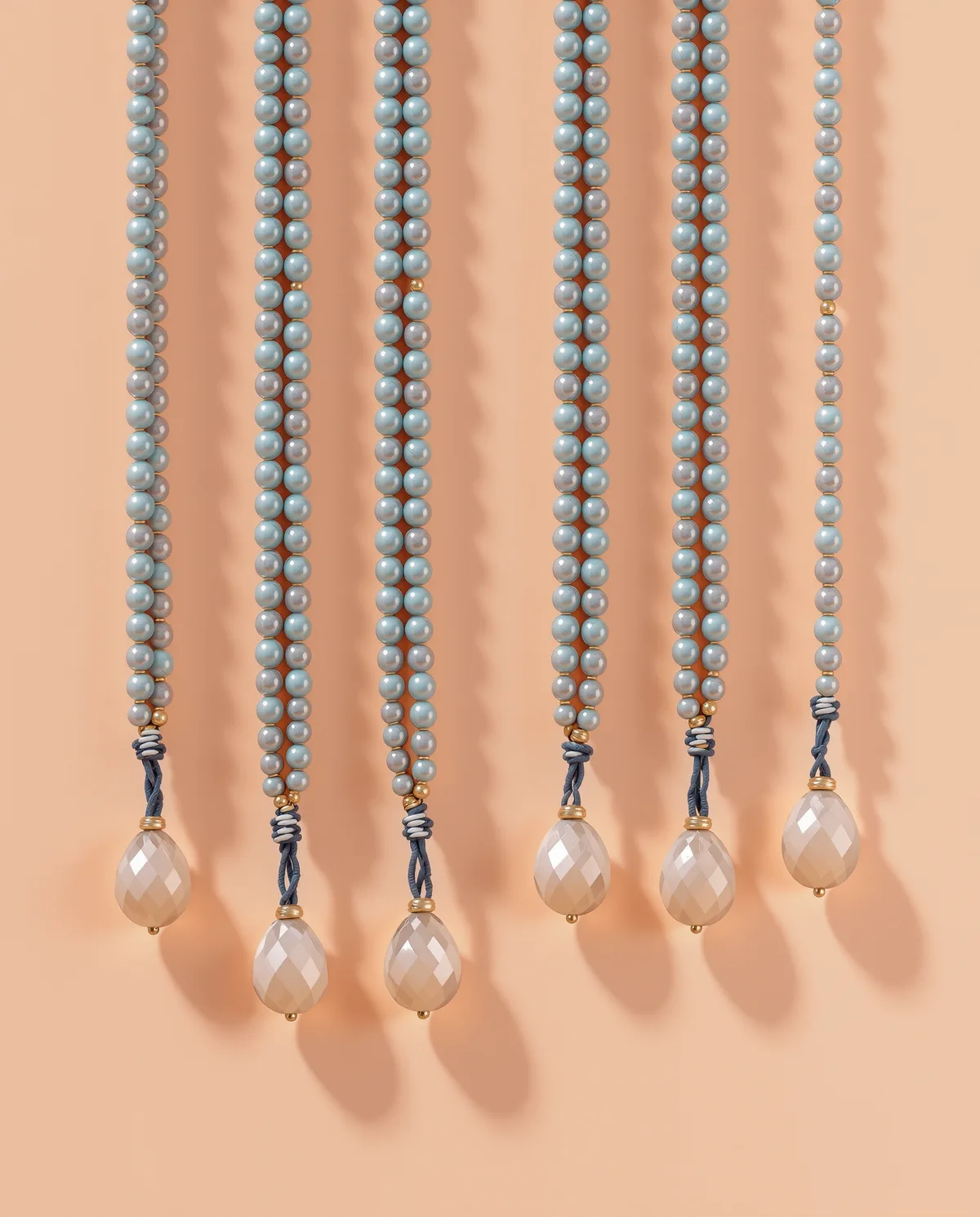
Because a trim is only as good as its repeat, and a repeat error compounds. A repeat that runs half a bead long looks perfect over one cycle and is visibly out after two metres. Worse, if the repeat does not divide cleanly into the length the receiving product consumes, every join in the finished product shows a broken pattern.
The right order of work is therefore backwards from the end product: establish the consumed length, choose a repeat that divides into it, then design the drop within that repeat. Designing the drop first and discovering the repeat afterwards is the standard way a trim programme fails.
The end product and the length it consumes per unit. The repeat length. The drop, as a bead count. The header type and width, and whether it will show. The bead material, shape and size for the body and the end bead. The colours, with references or physical chips. Total metres per colourway, and whether a single dye lot is required across them. Then winding and packing format, and the port or factory.
Glass seed and bugle beads build the body of a drop; faceted glass gives the crystal-look end bead, and we call it glass rather than crystal because that is what it is. Pressed glass gives a repeatable motif bead, which on a trim is often the thing that defines the repeat. Acrylic is the answer where the end product has a weight limit or where the widest dyed colour range matters. Cast faux capiz — cast resin or dyed cut acrylic — gives a pearlised shell-look drop with no shell in it.
| Specification | Value |
|---|---|
| Quoting unit | A running metre |
| Primary price driver | Bead count per metre |
| Secondary price drivers | Bead size and material, header type, end bead |
| Governing dimension | Repeat length |
| Practical cut tolerance | One repeat |
| Drop tolerance | One bead |
| Sample length needed to judge a repeat | At least three full repeats |
| Packing | Wound on a core or in hanks, drops protected |
| Dye-lot continuity | Specified per order where one length spans rolls |
| Minimums | Set per design and confirmed per quote |
| Sampling | 16–20 days from an agreed brief, quoted separately |
| Production | 40–60 days after sample approval |
Nothing in that table is a price and nothing is a stock item. It is a model: the values that have to be settled, and the tolerances that are real in hand-strung work. A metre-quoted line gives a buyer flexibility on quantity and gives up the certainty of a catalogue number, and that trade is worth making explicit before a brief starts.
Beads are matched to a colour reference or a physical chip and confirmed on the sample. The header is matched separately where it will show in the finished product.
The question a metre-quoted order raises that piece work does not is dye-lot continuity. Surface-dyed glass shifts between lots, which is a batch property rather than a fault. Across one cushion it is invisible; across forty metres of trim running round a single room it is not. If a single lot is required, it has to be asked for at the brief, because it constrains how the run is scheduled.
A brief that starts with the end product and the consumed length. A rough cost sheet before anything is made, quoted per metre. Then a sample length long enough to show at least three full repeats, which is the shortest piece on which a repeat can be judged. Usually 16 to 20 days from an agreed brief, photographed for approval before it ships.
Production runs against that approved sample length, and the sample is kept as the reference the run is measured against.
Wound on a core, or made into hanks, so the drops cannot tangle, with the header protected and cut ends secured. Each unit is labelled with its measured length, because on a component sold by length the length is the specification and an unlabelled roll is unusable in a receiving factory.
Tangling is the real failure mode. A finished piece has its strands fixed at the top and spaced across a dowel; a wound trim has its drops lying against each other for the whole length of the roll, and a fringe that arrives matted costs the receiving plant more in untangling than the trim cost in the first place.
Measured length first, recorded per unit. Then repeat accuracy across several repeats rather than one. Then drop length against the count sheet in bead counts, knots and crimps closed, header stitch even and edge straight, and colour against the approved sample with dye-lot continuity checked where it was specified. First-article and lot inspection run through our own quality and packing house.
Bead count per metre, which is beads per drop multiplied by drops per metre, and it dominates everything else. Bead size and material next. Then the header type: a woven tape is a textile component, where a beaded top band is beadwork and prices like beadwork. Then the end bead.
The most effective change on a trim above target is to open the drop spacing slightly. It takes beads out of every single metre and, once the trim is sewn into a product, almost nobody sees it.
Lighting manufacturers and lamp-parts distributors buying fringe for shade hems. Furniture and soft-furnishing makers edging cushions, pelmets, ottomans and blinds. Apparel and accessory makers working on hems, cuffs and bag edges. Event and display companies, who genuinely buy length rather than pieces. And contract manufacturers, for whom this is one line on a bill of materials and the repeat has to match a drawing somebody else approved.
Good to know
Beaded décor runs 40 to 60 days after sample approval, and trim follows that. Sampling usually takes 16 to 20 days from an agreed brief and is quoted separately. A metre-quoted line does not run faster than piece work: the hours are the same hours, counted differently.
By length rather than by piece. Trim is wound on a core or made into hanks so the drops cannot tangle, with the header protected and cut ends secured, and each unit is labelled with its measured length. Where trim goes to retail on a card, the card and its length are part of the specification.
Glass beads are drawn and hand-strung in our own Firozabad glass works. Acrylic beads are moulded and dyed to our colour, to our own dies where a design needs a custom bead. Stringing is done in our own beadwork studios, and inspection and export packing run through our own Greater Noida house.
No, and on a metre-quoted line a fixed figure would be particularly misleading. Minimums are set per design and confirmed per quote. A dense faceted-glass fringe and an open acrylic fringe at the same drop differ several times over in bead count per metre, so the sensible minimum differs too.
Not by the metre off a card. Trim is developed to a brief and quoted per design: slower to start than buying stock, and it gives you a repeat that fits your product instead of ours.
Yes. Beads are matched to a colour reference or a physical chip and confirmed on the sample, and the header is matched separately if it will show in the finished product. On a long run, say whether a single dye lot is required across the whole length — it is answerable, but it has to be asked at the brief.
The drop can be changed freely; the repeat cannot be changed casually. A new repeat re-plots where every motif lands, and if the repeat does not divide into the length the receiving product consumes, the joins become visible. Settle the repeat against the end product's dimensions before anything else.
Keep exploring
Manufacturing
The header tape, the drop, the repeat length and the tolerances — how beaded fringe is built and quoted when it is a component in somebody else's product.
See the detailPillar
Brief, rough cost sheet, colour match, sample, production, packing — the six stages with the real published timings.
See the detailHub
The full beaded range — curtains, portals, valances, tabletop, cushions, textiles and beads — from a leading manufacturer that makes the bead as well as the piece.
Open the referencePillar
Door curtains, portals, café lengths and valances: the standard sizes, the strand counts and the one question each format answers.
Read the guideSpecification
Diameters, drill holes, cord selection, strand counts and format dimensions — the sheet to copy into a tech pack.
How it is made
Start a conversation
Send a reference, a colour chip or a sketch. Minimums are set per design and confirmed per quote; sampling is quoted separately and usually runs 16 to 20 days from an agreed brief.