Design
Colour stories, by construction
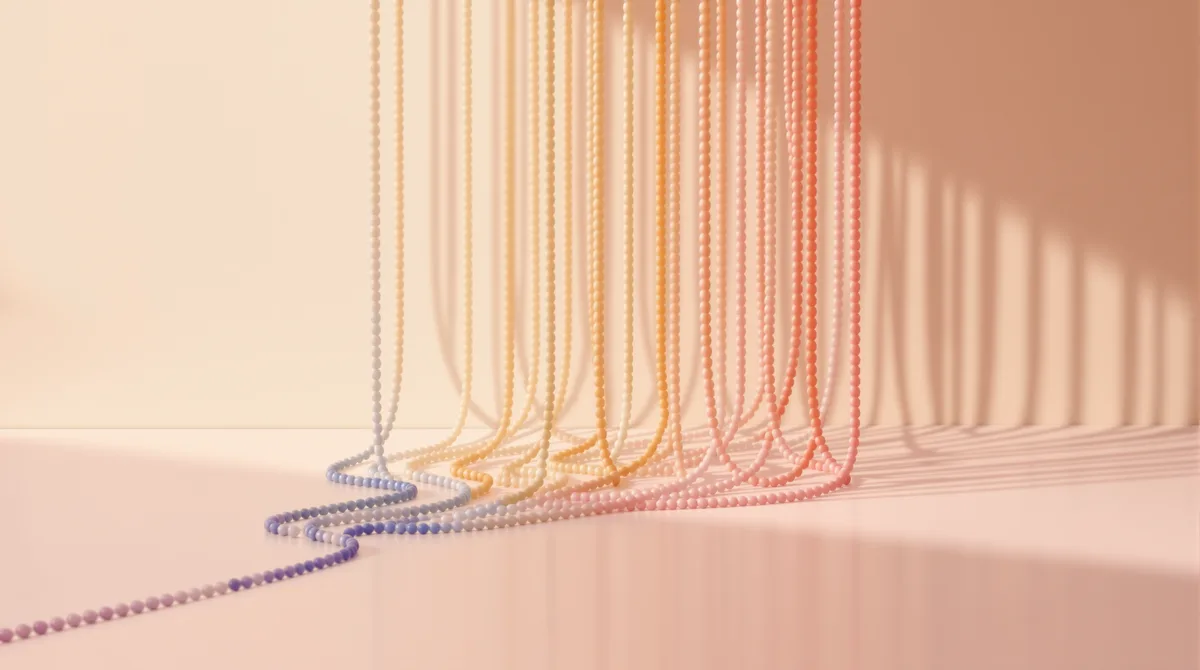
Colour stories documented by how they are built, not by how they look in a mood board.
See the detailDesign library · Index
A portal frames an opening and leaves the middle clear. A division screens. The two are strung the same way and designed almost oppositely.
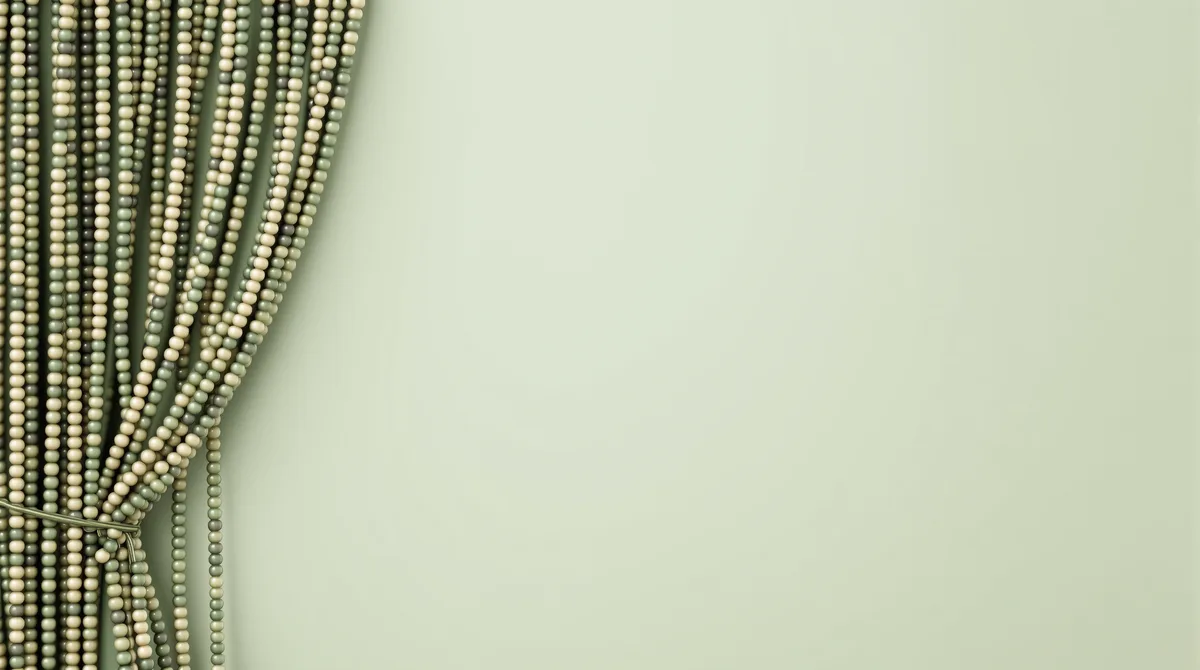
The portal designs are built at 76 × 140 cm on 27 to 40 hand-strung strands, with the centre strands shortened into an arched opening so the piece frames a walk-through rather than closing it. Hanging divisions are drawn at 90 × 180 and 120 × 180 cm and are available to develop; the division we build today is panels hung side by side.
Design by design
Each page gives the opening shape, the strand count, the header type and the bead list, and says whether it is a shipped design or one available to develop.
Design
Mixed translucent jewel-tone beads at 90 × 200 cm, cut to an arched centre opening on a stained header rail.
Design
A fabric-mounted portal at 24 × 30 in on a 10 oz canvas pattern with a three-inch rod pocket, built with a custom moulded flower bead.
Design
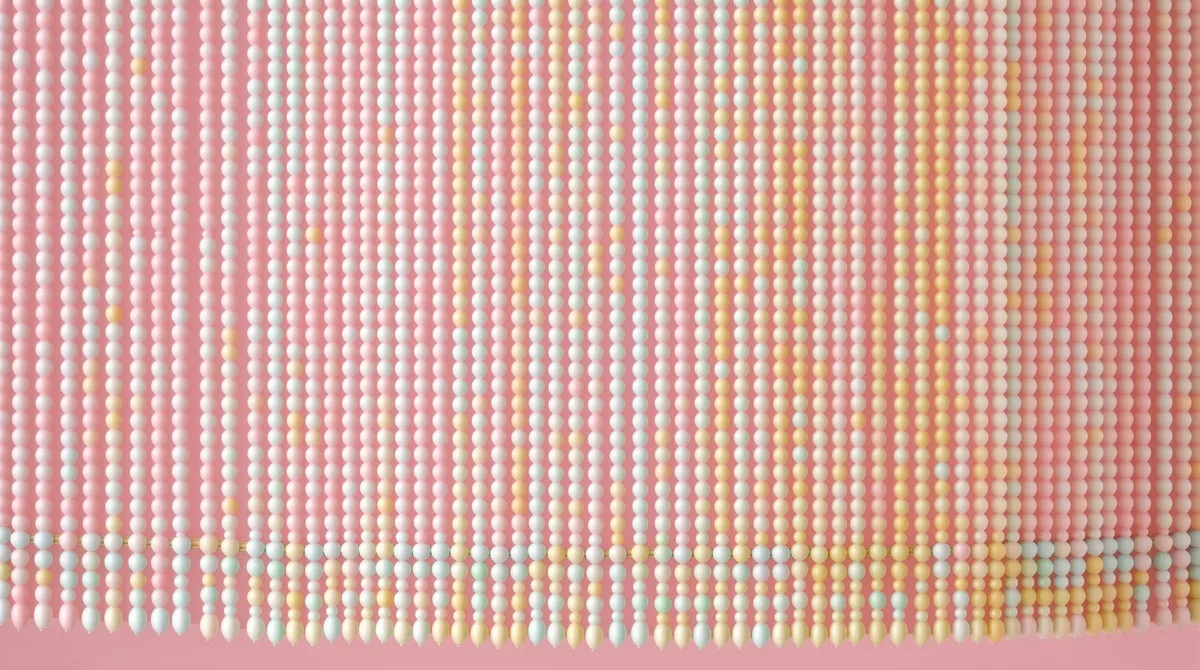
A legible motif carried across a 76 × 140 cm portal, where bead diameter against strand pitch decides whether the image reads.
Design
A scattered accent field on an arched portal, where the arch profile and the scatter map are drawn as one document.
Design
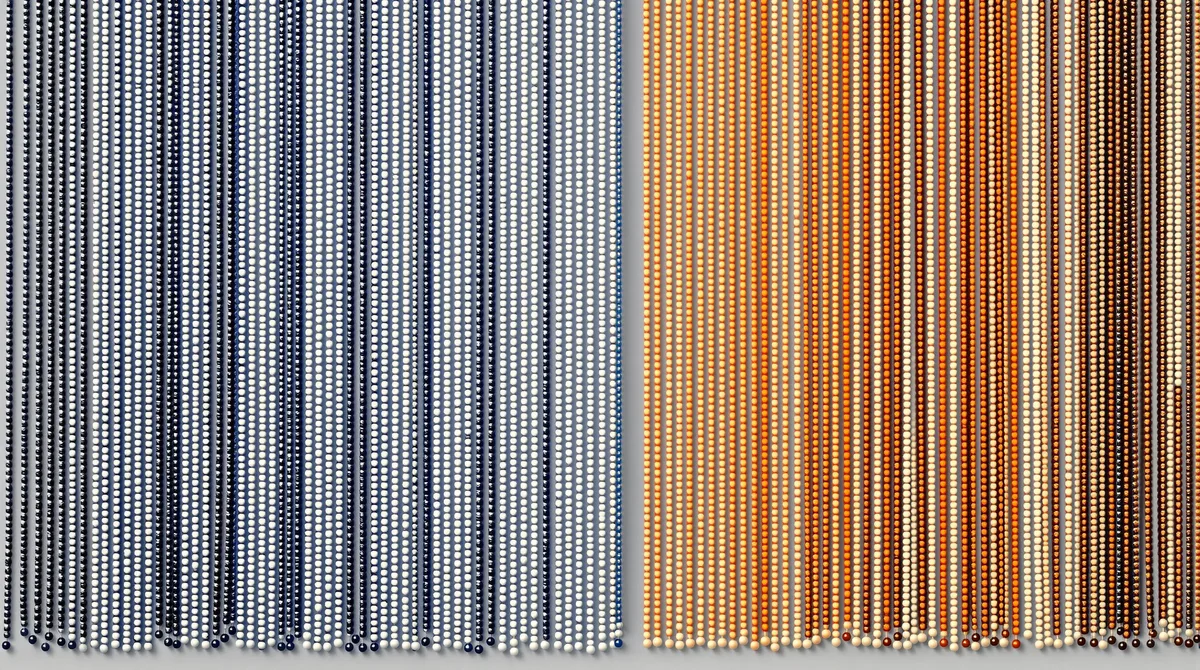
Wood, bone and amber glass on one strand at 90 × 180 and 120 × 180 cm — a design available to develop, not a current line.
Work in which the shape of the opening is the design: portals, and a hanging division, each documented by strand count, strand-length map, header type and bead list.
A portal is the format most often mis-specified, because a buyer describes it as a curtain and gets quoted as a curtain. The difference is a strand-length map: the centre strands are cut short so the piece reads as a frame with a clear middle, and the longest strands sit at the sides. That changes the bead count, the carton height and the way the piece settles after hanging.
By opening geometry first. The arched-cut drop — an arched centre opening that frames a walk-through — is the defining construction in this group, and most of the work in this group uses some version of it.
The division at the end of the index is the inverse. Its strands run full length across 90 or 120 cm, so it screens rather than frames, and the longest drop is the only drop. Everything else in the build is the same: cord, hand-stringing, a turned wooden dowel or header rail.
With Fallon. It is a catalogued arched door at 90 × 200 cm in mixed translucent jewel-tone beads — ruby, cobalt, emerald, amber, lilac — on a stained wooden header rail, and the arch is cut rather than woven, which is the whole point. Nothing is shaped by the beads; the shape is in the strand lengths on the colour-count sheet.
By the numbers that build it. The faux-capiz division is drawn at true size and available to develop, and its page carries the strand count, the disc weight and the fixing load — which is what a buyer specifying a division actually needs on a drawing.
The division we build today is panels, portals or wall hangings hung side by side across an opening: cord sized to the smallest drill hole in the build, strands mapped from a colour-count sheet, hung from a dowel turned in our own wood factory. A single engineered division starts from the drawing and a sample.
Fallon is a catalogued style. The Sixties portal was sampled at 24 × 30 in on a ten-ounce canvas mounting pattern with a three-inch rod pocket, and went through several design iterations before the construction settled — two bead sizes instead of one being the change that made it work.
Have a Nice Day, Confetti Arch and the Ember and Honey division are drawn designs, available to develop at the sizes shown.
The Sixties portal, because it is the only page in this group that documents a fabric-mounted header rather than a dowel, and the rod-pocket mount is what a window-panel programme asks for. It also records the version of cost engineering: the iterations happened because the first construction was too expensive, and the fix was a second bead size, not a cheaper bead.
Each page carries a specification table with the finished size, the strand count, the opening geometry and the header. Behind them, hand-strung strands covers how an arched-cut drop is mapped and assembled, and bead sizes and stringing specifications gives the sheet the numbers belong on.
Because at portal scale the arch geometry is the entire design. The Wiggle portal and the 90 × 67 cm dual format that hangs either as a wall piece or as a short door portal are both mapped strand by strand before anything is strung, and the map is what makes the arch repeat identically across a production run. The same sheet sets the bead count and the carton height, so it is the document a quote is built from.
Good to know
By what the piece does to an opening. A portal leaves a clear walk-through in the middle, so its centre strands are deliberately short. A division screens, so its strands run full length across the whole width. The stringing is identical; the strand-length map is not.
Plants we own. Glass is drawn and hand-strung in our own Firozabad glass works, acrylic and faux-capiz discs are moulded, cast and dyed to our own dies, and the stained wooden header rails are turned and finished in Saharanpur. We make the panel and the rail it hangs from; tracks, brackets and ceiling fixings are specified by the installer.
The Fallon arched door, because the arched-cut drop is the one construction decision that separates a portal from a curtain, and Fallon is the cleanest example of it: mixed translucent jewel-tone beads, a stained wooden header rail and an arched centre opening.
Fallon is a catalogued style and the Sixties portal was sampled with a canvas rod-pocket mount, so those carry production detail. Have a Nice Day, Confetti Arch and the Ember and Honey division are drawn at true size and available to develop, with every figure confirmed on the approved sample.
The strand-length map. A portal's centre strands are cut short so the piece frames a clear walk-through, with the longest strands at the sides, and that single sheet changes the bead count, the carton height and the way the piece settles after hanging. Quoting a portal as a curtain is the most common mis-specification in the category.
Keep exploring
Design
Colour stories documented by how they are built, not by how they look in a mood board.
See the detailPillar
Door curtains, portals, café lengths and valances: the standard sizes, the strand counts and the one question each format answers.
How it is madeDesign
Linked faux-capiz disc hangings at 70 × 130 to 90 × 200 cm, and beaded shade designs from a 15 cm sconce to a 50 cm pendant.
View the rangeDesign
The full-length doorway designs, 90 × 200 to 120 × 210 cm, documented by strand count, hem shape and bead count.
Compare the optionsDesign
Valances at 120 × 30 to 40 cm and café curtains at 76 × 76 cm, documented by hem shape, strand count and bead count.
Open the referenceTechnique
The bead map, the cord, thirty strands on a dowel, hem shapes, suspension loops — and the three levers that move the cost.
See the detail
Start a conversation
Send a reference, a colour chip or a sketch. Minimums are set per design and confirmed per quote; sampling is quoted separately and usually runs 16 to 20 days from an agreed brief.