Reference
The five craft families
Five craft families — strung, embroidered, wire-wrapped, knotted and wrapped fibre — and what each one is good for.
How it is made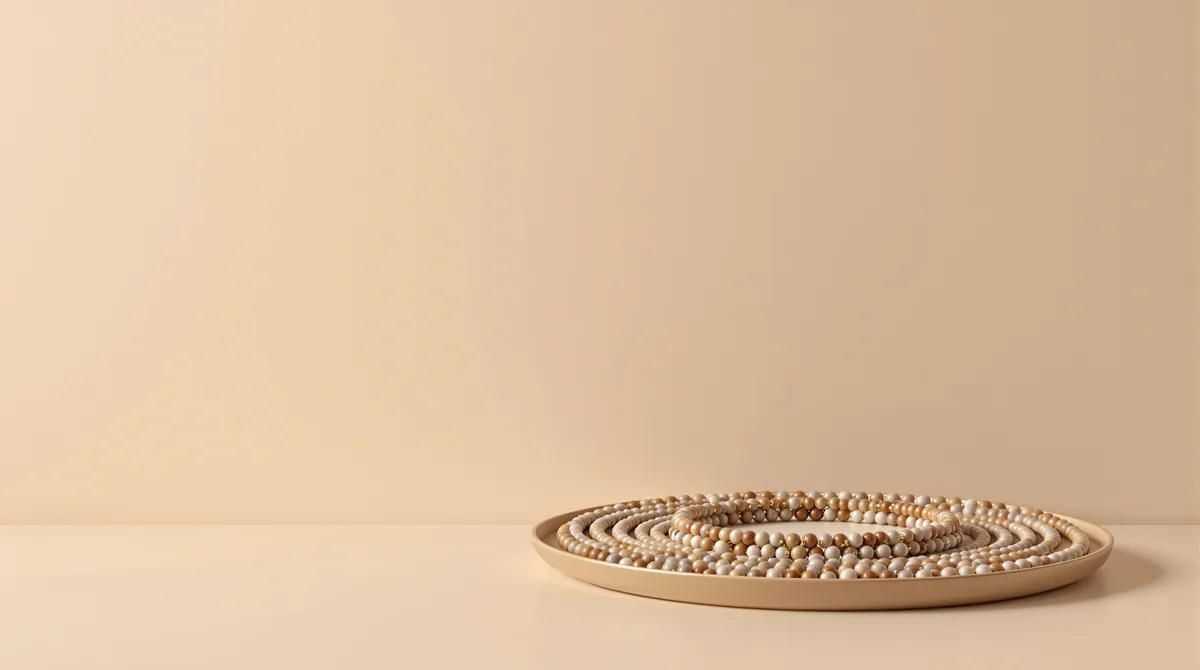
Manufacturing · Tabletop
A napkin ring has to hold a circle while something is pushed through it. No stitch does that. The shape comes from a brass armature, and the beads are wrapped over it — which is why this is wire work, not embroidery.
A coiled beaded mat lying flat, strands of wood and glass beads wound in close concentric rounds.
A beaded napkin ring is built by wrapping beaded wire over a shaped brass armature. The armature holds the circle; the beads are the surface. Catalogued rings run 6 to 9 cm, with a flat-back wrap so the ring sits still on a cloth. Metal components are finished and plated in our own plants, in eight standard finishes.
A beaded napkin ring belongs to the wire-wrapped beadwork family, and the reason is structural. The ring has to hold an open circle while a folded napkin is pushed through it, which no stitch into a fabric ground can do. So the shape comes from a shaped brass wire armature, and glass seed and bugle beads are threaded on fine brass wire and wrapped turn against turn over that armature.
This craft family runs wire-wrapped rings documented at 6 to 9 cm, charms at 7 to 10 cm, and figural birds and animals at 12 to 18 cm.
Because the object has no ground. Everything else on a table — a coaster, a placemat, a runner — is a flat panel with a cloth or felt behind it, and the beads are couched onto that panel in the bead and thread embroidery tradition. A napkin ring has nothing behind it. The armature is both the structure and the backing.
That single difference changes the bench, the materials and the day rate. It also changes what the object can depict: wrapped work produces shape and texture rather than image, because the bead sequence follows a wire path instead of filling a field.
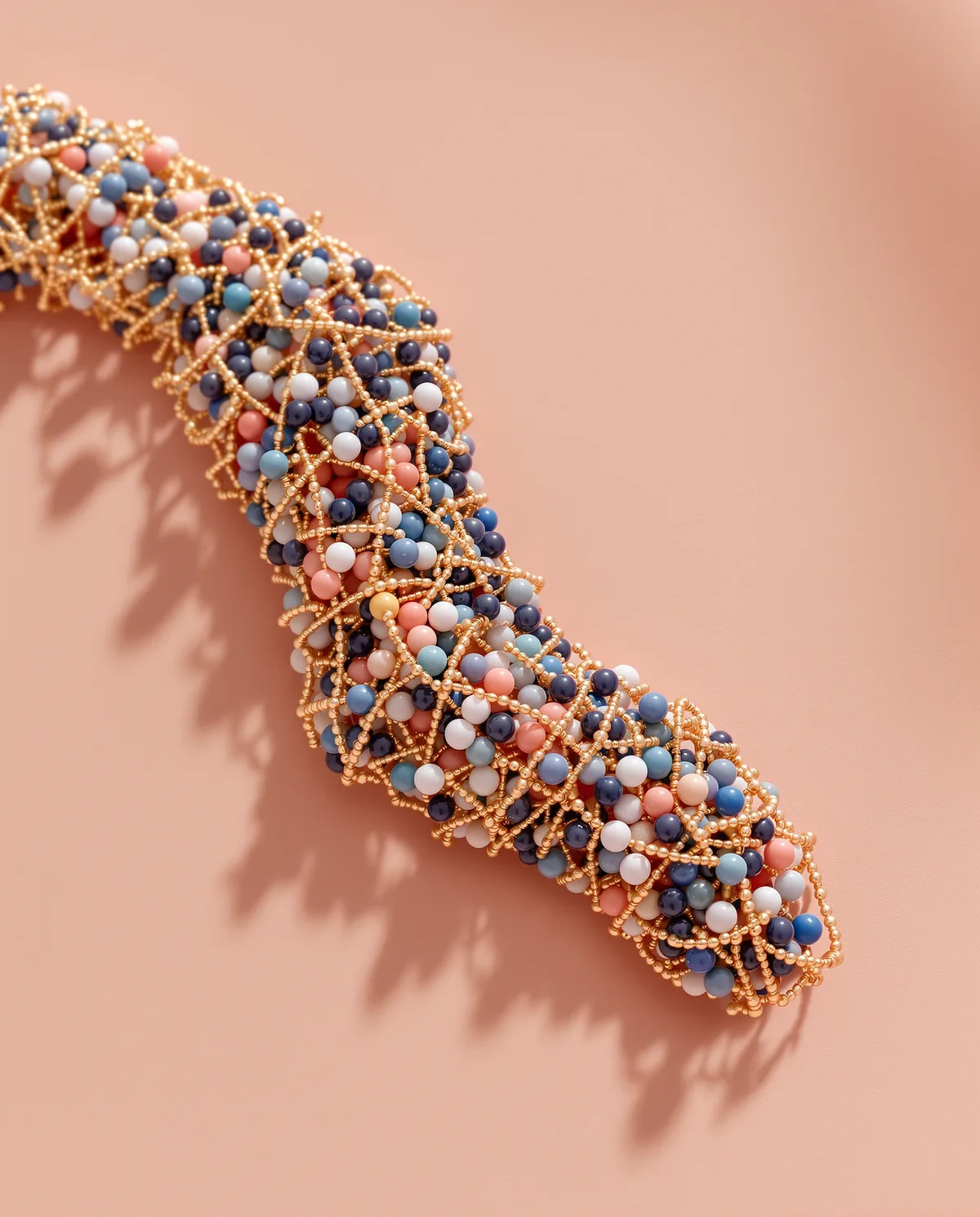
A ring wrapped evenly all the way round is a cylinder, and a cylinder rolls. On a laid table that means the motif ends up facing the tablecloth half the time.
The flat-back wrap solves it: the back of the ring is wrapped flat rather than domed, so the ring has a stable face and a resting side. It is a small construction decision and it is the difference between a ring that photographs well in the studio and a ring that still looks right on the eighth cover of a service.
Changeable: diameter, wire gauge, bead material and size, the bead sequence, the motif, the metal finish, and whether the piece is wrapped or hand-crocheted over a ring in cotton yarn.
Fixed: the armature is shaped before any bead goes on it, so a shape change is a new armature rather than an adjustment. The wire is anchored at the back, not at a visible edge. And the bead has to pass the wire — fine brass wire and a one-to-three millimetre seed bead are a matched pair, and a larger decorative bead needs its own hole checked against that wire before the design is signed off.
| Specification | Value |
|---|---|
| Catalogued size range | 6–9 cm |
| Construction | Beads on fine brass wire, wrapped over a shaped armature |
| Craft family | Wire-wrapped beadwork on a brass armature |
| Back treatment | Flat-back wrap |
| Bead material | Glass seed and bugle beads |
| Armature | Shaped brass wire |
| Metal finishes | Matte gold, matte black, rose gold, brilliant gold, champagne gold, antique silver, brilliant silver, matte silver |
| Alternative construction | Hand-crochet in cotton yarn, 4–8 ply |
| Colour matching | To a colour reference or a physical chip, confirmed on the sample |
| Sampling | 16–20 days from an agreed brief, quoted separately |
| Production | 40–60 days after sample approval |
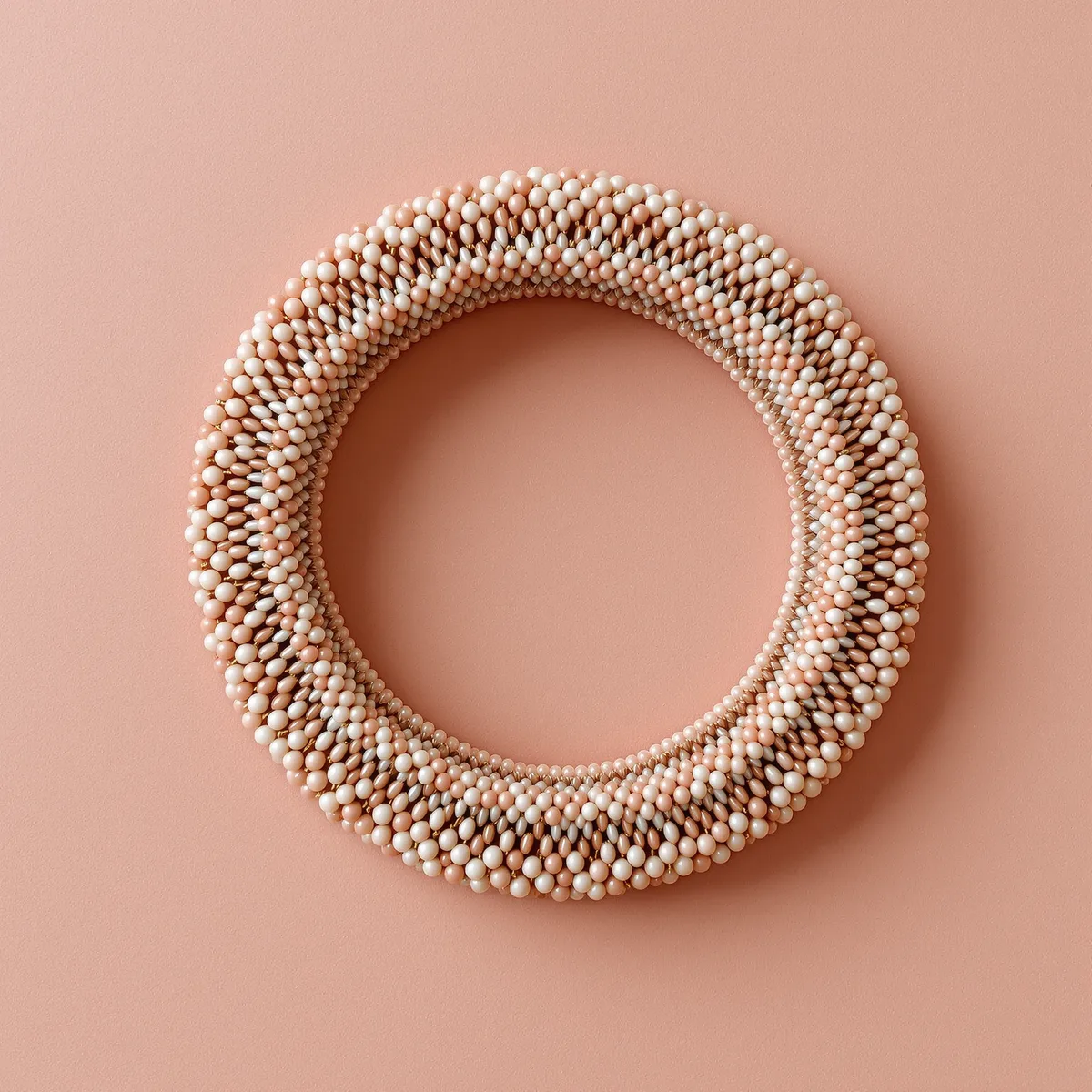
Six to nine centimetres is the catalogued range, and it is a range rather than a standard because the figure that matters is the inside opening, not the outside diameter. A heavily textured ring at nine centimetres outside can have a smaller usable opening than a plain one at seven. Specify the opening and the outside dimension follows.
Glass seed and bugle beads do the work, because they are the beads fine brass wire will carry. Larger pressed or moulded beads appear as single accents where the design has somewhere to seat them.
On the metal, all eight of our standard finishes are available because metal finishing and plating are in-house: matte gold, matte black, rose gold, brilliant gold, champagne gold, antique silver, brilliant silver and matte silver. Custom finishes use hand battering, large-grain sand casting, physical vapour deposition and gold plating. Where a range wants a softer object, the same ring is made in hand-crochet over a ring form in cotton yarn at four to eight ply.
The inside opening and the outside diameter. The motif. The bead material and bead size. The wire gauge, or the weight of object you want in the hand. The metal finish. The colours, with references or physical chips. The set size and the box. Then packing, quantity per colourway, and the port or warehouse.
The usual omission is the set size, and it matters more than it looks: a four-ring set and a six-ring set are different products with different boxes, different cartons and different minimums.
Beads are matched to a colour reference or a physical chip and confirmed on the sample. The metal finish is approved as a separate swatch, because a warm bead palette against antique silver is a different object from the same palette against brilliant gold, and the two cannot be judged from a drawing.
A brief with the opening, the motif, the bead palette and the finish. A rough cost sheet before anything is made. The armature is drawn and shaped first, then the bead sequence is drawn against it. Then the sample, usually 16 to 20 days from an agreed brief, photographed for approval before it ships. Production runs against the approved sample.
Where a design lands above target, the lever is wrap density rather than diameter — opening the turn spacing takes beads and minutes out together.
Wrap security first, with a pull test at both ends of the wrap where a napkin loads it. Then the opening measured, the ring checked for roll on a flat surface, the bead sequence against the drawing, the colour against the approved sample, and the plated finish for coverage and for bare spots at the wire anchor. A set is checked as a set, because four rings that each pass individually can still look mismatched in one box. First-article and lot inspection run through our own quality and packing house.
Wrap length first, which is circumference multiplied by turn density — that is the labour. Bead count second. The armature and its finish third, and on a small ring a specialty plated finish can be a larger share of the cost than the beadwork. The box fourth, which on a boxed set is never trivial.
Making the ring smaller saves least, because the armature forming, the anchoring and the finishing do not shrink with the diameter.
Home and lifestyle retailers buying under their own label, where boxed sets of four or six are the standard shelf unit. Tabletop and gifting programmes, which is where seasonal motifs belong. Interior and hospitality designers specifying for hotel and restaurant covers, where the flat-back wrap is a service requirement rather than a nicety. And corporate gifting, where a set of rings carries a high perceived value for a small object.
Good to know
Yes, on both halves. Beads are matched to a colour reference or a physical chip and confirmed on the sample. The metal is a separate decision from one of eight standard finishes, or a custom finish using hand battering, large-grain sand casting, physical vapour deposition or gold plating.
Yes. The armature is reshaped to the new diameter and the bead sequence is recalculated for the new circumference, so a motif keeps its proportion instead of stretching. Going smaller is the harder direction: below about six centimetres a wrapped motif has nowhere to sit, and the answer is a simpler motif rather than a shrunken one.
Beaded décor runs 40 to 60 days after sample approval. Sampling usually takes 16 to 20 days from an agreed brief and is quoted separately. A crochet version falls under bohemian work at 60 to 90 days.
Normally as a boxed set of four or six, which is how the category sells, with each ring held so the wrapped surface cannot rub against its neighbour. The box is part of the specification and is sampled with the rings. Cartons and labels follow your specification.
Glass seed and bugle beads are drawn and hand-strung in our own Firozabad glass works. The brass armature and any plated metal component are made, finished and plated in our own Moradabad metal plants. Wrapping is done in our own beadwork studios, and inspection and export packing run through our own Greater Noida house.
No. Minimums are set per design and confirmed per quote, because bead count and wrap length change entirely with the motif. A plain wrapped collar and a figural ring at the same diameter are not the same job.
Not if the wire gauge and the turn spacing are right, and both are specification decisions. The failure mode to design against is a wrap that is too loose at the ends, where a napkin is pushed in and out. The wire is anchored at the back of the ring rather than at a visible edge, so the stress point is also the hidden point.
Keep exploring
Reference
Five craft families — strung, embroidered, wire-wrapped, knotted and wrapped fibre — and what each one is good for.
How it is madePillar
The table cluster: coasters, placemats and chargers, runners and napkin rings, with the construction and ground material each one needs.
Read the guideManufacturing
Two constructions — a couched bead field on a stiffened ground, and coiled strung rounds lashed together — plus the limits on heat and washing.
Specs and sizesManufacturing
The ground, the couched bead field, the fringed or beaded end — and how runner length and end drop are set from the table rather than from the drawing.
See the detailManufacturing
Bead-embroidered glass coasters on stiffened felt, or moulded acrylic sets in translucent and opaque — construction, sizes and what moves the cost.
Compare the options
Start a conversation
Send a reference, a colour chip or a sketch. Minimums are set per design and confirmed per quote; sampling is quoted separately and usually runs 16 to 20 days from an agreed brief.