Pillar
Beadwork for the table
The table cluster: coasters, placemats and chargers, runners and napkin rings, with the construction and ground material each one needs.
How it is made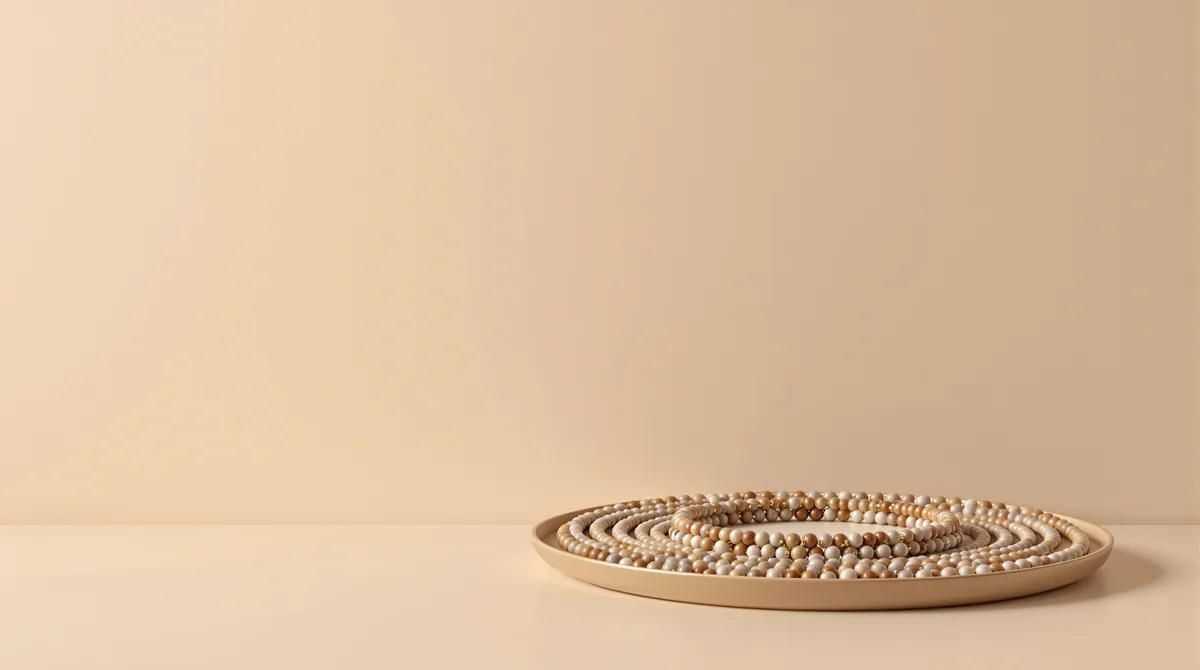
Manufacturing · Tabletop
A runner is the longest flat beaded object we build, and length is what makes it difficult. The ends carry the weight, the middle carries the pattern, and the arithmetic has to start from the table rather than from the design.
A coiled beaded mat lying flat, strands of wood and glass beads wound in close concentric rounds.
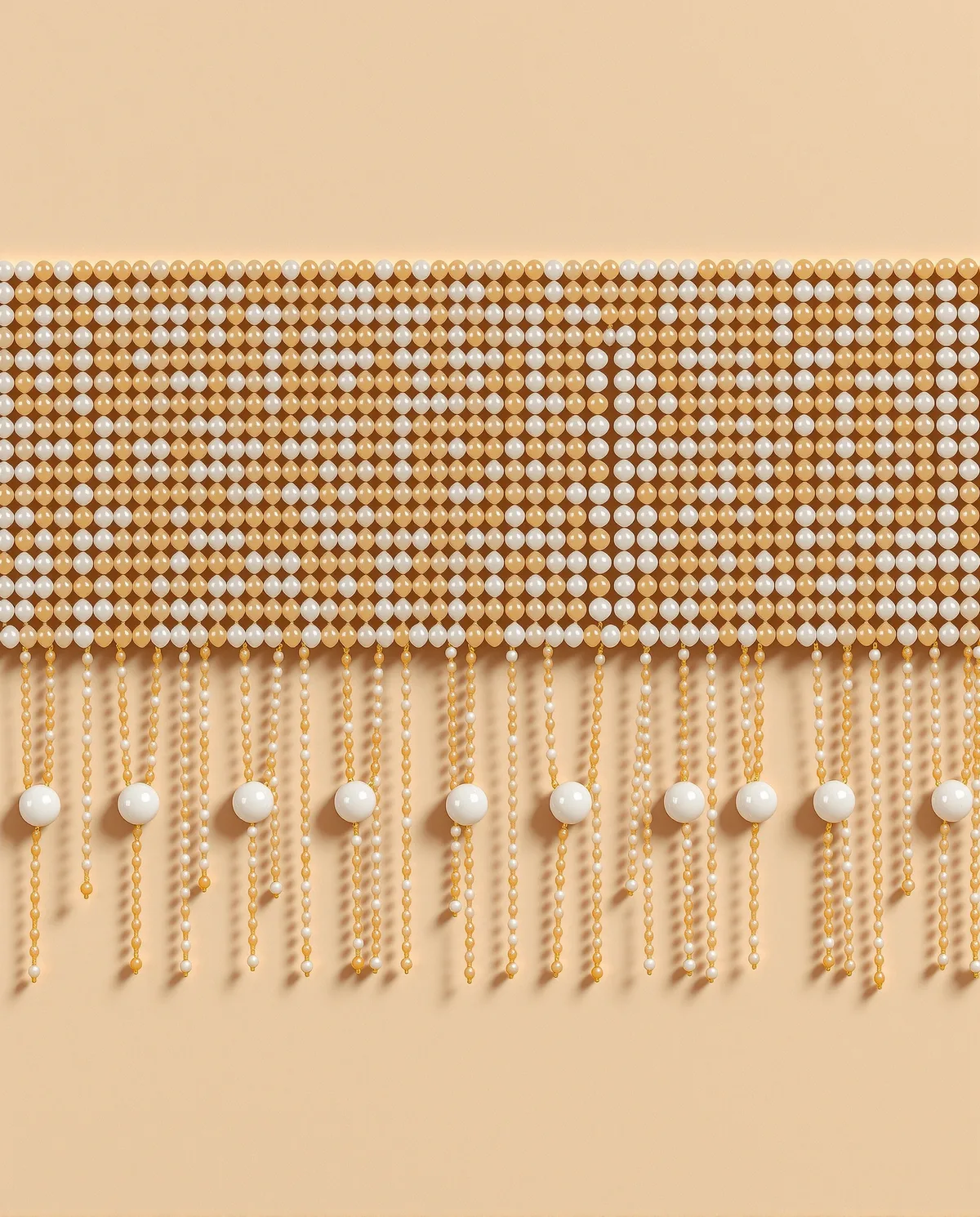
A beaded table runner is a long stiffened panel carrying a couched bead field, usually finished at each end with a beaded band and a fringe of drops. Length is set from the table — the table length plus or minus the overhang the buyer wants — and the ends carry most of the weight, which is why the end detail decides whether it hangs straight.
A beaded table runner is a long stiffened panel carrying a couched bead field. Glass seed and bugle beads are laid on the ground and held down by a separate fine thread in the bead and thread embroidery tradition, with dimensional florals at nine to twelve centimetres couched in rows where the design calls for relief. Each end is normally finished with a beaded top band — close horizontal rows worked solid — and often a fringe of bead drops below it.
Table runners are named in our published Beaded Décor scope, and they sit in the same craft family and the same studios as our coasters and placemats.
Because three things change at once with it.
The repeat has to divide into the finished length, or the two ends of a symmetrical runner will not match — the one defect on a long object that everybody sees immediately. The bead count scales directly with length, so a runner is the most expensive flat beaded object per piece in the category. And the weight accumulates: a long couched panel with fringed ends carries real mass at each end, and the ground has to be stiff enough to stay flat under it.
So the arithmetic starts at the table, not at the drawing.
Start from the table length, then decide the end condition. A runner can finish flush with the table end, stop short to leave a reveal of the table surface, or overhang. The conventional overhang is roughly 15 to 30 cm each end — that is design convention rather than a tested Gemixx standard, and we flag it as such.
Then subtract or add. A 180 cm table with a 20 cm overhang each end needs a 220 cm runner; the same table with a 15 cm reveal each end needs 150 cm. The repeat is then chosen to divide into whichever figure results, and the motif is placed from the centre outwards so the two ends resolve identically.
Because the ends are the only part that hangs. Everything between them is supported by the table.
That makes the end detail a structural decision as well as a decorative one. A solid beaded band gives the end a defined edge and distributes the load of a fringe across the full width rather than into a few stitches. The fringe below it then wants a weighted end bead, so the drops fall straight instead of curling back under the table edge. Where a runner overhangs a cloth rather than a hard table, a heavier end bead is worth specifying again, because a soft cloth gives the drops nothing to fall against.
Changeable: length, width, the ground and its stiffening, bead material and size, the motif and its repeat, infill density, the end band, the fringe and its drop, the edge treatment and the backing.
Fixed: made to order, so nothing ships from stock. The bead map precedes the first stitch. The repeat, once approved, governs production. And a runner is decorative rather than thermal: heat tolerance is confirmed on the sample.
| Specification | Value |
|---|---|
| Construction | Glass beads couched onto a stiffened ground |
| Dimensional floral motifs | 9–12 cm, couched in rows |
| End detail | Beaded top band, optional fringe of drops |
| Length | Set from the table, per design |
| Conventional overhang each end | Roughly 15–30 cm, or flush to the table end |
| Width | Set per design, against the cover and the centrepiece |
| Edge | Turned, with a backing |
| Bead material | Glass seed and bugle, with pressed accents |
| Heat | Decorative; a hot dish belongs on a trivet rather than on the beadwork |
| Cleaning | Spot-clean only, never immersed |
| Sampling | 16–20 days from an agreed brief, quoted separately |
| Production | 40–60 days after sample approval |
Width is the quiet decision. Too narrow and the runner reads as a strip of tape; too wide and it competes with the covers either side of it. The useful way to set it is against what will sit on top — a centrepiece, candles, a row of small vessels — rather than as a proportion of the table.
Glass seed and bugle beads carry the couched detail, because they are the only beads small enough to draw. Pressed glass gives the accent and motif beads, and on a long panel that matters commercially: a larger moulded bead covers an area for a fraction of the units a seed-bead field needs, so the accent strategy is what keeps a runner affordable. Metallic thread and zari sit in the same stitch. Faceted glass drops make the best weighted end bead.
On the ground: stiffened cotton for anything that must stay flat over a long span, with felt backing and a turned edge.
The table length and the end condition — flush, reveal or overhang, with the figure. The runner width. The ground and its stiffening. The bead material and bead size. The motif and whether it repeats or runs as a single composition. The infill density. The end band and the fringe drop. The colours, with references or physical chips for beads and ground. The care wording for the pack. Then packing, quantity per colourway, and the port or warehouse.
Beads are matched to a colour reference or a physical chip and confirmed on the sample; the ground is matched separately and approved with them. On a runner the ground shows more than on any other flat beaded piece, because the motifs are spaced along a long span rather than filling a small face — so a ground chosen as a neutral afterthought ends up being half of what the customer sees.
A brief that begins with the table dimensions. A rough cost sheet before anything is made. Then the bead map, drawn centre-outwards so both ends resolve. Then the sample, usually 16 to 20 days from an agreed brief, photographed for approval before it ships. Production runs against that approved sample.
On a long runner it is worth approving a part sample — one full repeat plus both end treatments — before committing to the full length, because that is where the cost sits and where the repeat error would show.
Forty to sixty days after sample approval, with sampling quoted separately — unless the runner mixes couched beadwork with crochet appliqué or knotting, in which case the 60-to-90-day bohemian window governs, because the slowest craft on a piece sets its date.
Rolled, never folded. A fold puts a permanent crease across a stiffened ground and can lift couching along the fold line. The core has to be wide enough not to crease, the beaded face sits outermost and protected, and the end fringes are wrapped so they cannot tangle with each other. Cartons, labels and inner packing follow your specification, and the care instruction is printed rather than left to the shelf.
Bead security first, with a pull check across the field and particularly at the end band where the fringe loads it. Then the length measured, the repeat checked across the whole span, the two ends compared against each other, the fringe drops checked against the count sheet, the colour checked against the approved sample, and the panel laid flat to confirm it has no twist. First-article and lot inspection, kitting and export packing run through our own quality and packing house.
Length first, because bead count scales with it almost linearly. Then density, where de-densifying the infill — tight outline, open fill — is the most effective change available and is invisible at arm's length. Then bead size. Then the end detail, which on a fringed runner is a disproportionate share of the hours relative to its area.
Narrowing the runner saves less than shortening it, because the end bands and the edge treatment do not shrink with the width.
Home and lifestyle retailers buying under their own label, who sell a runner as the anchor of a tabletop set and the napkin rings and coasters alongside it. Interior and hospitality designers specifying banquet and restaurant tables, where a runner replaces a full cloth. Event and wedding companies, who buy long lengths for a single evening. And gifting programmes, where a boxed runner is the top of a tabletop range.
Good to know
No. There is no retail stock programme for beaded décor. Every runner is made to order against an approved sample, at the length, width, colours and packing you specify.
Yes. Beads are matched to a colour reference or a physical chip and confirmed on the sample, and the ground is matched separately. On a runner the ground matters more than on a small piece, because so much more of it shows between motifs.
Yes, but changing a runner's length is a repeat decision rather than a scaling one. The motif repeat has to divide into the new length or the two ends will not match, which on a long symmetrical object is the first thing anybody notices. The bead map is re-plotted rather than stretched.
Beaded décor runs 40 to 60 days after sample approval. Sampling usually runs 16 to 20 days from an agreed brief and is quoted separately. A runner sample takes the same time as a smaller piece but uses far more material, which is reflected in the sample quote.
Rolled rather than folded, on a core wide enough not to crease the ground, with the beaded face outermost and protected, and the end fringes wrapped so they cannot tangle. Folding a beaded runner puts a permanent crease across a stiffened ground and can lift couching at the fold line. Cartons and labels follow your specification.
Glass seed and bugle beads are drawn and hand-strung in our own Firozabad glass works. Couching is done in our own beadwork studios, which work in zardozi and in faux capiz. Acrylic and resin beads are moulded and dyed to our colour. Inspection and export packing run through our own Greater Noida house.
No. Minimums are set per design and confirmed per quote. A runner's bead count scales with its length, so the same design at 120 cm and at 220 cm is not the same order, and one range-wide number would be meaningless.
Keep exploring
Pillar
The table cluster: coasters, placemats and chargers, runners and napkin rings, with the construction and ground material each one needs.
How it is madeReference
Five craft families — strung, embroidered, wire-wrapped, knotted and wrapped fibre — and what each one is good for.
Open the referenceManufacturing
Six to nine centimetres, beads wrapped over a shaped brass armature with a flat-back wrap — the construction, the sizes and what sets the cost.
Specs and sizesManufacturing
Two constructions — a couched bead field on a stiffened ground, and coiled strung rounds lashed together — plus the limits on heat and washing.
Read the guideManufacturing
Bead-embroidered glass coasters on stiffened felt, or moulded acrylic sets in translucent and opaque — construction, sizes and what moves the cost.
Open the reference
Start a conversation
Send a reference, a colour chip or a sketch. Minimums are set per design and confirmed per quote; sampling is quoted separately and usually runs 16 to 20 days from an agreed brief.