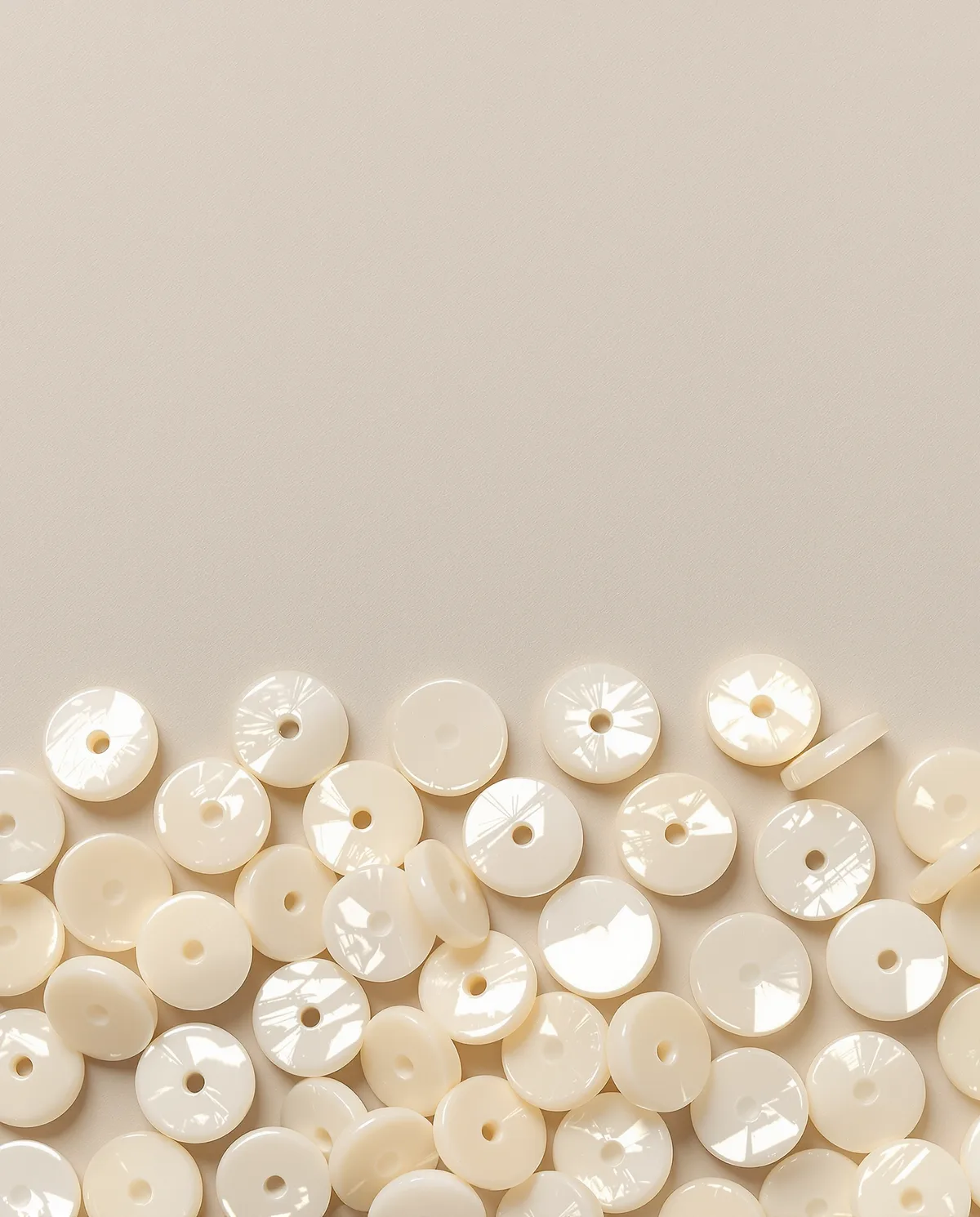
Material
Faux capiz discs
Cast resin or dyed cut acrylic, finished to imitate capiz shell: what it gives that real shell cannot, and why thin discs tangle.
Compare the options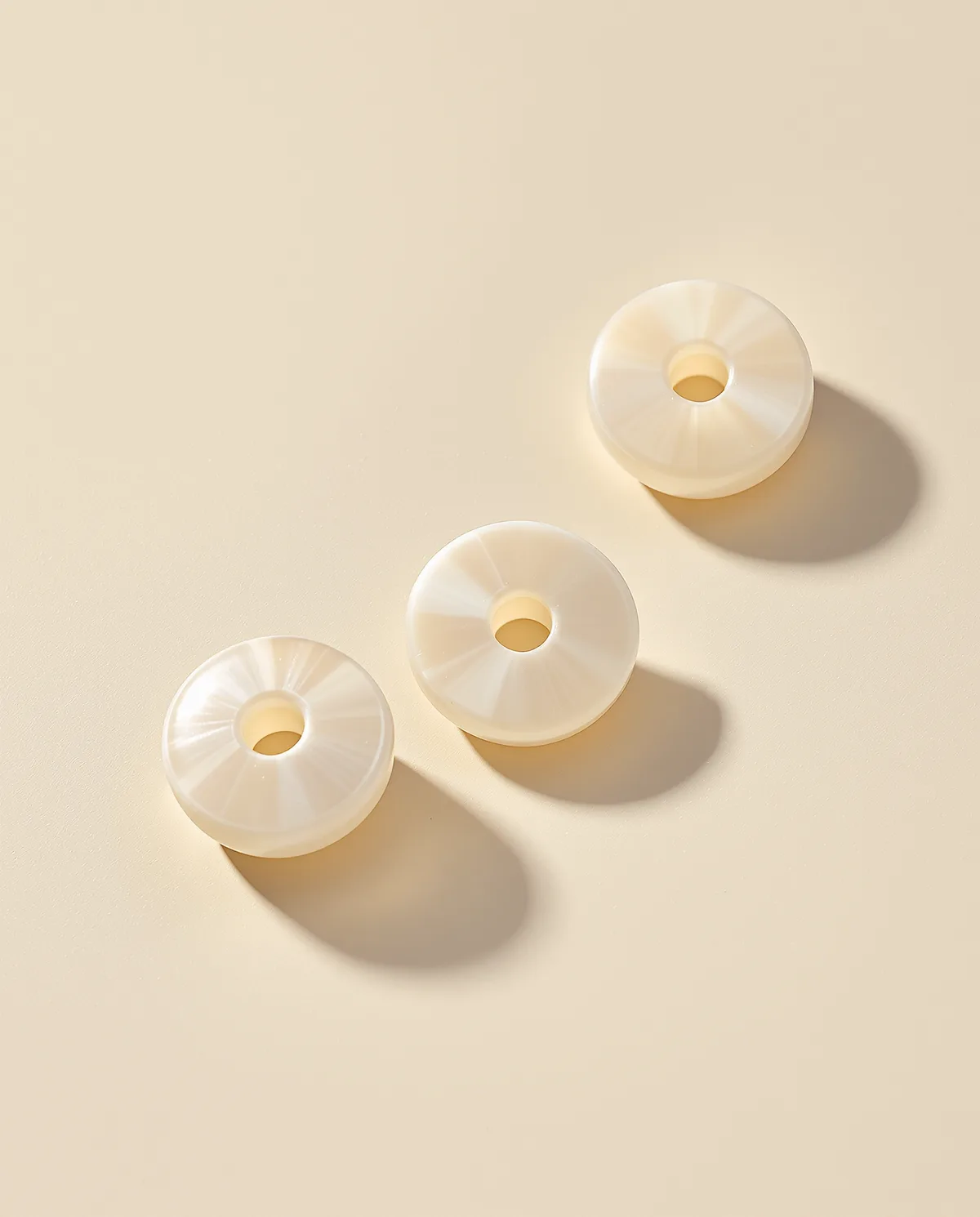
Design · Capiz Petal Arch
An arch in a linked piece is not a set of strand lengths. It is a set of disc counts, and a column with fewer discs behaves differently from its neighbour.
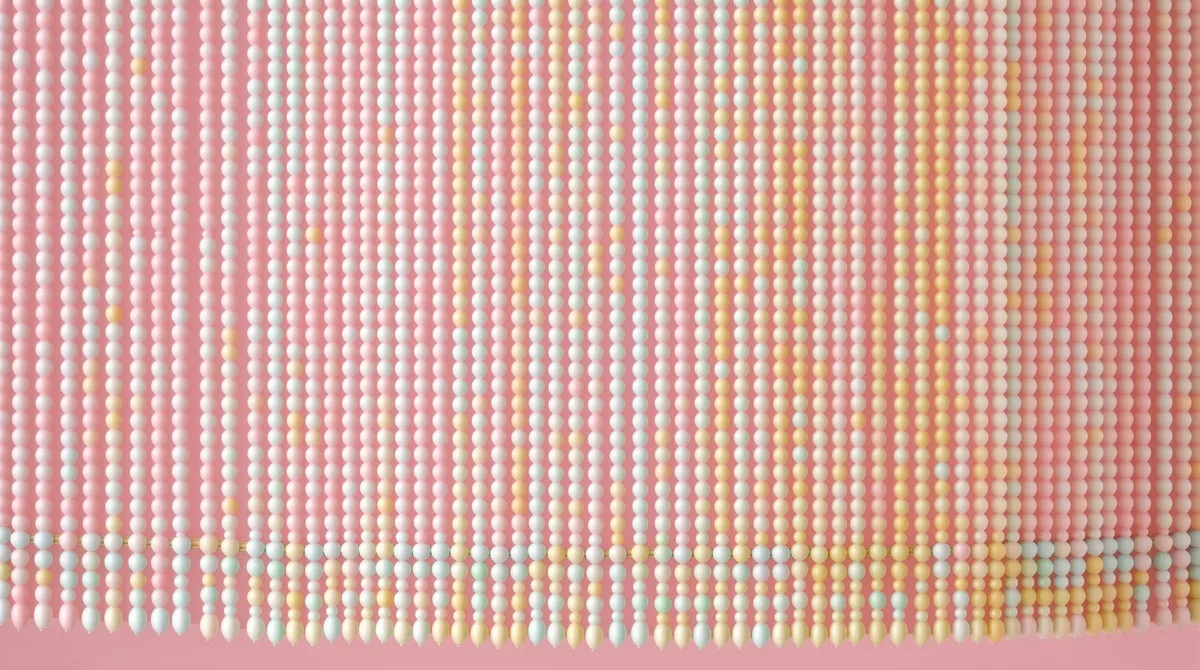
Macro view of a faux capiz disc: an engineered imitation of capiz shell, pale and pearlised, cast to an even thickness and an even colour that natural shell never has.
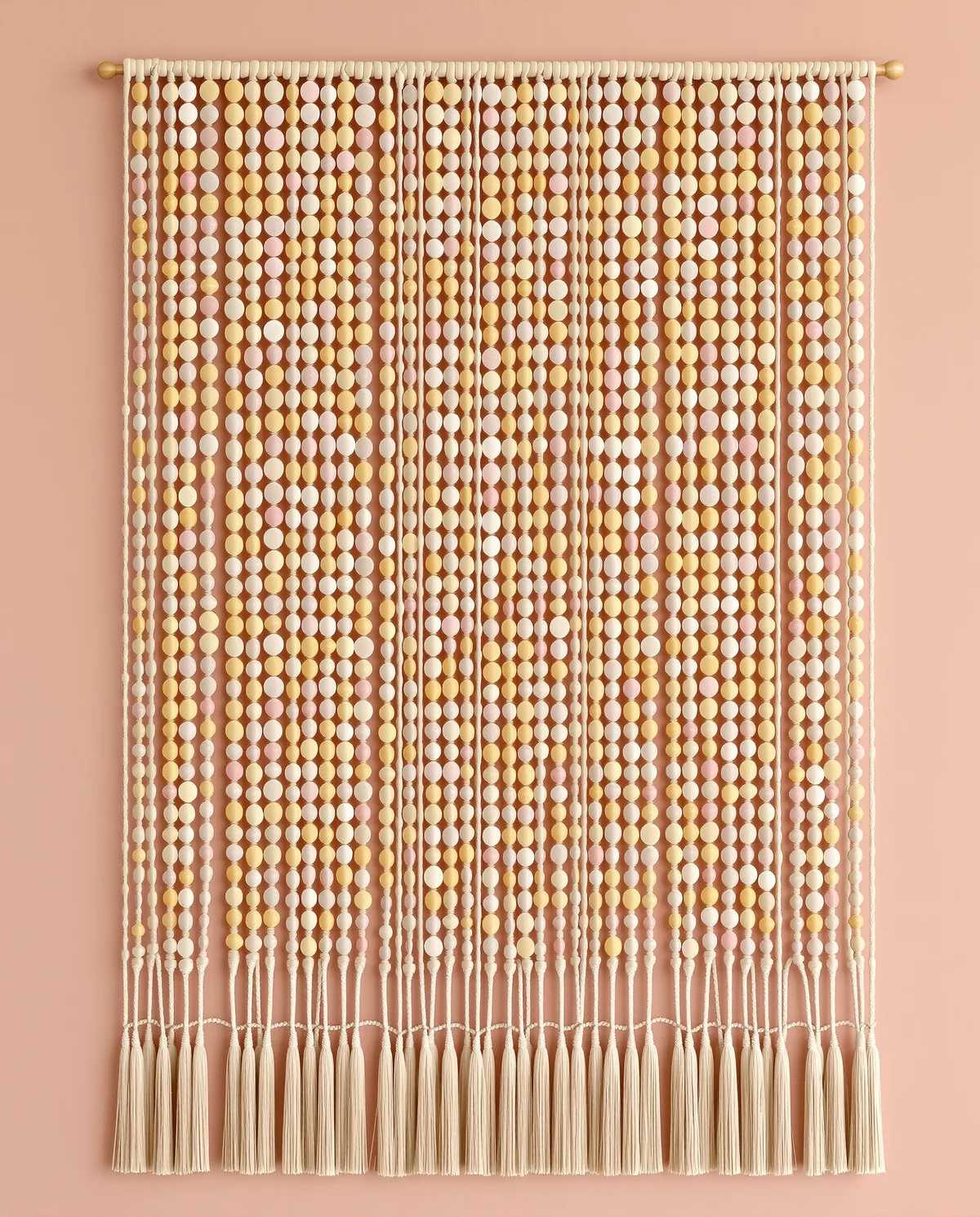
The Capiz Petal Arch is drawn at 90 × 180 cm from petal-shaped faux-capiz discs linked into columns, with an arched field cut into the piece. On a linked design an arch is expressed as a disc count per column rather than as a strand length, so the shortest columns carry fewer discs and settle differently from the longest ones.
The Capiz Petal Arch is drawn at 90 × 180 cm from petal-shaped faux-capiz discs linked into columns, with an arched field cut into the piece. Available to develop at the drawn size.
The record does not give a disc count or a column count for it, and this page does not invent one. That gap is stated in the specification table rather than filled.
Not in strands. Discs are linked one below the next into columns, so the discs carry each other and there is no cord doing structural work.
The petal shape adds a second variable that a round disc does not have: orientation. A round disc does not care which way it hangs; a petal does, and getting it consistent across hundreds of links is a bench discipline rather than a drawing one.
One entry on this sheet is unusual and two are settled at sampling. Disc count and column count both fall out of the arch geometry, so they are fixed when the curve is drawn and confirmed on the sample. The unusual entry is the arch itself, given as disc counts per column rather than as a drop list, so disc diameter and the smoothness of the curve are the same decision.
| Specification | Value |
|---|---|
| Finished size | 90 × 180 cm |
| Disc shape | Petal-cut rather than round |
| Disc material | Faux capiz — cast resin or dyed cut acrylic |
| Construction | Discs linked one below the next into columns |
| Field shape | Arched, cut into the disc counts per column |
| Header | Turned wooden dowel at 90 cm |
| Status | A design available to develop |
None of the named 2027 stories specifically. It sits with the faux-capiz group by material rather than with a palette family, and because every colour in a disc piece is dyed, its palette is more open than any strung design's.
The useful reference points are the two named linked pieces — the cool low-contrast one at 90 × 200 cm and about 497 discs, and the matte one at 70 × 130 cm and about 239 — which bracket the likely disc count for a piece this size.
None, again. The piece is discs, and the disc is doing everything: the shape, the colour and the surface.
Faux capiz: cast resin or dyed cut acrylic, cut and finished to imitate capiz shell. On an arch of several hundred petals the engineered material is the reason the piece is buildable at all — a natural shell varies in thickness and translucency petal to petal, and an arch reads every one of those variations as an error.
As an arch, and the mechanics are genuinely different from a strung arch. On a strung piece an arch is a list of strand lengths, and a strand length can be any value. On a linked piece an arch is a list of disc counts, and a disc count is a whole number.
So the curve is quantised. With 25 mm discs the arch resolves in 25 mm steps; with 50 mm discs it resolves in 50 mm steps, which on a 180 cm piece is a visibly coarser curve. Disc diameter and arch smoothness are the same decision, which is not obvious from a render.
A turned wooden dowel at 90 cm, made in our own Saharanpur wood factory, with its section checked against the finished weight. The load distribution on an arched linked piece is the part worth modelling before sampling. The longest columns carry the most discs and therefore the most weight, and on an arch those columns sit at the edges — so the dowel is loaded at its ends, which is the same asymmetry a strung arched portal has but concentrated at link points rather than spread along cords.
Recoloured without limit. A disc has no natural colour, so every colour is a dye decision, and both cast resin and cut acrylic take dye uniformly because the colour runs through the material.
Resized with the arch recalculated rather than scaled, for the quantisation reason above. A new column pitch means a new set of disc counts, and the counts are integers.
Interior and hospitality specifiers. At 90 × 180 cm this is a screening or zoning piece rather than a decorative one, and the audience for it works from drawings and needs the load and fixing answered rather than the palette.
For that audience a beaded division is available to develop: it starts from a brief and a sample, and the load and the fixing are answered on the approved build.
Two things bear on it, both from the bench.
Faux-capiz disc sampling covers 10 to 30 mm discs, and the 2027 linked designs are drawn with 25 and 50 mm. The smaller disc sits inside sampled experience; the 50 mm option is confirmed on the sample before a run.
And a faux-capiz piece was quoted once as a cast-to-shape rather than cut-from-sheet design specifically to avoid material wastage — cutting a shape out of a square sheet throws away the corners, while casting it does not. On a petal shape, which is further from a square than a disc is, that difference is larger. For this design the cast route is likely the right one, and it is the first thing a development should test.
It would be agreed on the sample. Columns of unequal length on an arched piece are not interchangeable, so they are bundled in order and labelled, and the carton is set by the longest column.
A linked column does not fold and a thin petal tangles more readily than a round disc, which makes packing a design constraint on this piece rather than a downstream detail.
Good to know
Exclusivity is a commercial decision taken per programme rather than a property of the design. On an unsampled design it is a conversation to have alongside the development.
It shows the format and the arched field as drawn. Disc and column counts are set when the design is developed to a size, and confirmed on the sample.
It would be agreed on the sample. Columns of unequal length on an arched piece are not interchangeable, so they are bundled in order and labelled, and the carton is set by the longest column.
Yes. For an arched linked piece the useful things to send are the disc diameter, the column pitch, the overall size, the arch profile as disc counts per column, and the link method.
Entirely, because a disc has no natural colour and every colour is a dye decision. Both cast resin and cut acrylic take dye uniformly, which makes a disc design the easiest thing in the library to match to a brand palette.
Yes, with the arch redrawn rather than scaled. An arch expressed as disc counts has to be recalculated for a new column pitch, and the counts are whole numbers — there is no half disc to fine-tune a curve with.
Keep exploring
Material
Cast resin or dyed cut acrylic, finished to imitate capiz shell: what it gives that real shell cannot, and why thin discs tangle.
Compare the optionsDesign
Linked faux-capiz disc hangings at 70 × 130 to 90 × 200 cm, and beaded shade designs from a 15 cm sconce to a 50 cm pendant.
Read the guideDesign
An empire frame at 25 and 40 cm by 28 cm high, with a straight hem finished on a flower ring.
Specs and sizesDesign
A long-fringe drum at 40 cm diameter by 50 cm deep with deep scalloped hems — the longest fringe in the shade group.
See the detailDesign
90 × 200 cm at about 497 linked faux-capiz discs in 12 to 16 columns — the largest disc piece in the library.
Specs and sizesDesign
70 × 130 cm at about 239 matte faux-capiz discs — the smaller, lighter end of linked-disc construction.
Specs and sizes
Start a conversation
Send a reference, a colour chip or a sketch. Minimums are set per design and confirmed per quote; sampling is quoted separately and usually runs 16 to 20 days from an agreed brief.