Design
The design library: colour stories, by construction
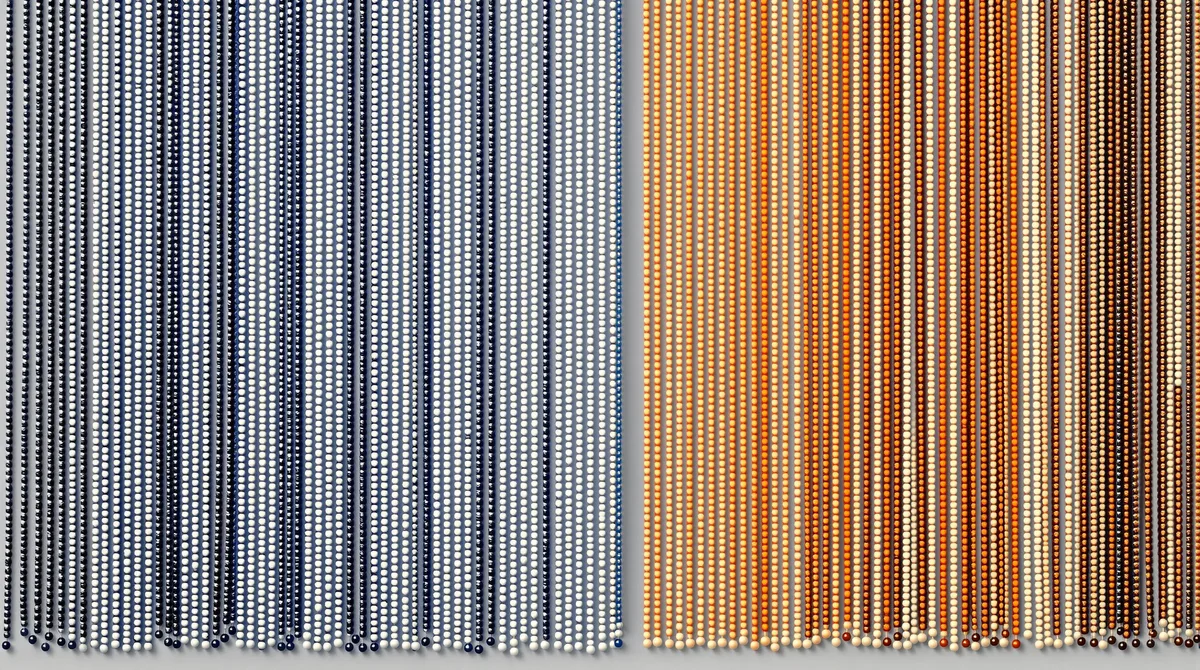
Colour stories documented by how they are built, not by how they look in a mood board.
Read moreDesign library · Index
Two builds that are not strung in the ordinary sense: discs linked into columns, and beads carried on a metal frame.
Linked faux-capiz disc hangings run 70 × 130 cm to 90 × 200 cm in 12 to 16 columns of 25 and 50 mm discs, from roughly 239 to 497 discs a piece. Beaded shade designs run from a 15 cm mini-drum sconce to a 50 cm fringed pendant, at 36 to 120 strands on a metal frame made, finished and plated in our own plants.
Design by design
Each page gives the column or strand count, the disc or bead sizes, the frame or dowel, and says whether it is a shipped design or one available to develop.
Design
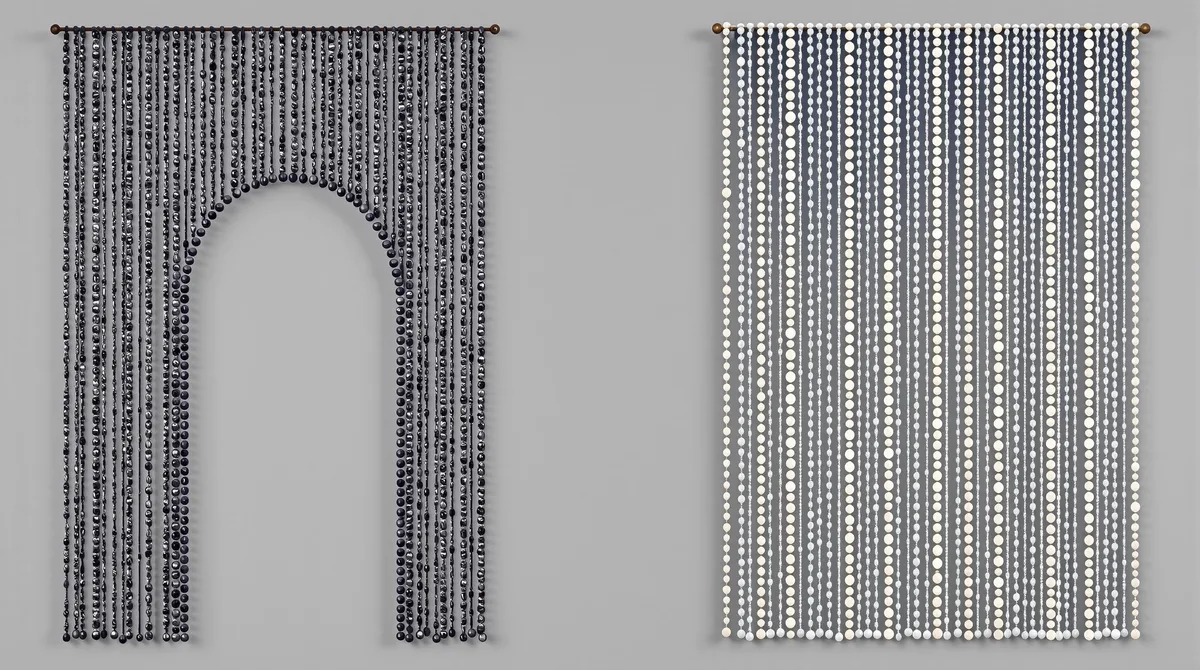
90 × 200 cm at about 497 linked faux-capiz discs in 12 to 16 columns — the largest disc piece in the library.
Design
70 × 130 cm at about 239 matte faux-capiz discs — the smaller, lighter end of linked-disc construction.
Design
Petal-cut faux-capiz discs in an arched field at 90 × 180 cm, with the arch cut into the column disc counts.
Design
An empire frame at 25 and 40 cm by 28 cm high, with a straight hem finished on a flower ring.
Design
A long-fringe drum at 40 cm diameter by 50 cm deep with deep scalloped hems — the longest fringe in the shade group.
Two unrelated construction families sit in this group: linked faux-capiz disc hangings, and beaded shades on a metal frame. They sit together because neither is built the way a bead curtain is built, and a specifier who assumes they are will get the quote wrong.
A disc hanging has no strands. Discs are linked one below the next into a column, and columns hang side by side from the dowel. There is no cord carrying beads; the discs carry each other. The quantity that drives everything is the disc count.
Linked work first, framed work second, each in descending size. The linked designs run 70 × 130 cm at about 239 discs, 90 × 180 cm as a petal arch, and 90 × 200 cm at about 497 discs, in 12 to 16 columns.
The shade designs invert the logic. A shade's silhouette comes from its frame — empire, drum, tapered — and the beads follow the frame. Strand counts run from 36 on the smallest sconce to 120 on the largest pendant drum, which is far denser per centimetre than any curtain.
All five are available to develop at the drawn size, and each page carries the development questions its own design raises.
Diameter is the figure that decides the piece. Sampled work covers 10 to 30 mm discs; the linked-disc designs are drawn at 25 mm and 50 mm. A 50 mm disc is heavier, catches more air and puts more load through each link point, so the diameter is set in the drawing and confirmed on the approved sample. Because we cast and cut the discs to our own dies and finish them in our own beadwork studios, a diameter can be changed as readily as a colour.
Frame first, beads second. Beaded lamp shades are a real part of the range in pendant drum, empire table and sconce formats, made as shades to fit the fitting a buyer names, on frames made, finished and plated in our own metal plants. Fittings, cord sets and conversion kits are the buyer's, and the electrical assembly is listed to their market. Every piece here is made to order against an approved sample.
The two disc hangings, because they answer the question buyers ask first about faux capiz: is it shell. It is not. Faux capiz is cast resin or dyed cut acrylic, cut and finished to imitate capiz shell. That is a strength rather than a compromise — colour is consistent batch to batch, there is no shell-import exposure, and the material is more durable than the shell it imitates.
Each page carries a specification table. For a linked hanging the specification is the column count, the column pitch, the disc diameter, the disc count and the link method. For a shade it is the frame dimensions top and bottom, the height, the strand count and the hem shape.
Bead sizes and stringing specifications holds the general sheet, and the care guidance covers the one material note that matters for faux capiz: a soft damp cloth, never an abrasive cleaner, because abrasives dull the surface that does the imitating.
With Moonwater at 90 × 200 cm. At that size the construction is unavoidable: around 497 discs in 12 to 16 columns, every link point carrying the weight of everything below it, and a dowel that has to stay straight across 90 cm with the whole weight hanging off two fixings.
The disc diameter. It sets the column pitch, the disc count, the weight carried at each link point and most of the cost, which is why it is the first number settled in a drawing and the first confirmed on a sample. Change the diameter and you have a different object at the same finished size. Change the colour and you have the same object, which is the cheapest change in the group — and because the discs are dyed to our own reference, the colour is a specification rather than a selection.
Good to know
Column count, column pitch, disc diameter, disc count and link method on a linked hanging; frame dimensions top and bottom, height, strand count and hem shape on a shade. All of them are drawn at true size against real discs and real beads, and each is confirmed on the approved sample when a design is developed.
Plants we own. Faux-capiz discs are cast resin or dyed cut acrylic, cast or cut to our own dies and finished in our own beadwork studios. Shade frames are made, finished and plated in our own Moradabad metal plants, in any of eight standard finishes. Glass beads are drawn and hand-strung in our own Firozabad glass works, and inspection and export packing run through our own Greater Noida house.
By how the piece is held together. Linked-disc hangings come first: discs joined one below the next into columns, which is not stringing. Then the shade designs, where beads are carried on a metal frame and the frame rather than the strand sets the silhouette.
Frame first. A shade is designed and made as a shade, built to fit the fitting a buyer names, so the fitter type is settled before the strand count is. Cord sets, flush-mount conversion kits and the rest of the electrical assembly are the buyer's and are listed to their market.
The Moonwater linked disc hanging, because it is the largest piece in the group at 90 × 200 cm and about 497 discs, and because the column construction is clearest at that scale — the disc count, not the strand count, is what a quote is built on.
Keep exploring
Design
Colour stories documented by how they are built, not by how they look in a mood board.
Read morePillar
Door curtains, portals, café lengths and valances: the standard sizes, the strand counts and the one question each format answers.
Read the guideDesign
The full-length doorway designs, 90 × 200 to 120 × 210 cm, documented by strand count, hem shape and bead count.
See the detailDesign
Portals at 76 × 140 cm and hanging divisions at 90 × 180 and 120 × 180 cm, documented by strand count and opening shape.
Specs and sizesDesign
Valances at 120 × 30 to 40 cm and café curtains at 76 × 76 cm, documented by hem shape, strand count and bead count.
Read the guideDesign
Strung wall pieces from 50 × 90 to 60 × 100 cm at 20 to 40 strands, documented by hem shape and bead list.
Specs and sizes
Start a conversation
Send a reference, a colour chip or a sketch. Minimums are set per design and confirmed per quote; sampling is quoted separately and usually runs 16 to 20 days from an agreed brief.