Manufacturing
Bead shades for lighting
Pendant drums, empire table shades and sconce shades in glass beads — how the frame carries the shape, and why we supply shades only.
How it is made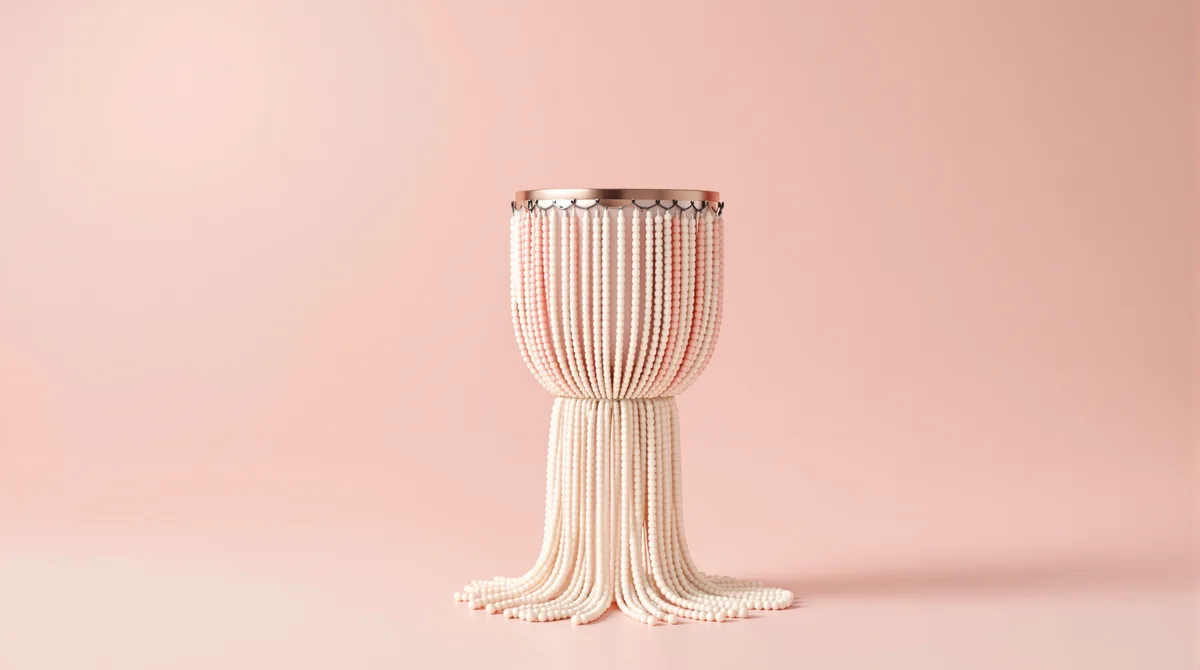
Design · Blossom Fringe Pendant
Fifty centimetres of depth on a forty centimetre drum. More of this shade is fringe than is shade, which changes where the load goes.
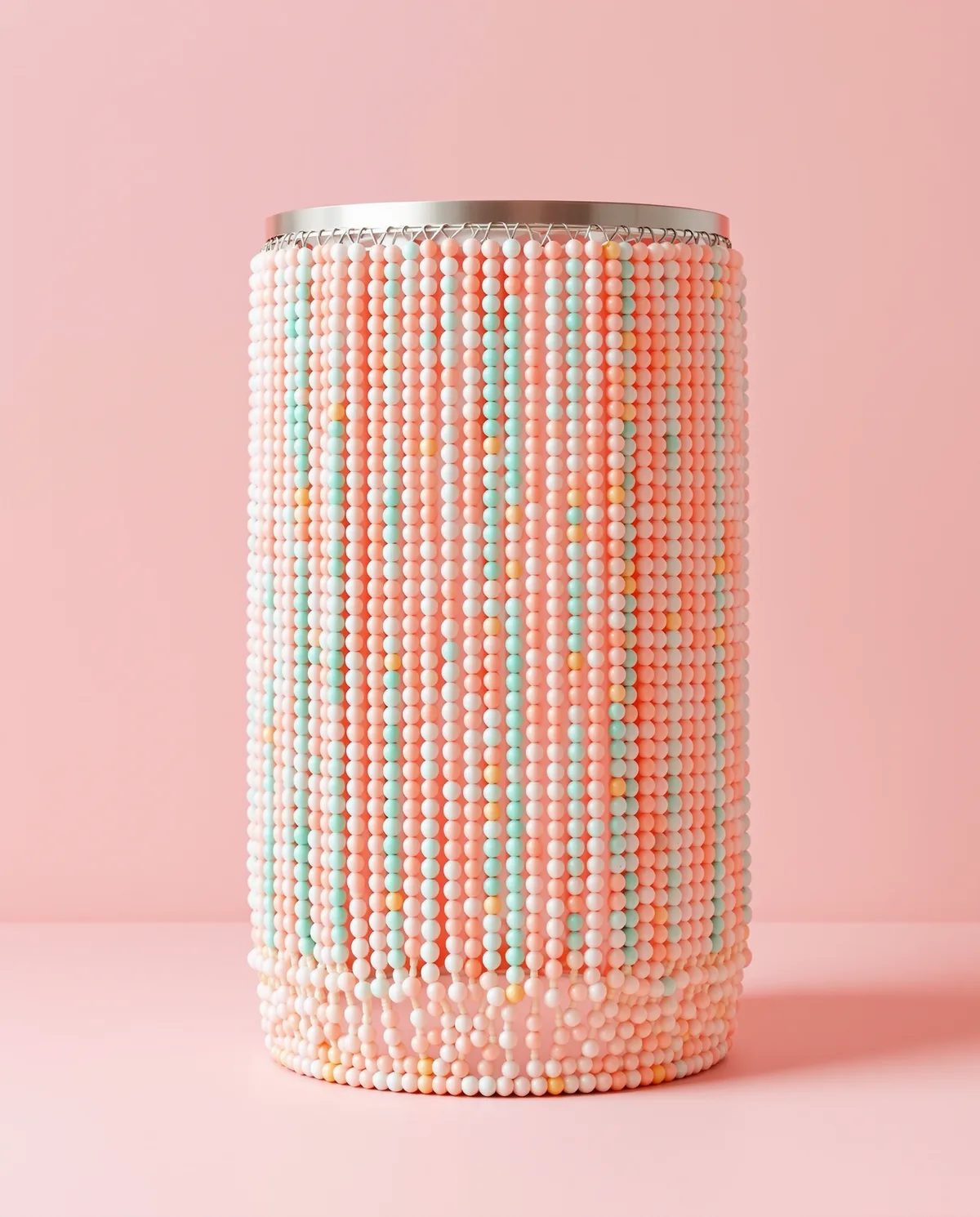
A bare beaded drum shade standing on its own in blush pink, cream and chalk white, a long free-hanging beaded fringe falling from its lower ring, empty and dark inside with no…
The Blossom Fringe pendant is drawn as a drum 40 cm in diameter and 50 cm deep, with deep scalloped hems. On an open drum each strand hangs free from the top ring, so strand length sets the hem — and at 50 cm of depth on a 40 cm frame more of the piece is hanging fringe than framed shade, which puts the load on the top ring.
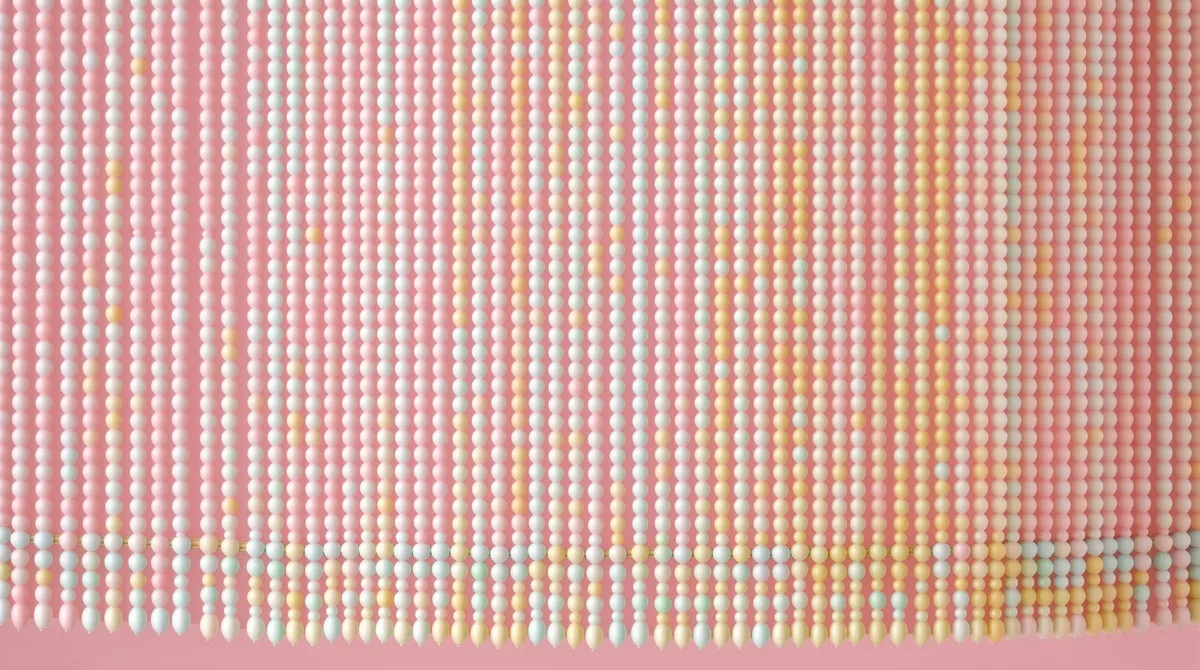
The Blossom Fringe pendant is drawn as a drum 40 cm in diameter and 50 cm deep, with deep scalloped hems. It is the deepest shade in the 2027 set, and the only one where the fringe is longer than the frame is wide.
Beaded lamp shades are a real part of the Gemixx range in pendant drum, empire table and sconce formats. Available to develop.
Free-hanging, which is the opposite of an empire frame. On an open drum each strand hangs from the top ring under its own weight, so strand length sets the hem and the strands are not tensioned between two rings.
That makes a drum the more straightforward of the two shade constructions to specify — a strand is a length and a bead sequence, as it is on a curtain — and the more demanding one to engineer, because all of the fringe weight arrives at the top ring.
On an open drum the fringe length is the dominant quantity. The strand count follows the top-ring circumference, the bead count follows the fringe length, and the panel weight all arrives at the top ring and then at the fitting. Freight cubing is the fourth entry, because a rigid 40 cm frame with a 50 cm fringe does not pack down.
| Specification | Value |
|---|---|
| Frame shape | Drum — straight-sided, open |
| Diameter | 40 cm |
| Depth | 50 cm |
| Hem shape | Deep scallops, repeating around the circumference |
| Strand behaviour | Each strand hangs free from the top ring |
| Load path | Fringe weight into the top ring, then into the fitting |
| Strand count range in the shade group | 36 at the smallest sconce to 120 at the largest pendant drum |
| Scope | Supplied as a shade only, to fit the fitting a buyer specifies |
| Status | A design available to develop at the drawn size |
Deep scallops, repeating around the circumference. On a circular frame a scallop is a repeat rather than a one-off profile, so it is specified as one repeat plus a count instead of as every strand individually.
That is the same economy the awning valance gets from a repeating profile: fewer numbers to calculate, fewer chances to be wrong, and a more forgiving first-article check. On a 40 cm drum with deep scallops the repeat count is the figure that sets how the hem reads.
A pendant fitting that the buyer specifies. Shades are supplied as shades only, made to fit the fitting named; the fitting, the cord set and any conversion kit are not supplied.
The load path is the whole engineering story on this design. Fifty centimetres of hanging fringe puts its entire weight into the top ring, and the top ring puts it into the fitting. Acrylic is worth considering seriously here for that reason. As a general property acrylic runs around 1.2 g/cm³ against roughly 2.5 for glass, so the material choice roughly halves the load a fitting has to carry.
Both. Colours are matched to a physical chip or a colour reference and approved on a sample, and on a shade the approval has to be made lit as well as unlit — a bead that reads cream in a room reads yellow with a lamp behind it.
Resizing recalculates rather than scales. Strand count follows the top-ring circumference; bead count follows the fringe length. Reducing the depth is the obvious cost lever, and it is a large one: fringe length is the dominant quantity in the build, and the same logic that cut a sampled valance from 30 inches to 26 applies with more force to a 50 cm fringe.
Lighting and home-décor programmes, and hospitality specifiers wanting a statement pendant over a table or a bar. A long-fringe drum is the most dramatic shade shape in the set and the one that reads from across a room.
Because the beadwork is built onto the frame, so the frame cannot be the open variable. Settle the frame and the fitter first — orientation, and whether it screws on or sits on an O-ring — and sample the beadwork onto a frame that is final.
Strand count follows ring diameter and bead count follows height, so changing the frame changes the count sheet, the bead quantity and the stringing hours together. That makes a frame change a new sample rather than an adjustment to one.
It would be agreed on the sample, and this is the hardest packing case in the whole library.
A 50 cm fringe on a rigid 40 cm frame is large, non-collapsible and prone to tangling, and the strands have to be restrained without being compressed — compress a beaded fringe and it arrives kinked. Oversize, non-collapsible packaging is the known exposure on this construction, and a long fringe increases it, so the carton is specified alongside the sample rather than after it.
Because a beaded shade is a materially different object illuminated from inside, and on a pendant the lit state is the one that matters. The sample is approved lit as well as unlit, and the blossom elements are judged against the lamp rather than against daylight.
The blossom motif family in the 2027 library rather than one of the named palette families. It is worth reading against the Cherry Blossom wall hanging, which uses a cut faux-capiz blossom held by a spacer bead, and against the Daisy Daydream shade, which puts a flower motif in a ring at the hem.
Three blossom treatments, three constructions: a cut shape on a cord, a ring on a frame, and elements worked into a hanging fringe. The motif is the cheap part; the construction is the decision.
The fringe, and within it the blossom elements. A long fringe is read as movement rather than as individual beads, so the field bead matters less here than on any other design in the library and the blossom elements matter more.
That is a useful cost position. The field can be an inexpensive bead because nothing is examining it closely, and the budget goes into the elements that are.
Good to know
It would be agreed on the sample. A 50 cm fringe on a rigid 40 cm frame is a large, non-collapsible object that tangles readily, so packing is a design question — the strands have to be restrained without being compressed.
Yes. For a shade the specification is the frame — diameter, depth, fitter type — plus the bead sequence and the hem. Send the frame and the fitting it has to suit and the beadwork follows from it.
Yes, and on a shade the colour has to be approved lit as well as unlit. A bead that reads cream in a room reads yellow with a lamp behind it, so the approved sample should be seen both ways before production.
Yes. Strand count follows the circumference of the top ring and bead count follows the fringe length, so both are recalculated rather than scaled. Reducing the depth is the obvious lever: fringe length is the dominant cost here.
Glass or acrylic beads on a metal frame, with blossom elements in the fringe. Acrylic is worth considering seriously on this design because the fringe weight goes into a lamp fitting, and acrylic is roughly half the density of glass.
Exclusivity is a commercial decision taken per programme rather than a property of the design. On an unsampled design it is a conversation to have alongside the development.
Keep exploring
Manufacturing
Pendant drums, empire table shades and sconce shades in glass beads — how the frame carries the shape, and why we supply shades only.
How it is madeDesign
Linked faux-capiz disc hangings at 70 × 130 to 90 × 200 cm, and beaded shade designs from a 15 cm sconce to a 50 cm pendant.
Specs and sizesDesign
90 × 200 cm at about 497 linked faux-capiz discs in 12 to 16 columns — the largest disc piece in the library.
See the detailDesign
70 × 130 cm at about 239 matte faux-capiz discs — the smaller, lighter end of linked-disc construction.
See the detailDesign
Petal-cut faux-capiz discs in an arched field at 90 × 180 cm, with the arch cut into the column disc counts.
See the detailDesign
An empire frame at 25 and 40 cm by 28 cm high, with a straight hem finished on a flower ring.
See the detail
Start a conversation
Send a reference, a colour chip or a sketch. Minimums are set per design and confirmed per quote; sampling is quoted separately and usually runs 16 to 20 days from an agreed brief.