Technique
Linked discs: a column build, not a strand build
Why a column of linked discs is a different build from a strung strand: the connection, the twist, the packing, and the repair.
Read the guide
Design · Moonwater Linked Disc Hanging
No cord and no strands. Each disc hangs from the one above it, so every link point carries the weight of everything below it.
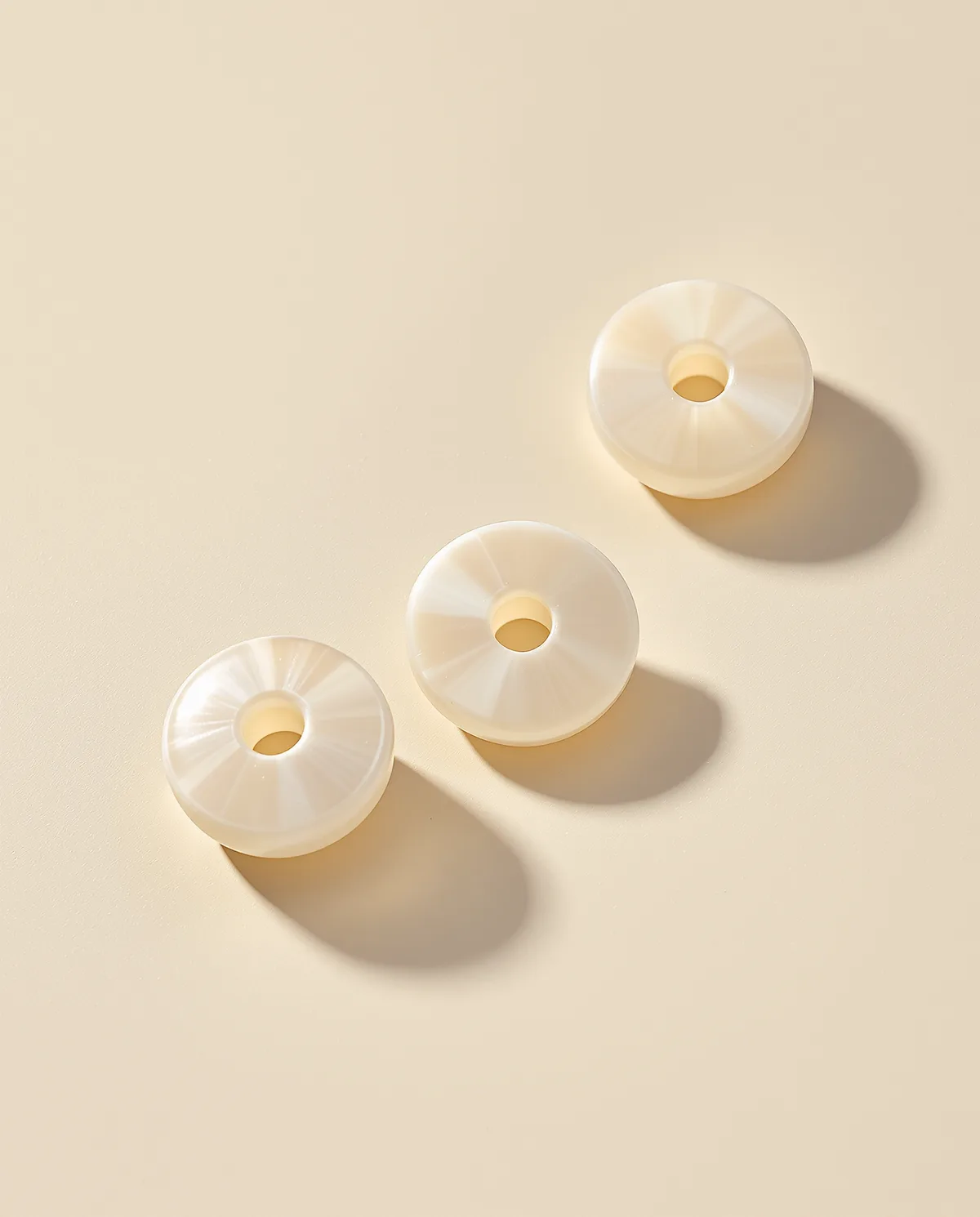
Faux capiz discs at twenty-five and fifty millimetres, cast and dyed to imitate capiz shell, each of even thickness and even colour with a hole near the edge.
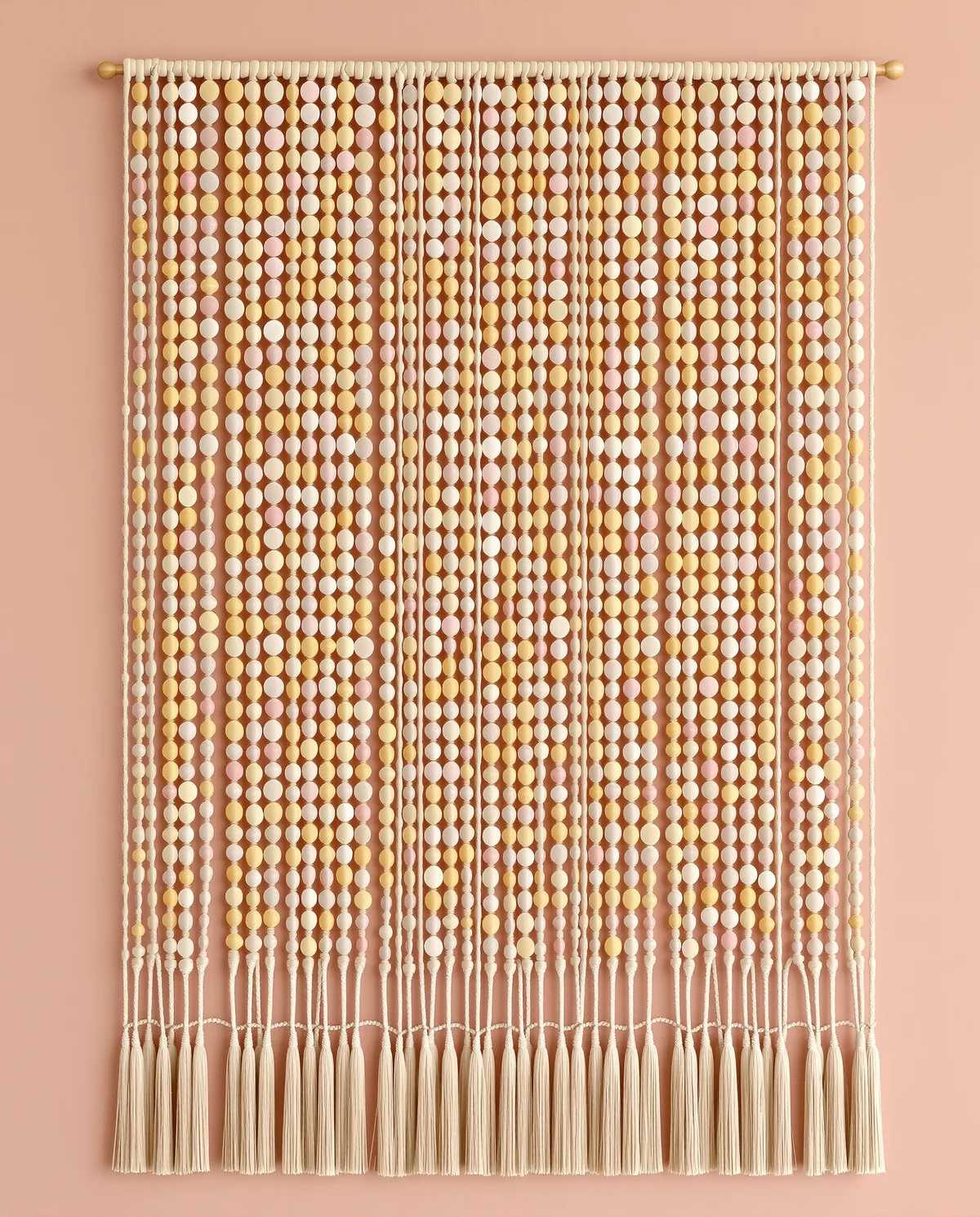
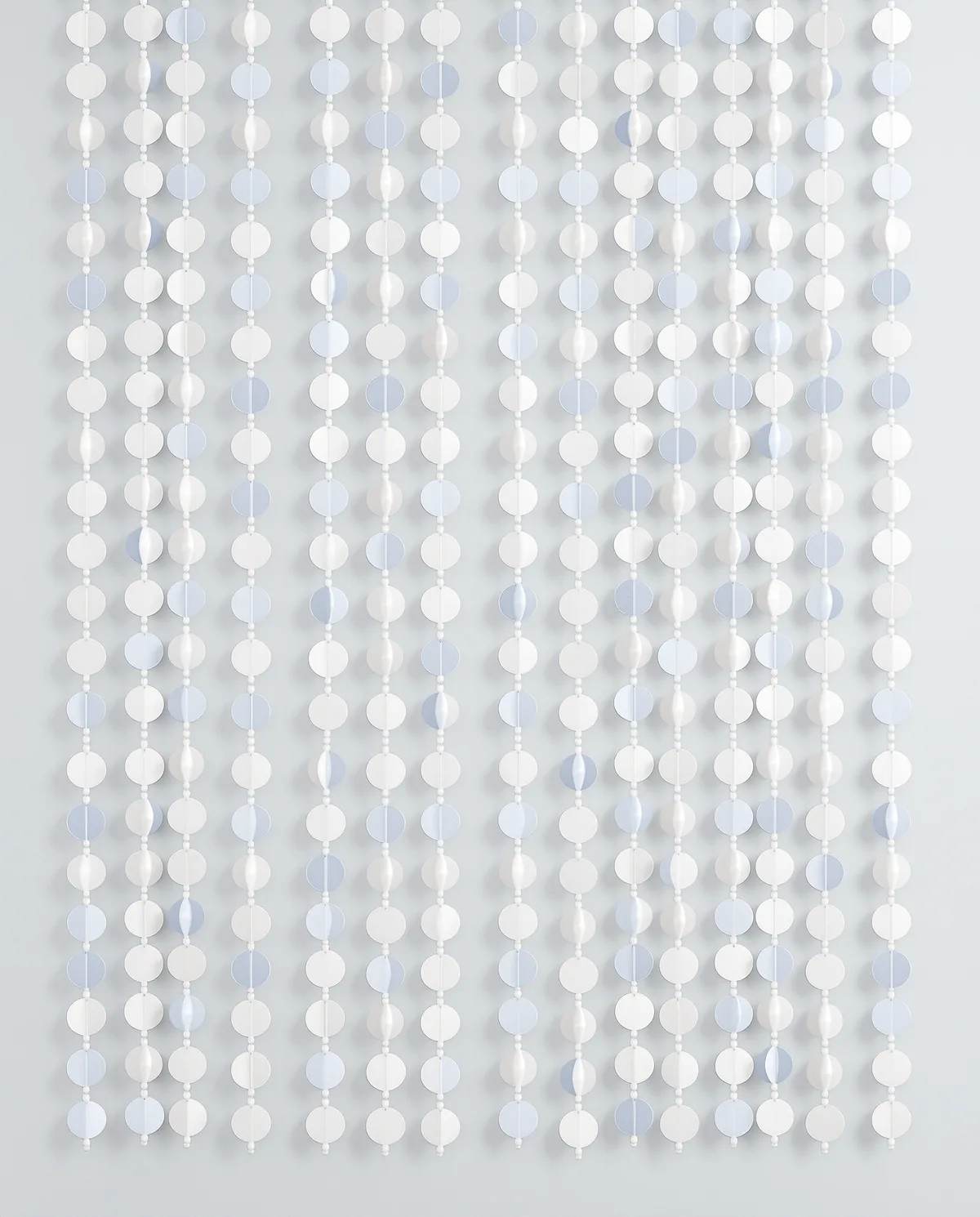
The Moonwater linked disc hanging is drawn at 90 × 200 cm with about 497 discs in 12 to 16 columns. It is not strung: discs are linked one below the next, so each link point carries the weight of everything beneath it and the quote is built on a disc count rather than a strand count. Discs are faux capiz — cast resin or dyed cut acrylic.
The Moonwater linked disc hanging is drawn at 90 × 200 cm with about 497 discs in 12 to 16 columns. It is the largest piece in the disc and shade group and the most quantity-driven design in the whole library.
It is also not strung. There is no cord carrying beads: discs are linked one below the next into columns, and the columns hang side by side from the dowel.
It is not constructed strand by strand at all, and that is the single most important thing to understand before quoting it.
A strung design has strands whose specification is a bead sequence and a length. A linked design has columns whose specification is a disc count and a link method. The discs carry each other, so each link point bears the weight of everything beneath it, and the topmost links on a 200 cm column are the most loaded parts of the entire piece.
A linked piece is specified by count, not by strand. The disc count, the column pitch, the disc diameter and the link method are the four entries, and none of them is a bead count or a strand count. The panel weight concentrates at every joint rather than spreading along a cord, which is what a ceiling fixing has to be rated for.
| Specification | Value |
|---|---|
| Finished size | 90 × 200 cm |
| Disc count | About 497 |
| Columns | 12 to 16 |
| Construction | Discs linked one below the next into columns |
| Disc material | Faux capiz — cast resin or dyed cut acrylic |
| Disc sizes drawn | 25 mm and 50 mm |
| Sampled disc range | 10 to 30 mm — the 50 mm size sits outside it |
| Header | Turned wooden dowel at 90 cm, section checked against finished weight |
| Status | A design available to develop at the drawn size |
It would be agreed on the sample, and on this design that is a real development task rather than a formality.
A linked column cannot be folded the way a textile can, and a thin disc tangles readily. Columns bundled in order with interleaving is the starting point, and the carton is set by the 200 cm column length. A piece of this size and fragility is where packing design and product design overlap.
It cannot show how 497 linked discs behave hanging at 200 cm after a week. Link-point creep, column twist and settling are sample questions, and they are the whole development risk on this design.
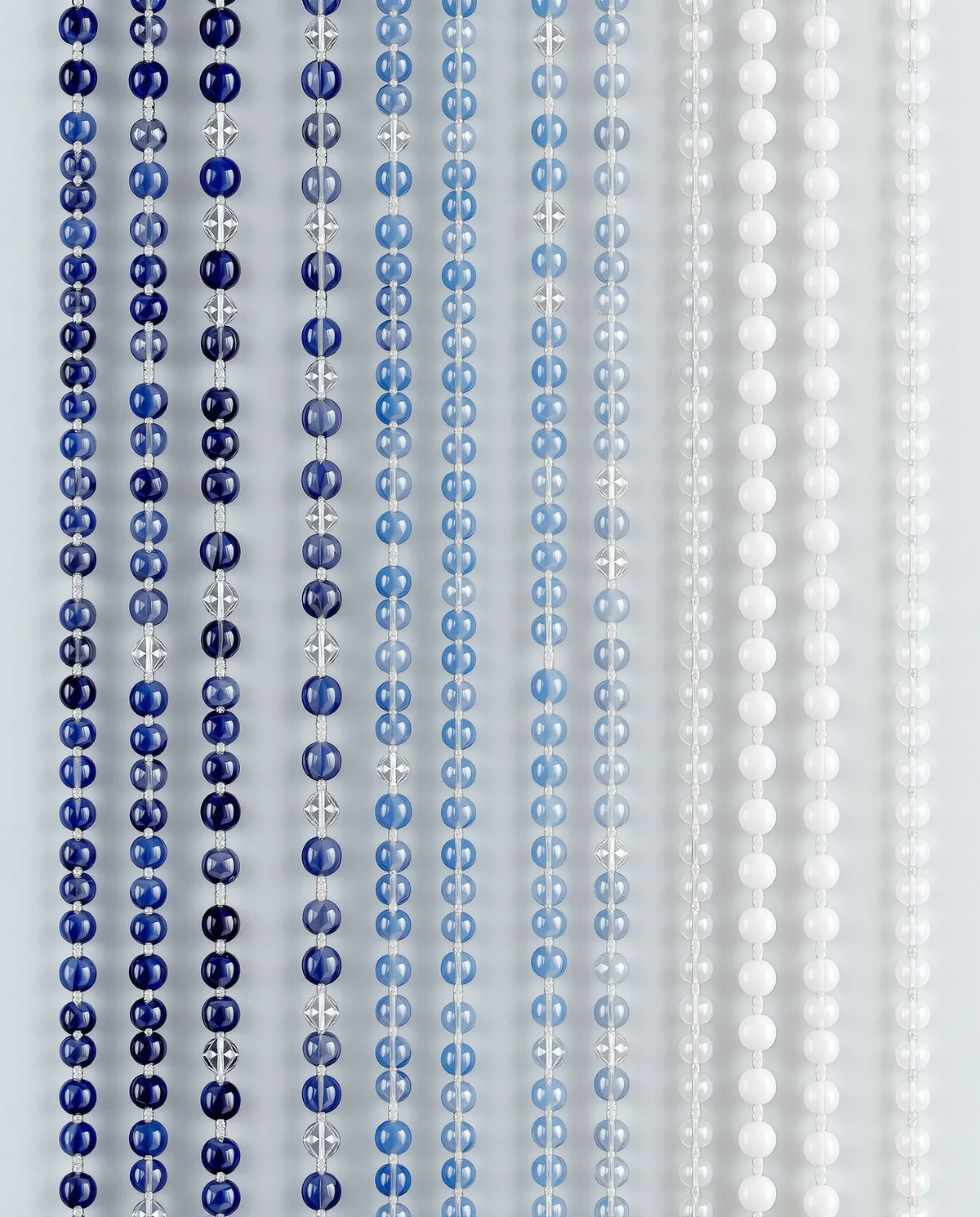
The cool low-contrast story, which is the only story in the library drawn in two genuinely different constructions. The other is a strung wall hanging at 60 × 100 cm on 22 strands.
Those are not two sizes of one product. Reading them together is the clearest illustration available of how far apart two pieces in the same colour story can be: one is beads on cord with a bead count, the other is linked discs with a disc count, and nothing in either quote resembles the other.
None. The piece is discs, and the palette has to be reached by dye because a cast or cut disc has no natural colour to start from.
That is an advantage rather than a limitation. Dyed resin and dyed acrylic are both more uniform than a dyed glass bead of the same lightness, because the colour runs through the material, so a pale palette is easier to hold in a disc than in glass.
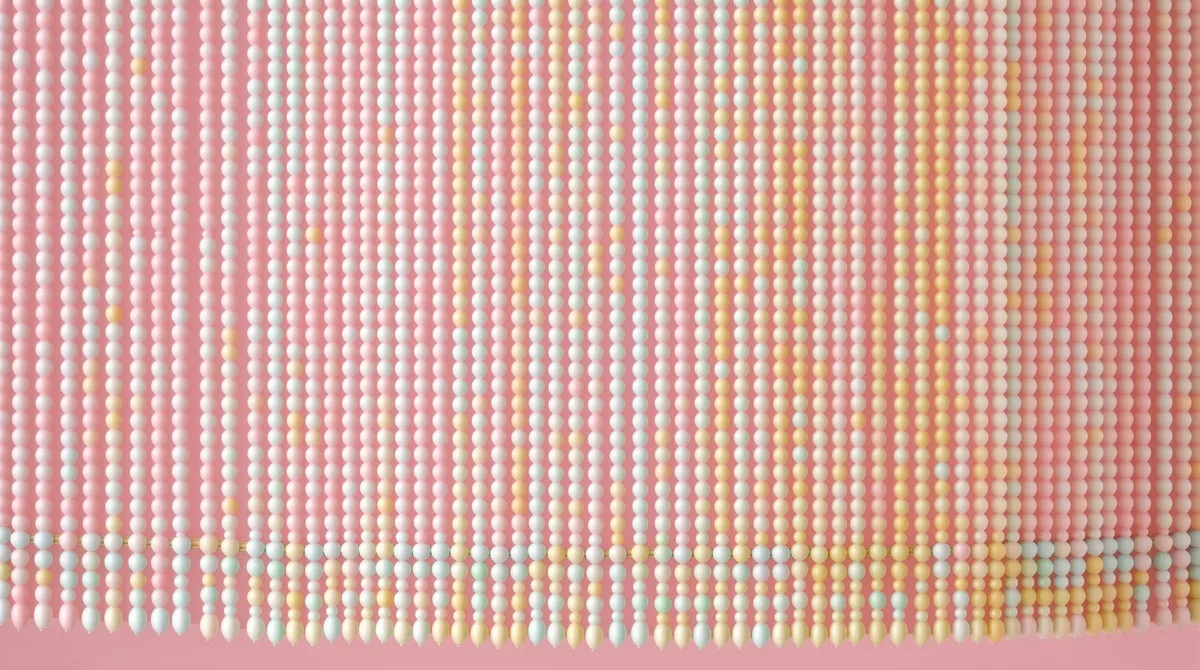
As the bottom of the columns, and the simplest version is level. A shaped lower edge on a linked piece means columns of different disc counts, which is possible and changes the load on each column — a shorter column is lighter and settles differently from its neighbour.
For a first development, level columns are the right choice.
A turned wooden dowel at 90 cm, made in our own Saharanpur wood factory, with its section checked against the finished weight. The load question here is unlike anything else in the library. On a strung piece the cord distributes the load along its length; on a linked piece the load concentrates at every joint, and the uppermost joint of a 200 cm column is carrying the mass of every disc below it. Establishing that figure on a sample is the first development task.
Recoloured freely and exactly, which is the disc build's main commercial advantage: every colour is a dye decision and a dye decision can be matched to a physical chip and confirmed on the sample.
Resized with the disc count following the area rather than one dimension. Halving the drop roughly halves the count; narrowing the width removes whole columns.
Interior and hospitality specifiers, and retailers with a coastal or calm-interior range. At 90 × 200 cm it is an architectural piece rather than a decorative one, which places it with the people who work from drawings.
The caution for that audience is that it is unsampled, so the lead time has to include a development and a sample, not just production.
Nothing directly — it has not been sampled — but the record holds one genuine conflict that this design sits on top of, and it belongs on the page.
Faux-capiz disc sampling so far covers 10 to 30 mm discs. The 2027 linked designs are drawn with 25 mm and 50 mm discs. The 25 mm size is inside sampled experience; the 50 mm is not. A 50 mm disc is heavier, catches more air and puts more load on each link point, and at 497 discs those differences compound rather than cancel. If a programme needs certainty, start at 25 mm and treat the 50 mm as the development question it is.
Good to know
Yes, and the disc count moves with the area rather than with one dimension. Halving the drop roughly halves the count; narrowing the width removes whole columns. The disc count is what should be quoted against, not the finished size.
None, strictly. The piece is built from faux-capiz discs — cast resin or dyed cut acrylic — linked to each other. There is no cord carrying beads, which is why the whole specification reads differently from every strung design in the library.
Exclusivity is a commercial decision taken per programme rather than a property of the design. On an unsampled design it is a conversation to have alongside the development.
It shows the format, the column range and a disc count that is an accurate count of the design. What a drawing cannot show is how 497 linked discs behave hanging at 200 cm — which is the open question on this design.
It would be agreed on the sample. A linked column cannot be folded like a textile and a thin disc tangles readily, so packing is a development question rather than a downstream detail — columns bundled in order with interleaving is the starting point.
Yes. For a linked piece the useful things to send are the disc diameter, the column pitch, the overall size and the link method. A rough cost sheet is produced before any sample is made so the levers are visible early.
Keep exploring
Technique
Why a column of linked discs is a different build from a strung strand: the connection, the twist, the packing, and the repair.
Read the guideColour story
Cool, low-contrast tones in foil-lined and frosted glass, built as a strung hanging and as a linked disc piece.
See the detailDesign
Linked faux-capiz disc hangings at 70 × 130 to 90 × 200 cm, and beaded shade designs from a 15 cm sconce to a 50 cm pendant.
How it is madeDesign
70 × 130 cm at about 239 matte faux-capiz discs — the smaller, lighter end of linked-disc construction.
Compare the optionsDesign
Petal-cut faux-capiz discs in an arched field at 90 × 180 cm, with the arch cut into the column disc counts.
Read the guideDesign
60 × 100 cm on 22 strands of foil-lined and frosted sea-glass tones, with disc drops closing a straight hem.
See the detail
Start a conversation
Send a reference, a colour chip or a sketch. Minimums are set per design and confirmed per quote; sampling is quoted separately and usually runs 16 to 20 days from an agreed brief.