Manufacturing
Beaded lamp shades: drums, empires and sconces
Pendant drums, empire table shades and sconce shades in glass beads — how the frame carries the shape, and why we supply shades only.
Open the reference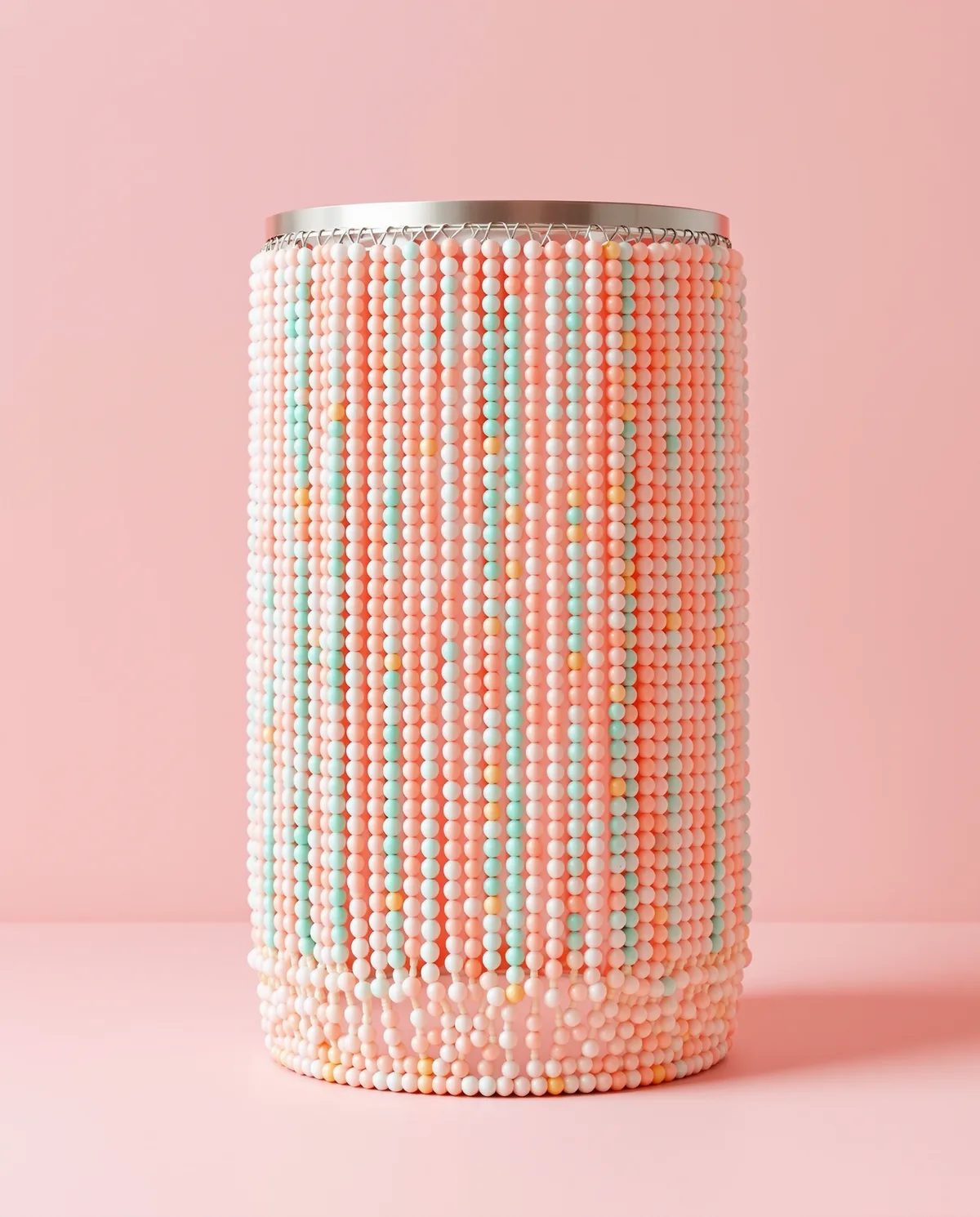
Design · Daisy Daydream Table Shade
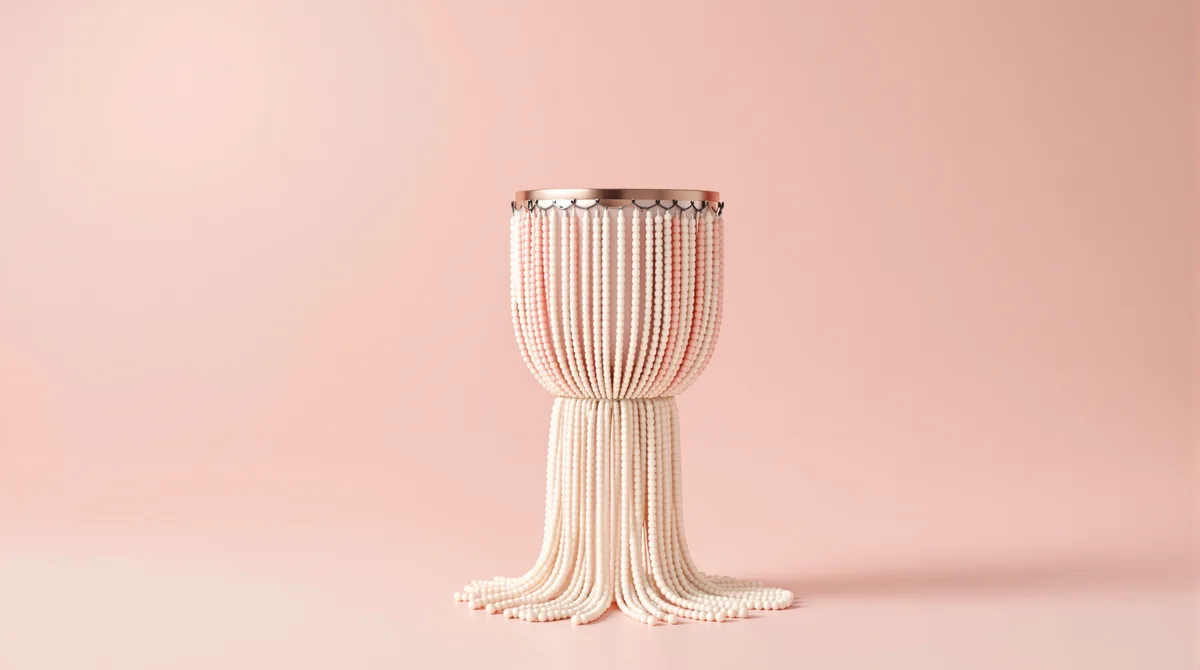
On an empire frame the strands do not hang free. They run from a narrow top ring to a wider bottom ring, and the slope is what holds the shape.
A beaded drum pendant shade, close-strung candy pink, lemon and mint beads in vertical rows on a plain metal ring with a short beaded fringe.
The Daisy Daydream table shade is drawn as an empire frame — 25 cm top ring, 40 cm bottom ring, 28 cm high — with a straight hem finished on a flower ring. On an empire frame the strands run from the narrow ring to the wider one under tension rather than hanging free, so the slope, not the strand length, holds the silhouette.
The Daisy Daydream table shade is drawn as an empire frame: a 25 cm top ring, a 40 cm bottom ring and 28 cm of height, with a straight hem finished on a flower ring.
A table shade in the empire form, which is the format in the shade range that wants a motif: an empire taper gives a reading face that a drum does not, and a daisy placed on it is legible from a seated height.
Under tension, which is the fact that separates a shade from everything else in the library.
On a hanging piece a strand hangs free and its length is its specification. On an empire frame the strands run from the narrow top ring to the wider bottom ring, held between the two, and the slope is what holds the shape. The strand length is therefore set by the frame geometry rather than chosen, and the bead count per strand follows the slope length rather than a drop.
That also means a shade's strand count is set by the circumference of the bottom ring. Across the shade designs in the library strand counts run from 36 on the smallest sconce to 120 on the largest pendant drum, which is far denser per centimetre than any curtain.
A shade sheet starts with the frame. Top and bottom ring diameters and the height define the slope, and the strand count follows the circumference of the bottom ring rather than being chosen. The panel weight goes into a lamp fitting rather than into a wall, so it is the figure a fitter has to be specified against.
| Specification | Value |
|---|---|
| Frame shape | Empire — tapered, narrow top ring to wider bottom ring |
| Top ring | 25 cm diameter |
| Bottom ring | 40 cm diameter |
| Height | 28 cm |
| Hem shape | Straight, finished on a flower ring |
| Strand behaviour | Tensioned between two rings rather than hanging free |
| Strand count range in the shade group | 36 at the smallest sconce to 120 at the largest pendant drum |
| Scope | Supplied as a shade only, to fit the fitting a buyer specifies |
| Status | A design available to develop at the drawn size |
Glass or acrylic on a metal frame, with flower elements forming the bottom ring. The motif is the flower ring rather than a pattern in the field, which is the usual arrangement on a beaded shade: the field carries light and the hem carries the design.
Glass gives more sparkle and weight; acrylic is lighter. Weight matters more on a shade than on a wall piece, because the load goes through a lamp fitting rather than into a wall, and a fitting has a limit a buyer specifies.
Straight, finished on a flower ring. On a shade a straight hem is the norm rather than a compromise — the bottom ring is a physical ring, so the hem is already a defined line and a shaped hem has to be built below it.
The flower ring is what stops a straight hem reading as a cut edge. It gives the bottom a line of its own, and it is the element to change first when adapting the design.
A lamp fitting the buyer specifies, and on a table shade the fitter type is the field that has to arrive first — a Uno fitter and a spider sit the shade at different heights and change the frame, not just the fixing.
That scope limit is worth stating plainly because it is the first question a lighting programme asks. ## Can the flower ring recolour on its own?
Both. Colours are matched to a physical chip or a colour reference and approved on a sample, and the flower ring recolours independently of the field.
The approval on a shade has one requirement nothing else in the library has: the colour has to be approved lit as well as unlit. A bead that reads as cream in a room reads as yellow with a lamp behind it, and the approved sample should be seen both ways.
Resizing recalculates rather than scales. Strand count follows the bottom-ring circumference and bead count follows the slope length, so a change in either ring diameter changes both.
Lighting and home-décor programmes, and retailers with a lamp range. The empire table format is the most domestic of the shade shapes and the easiest to merchandise, because it sits on a table rather than needing an installation.
A shade range is a buyer-led decision rather than a search-led one. The category rewards a retailer who already knows how lighting sells on its own floor, and the design side of it — frame size, fitter type, fringe depth — is settled in sampling.
Because on a shade the frame is the structure and the beadwork is built onto it. The frame and the fitter — the orientation, and whether it screws on or sits on an O-ring — are settled before any beadwork is sampled, so the beadwork is built onto a frame that is final.
On a table shade the frame is a smaller object than on a pendant, so the proportions are less forgiving: a centimetre of extra height at this scale is a visible change in the motif's position, not a tolerance. Settle the frame before the daisy is drawn on it.
It would be agreed on the sample. A framed shade is rigid and non-collapsible, so the carton is set by the 40 cm bottom ring and the piece occupies a large carton for its value.
That is a design constraint rather than a downstream detail, and it is the same trap a non-collapsible wall piece in the record fell into. On a shade range, carton cube is part of the design brief.
It cannot show the thing a shade exists to do. A beaded shade is a different object lit from inside than it is unlit, so the lit state is what the physical sample is for — photograph it under the lamp it will live with, before the design is approved.
The daisy story in the 2027 library, which is a motif family rather than a palette family. It is worth reading against the Daisy café curtain in the valance group, which uses a daisy motif assembled from custom moulded connector beads on a fabric header.
Same subject, two entirely different constructions: a ring on a frame against a connector in a strand. That comparison is the most useful thing on this page for anyone briefing a motif across formats.
Good to know
It shows the frame dimensions, the hem and the motif as drawn. What a drawing cannot show is the thing a shade has to prove, which is how it looks lit from inside — a beaded shade is a different object illuminated.
It would be agreed on the sample. A framed shade is rigid and non-collapsible, so the carton is set by the 40 cm bottom ring, and a shade occupies a large carton for its value. That is a design constraint, not a downstream detail.
Yes. For a shade the specification is the frame — top and bottom ring diameters, height, fitter type — plus the bead sequence and the hem. Send the frame and the fitting it has to suit and the beadwork follows from it.
Yes. Colours are matched to a physical chip or a colour reference and approved on a sample, and the flower ring can be recoloured independently of the field. On a shade the colour has to be approved lit as well as unlit.
Yes. Strand and bead counts are recalculated for the new diameter and height rather than scaled, because the strand count follows the circumference of the bottom ring and the bead count follows the slope length.
Glass or acrylic beads carried on a metal frame, with flower elements forming the bottom ring. Glass gives more sparkle and weight; acrylic is lighter, which matters more on a shade than on a hanging because the fitting carries the load.
Exclusivity is a commercial decision taken per programme rather than a property of the design. On an unsampled design it is a conversation to have alongside the development.
Keep exploring
Manufacturing
Pendant drums, empire table shades and sconce shades in glass beads — how the frame carries the shape, and why we supply shades only.
Open the referenceDesign
Linked faux-capiz disc hangings at 70 × 130 to 90 × 200 cm, and beaded shade designs from a 15 cm sconce to a 50 cm pendant.
Compare the optionsDesign
70 × 130 cm at about 239 matte faux-capiz discs — the smaller, lighter end of linked-disc construction.
Read the guideDesign
Petal-cut faux-capiz discs in an arched field at 90 × 180 cm, with the arch cut into the column disc counts.
Specs and sizesDesign
A long-fringe drum at 40 cm diameter by 50 cm deep with deep scalloped hems — the longest fringe in the shade group.
Specs and sizesDesign
Six-inch daisies assembled from custom moulded almond beads, on a cotton header with a three-inch rod pocket and a scalloped chevron hem.
See the detail
Start a conversation
Send a reference, a colour chip or a sketch. Minimums are set per design and confirmed per quote; sampling is quoted separately and usually runs 16 to 20 days from an agreed brief.