Manufacturing
Custom moulded beads
Draw the bead, cut the die, mould and dye it: what a custom bead shape costs, what it needs from a buyer, and when it pays.
See the detail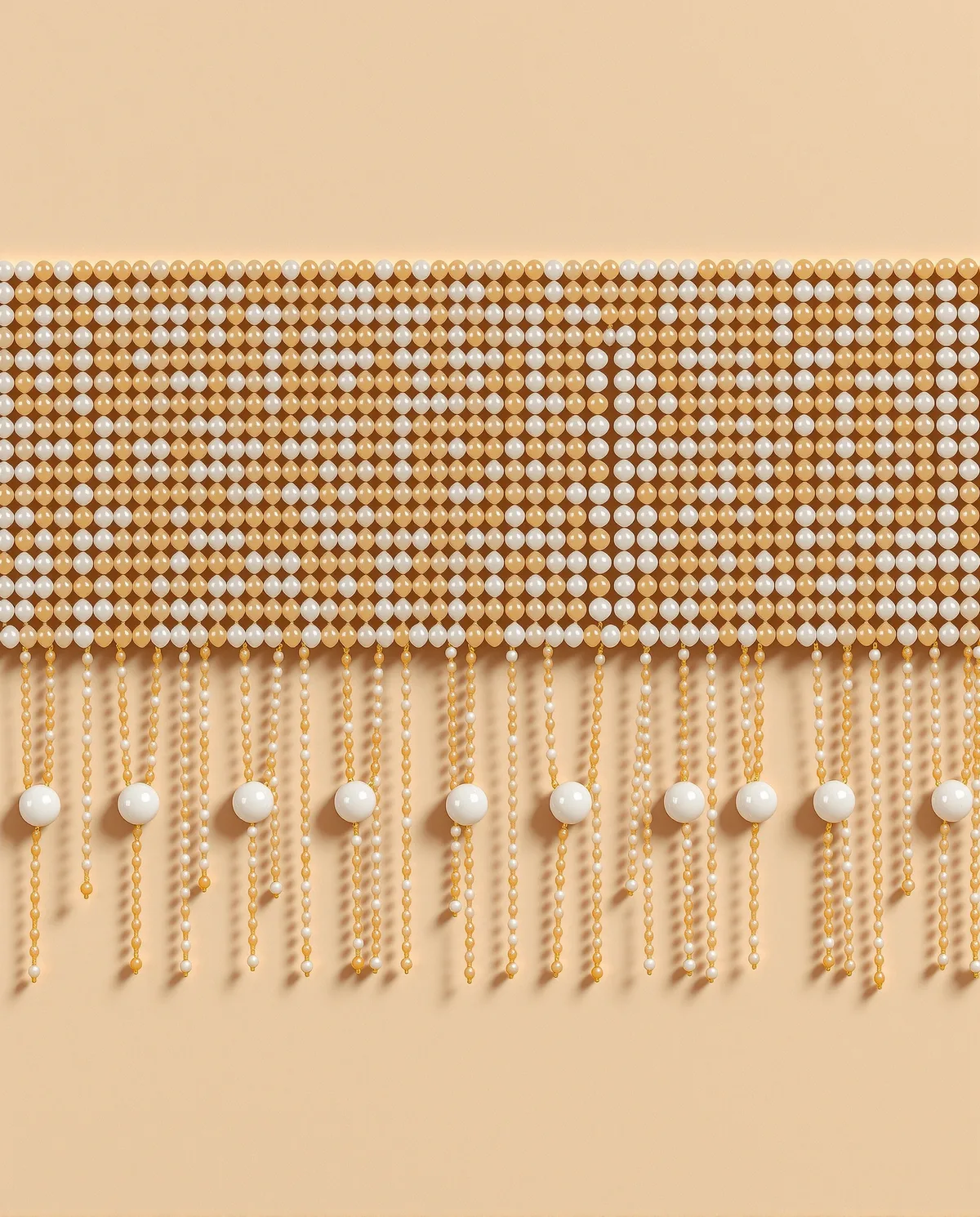
Design · Daisy Café Curtain
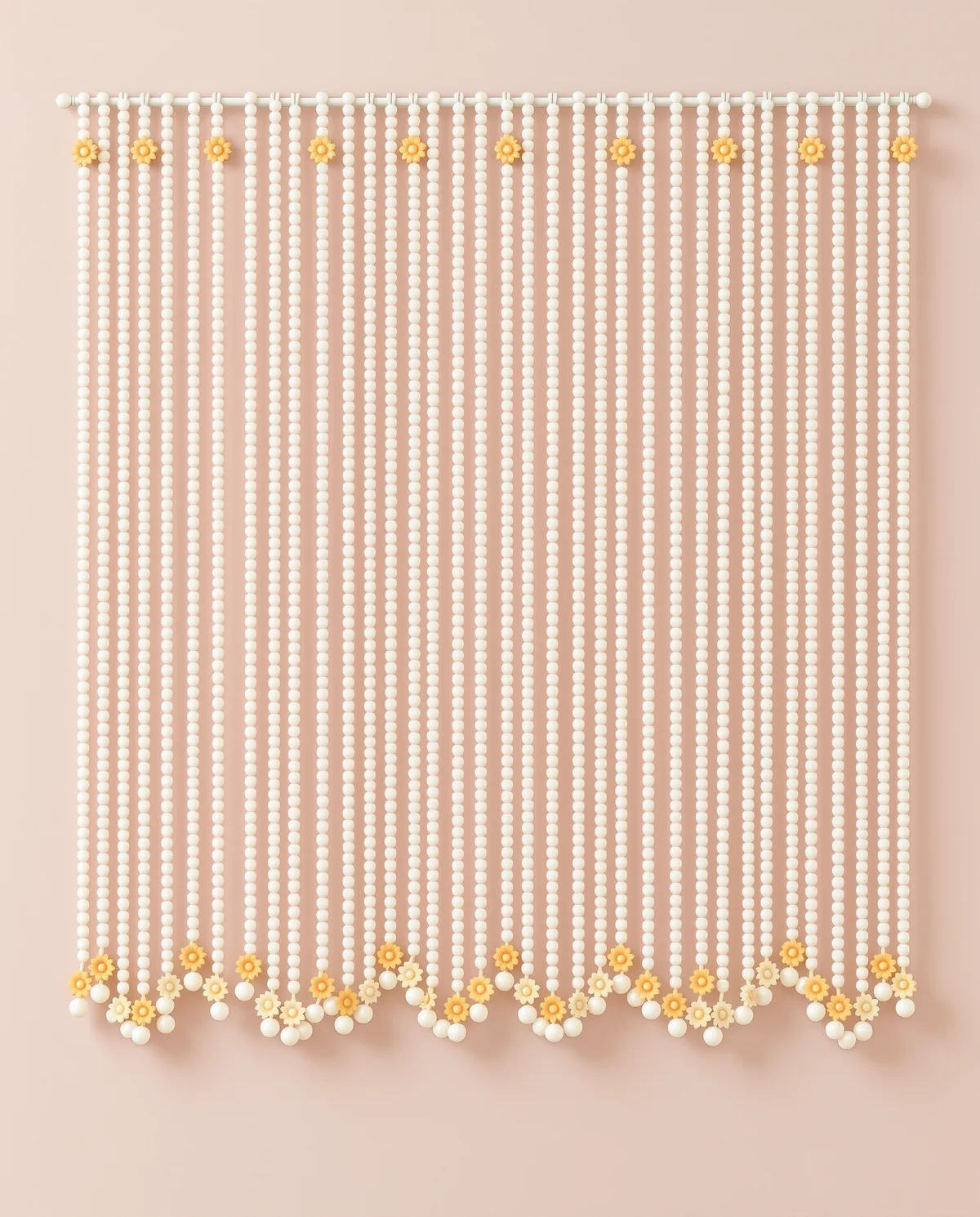
The flowers are not flower-shaped beads. Each daisy is assembled from almond-shaped connector beads moulded to our own dies.
A solid beaded top band worked in close horizontal rows above the point where the strands separate and fall free.
The Daisy café curtain assembles its flowers rather than using a flower bead. Each six-inch daisy is built from custom almond-shaped beads injection-moulded to our own dies and used as connectors, so the petals link the beadwork together as well as forming the shape. It runs at 24 × 30 in on a cotton header with a three-inch rod pocket and a scalloped chevron hem.
The Daisy café curtain is the most composite design in the library: a 100 per cent cotton header band with a three-inch rod pocket, a beaded top trim above the strands, custom moulded daisy connectors, oval drop beads, and a scalloped chevron hem, all in a piece 24 inches tall.
It is a live style, in current production. Four construction families in a small piece is unusual, and each one is there for a reason.
From the top down. The cotton band carries the rod pocket and the beaded top trim. Below that the beaded strands run, with daisies set into them and oval drops finishing the ends.
The daisy itself is the construction worth understanding. It is not a flower-shaped bead. Each daisy is assembled from almond-shaped beads at three inches, arranged as petals, and those almond beads act as connectors — they link the beadwork as well as forming the shape. So a daisy is simultaneously a motif and a structural junction, which is why it can sit in the middle of a strand without an additional fixing.
Four documents rather than one. A rod pocket header on a cotton band is a sewing specification. The daisy is a moulded bead with a die behind it. The scalloped chevron is a list of strand lengths, so the longest and shortest drop are both stated. And the beads are dyed to match the cotton, which is two colour approvals rather than one.
| Specification | Value |
|---|---|
| Finished size | 24 × 30 in, plus a three-inch rod pocket |
| Header | 100 per cent cotton header band with a sewn rod pocket |
| Top trim | Beaded top trim above the strands |
| Feature bead | Custom almond-shaped beads, three inches, injection-moulded to our own dies |
| Daisy diameter | About six inches, assembled from almond beads as connectors |
| Secondary bead | Oval drop beads |
| Hem shape | Scalloped chevron |
| Tooling | Die costs for the almond bead were carried by us, not the buyer |
| Production | 40 to 60 days after sample approval |
A fabric-headed piece has a packing advantage over a dowel-hung one: the cotton folds, the rod is not in the shipment, and the carton is set by the folded dimension rather than by a rigid header. At café-curtain size that makes the piece unusually efficient to freight.
The imagery here is editorial and shows construction: the header band, the connector assembly, the chevron hem. It is not a photograph of the specific piece a buyer receives, and it is not captioned as if it were.
None of the fourteen named 2027 stories. Its own colourway is described as a pink — a rose cotton header with tonal pink daisies and beads — and it belongs to the production programme.
The design is worth reading against the daisy story in the 2027 lamp-shade designs, which uses a flower motif as a ring on a frame rather than as a connector in a strand. Same subject, entirely different construction.
The almond bead, and it is a bead that did not exist before the design. An almond shape at three inches is not a catalogue item, so it was injection-moulded to our own dies — acrylic is injection-moulded and dyed to the colour given, which makes a new shape a tooling question rather than a material one.
The die costs on that bead were carried by us rather than by the buyer. That is a commercial choice with a design consequence: because the tooling is ours, the shape is available to other programmes, which is how a one-off custom bead becomes a library bead.
A scalloped chevron: a chevron profile whose edges are scalloped rather than straight. Two profiles in one edge, and both exist only as strand lengths on the count sheet.
It is the most demanding hem in the library to specify because every strand length is doing two jobs at once — placing the chevron and placing the scallop within it. Written out, it repeats exactly; judged at the bench, it does not repeat at all.
A rod of the installer's choice, through a three-inch cotton pocket. The fabric header changes where the load sits. On a dowel-hung curtain the strands pull on the dowel; here they pull on a sewn seam, so seam construction and fabric weight are part of the engineering rather than part of the trim.
Recoloured across three independent elements: the cotton, the moulded beads and the drops. That means three colour approvals rather than one, and the one most often mismatched is the cotton against the beadwork, because fabric dye and acrylic dye do not respond to the same reference in the same way.
Resizing moves the sewing pattern as well as the beadwork, and the daisy is a fixed assembly at about six inches, so a much smaller piece either carries fewer daisies or needs a new almond bead size.
Retailers and own-label brands, in kitchen, dining and children's ranges, and anywhere a window-treatment programme needs a beaded piece that hangs from a standard rod. It is in current production.
The rod pocket is what makes it saleable into a soft-furnishings range rather than only into a décor range, and that is worth more commercially than any individual design decision in the piece.
That bead size is a design decision with a price attached, and it is best settled early. The almond bead went through a sizing question before the dies were cut — a smaller almond against the three-inch one — and the answer determined the daisy diameter, the bead count and the whole proportion of the piece.
The second lesson is about ownership. Funding the dies ourselves put the shape in our own library rather than in a buyer's, which is why the connector daisy has since been available to other developments. On a custom bead, who pays for the tooling decides who can use the shape afterwards.
Good to know
Yes. A sketch, photo or artwork with size, materials, colours and quantity becomes a colour-count sheet. Where a design needs a bead shape nobody stocks, it is injection-moulded to our own dies, and the die work is quoted as part of the development.
Yes, across all three elements independently: the cotton header, the moulded almond beads and the oval drops. Acrylic is injection-moulded and dyed to the colour given, and the cotton is dyed separately, so the header and the beadwork are two colour approvals rather than one.
Yes, with two constraints. The daisy is a fixed assembly at about six inches, so a much smaller piece either carries fewer daisies or needs a new bead size. And a size change moves the cotton pattern, so it is a sewing change as well as a beadwork one.
Custom three-inch almond-shaped beads used as daisy connectors, oval drop beads on the strands, and smaller beads in the top trim. The almond bead is injection-moulded to our own dies rather than selected from stock.
Exclusivity is a commercial decision taken per programme rather than a property of the design. Where a design uses a bead moulded to our own dies, the tooling arrangement belongs in the same conversation and is quoted with it.
The imagery on this page is editorial and shows construction — the header band, the connector assembly, the chevron hem. It is not a photograph of the specific piece a buyer receives, and it is not captioned as one.
Strands are kept in order and protected against knocking in transit, then packed to your carton, label and packaging specification. A fabric-headed piece folds, so it packs more compactly than a dowel-hung curtain of the same area.
Keep exploring
Manufacturing
Draw the bead, cut the die, mould and dye it: what a custom bead shape costs, what it needs from a buyer, and when it pays.
See the detailManufacturing
Built on a cotton or organza header with a three-inch rod pocket: the band, the strands, the hem and the sizes we have shipped.
Compare the optionsDesign
Valances at 120 × 30 to 40 cm and café curtains at 76 × 76 cm, documented by hem shape, strand count and bead count.
Read moreDesign
The deep blue story at valance drop — 120 × 30 to 40 cm, where the same palette runs a fraction of the doorway bead count.
Specs and sizesDesign
A scalloped awning profile over a pastel scatter at the 120 cm width, so the short drop reads as deliberate.
Specs and sizesDesign
Dyed glass seed beads embroidered onto a sheer ground at 30 inches square, with a three-inch rod pocket.
See the detail
Start a conversation
Send a reference, a colour chip or a sketch. Minimums are set per design and confirmed per quote; sampling is quoted separately and usually runs 16 to 20 days from an agreed brief.