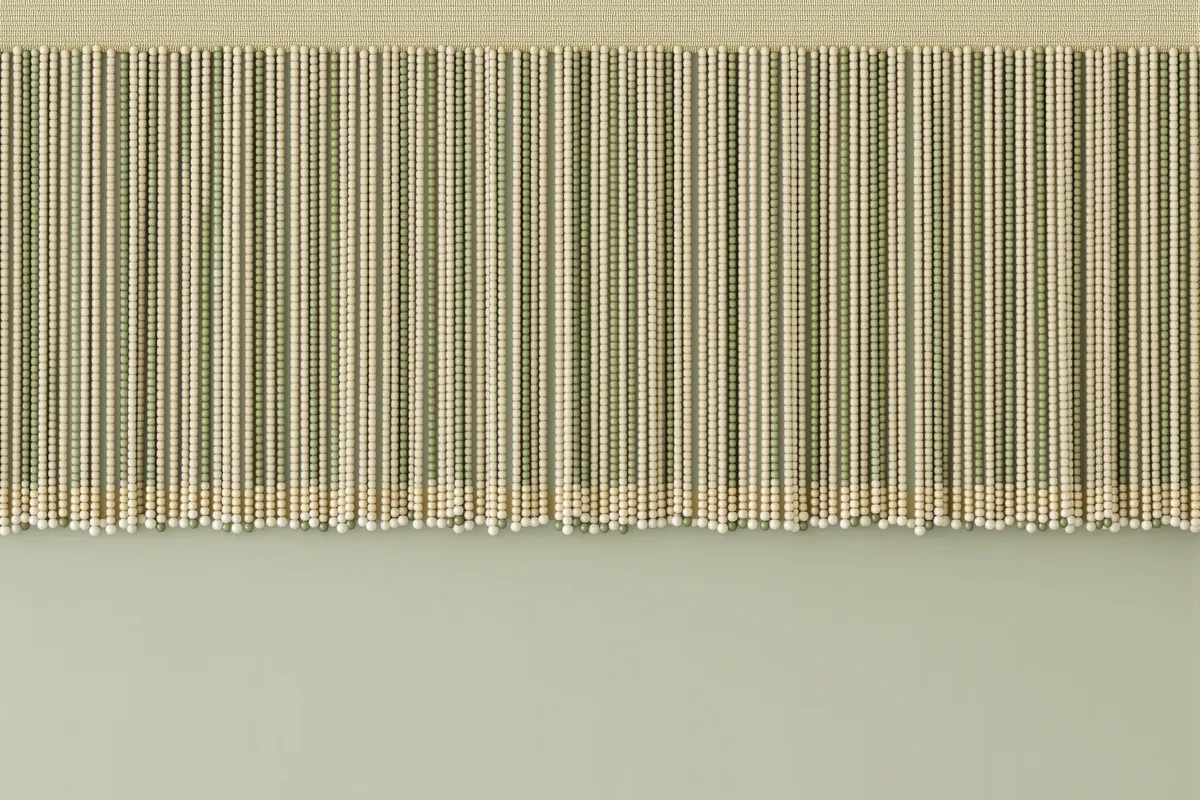
Colour story
Seventies Sunroom palette
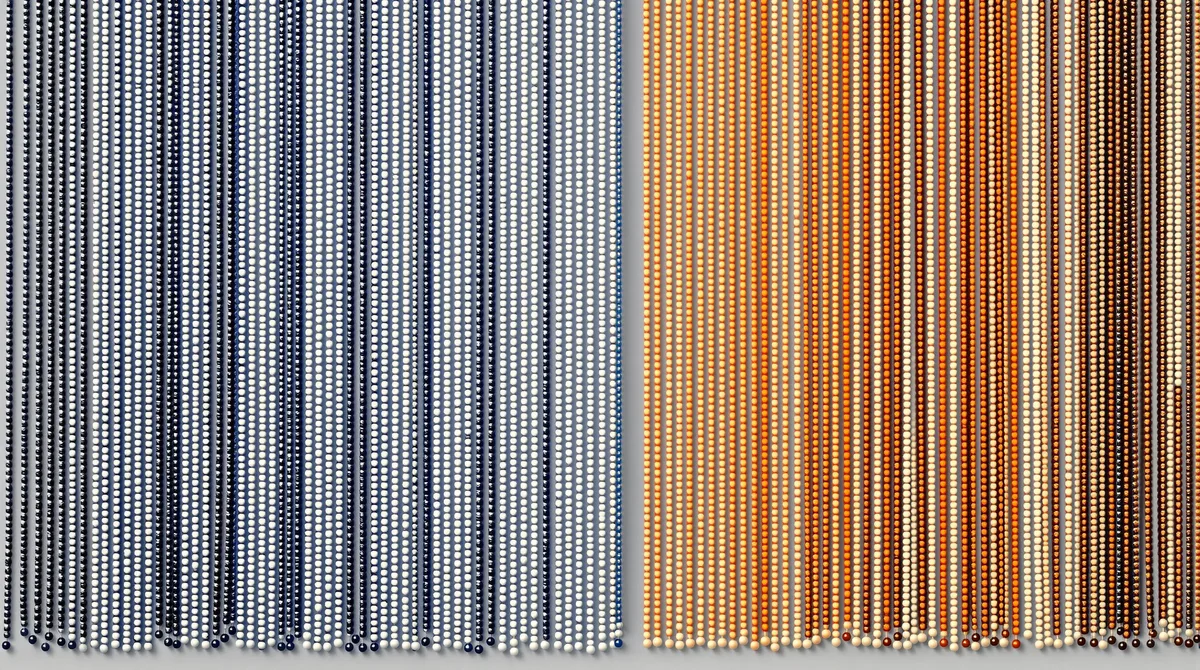
Glossy orange, canary glass, chocolate brown and cream soda, built as a door curtain, a sunburst valance and a wall hanging.
Read the guide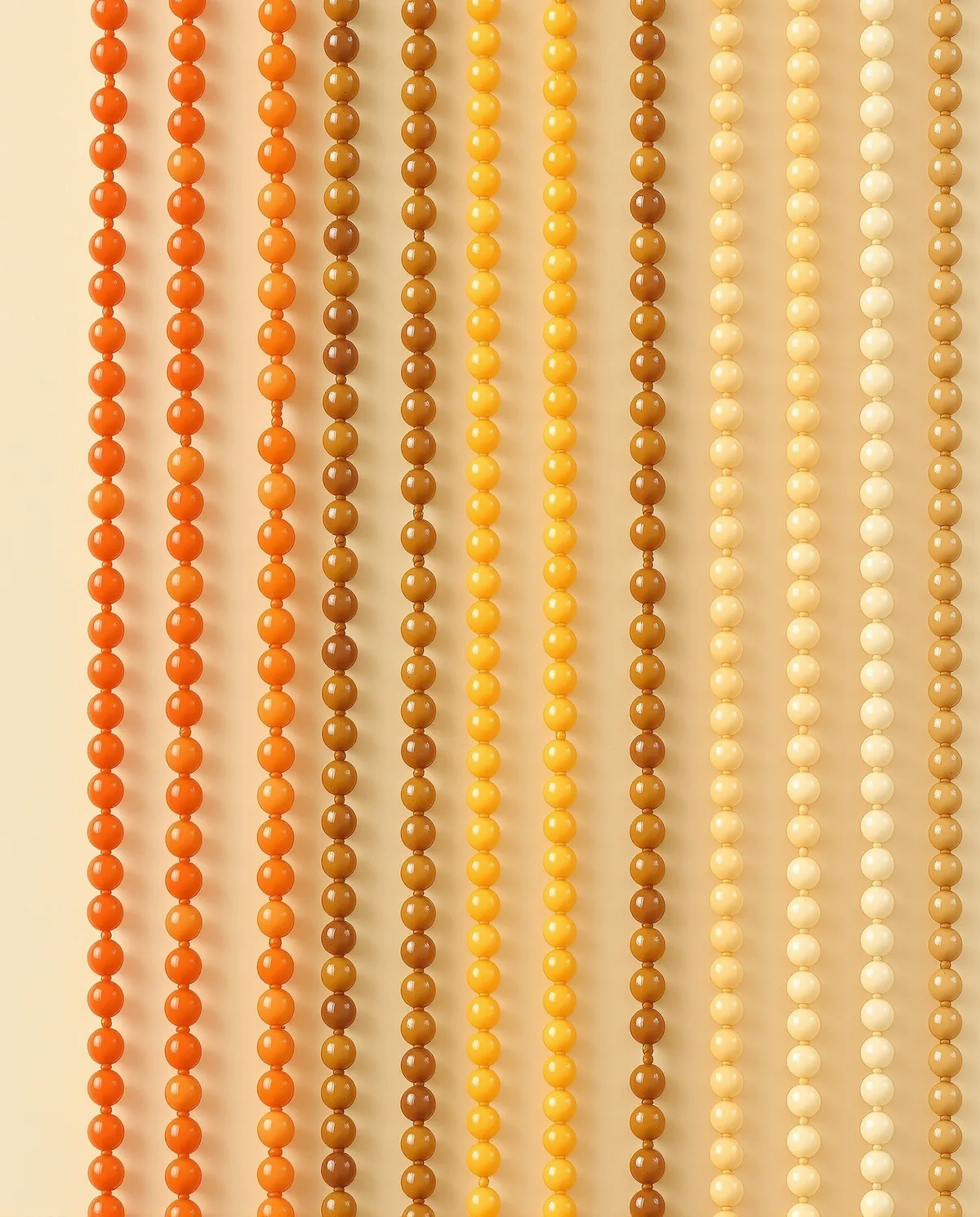
Design · Seventies Sunroom Door Curtain
An inverted-V hem is the opposite of a point: longest at the edges, shortest in the middle. On a doorway that is a functional decision, not a decorative one.
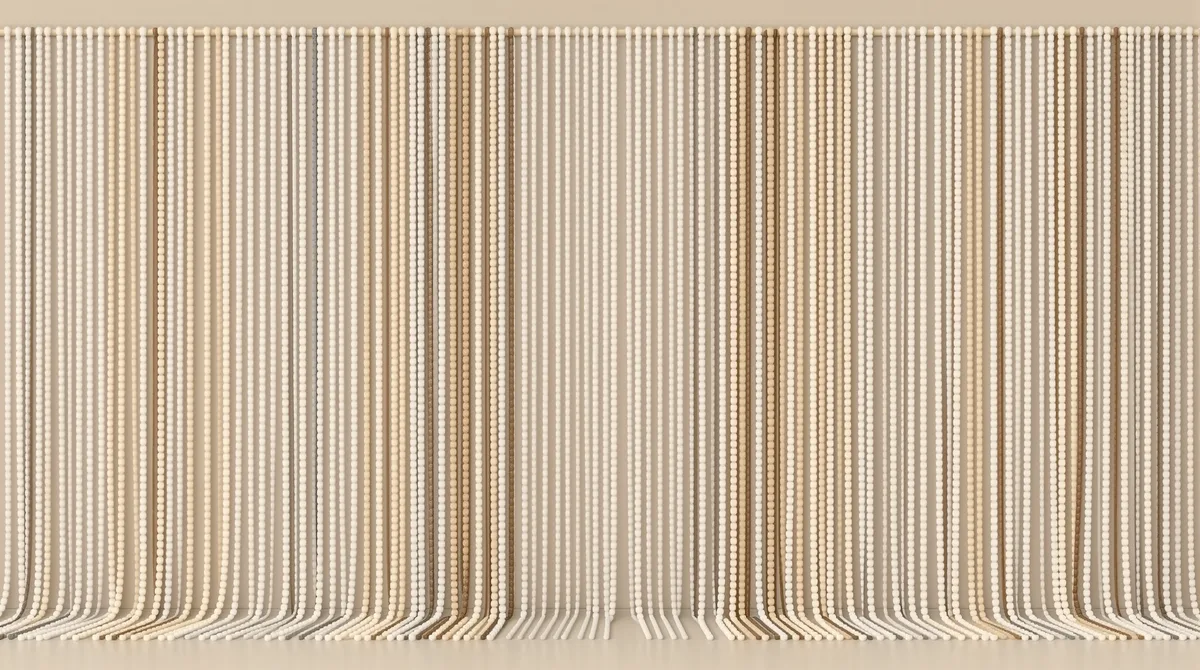
Six bead strands in the Seventies Sunroom palette — glossy orange, canary, chocolate brown and cream soda — hung parallel against a cream-soda ground.
The Seventies Sunroom door curtain is drawn at 120 × 200 cm on 60 strands with an inverted-V hem, in glossy orange, canary glass, chocolate brown and cream soda. An inverted-V runs the longest strands at the two edges and the shortest at the centre, so the middle of the panel is the easiest place to walk through.
The Seventies Sunroom door curtain is drawn at 120 × 200 cm on 60 strands with an inverted-V hem, in the collection's own palette of glossy orange, canary glass, chocolate brown and cream soda.
It is the largest piece in this story — the others being a sunburst valance at 120 × 35 cm and a wall hanging at 60 × 100 cm — and it belongs to the one 2027 collection that is beaded throughout.
Sixty strands across 120 cm, which is the library's convention at this width and works out at about a 2 cm pitch. That is dense enough to read as a full panel rather than as an open screen.
Each strand is a written sequence of the palette's four colours. There is no scattered accent and no graphic map, so the design's interest comes from the palette and the hem rather than from a pattern.
At 120 cm the figures to check are the ones about span rather than colour. Strand count and pitch set the density; the header rail section has to be checked against the panel weight at that width; and the inverted-V profile needs the longest and shortest drop given, not a single height. Carton sizes follow the 120 cm dowel.
| Specification | Value |
|---|---|
| Finished size | 120 × 200 cm |
| Strand count | 60 |
| Strand pitch | About 2 cm centre to centre |
| Hem shape | Inverted V — longest at the edges, shortest at the centre |
| Palette | Glossy orange, canary glass, chocolate brown, cream soda |
| Finish | Gloss, specified alongside colour |
| Matched pieces | Sunburst valance at 120 × 35 cm; wall hanging at 60 × 100 cm |
| Studio link | Confirmed collection slug — app.gemixx.com/?c=seventies-sunroom |
| Status | A design available to develop at the drawn size |
What it does not show is a shipped piece. The figures here are the design's own — a count of what is drawn, which is available to develop at that size — rather than a measurement off a finished curtain.
The Seventies Sunroom colour story, which is collection 10 in the Design Studio and was announced in October 2026. Its notes describe it as a sun-faded record sleeve, and the commercial observation attached to it was that buyers were asking for statement pieces in warm, dotted and amber looks.
The Design Studio link for this collection is confirmed: app.gemixx.com/?c=seventies-sunroom, where the design opens as your own copy to recolour, resize and send back for costing.
Glossy glass, and gloss is as much the specification as colour is. On a glass bead, gloss is decided at the works alongside colouring and frosting, and a glossy orange reads several steps more saturated than the same colour matte.
Cream soda is the note that does the structural work and gets the least attention. It sits between a warm white and a pale yellow, which is exactly where two people describe the same bead differently, so it is the line to sample first.
An inverted V: the longest strands at the two edges, the shortest at the centre. That is the opposite of a V-point, and on a doorway it is a functional decision rather than a decorative one — the panel is at its thinnest exactly where a person walks through it.
It also has a cost consequence worth knowing. An inverted V removes bead length from the middle of the panel, where a doorway needs it least, so it is one of the few shaped hems that reduces the bead count rather than complicating it.
A single turned wooden dowel at 120 cm, made in our own Saharanpur wood factory. At that span the dowel section matters: a dowel that is adequate at 90 cm will sag at 120 cm with a dense glass panel on it.
Weight is established on the approved sample and recorded on the packing specification, and it drives the fixing — at this width, a rod with brackets fixed into the frame or the wall.
Both. The palette structure — two warm brights against two neutrals — transfers cleanly to any hue family, and in the Design Studio the design opens as a copy to recolour directly.
Resizing a width means dropping or adding strands on the library's convention. Resizing the hem means redrawing the V rather than scaling it, because the depth of the V relative to the width is what makes it read as a shape rather than as a sag.
Retailers and own-label brands, and the whole three-piece set is the strongest merchandising argument in the library: one palette, three formats, one approved colour set. A buyer can take the valance as the entry piece, the wall hanging as the mid-size one and this curtain as the statement.
It also suits hospitality and event specifiers wanting a warm period reference, which is the register the palette was built in.
The design has not been through development, so the answer is that the lessons come from adjacent sampled work. Two apply directly: that gloss has to be specified and approved physically because a chip cannot record it, and that a 120 cm dowel needs its section checked against the finished weight rather than copied from a 90 cm build.
At 120 cm wide the carton is the limiting dimension and pieces per carton are agreed at quote stage rather than assumed.
Good to know
Exclusivity is a commercial decision taken per programme rather than a property of the design. Name it in the brief and it is quoted alongside the piece.
It shows the design as drawn — format, strand count, hem and palette — built from named beads, so it can be turned into a colour-count sheet for sampling. The design is drawn to size and available to develop.
Strands are kept in order and protected against knocking in transit, then packed to your carton, label and packaging specification. At 120 cm wide the carton is the limiting dimension, so pieces per carton are agreed at quote stage.
Yes. A sketch, photo or artwork with size, materials, colours and quantity becomes a colour-count sheet, with a rough cost sheet before any sample is made. In the Design Studio this design also opens as your own copy to change, and the collection link for it is confirmed.
Yes, and the palette structure travels well — two warm brights against two neutrals. Keep the gloss specification when recolouring, because a matte version of this palette is a different design.
Yes. The library's conventions are 40 strands on a 90 cm width and 60 on 120 cm, so a narrower version drops strands. The inverted-V hem needs redrawing rather than scaling, because the depth of the V relative to the width is what makes it read.
Keep exploring
Colour story
Glossy orange, canary glass, chocolate brown and cream soda, built as a door curtain, a sunburst valance and a wall hanging.
Read the guideDesign
The full-length doorway designs, 90 × 200 to 120 × 210 cm, documented by strand count, hem shape and bead count.
Read moreDesign
120 × 180 cm on 60 strands at about 2 cm pitch, with pastel accents placed from a written bead map and a straight hem.
Compare the optionsDesign
120 × 210 cm, the largest drop in the library, in silver, clear and off-white faceted glass.
Read the guideDesign
Thirty hand-strung strands of translucent acrylic at 90 × 200 cm on a stained header rail, recoloured season after season on one construction.
Read the guideDesign
120 × 35 cm with a radiating hem, in glossy orange, canary, chocolate and cream soda.
See the detail
Start a conversation
Send a reference, a colour chip or a sketch. Minimums are set per design and confirmed per quote; sampling is quoted separately and usually runs 16 to 20 days from an agreed brief.