Compliance
Do glass beads contain lead?
Why lead oxide is used in cut glass, which bead families are affected, and what the limits actually measure.
Specs and sizes
Guide · Safety
Touching a glass bead is not the risk anyone should be worried about. Mouthing one is a different question, and it has a real answer.
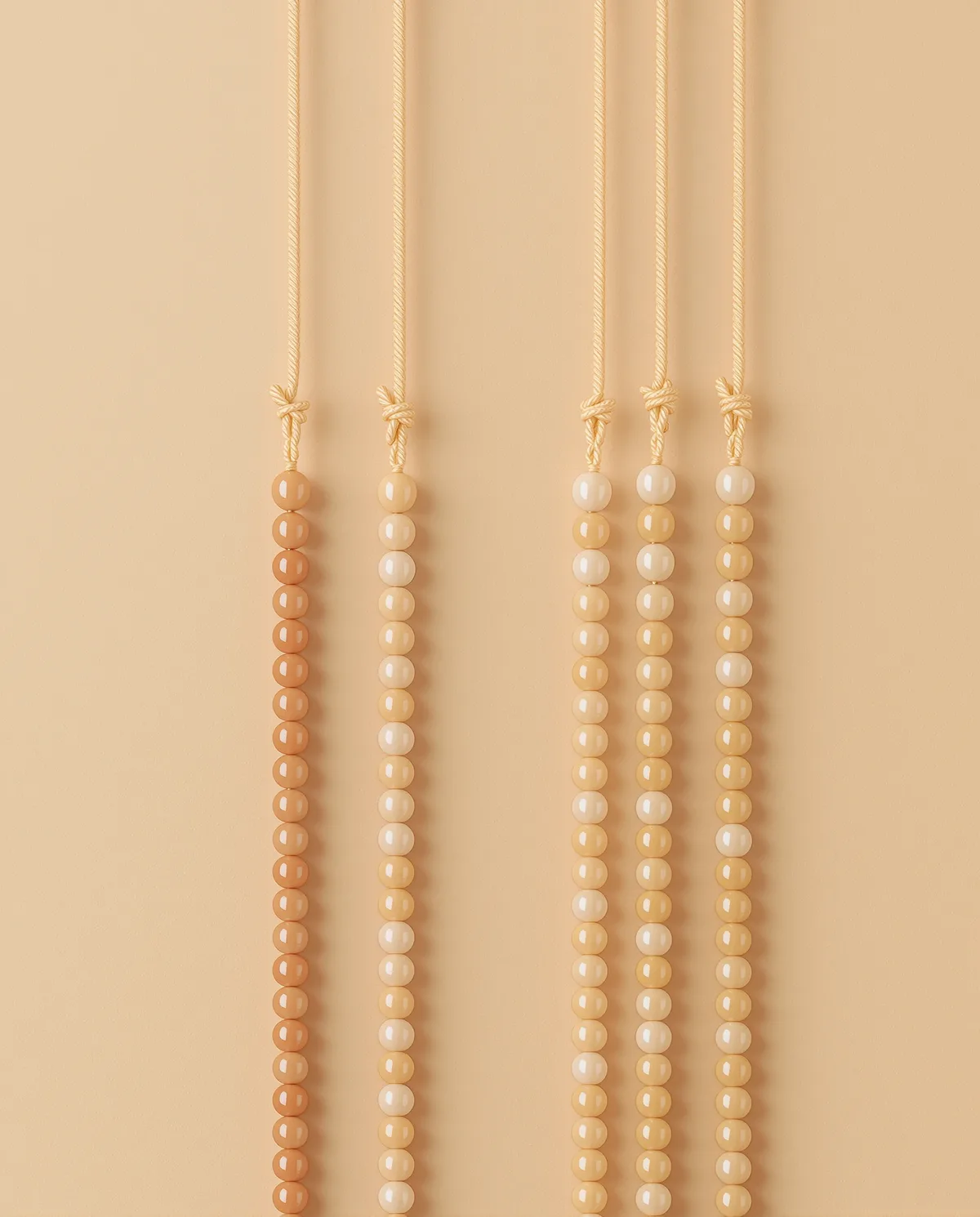
Macro view of five glass seed beads, the barrel shape left by drawing the glass and the bored threading hole running through each bead clearly visible.
Handling a finished glass bead is not the exposure route of concern. Lead and other metals used in glass colouring are bound in the glass matrix, so the question that matters is ingestion and mouthing rather than touch — which is why the regulated cases are children's products and small parts, not decorative panels an adult walks through.
Yes, for an intact bead. Picking up, hanging, dusting and walking through glass beadwork is not an exposure route anyone needs to manage.
The questions worth taking seriously are different ones: a young child mouthing a bead, a loose bead as a small part, and a sharp edge after a bead has broken. All three are about where the piece is and who is in the room, not about the glass.
Colour in glass is in the glass. Metals used as colourants are bound into the vitrified body during melting, which is why a finished, unbroken glass bead does not transfer them to a dry hand. That is the same reason the regulatory attention in this area sits on children's products, on paint and coatings, and on small parts — categories where material reaches a mouth — rather than on decorative objects adults pass through.

Where the reasoning changes is at a surface. A surface-dyed seed bead carries its colour as a coating; an iridescent or pearlised finish on a faceted bead is applied after forming. Those are surfaces, and a surface on a frequently handled object is a reasonable thing to ask about. On a hanging panel it is academic. On a bead a toddler will hold, it is not.
| Question | Applies to | Honest position |
|---|---|---|
| Skin contact with a finished bead | All bead materials | Not an exposure route of concern for an intact bead |
| Mouthing or swallowing | Children under three, and pets | The route that matters; keep loose beads and broken beads away |
| Lead in glass colourants | Coloured glass generally | Bound in the glass body; tested per programme where a buyer requires it |
| Surface dye on seed beads | Surface-dyed glass and acrylic | A coating rather than a body colour; specify body colour where handling is constant |
| Iridescent or pearlised finish | Faceted and AB-finish beads | Applied after forming; a surface, and treated as one |
| Sharp edges | Broken or chipped glass | The immediate hazard from breakage; clear up and re-string |
| Small parts | Any loose bead | A choking hazard in a household with a young child |
| Published lead figure for our glass beads | — | None published. Tested per build when a programme requires it |
It says very little about decorative glass beadwork specifically, and a lot about children's products.
In the United States the rules that bite are the children's-product rules and the Proposition 65 listing regime in California, which is a warning obligation rather than a prohibition. Proposition 65 is why lead testing appears as a standard line item in retail programmes: a buyer selling into California wants documentation, and the way to get it is to test the bead. In the United Kingdom and the European Union the equivalent arrives as incremental testing on an order, which is quoted and amortised across the units.
What none of those regimes do is set a limit for touching a decorative panel. The reading is that the regulation is pointed at ingestion, and so should a buyer's attention be.
Three decisions, all taken before sampling.
Specify body-coloured glass rather than surface-dyed beads wherever a piece will be handled constantly, because a body colour is not a coating and there is nothing on the surface to come away.
Specify a bead size that is not a small part — a pressed oval at about 13 × 22 mm rather than a seed bead — for any piece going into a household with a child under three, and keep the spare-bead bag sealed and high up.
And specify the test, if the programme needs documentation. Lead testing against California Proposition 65 is a line item rather than an obstacle; it is arranged against the actual bead and quoted separately, in the same way sampling is quoted separately. Asking for it at brief stage costs far less than retro-fitting a certificate to a finished order.
Through small parts, not chemistry. A seed bead at one to three millimetres is the easiest bead in the category to lose into a carpet and the easiest for a crawling child to find. A pressed oval at about 13 × 22 mm is a different proposition, and a 50 mm faux-capiz disc is not a small part at all.
So if a panel is going into a household with a child under three, the size conversation is worth having at specification stage: larger beads, fewer accents, and a hem that finishes above a crawling child's reach.
Breakage, because every other hazard follows from it. An intact bead is inert; a broken glass bead is a sharp edge and a scatter of small parts at once.
Glass strength is colour-dependent, which is the most useful and least known fact in this whole area. Some colours knocking against others in a hanging panel will chip, and the fix is a furnace-process change, annealing the larger feature beads, and revising the palette so incompatible colours are not adjacent. On one Venetian-glass portal we did exactly that. Designing a panel so its beads do not break is a safety measure as well as a quality one.
Glass beads are drawn and hand-strung in our own Firozabad glass works, which means the colour formulation, the annealing and the hole consistency are ours to control rather than ours to inspect. Larger feature beads are annealed for strength. Hole size is specified — one development customer specified a bead hole of four to five millimetres and we made to it — because a hole that is too tight abrades the cord and a hole that is too loose lets a bead rock and chip its neighbour.
First-article and lot AQL inspection happens at our quality-control and packaging house in Greater Noida, and product issue rates across the network run at a fraction of a percent. Spare beads can be built into the production run where the order specifies them, so a chipped bead can be replaced rather than tolerated.
Tested: lead against California Proposition 65, as a standard line in retail programmes, with incremental testing for the United Kingdom and the European Union quoted on top. Those results belong to the builds they were run on.
Lead and migration figures belong to a specific build and a specific colourway, so they are tested against the approved sample and reported against it. California Proposition 65 lead testing is covered as standard on our retail programmes. Our food-grade compliance statements — FDA and Proposition 65 — cover the stainless steel lines, and copper products with a food-safe coating or a stainless lining. Decorative beads are not a food-contact surface, so keep them clear of anything that meets food.
"Lead free", unless a test result for that specific bead supports it. "Non-toxic", which is a marketing word with no specification behind it. And any figure for a bead we have not had tested.
We also refuse to carry a result sideways. A lead result on one glass colour in one run is a result for that colour in that run. Colourants differ by colour, which is exactly why the testing is done per build.
Anyone specifying beadwork into a children's product, a nursery or a childcare setting, and the question goes to a test laboratory and to the regulation itself. The California Office of Environmental Health Hazard Assessment publishes the Proposition 65 list and the state's guidance on metals in glass beads; read that rather than a manufacturer's paraphrase of it.
Anyone else can reason from the material. Intact glass, handled by adults, in a doorway: not a chemistry question.
In a nursery, treat it as a small-parts and cord question, not a lead question. Hang it in the doorway rather than over a cot, specify larger beads, keep spares in a sealed bag out of reach, and sweep up a breakage immediately.
In a hotel, the question will arrive as a documentation request rather than a safety one: a buyer or a compliance team wants a test certificate to file. That is a reasonable request and the answer is to test the build and quote the testing separately, which is how it is handled on every retail programme we run.
The material, the bead size, and a small-parts warning where the audience includes households with young children. "Glass beads, approximately 4–5 mm, on cotton cord" tells a parent everything they need to make their own decision.
Avoid absolutes. A listing that says "completely safe" invites the one question it cannot answer, where a listing that names the material and the size answers the question before it is asked.
Good to know
For a programme that needs a number, a third-party test laboratory, and the test should be run against the actual bead rather than against a bead family. For regulatory interpretation in the United States, the California Office of Environmental Health Hazard Assessment publishes the Proposition 65 list, and the state's guidance on metals in glass beads is the document a specifier should read rather than a manufacturer's summary of it.
It changes the hazard, not the chemistry. A small loose bead is a choking hazard for a young child in a way a 13 × 22 mm oval is much less likely to be, and a seed bead at one to three millimetres is the easiest of all to lose into a carpet. Size is a small-parts question, and that is the one worth designing around.
Yes, for an intact bead by an adult or an older child: colourants are bound in the glass and a finished bead does not shed them onto a hand. The questions that remain are mouthing by a young child, loose beads as small parts, and sharp edges after breakage.
It changes which questions apply. Glass raises the colourant and sharp-edge questions. Acrylic does not shatter, so no sharp edges, but it is dyed and a dye is a surface. Wood and bamboo are inert but can splinter. Cast-resin faux capiz is an engineered imitation of capiz shell, so it carries none of the shell-import questions real shell would.
The material, the bead size and a small-parts warning where the piece is sold into a household with children. Do not write "lead free" unless a test result for that specific bead supports it, and do not write "non-toxic", which means nothing in a specification. Naming the glass and the size is both more useful and more defensible.
Lead testing against California Proposition 65 appears as a standard line in the retail programmes we run, and incremental testing for the United Kingdom and the European Union is quoted and amortised across an order's units. A lead figure belongs to a specific build and colourway, so it is tested against the approved sample and reported against it.
Keep exploring
Compliance
Why lead oxide is used in cut glass, which bead families are affected, and what the limits actually measure.
Specs and sizesGuides
One guide per question that arrives often enough to be worth answering properly.
Read moreGuide
Where a loop can form on a strung panel, why strands are finished individually, and what to check on an older piece.
Read the guideGuide
A detached bead becomes a small part, which is why bead attachment is tested rather than assumed.
Specs and sizesGuide
Which component carries the fire risk, which materials change it, and how a classification is tested on the specified build.
See the detail
Start a conversation
Send a reference, a colour chip or a sketch. Minimums are set per design and confirmed per quote; sampling is quoted separately and usually runs 16 to 20 days from an agreed brief.