Guide
Climbing pets
The failure sequence under a climbing load, which materials survive claws, and how to hang so the panel gives before the wall does.
See the detail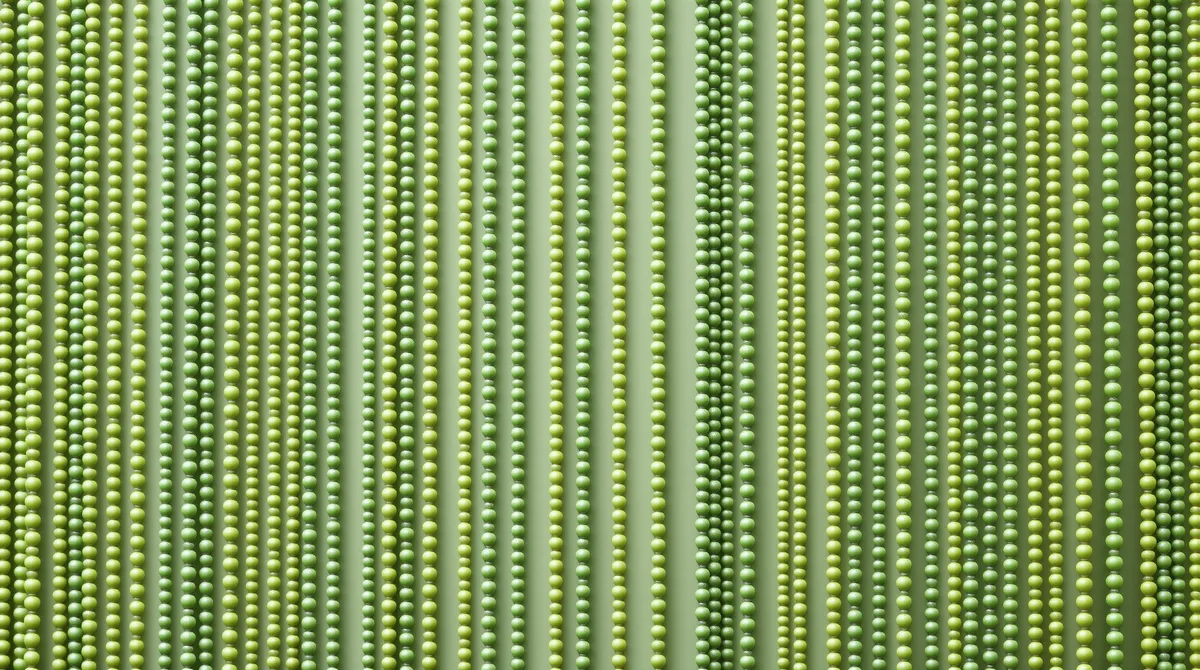
Guide · Safety
A dog treats a bead curtain as a door. A cat treats it as apparatus. Those are different problems, and only one of them is about the beads.
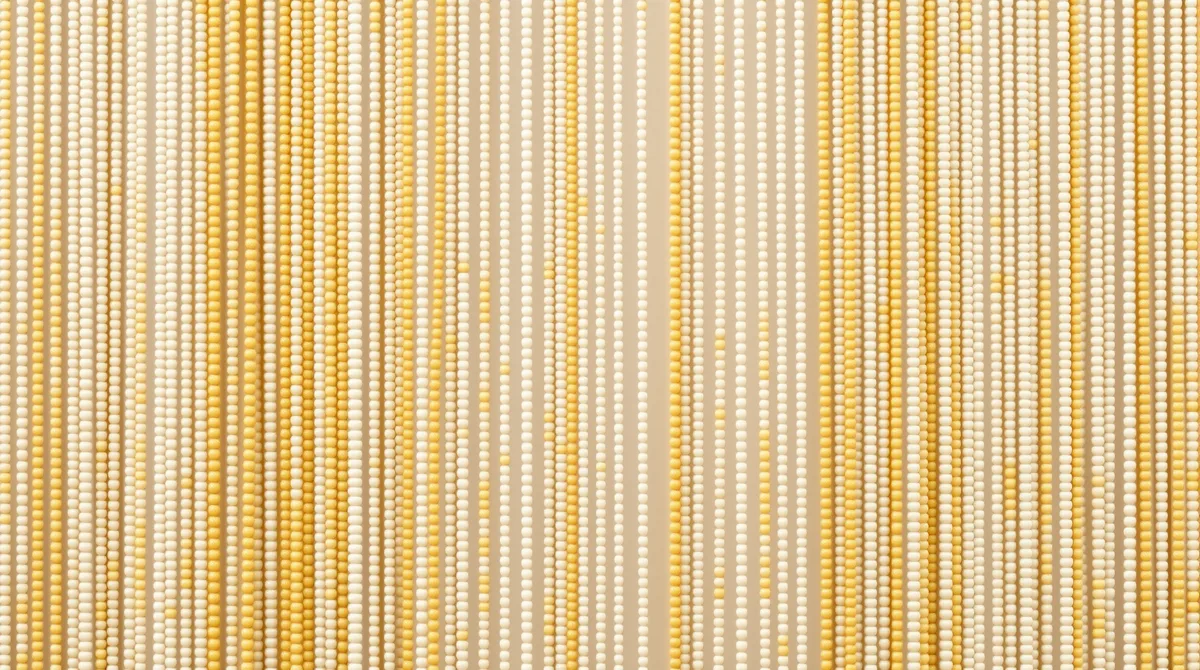
Close hand-strung cords of small lime and forest-green glass beads, the strands grouped in bands with clear ground showing between each group.
A beaded curtain is generally safe for dogs and is a climbing frame for cats. The two real risks are a cat's weight pulling strands off the header, and a small bead coming loose and being swallowed. Both are addressed at the design stage: a securely gathered header, larger beads rather than seed beads, and a hem that clears the floor.

Two things, and they are quite different. A cat may climb, which puts a load on the header that no strung panel is engineered for and which is the main cause of strands parting in pet homes. And a loose bead may be eaten, which is a hazard for any animal that chews and is almost entirely a function of bead size.
Everything else people worry about — the noise, the movement, the dog pushing through — is a non-problem. A dog treats the panel as a door and the panel behaves like one.
It moves, visibly and audibly, which is exactly why cats are interested. For the first week a new panel is the most interesting object in the house. Then it stops being novel, because it does not fight back and it does not reward a swipe with anything.
Dogs adapt faster still. Most learn within a day that a bead curtain parts when you walk at it and closes behind you, and they walk through at full speed thereafter.
Three things matter: whether it shatters, whether it is swallowable, and whether it is heavy.
Acrylic is the safest all-round choice. It does not shatter, it is light enough that contact carries no force, and it takes the widest colour range. Wood is similar in weight, matte, quiet, and in larger rounds completely unswallowable. Glass is fine on contact but can chip if beads are knocked hard against each other, and a chip is sharp. Seed beads, in any material, are the one thing to avoid in a home with a chewer, because a parted strand puts hundreds of small beads on the floor at once.
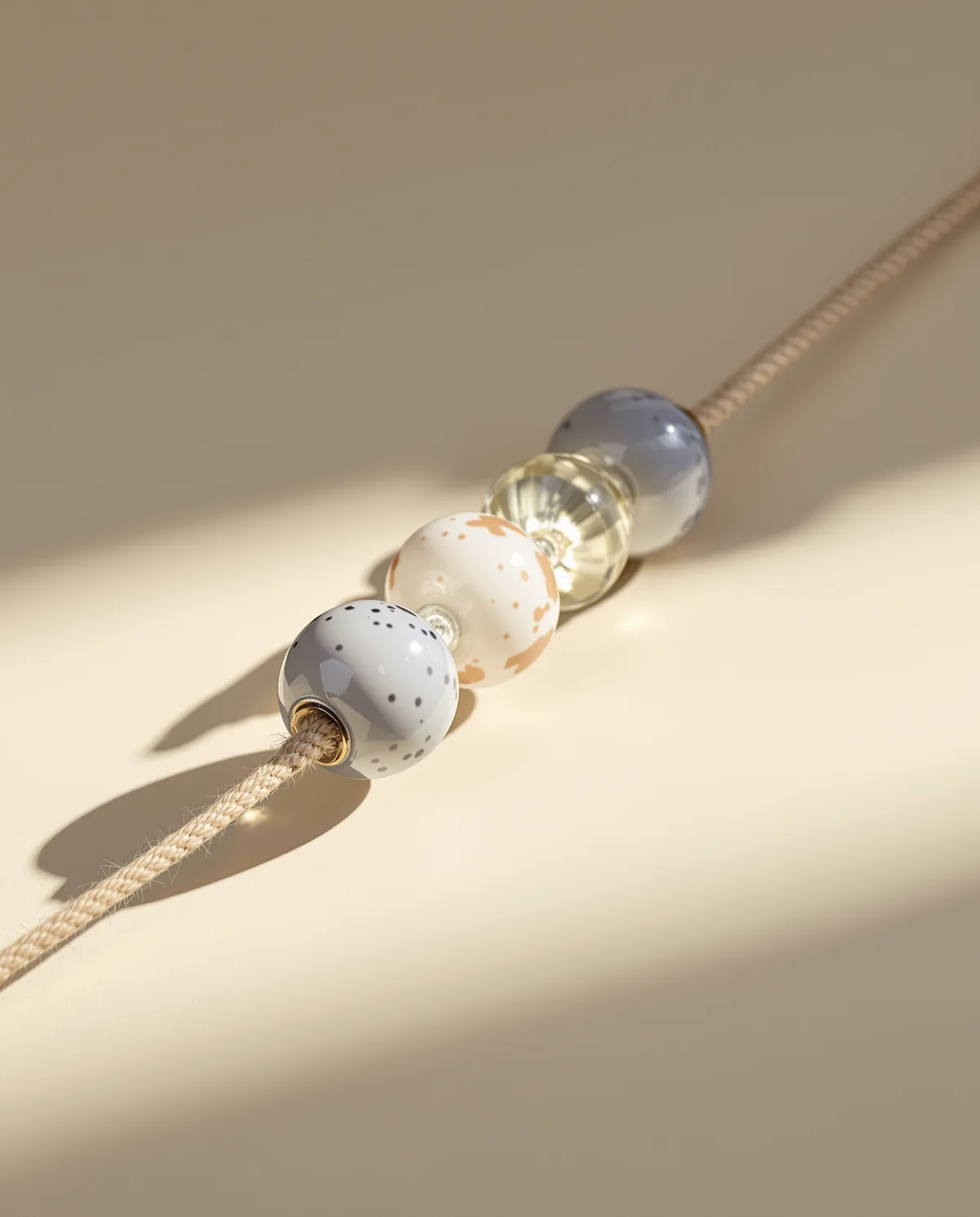
Not where people expect. The cord itself is strong; a strung strand carries several thousand beads' worth of its own weight without complaint. The load goes to two places: the knot at the header, where the strand is tied over the dowel, and the drill hole of the topmost beads, where cord bears against glass or wood under a sudden pull.
That is why the way strands are gathered at the header is the specification that matters in a pet home. A panel whose strands are knotted individually over the dowel keeps its remaining strands when one goes; a continuous run that depends on a single pass does not.
Over-specify the fixing. A pet home is the one case where the panel's own weight is not the governing load — a cat hanging on a strand is. Hooks or brackets screwed into the frame or into solid wall are the right answer.
A tension rod is the wrong answer here even for a light acrylic panel, because the failure mode is bad: the rod drops, the panel comes with it, and the animal is now tangled in the whole thing rather than in one strand.
Yes, and by more than you would leave otherwise. The strands need to swing free. A hem that rests on the floor gives a paw something to hook under, and the force of an animal pulling against a trapped strand is applied straight to the drill hole and the header knot.
Leaving a clear gap also keeps the hem out of the dust and hair that collects at floor level, which is the other thing that shortens a panel's life in a pet home.
Specify no loose loops below the header. Each strand should finish in a knot, a crimp or a stopper bead, not in a return loop that a leg or a head can pass through. End suspension loops belong at the top of the panel, where they let it hang level from either a dowel or a rod pocket.
This is the same principle that governs beadwork around small children, and it is a design decision rather than a product warning: a panel built without loops cannot present a loop hazard.
An animal going through at speed is louder than a person, because it hits more strands at once and lower down. For a nervous cat that noise is the deterrent, which is the opposite of the problem most owners expect.
If someone sleeps near the doorway, wood or acrylic are the materials to specify. This is the most under-considered property in beadwork and the easiest to get right in advance.
Shorter than in a quiet hallway, and the failure will be a parted strand rather than a broken panel. Cord is the service item on every strung piece; in a pet home it simply reaches the end of its service life sooner.
A parted strand is re-strung in bead-map order and re-knotted at the header. This is why spare beads are worth asking for on the packing specification, and why the bag is worth keeping in a drawer once it arrives rather than throwing it away.
Yes, with two conditions: larger beads, and a proper fixing. It is genuinely better than a fabric curtain in a house with animals, because there is nothing to hold hair, nothing to shred, and nothing that needs washing — and when something does fail, you repair one strand instead of replacing the panel.
If you have a cat that climbs curtains as a matter of policy, hang the panel in an opening the cat has no reason to climb, or accept that you will be re-stringing a strand occasionally.
Bead size is the decision that carries most of the risk, so choosing a bead size is the page to read next. Child safety around beadwork covers the same ground for a toddler and reaches the same conclusion from a different direction. Panel weight and load matters here more than in a quiet hallway, because a climbing animal loads the fixing well beyond what the panel weighs. If a strand does part, routine care sets out the re-string. And an acrylic bead curtain is the specification we would start from in almost any home with animals in it, for the simple reason that nothing in it can shatter.
Two more pages are worth a look. Bead curtain formats covers the short drops that take the hem out of reach entirely, which is the simplest answer in a house with a climber in it. And panel headers covers the fixings, because a screwed fitting rather than a friction one is what keeps a panel up under an animal's weight.
Good to know
A determined kitten will test one, and a bored adult cat will bat at the hem. What rarely survives is a cat that climbs: a few kilograms hanging halfway up a strand is far more load than the strand was designed for, and it pulls at the header. Adult cats usually lose interest within days once the panel stops reacting dramatically.
A loose bead is a swallowing and choking risk for any animal that chews, which is a reason to specify larger beads in a pet home. A 13 by 22 mm dotted oval or a 20 mm wood round is not a realistic swallowing hazard; a 2 mm glass seed bead is. If a strand parts, collect the beads before the animal does.
Acrylic and wood, because they do not shatter and they weigh little, so a dog shouldering through the panel takes no real force. Glass stands up to the contact perfectly well but can chip if two beads are knocked hard against each other, and chips are sharp.
On a fixing rated well above the panel's own weight, because a climbing cat adds load no bead curtain is designed for. Brackets or hooks screwed into the frame are better than a tension rod for this reason alone — a tension rod that drops under a cat brings the whole panel down with it.
No, and this matters more in a pet home than anywhere else. Leave a clear gap so the strands swing free. A hem resting on the floor lets a paw hook under a strand, and pulling against a trapped strand is how cords part.
Specify a panel with no loose loops below the header. Strands should be knotted or crimped individually, not hung as continuous loops a head or a leg can pass through. End suspension loops sit at the top of the panel where they belong, not at the bottom.
Keep exploring
Guide
The failure sequence under a climbing load, which materials survive claws, and how to hang so the panel gives before the wall does.
See the detailPillar
Door curtains, portals, café lengths and valances: the standard sizes, the strand counts and the one question each format answers.
Open the referenceGuide
Pulling, cord loops and loose beads: the three real risks, and the two that are design decisions rather than inevitabilities.
See the detailGuide
Breaking light rather than blocking it: what a bead panel does to daylight through the day, and which beads come closest to shade.
See the detailGuide
Cord first, then surface finish, then beads: what wears out in which order, and what each stage looks like before it fails.
See the detailGuide
Strand weight, pitch, handling and packing: the four variables that decide whether a panel knots, and the three set at the brief.
See the detailGuide
Dry dusting first, spot cleaning the beads, keeping the cord dry, what never to use, and how to handle a broken strand.
Read the guide
Start a conversation
Send a reference, a colour chip or a sketch. Minimums are set per design and confirmed per quote; sampling is quoted separately and usually runs 16 to 20 days from an agreed brief.