Manufacturing
Beaded shades
Pendant drums, empire table shades and sconce shades in glass beads — how the frame carries the shape, and why we supply shades only.
View the range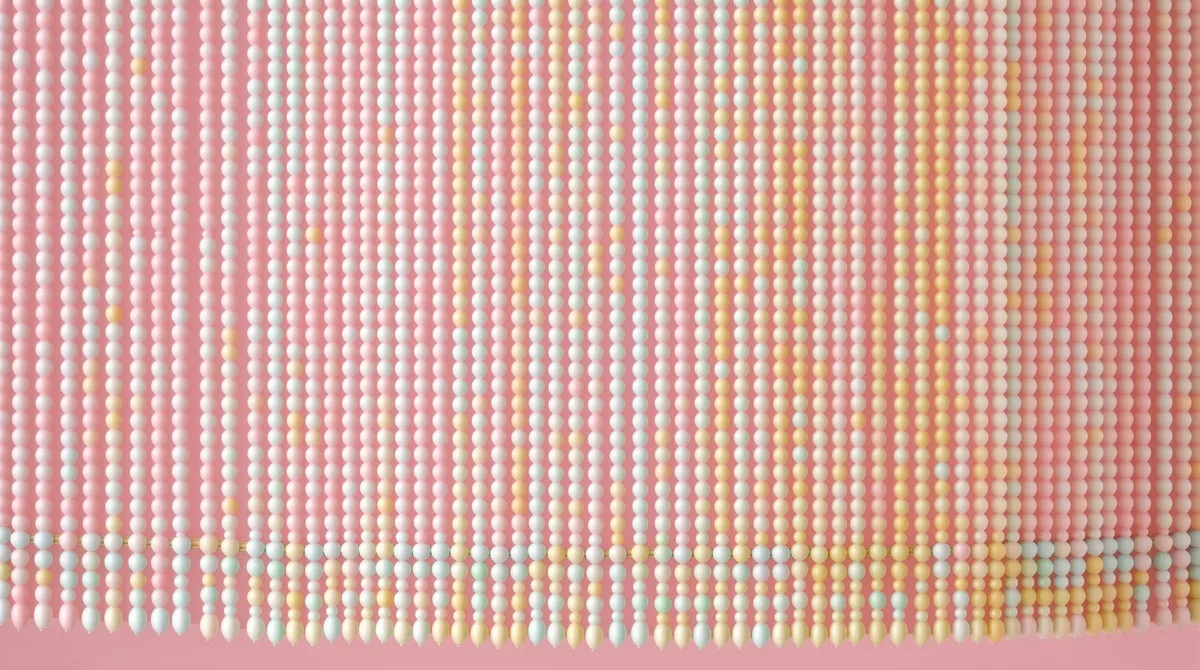
Guide · Tabletop
Everything else in beadwork can be taken down and worked on flat. A beaded shade cannot, so the whole method has to work in place and in the air.
The close-strung bead wall of a beaded drum shade in candy pink, lemon and mint, shown unlit so the vertical bead rows and the fringe below read straight across.
Switch the lamp off and let it cool, then dust the shade dry from the top ring downwards, strand by strand, supporting each strand from behind. Keep every trace of damp away from the fitting and the frame: a plated metal frame marks, and water near a live fitting is the one genuine hazard in beadwork care.
Isolate. Cool. Dust dry. Spot-wipe, rarely, with the lamp still off.
Switch the lamp off at the switch and, for a pendant, at the circuit if you are going to be working at it for a while. Let the bulb cool completely. Then dust dry from the top ring downwards. A damp pass on the beads is available but it should be exceptional, and the lamp stays off throughout.
A warm bulb and a damp cloth in the same hand is the only genuinely dangerous combination in beadwork care, and it is specific to this product.
On a shade the cord does its usual job under unusual conditions.
Every strand hangs free from the top ring on an open drum, so the finished drop sets the hem; on an empire or tapered shade the strands run from a narrow top ring to a wider bottom ring, and the bottom ring is what holds the slope. In both cases the cord is carrying beads in free air at head height, and it is doing it next to a heat source.
Heat ages cord. A cord that has spent five years ten centimetres from a bulb is stiffer and more brittle than the same cord in a doorway, and it will part sooner. That is the one failure mode specific to lighting, and it argues for a lamp with a cool source rather than for any particular cleaning method.
| Component | Dry dust | Damp cloth | Immersion | Notes |
|---|---|---|---|---|
| Glass beads | Yes | Lightly, lamp off | No | Glass gives the sparkle a shade is specified for |
| Acrylic beads | Yes | Lightly, lamp off | No | Softens with heat; keep clear of a hot bulb |
| Cotton cord or wire on the strand | Yes | Avoid | No | The structure; it carries the strand from the ring |
| Top and bottom rings | Yes | No | No | On a tapered shade the bottom ring holds the slope |
| Gold-plated frame | Yes | No | No | Plating is a surface; water marks it |
| Powder-coated frame | Yes | Barely damp | No | Tougher than plating; still not to be wetted near a fitting |
| Fitting, flex and lamp holder | No | No | No | Not ours and not to be cleaned wet. Isolate the lamp first |
| Drum shade strands | Yes | Lightly | No | Each strand hangs free from the top ring; length sets the hem |
| Empire shade strands | Yes | Lightly | No | Run from a narrow top ring to a wider bottom ring |
Lightly, and with the strand supported.
The difference from every other bead product is mechanical rather than chemical. A shade's strands hang free, so a cloth pressing on a bead pushes the whole strand sideways and loads it against the ring. Put your free hand behind the strand, take the pressure on that hand rather than on the fixing, and draw the cloth downwards.
The chemical rules are the usual ones, and they follow the bead materials rather than the format. Frosted and sea-glass beads polish up if rubbed; a bead dyed to match an accent lifts under pressure and solvent; body-coloured glass tolerates a firm wipe. On a shade, body colour is worth specifying for a second reason: colour is what a lit shade is for, and a dye lot that shifts is more visible with light behind it than it is in reflected light.
A shade has neither, and what it has instead is the component that decides everything: a metal frame.
Frames on our shades are made to fit the fitting a buyer specifies, in the orientation they specify. A gold-plated frame has its finish as a surface, and water marks plating — so the frame is dusted dry and never wiped damp. A powder-coated frame is tougher and will take a barely damp cloth away from the fitting, but there is rarely any reason to.
The rings are also the structural members. On a tapered shade the bottom ring holds the slope; if it is knocked out of true the hem goes visibly wrong and no amount of re-dressing the strands will hide it. Handle a shade by its frame at the rings, never by the strands and never by the fitter.
Take the shade down and treat it as a workshop repair.
A strand on an open drum is fixed at the top ring only, which is recoverable with patience. A strand on a tapered shade is fixed at both rings, and re-stringing it means matching the drop exactly or the hem steps. Neither job should be attempted in place on a hanging pendant, where you cannot see the fixing and cannot support the piece.
Keep the spare beads. Strand count and bead count are recalculated for each diameter and height, so a replacement strand has to match a specific drop rather than a generic one, and the tech pack documents it for the design.
Upright, in its carton, with nothing on the frame.
A beaded shade stored on its side bends every strand against the ring it hangs from and takes a set. A frame stored under weight distorts, and a distorted ring shows instantly as an out-of-true hem.
If the original carton is gone, stand the shade on a shelf with its strands hanging naturally and cover it loosely against dust. Do not bag it tightly: compression against the frame is the thing to avoid.
Four lines, and the first is a safety line rather than a care line.
Switch off and allow to cool before cleaning. Dust dry from the top ring downwards, supporting each strand. Do not use water, sprays or solvents near the fitting. Handle by the frame, never by the strands.
One more line earns its place on this product, because customers ask: the shade is supplied as a shade only, to fit the fitting specified, and the lamp base, flex and holder are not part of it.
Yes, in access and in scope.
A pendant drum in a restaurant is cleaned from a ladder by someone with a cloth in one hand, which is exactly the posture in which a strand gets pulled sideways. Specify a shade for a position that can be reached properly, and put the handling instruction on a maintenance schedule rather than hoping.
Scope matters more. We supply shades, not lighting: a shade is made to fit the fitting specified, and any question about flex, holder, earthing or lamp type belongs to the lighting contractor. The fitter type and its orientation are part of that specification rather than something a cleaner or a housekeeper should be adjusting, which is the practical reason this page insists on handling a shade by its rings.
A distorted ring. A marked plated frame. A polished frosted bead. A lifted surface dye. A strand drop that has been re-made at the wrong length, which steps the hem.
Recoverable: dust, a chipped bead replaced from spares, and a slack strand re-tensioned at the ring by someone who can see what they are doing.
Put it somewhere with less dust and less heat. A beaded shade over a dining table collects cooking aerosol; the same shade in a bedroom collects almost nothing.
Then dust on a schedule — monthly is right for a pendant, less for a sconce — and never let it reach the point where a damp pass is required. On a shade more than on any other beadwork, dry dusting is not the first option. It is the only one worth using.
Monthly for a pendant drum in a living space. Quarterly for a bedside or sconce shade. Fortnightly for anything over a dining table or in a commercial dining room.
Damp work: ideally never, and in practice once every few years, lamp off and cool, on the beads only, with the frame and the fitting kept completely dry.
Good to know
Brush dry, wipe the bead tops with a barely damp cloth, dry at once, and never immerse. That is the method for flat work; a shade is strung rather than embroidered, so the rules here are a hanging panel's rules carried out at head height with a frame in the middle.
No, but it is a workshop repair rather than a domestic one. A shade's strands are fixed to a ring at the top and, on a tapered shade, to a second ring at the bottom, so re-stringing means working on both. Keep the spare beads and the shade; do not attempt it in place on a hanging pendant.
Upright, in the carton it came in, with the strands hanging in their natural position and nothing resting on the frame. A shade stored on its side bends its strands against the ring and a frame stored under weight distorts, which a beaded shade shows immediately because the hem goes out of true.
No, and on a shade the question should not arise — the beadwork and the metal frame are one assembly and cannot be separated. There is no stage at which any part of a beaded shade is a loose textile item.
Lamp off and cool. Then a soft brush drawn from the top ring down each strand to the hem, with your other hand supporting the strand from behind. Work round the shade in sections so you can see what you have done, and finish by dusting the top ring, which collects the most.
Solvent, bleach, abrasive cream, steam, hot water — and on a shade, any spray at all. A spray near a lamp holder puts liquid where it must never go, and the overspray settles on a plated frame and marks it. Dry dusting is the whole method here.
Keep exploring
Manufacturing
Pendant drums, empire table shades and sconce shades in glass beads — how the frame carries the shape, and why we supply shades only.
View the rangeGuides
One guide per question that arrives often enough to be worth answering properly.
Read moreGuide
Why the couching thread is the service item, how to use a cushion without abrading it, and what spot cleaning actually involves.
Specs and sizesGuide
The dusting routine, the yearly cord check at the dowel, and the two wall positions to avoid entirely.
See the detailGuide
Why a dishwasher cycle destroys bead embroidery, which component fails first, and the routine that works instead.
See the detail
Start a conversation
Send a reference, a colour chip or a sketch. Minimums are set per design and confirmed per quote; sampling is quoted separately and usually runs 16 to 20 days from an agreed brief.