Manufacturing
Beaded wall hangings
Widths from 50 to 76 cm on a turned dowel, in glass, wood and cast faux capiz — hem shapes, strand counts and what is a shipped format against a concept.
How it is made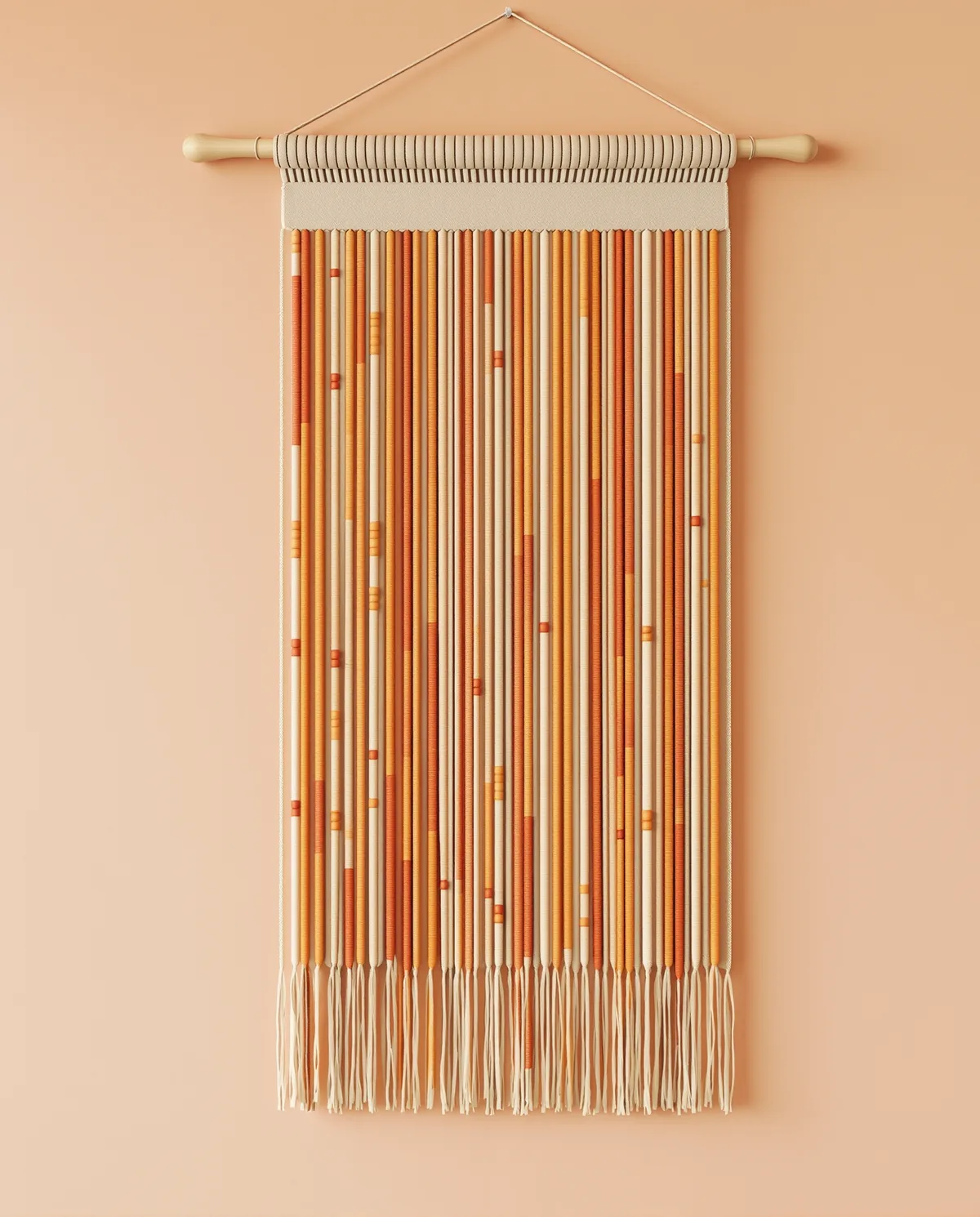
Guide · Tabletop
A wall hanging is the easiest piece of beadwork to own. Nobody walks through it, so the only real maintenance is dust and one annual check.
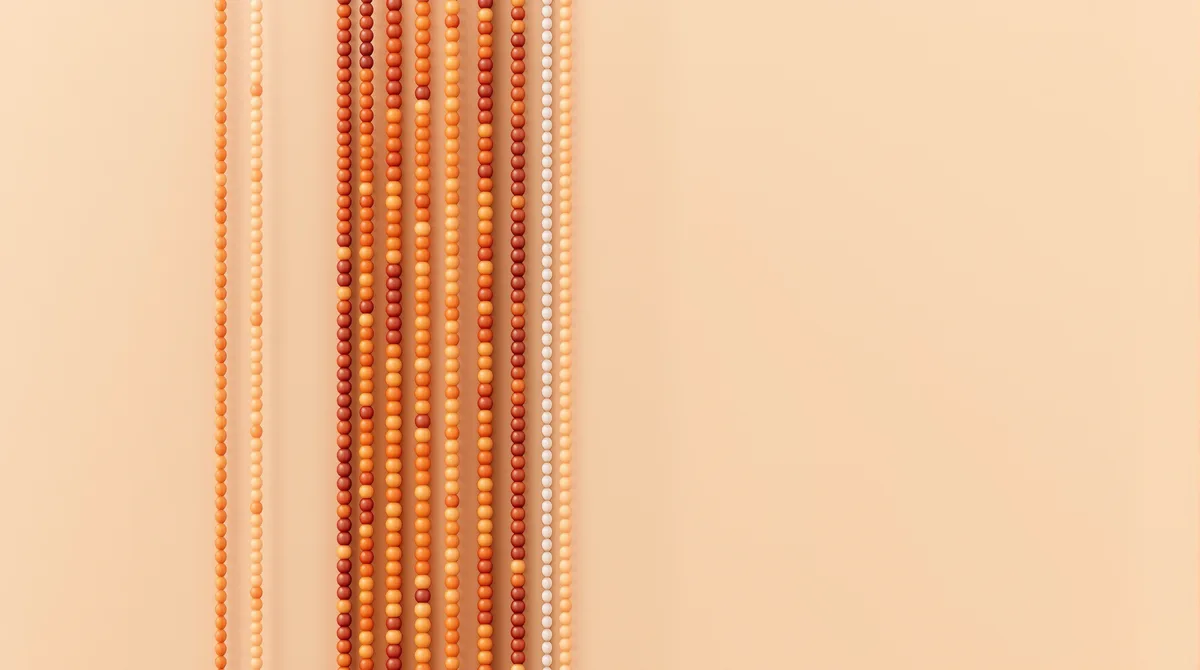
A beaded wall hanging of forty strands in rust, burnt orange, amber and honey mustard, the colour blocks stepping across the panel to a straight hem.
Dust a beaded wall hanging dry, downwards from the dowel to the hem, every month or two, and check the dowel's hanging cord and the header knots once a year. Keep it off a damp external wall and never hang one above a radiator: convected heat drives dust up into it continuously and ages the cord.
Dust dry, downwards. Spot-wipe the beads, rarely. Dry at once. Check the fixing annually.
That is the entire maintenance programme for a strung wall piece, and three of those four steps are things most owners will never need. The one that gets neglected is the fourth.
Because on a wall piece nothing else is under load, and because a static object hides a weakening fixing.
A doorway panel announces a problem: someone walks through it and a strand comes away in their hand. A wall piece says nothing. The cord at the dowel ages quietly, the hanging cord wears at the fixing point, and the first sign is the piece on the floor.
So the cord is the failure point here for the same reason as everywhere — it runs through the drill hole of every bead and it abrades — but the consequence is different. On a wall piece the cord needs an inspection rather than a method.
| Component | Routine | Annual check | Notes |
|---|---|---|---|
| Glass beads | Dry dust; damp cloth if marked | — | The most tolerant part of the piece |
| Wood and bone beads | Dry dust only | — | Water raises grain; bone marks |
| Faux capiz blossoms | Dry dust; soft damp cloth | Spacer beads still in place | Cast resin or dyed cut acrylic, laser-cut to shape |
| Strand cord | Keep dry | Look for slackening and discolouring | Runs through every bead on the strand |
| Header knots at the dowel | — | Check each is tight | Individually knotted per strand |
| Wooden dowel | Dry dust | Check for a split at the hook points | Turned in our own Saharanpur wood factory |
| Hanging cord or fixing points | — | Check for wear and for a loose fixing | Agreed at sample; a short fixed cord beats a long loop |
| Wall behind the piece | — | Check for damp | A damp wall reaches the cord by contact |
| Our strung formats | — | — | 50 to 76 cm wide on a dowel; 90 × 67 cm dual wall and portal format |
On a wall piece the dowel is not an accessory. It is the only structural member, and it is the component to inspect.
Every piece we make in this format is strung on a wooden dowel turned in our own Saharanpur wood factory, with the strands knotted over it individually in bead-map order — the panel headers reference covers the alternatives. Two things go wrong over years. The knots at the dowel work loose, one at a time, usually at the ends where the strands are pulled slightly sideways by the fixing. And the dowel splits at the hook points, where the load concentrates and where water will have reached it if anything was ever wiped.
Where a piece runs on a rod pocket header instead, the header is a textile and the inspection is different: look for the stitching at the pocket ends and for a tide line, which means moisture has reached it from the wall.
This is the easiest repair in beadwork, because a wall piece can come down and be worked on flat.
Take it off the wall, lay it on a table, and re-string the strand on new cord in bead-map order. Re-knot at the dowel and finish the end with a crimp or the original stopper bead rather than a knot alone. Use the spare beads from the original order, if the order specified them.
On a construction with locked components, replace them in position. A faux-capiz blossom is held on its cord by a small spacer bead dyed to match, and the spacer is what stops the blossom sliding down — the counts show how much of the piece depends on it, with one design running 155 to 170 blossoms in its dowel version and about 130 in its rod-pocket version.
Flat or rolled, dry, and indoors.
Bundle the strands loosely, tie each bundle at two or three points with soft ribbon, then lay the piece flat or roll it around a cardboard tube with the dowel along the axis. Keep it out of direct sun.
The storage mistake specific to wall pieces is leaving one hanging in an unheated room — a holiday house, a garage, a summer house. A year of humidity cycling is harder on cord and on a wooden dowel than a year on a heated interior wall, and it is also where mould reaches a cotton header.
Four lines. Dust dry with a soft brush, downwards from the dowel. Wipe beads with a barely damp cloth if needed and dry at once. Keep the dowel and any fabric header dry. Check the hanging fixing and the header knots once a year.
That last line is the one worth insisting on. It is the only piece of care advice in the category that prevents a piece from falling off a wall, and almost nobody prints it.
Yes, in two respects.
The inspection becomes a scheduled item rather than a good intention. In a hotel, a restaurant or a salon, a wall piece should be on the same list as light fittings and pictures: a six-monthly check of the fixing, the hanging cord and the header knots. A piece coming off a wall in a public space is a different kind of event from the same thing happening at home.
The second difference is the airstream. A wall piece in a lobby or a café front is in moving, dust-laden air all day, and will need dry dusting fortnightly rather than monthly. Specify a smaller bead where a piece will live in that position: there is less flat surface facing upwards and it stays cleaner for longer.
A split dowel. A polished frosted bead. A lifted surface dye. A dulled faux-capiz surface. A cord that has gone grey from damp, which shows at every drill hole.
Recoverable: a parted strand, a chipped bead, a loose header knot, a missing spacer bead — provided the spares exist. All four are half-hour jobs on a piece laid flat.
Choose the wall. That is most of it.
Avoid a damp external wall: the piece touches the wall, and wall moisture reaches the cord by contact, which is slower and more certain than any splash. Avoid the wall above a radiator, where convected air drives dust up through the strands continuously and the heat stiffens the cord — that position will double the cleaning interval and halve the cord's life.
Prefer an internal wall away from a heat source and out of direct sun. There, a strung wall piece 50 to 76 cm wide on a dowel is close to maintenance-free for years.
First article inspection checks the piece flat and dry against the approved sample: bead order, the finished drop, the hem shape, the header knots and the hanging arrangement.
The formats are worth knowing because they set the load. Our strung wall pieces run 50 to 76 cm wide on a dowel; a 90 × 67 cm format serves as both a wall hanging and a door portal and was developed in 2026. Those are light pieces by the standards of a full-length doorway panel, which means an ordinary wall fixing is adequate — provided it is right for the substrate and actually in something solid. The panel weight is the number to establish first.
First-article and lot AQL inspection happens at our quality-control and packaging house in Greater Noida, and network product issue rates run at a fraction of a percent. The hanging cord or hook option is agreed at sample rather than assumed, because it is the one component whose failure brings the piece down.
Dry dusting every four to eight weeks at home, fortnightly in a commercial interior or above a radiator.
Damp work on the beads: as needed, which on a wall piece is almost never.
The fixing and knot check: annually at home, six-monthly in a public space. Put it on the same day each year as the smoke-alarm batteries and it will actually happen; on a contract job it belongs on a maintenance schedule.
Good to know
No, and on a wall piece it is the easiest repair in the category, because the piece can be taken down and worked on flat. Re-string on new cord in bead-map order, re-knot at the dowel and finish with a crimp or the original stopper bead. Spare beads specified with the order are what this repair runs on.
Flat or rolled around a cardboard tube with the dowel along the axis, dry, with the strands bundled loosely and tied at two or three points with soft ribbon. Never store it hanging in an unheated space: a year of humidity cycling is harder on the cord than a year on a wall.
No. The cord is the structure, a drum tangles the strands into one mass, and a dowel is turned timber that raises its grain the moment it gets wet. Dry dusting is the only maintenance a wall piece needs and the only one it will tolerate.
Dry, downwards, strand by strand, from the dowel towards the hem, with your other hand supporting the strand from behind so you are not pulling it sideways against the header knot. Finish with the dowel itself, which collects more dust than any strand because it is horizontal.
Solvent, bleach, abrasive cream, steam, hot water and any spray. On a wall piece add one more: a vacuum. Suction pulls at a free-hanging strand and loads the header knot, and it is the most common cause of a strand failing on a piece that is otherwise never touched.
No. A dowel is turned timber, usually stained or lacquered, and water raises the grain and can lift the finish. On a wall piece the dowel is also the single structural member, and water at the hook points is what eventually splits one. Dust it dry.
Brush dry, wipe the bead tops with a barely damp cloth, dry at once, never immerse. Some wall pieces combine the two families — a solid beaded top band worked in close rows above strung strands — and where they do, the flat section follows the flat-work rules and the strands follow these.
Keep exploring
Manufacturing
Widths from 50 to 76 cm on a turned dowel, in glass, wood and cast faux capiz — hem shapes, strand counts and what is a shipped format against a concept.
How it is madeGuides
One guide per question that arrives often enough to be worth answering properly.
See the detailGuide
Why a dishwasher cycle destroys bead embroidery, which component fails first, and the routine that works instead.
Specs and sizesGuide
What a hot dish does to each component, why no temperature rating is published, and the service-piece distinction that resolves it.
Compare the optionsGuide
Why the backing fails before the bead, the blot-and-dry-flat routine, and how a service rotation keeps a set alive.
Read the guide
Start a conversation
Send a reference, a colour chip or a sketch. Minimums are set per design and confirmed per quote; sampling is quoted separately and usually runs 16 to 20 days from an agreed brief.