Guide
Sun fade on beads
Colour through the glass body survives; surface dye and coated finishes go first; acrylic sits between the two.
Compare the options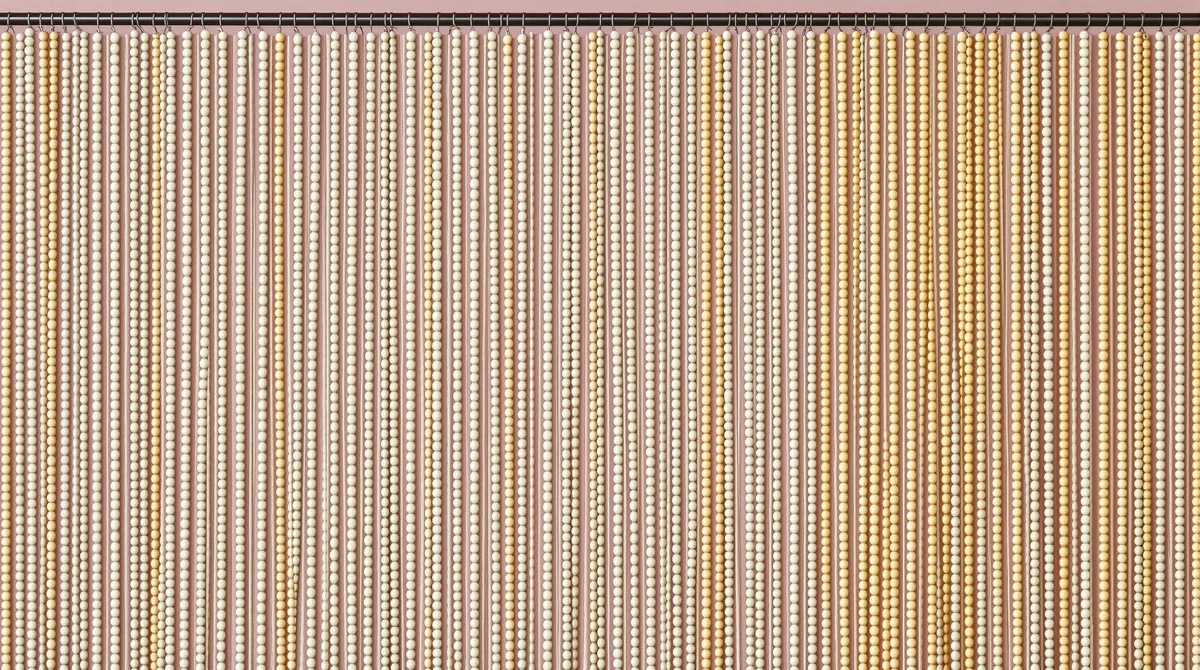
Guide · Care
A faded panel cannot be re-dyed in place, and anyone who tells you otherwise has not thought about what the dye would do to the cord. What can be done is swapping.
A hand-strung panel in sun-baked rose, sage and butter yellow at full saturation on one side, the same three colours bleaching cord by cord across the panel to a pale chalky wash…
A faded panel cannot be restored in place. Surface dye is a coating and it is gone; re-dyeing a strung panel would soak the cord, which is the one component that must stay dry. What works is swapping the faded strands or beads for replacements, moving the panel out of direct sun, or accepting the new colour as the panel's state.
Diagnose, test one bead, then decide between swapping, moving and accepting. Nothing wet, and no dye at any point.
The diagnosis matters because the two conditions look identical from across a room. A dusty panel and a faded panel both read as dull and slightly grey. One is reversible in ten minutes and the other is not reversible at all.
Two reasons, and either one is decisive.
The first is the cord. Dyeing requires immersion, and a strung panel's cord is the only structural component it has: wet cotton cord slackens, discolours, holds dust and abrades against the drill hole of every bead it passes through under load. A dye bath would do more damage than the fading did.
The second is control. Bead dyeing in production is a specified process — beads are dyed to a Pantone reference or a physical chip and confirmed on an approved sample before anything goes into production. A panel dipped at home is an uncontrolled process on a substrate that has already been altered by sunlight, and the result is uneven.
Because sunlight works on it as well, and more quietly. A panel in a sunlit doorway for several years has a cord that has been bleached, warmed and cooled daily, and its strength is lower than it was even where the beads look fine.
That changes the economics of a swap. Replacing faded beads on a cord that is near the end of its life gives you a bright panel that starts shedding strands. If the panel has had years of strong sun, the repair is a re-string rather than a bead swap.
| Colour method | Fades | Recoverable | What to do |
|---|---|---|---|
| Glass, body colour | No | n/a | Dust it; it is probably not faded |
| Glass, surface dye | Yes | No | Swap beads or strands |
| Acrylic, moulded colour | Slowly | No | Swap, or accept |
| Acrylic, surface finish | Yes | No | Swap beads or strands |
| Wood, natural | Lightens | No | Often improves with age |
| Wood, stained or lacquered | Yes | No | Swap; refinishing a strung bead is impractical |
| Faux capiz, dyed | Slowly | No | Swap discs |
| Cotton cord | Discolours | No | Re-string if it has also weakened |
Gently, and without expectations. Surface-dyed beads carry colour as a coating: once ultraviolet light has broken it down there is nothing underneath but clear or white glass, and no cleaning product reaches a colour that is no longer there.
Frosted and sea-glass beads are a different trap. They do not usually fade, because the effect is a surface texture rather than a colour, but they look dull when dusty and the instinct is to rub hard. Rubbing hard polishes the texture into gloss, which cannot be undone, and then the panel genuinely is damaged.
Beads at the bottom of a strand, which are reachable, and whole strands, which can be released at the header and rebuilt. A bead in the middle of a strand means opening the strand, which is a re-string.
The practical approach: if the fading is confined to one side of the panel — which it usually is, because sun does not arrive evenly — release the faded strands, rebuild them from the spare beads, and keep the original strands as a record. If the fading is across the whole panel, swapping strands means rebuilding all of them.
Because fading is a gradient, not a boundary. The strands nearest the window are worst, the ones in the shade are untouched, and everything between is somewhere on a curve. Replacing only the worst strands puts fresh colour next to half-faded colour, and the eye reads the step rather than the improvement.
If you are swapping, swap further than the obvious damage: out to where the fading is barely perceptible, so the new work meets the old at the point where they are closest.
A surface dye that has gone. A frosted bead polished to gloss. A lacquered dowel that has bleached and chalked. A cord that has lost strength to years of sun.
The one that surprises people: a size-graded design that has faded unevenly. On a panel where the gradient is carried by bead size rather than by dye — the honey ombre approach, smallest beads at the top and largest at the hem — fading changes the colour relationship between the sizes and the grade stops reading. That construction is more fade-tolerant than a dyed gradient and not immune to it.
Specify for the light, at the brief. Body-coloured glass in a sunlit opening. Pressed glass rather than surface dye where a colour has to last. A grade carried by bead size rather than by a dye gradient. And where surface dye is unavoidable, accept it as a consumable choice in that position.
The non-specification answer is placement: a panel in a doorway between two interior rooms will outlive the room, and the same panel across a south-facing window will not.
One line, carefully worded: strong direct sunlight will fade surface-dyed beads over time, and body-coloured glass will not. That is the entire useful content, and it manages the expectation before the complaint.
What a card should not say is that a panel is ultraviolet-stable or fade-resistant. No fade-rate or lightfastness test has been run on these panels and no figure is published, so any such claim would be invented.
In timescale and in budgeting. A hospitality panel in a sunlit atrium is on a replacement cycle rather than a care regime, and the right move is to specify it that way from the start: a construction that can be re-strung, spare beads held, and a known reorder route.
Production runs 40 to 60 days after sample approval, with sampling usually 16 to 20 days from an agreed brief, so a replacement is a planned item rather than an emergency. Nothing is held in stock — every beaded door curtain is made to order — which makes the planning the whole of the solution.
Checks colour against the approved sample, not against a swatch book. Dye lots shift between runs, which is exactly why the approved sample rather than the reference chip is the standard a production run is held to, and why colour variance is one of the defects first-article and lot inspection looks for before export packing.
The same logic applies to a swap years later: match to the panel, not to the catalogue. The panel is the standard now.
Good to know
Bundled loosely in hanging order, dry, and out of light — because the fading continues in storage if there is daylight on the box. If you are keeping it for its spare beads rather than as a panel, the unfaded strands from the shaded edge are the valuable part.
No, and dullness is rarely dirt anyway. A strung panel has no textile structure, so a drum tangles the strands and abrades the cord at every drill hole. Dry dust it first: a surprising proportion of apparently faded panels are simply dusty, especially where the beads are body-coloured glass.
Clean one bead. Take a barely damp cloth to a single bead at eye level, dry it immediately, and compare it with its neighbours. If it comes up bright, the panel is dusty. If it looks exactly the same, the colour has gone and no cleaning will bring it back.
Dye, solvent, polish and abrasive cream. Dye soaks the cord. Solvent lifts whatever surface colour is left. Polish and abrasive cream attack frosted and pearlised surfaces, which are matte by texture rather than by coating — rub them and they go glossy, permanently.
The dowel, yes, if it can be separated from the strands, and that is a bigger job than it sounds because every strand is knotted to it. In practice a sun-bleached dowel is better replaced than refinished, and replacing it means re-tying each strand at the correct pitch.
The same diagnosis and fewer options. On embroidered work every bead is couched individually, so swapping beads means unpicking and re-couching, which is skilled work. A faded coaster or runner is usually better retired from the sunlit position than restored.
Keep exploring
Guide
Colour through the glass body survives; surface dye and coated finishes go first; acrylic sits between the two.
Compare the optionsProcess
Colour through the body, colour in a dye bath, colour on a surface — what each one promises, what a dye lot is, and what direct sun does to all three.
See the detailGuides
One guide per question that arrives often enough to be worth answering properly.
Specs and sizesGuide
The one material that tolerates water, the method that works, and why immersing a complete panel ends it.
Read the guideGuide
Why water raises grain and lifts lacquer, the dry method that works, and the damp limit that is worth respecting.
See the detailGuide
A soft brush drawn downwards, strand by strand, so dust leaves at the hem instead of compacting in the header.
Compare the options
Start a conversation
Send a reference, a colour chip or a sketch. Minimums are set per design and confirmed per quote; sampling is quoted separately and usually runs 16 to 20 days from an agreed brief.