Guide
Beadwork in damp rooms
Cord and wood fail first in humidity, long before glass notices. Which materials and cords survive a persistently damp room.
See the detail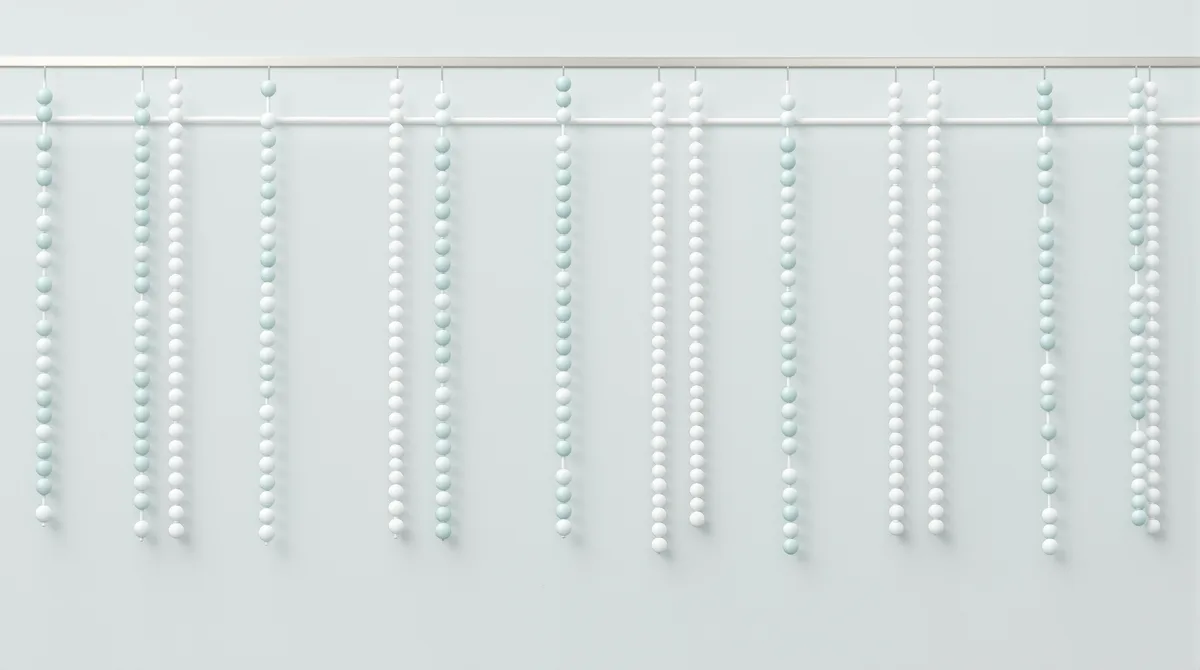
Guide · Format
The beads are not the problem. Steam reaches the cord, the cord is cotton, and cotton that is repeatedly wetted and dried is on a clock.
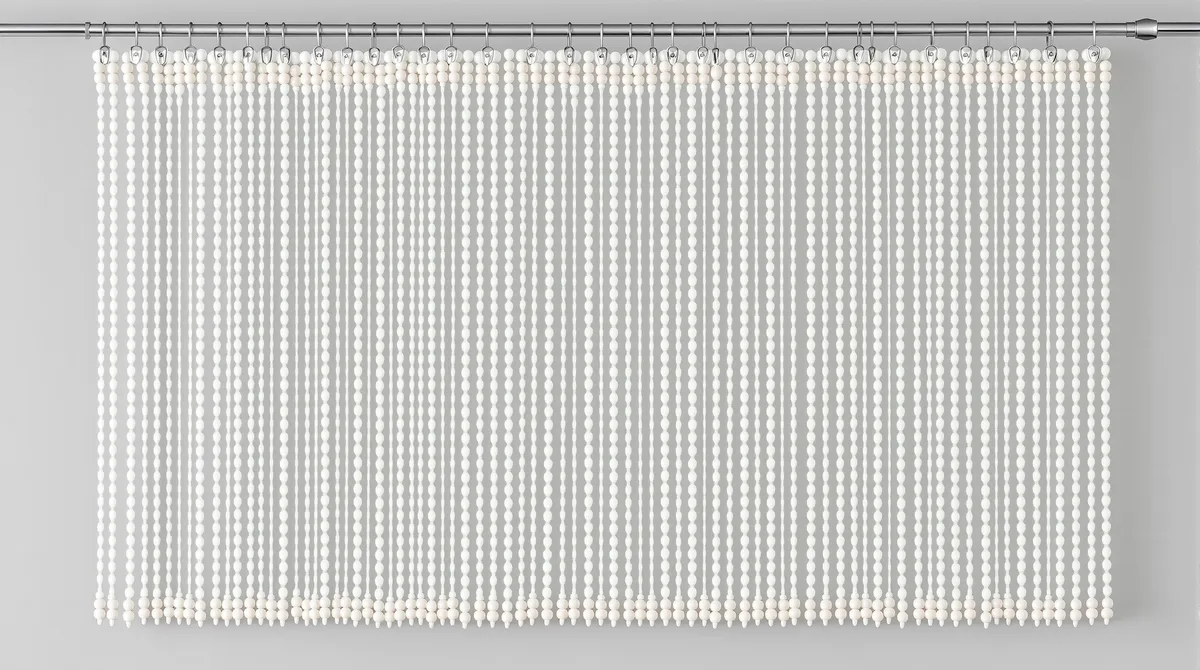
Short strands of pale glazed ceramic and glass beads hanging from a plain brushed metal rail, with no wood anywhere in the build.
A bead panel will work on a bathroom doorway if the material is chosen for humidity. Glass, acrylic and faux capiz tolerate steam; wood and bamboo mark permanently and should be avoided. The limit on all of them is the cord, which is cotton: repeated wetting and drying slackens and discolours it long before any bead is affected.

Humidity cycles. A bathroom doorway is not permanently wet; it is wetted and dried, twice a day, for years. That cycling is harder on organic materials than constant damp would be, because every cycle swells and shrinks the fibre.
The beads mostly do not care. Glass does not care at all. What cares is the cotton cord running through every bead in the panel, and anything cotton at the header.
It marks the threshold without closing it, which is genuinely useful in a small flat where a swinging door eats floor space. Air keeps moving, so the room dries faster than it would behind a closed door — a real functional advantage, and the one most people are actually buying.
What it does not do is contain steam, mute sound or give privacy. If any of those three is the reason you are looking, this is the wrong object and a door is the right one.
Four tolerate it and two do not.
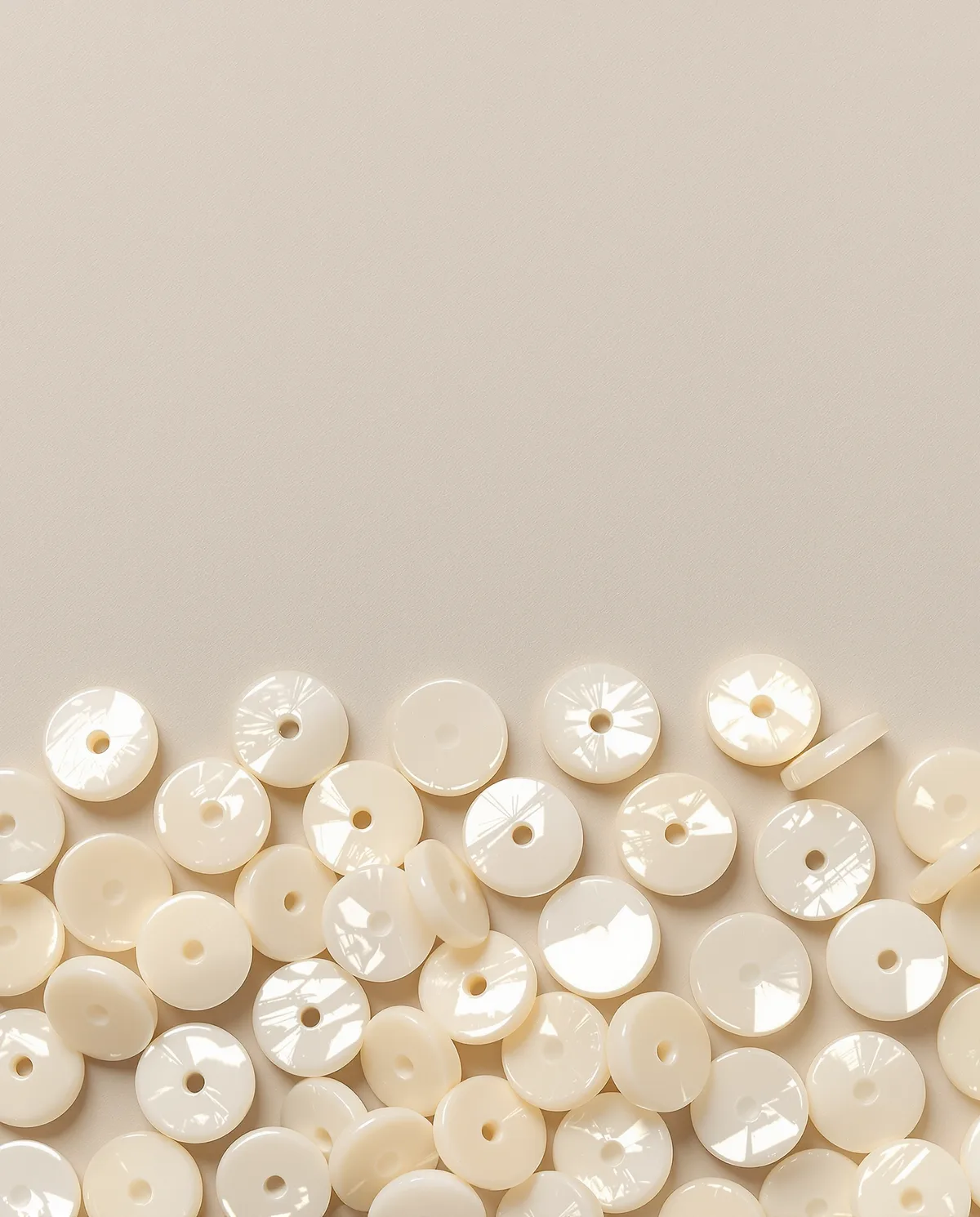
Because the cord is doing all the structural work. Thirty lengths of cord carry every bead in the panel, and each passes through the drill hole of every bead it holds. Wet cotton cord slackens, discolours, holds dust and abrades against those holes.
So the governing rule in a humid room is the same rule as in cleaning: keep the cord dry. Hang the panel where the steam is thinnest, dry it rather than letting it dry, and treat a slackening panel as a re-string rather than a failure.
On the dry side. A panel hung in the hallway outside the bathroom gets only the steam that escapes while the door is open; a panel hung inside sits in the full plume every time someone showers.
Keep the hem clear of the floor as well. Bathroom floors get wet, and a hem sitting in a puddle wicks water up the cord — which is the single fastest way to reach the failure described above.
A turned wooden dowel is the standard top fixing on a beaded curtain, and in a humid doorway it is worth reconsidering. Wood at the header is exposed to the warmest, wettest air in the room, because that is where steam collects.
A metal rod, with the strands hung on suspension loops, avoids the problem entirely. A cotton header band or a sewn rod pocket — standard on café curtains — is the option to avoid here: cotton shrinks unevenly and marks, and it is the one component you cannot dry quickly.
Body colour holds; surface colour goes. A pressed glass bead coloured throughout its body is unaffected by anything a bathroom does. A surface-dyed bead has its colour as a surface property, and humidity plus any cleaning product lifts it faster than it would in a dry room.
This matters for designs built on dyed-to-match base beads, where a base colour has been dyed to sit against an accent. If the base shifts and the accent does not, the design drifts. In a bathroom, specify body-coloured beads and accept a narrower palette.
The same as anywhere — a bead panel breaks light rather than blocking it — but a bathroom is often the one room where that is the point. Many bathroom doorways are internal with no window of their own, and a glass or translucent acrylic panel lets borrowed daylight through from the hall while still reading as a boundary.
With an opaque bead you lose that, and in a windowless bathroom you lose it entirely.
Shorter than in a hallway, and in a way that is predictable rather than sudden. The cord slackens first, which shows as strands hanging unevenly. Then surface finishes dull. The beads themselves, in the right materials, do not fail at all.
Re-stringing a slackened panel onto new cord in bead-map order restores it completely, which is the real argument for buying one built to a documented bead map in the first place.
Glass or acrylic beads, a metal rod rather than a wood dowel, hung on the dry side, hem clear of the floor, dusted dry and dried after any damp cleaning. On that specification a bathroom doorway is a reasonable place for beadwork.
Wood, bamboo, a cotton header, or any ambition to contain steam or sound: those are the four reasons to put the panel somewhere else in the house.
Beads in a bathroom takes the next step and explains why a shower enclosure is a different problem altogether. Routine care is the page that matters most once the panel is up, because keeping the cord dry is the whole of good practice in a humid room. Bamboo door beads and a wood bead curtain are both worth reading as the two materials to rule out. Panel headers covers the rod-versus-dowel decision, which in a steamy doorway is not a cosmetic choice. And the life of a bead curtain explains what a humid room actually shortens, which is the service interval rather than the piece.
Good to know
Not the beads, in most materials. Steam works on the cord and on the header: cotton cord that is repeatedly dampened and dried slackens, discolours and eventually abrades at the drill hole of every bead it passes through. A cotton header band or rod pocket is worse still, because it shrinks unevenly and marks.
Glass first — body-coloured glass is close to inert in domestic use. Acrylic next, since it is unaffected by humidity and only dislikes heat. Faux capiz, being cast resin or dyed cut acrylic, is also fine, though pearlised surfaces mark if wiped hard. Wood and bamboo are the two to avoid.
Water raises the grain on wood and can lift a lacquer; on bamboo there is no finish at all, so moisture goes straight into the fibre and the mark is permanent. Both are specified as dry-room materials. A wood dowel on an otherwise humidity-tolerant panel is also worth replacing with a rod.
On the dry side, outside the room, so the panel is in the hallway's air rather than in the bathroom's. It still gets the steam that escapes when the door is open, which is far less than it gets hanging inside. Keep the hem clear of a floor that gets wet.
Visually yes, practically no. It gives no sound separation, no steam containment and no privacy at close range. People who do it successfully are usually screening an en-suite or a cloakroom entrance within a private space, not a shared bathroom.
More often than elsewhere, because humidity turns airborne dust into a film. Dust it dry, downwards, strand by strand from header to hem, then spot-clean the beads with a barely damp cloth and dry them in the same pass. Keep the water away from the cord.
Our panels are cord-strung, and cord is the component a wet room ages. A monofilament or coated-wire strand behaves differently and is a different construction, so where a programme needs one it is a development with a sample at the end of it.
Keep exploring
Guide
Cord and wood fail first in humidity, long before glass notices. Which materials and cords survive a persistently damp room.
See the detailPillar
Door curtains, portals, café lengths and valances: the standard sizes, the strand counts and the one question each format answers.
See the detailGuide
One panel or a pair, where the join falls, and why the walk-through gap should be designed rather than left to chance.
See the detailGuide
Panels as modules: standard widths, where a join reads, and how a run is set out across a wall rather than an opening.
See the detailGuide
Cumulative strand weight, cord creep and header load: what changes when a bead panel goes past two metres.
See the detailGuide
Three predictable failures — soaked cord, lime scale, no containment — and the two things people usually want instead.
See the detailGuide
A dry rattle, almost no weight, a natural look that marks in damp — and the note that bamboo is confirmed design by design.
Specs and sizesGuide
Cord first, then surface finish, then beads: what wears out in which order, and what each stage looks like before it fails.
Specs and sizes
Start a conversation
Send a reference, a colour chip or a sketch. Minimums are set per design and confirmed per quote; sampling is quoted separately and usually runs 16 to 20 days from an agreed brief.