Material
Faux capiz discs
Cast resin or dyed cut acrylic, finished to imitate capiz shell: what it gives that real shell cannot, and why thin discs tangle.
View the range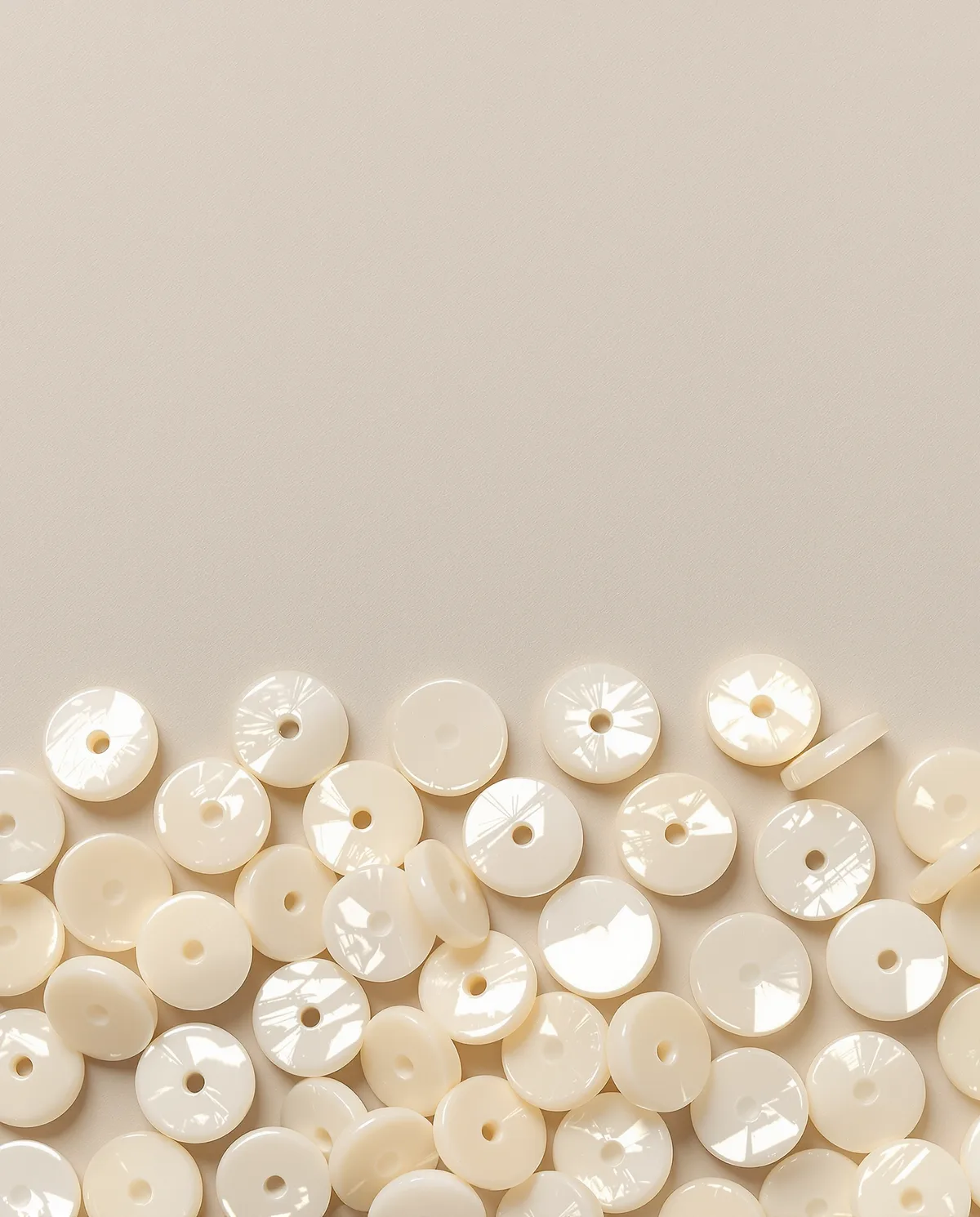
Guide · Comparison
One is a shell. The other is cast resin or dyed cut acrylic finished to look like one. Calling the second an imitation is not a concession — it is the reason it behaves better.
Faux capiz discs at twenty-five and fifty millimetres, cast and dyed to imitate capiz shell, each of even thickness and even colour with a hole near the edge.
Real capiz is a natural shell, so its colour and thickness vary piece to piece. Faux capiz is engineered: ours is cast resin or dyed cut acrylic, cut and finished to imitate capiz shell. The engineered route gives consistent colour across a production run, takes a dye reference, and is more durable. We make the imitation, not the shell.
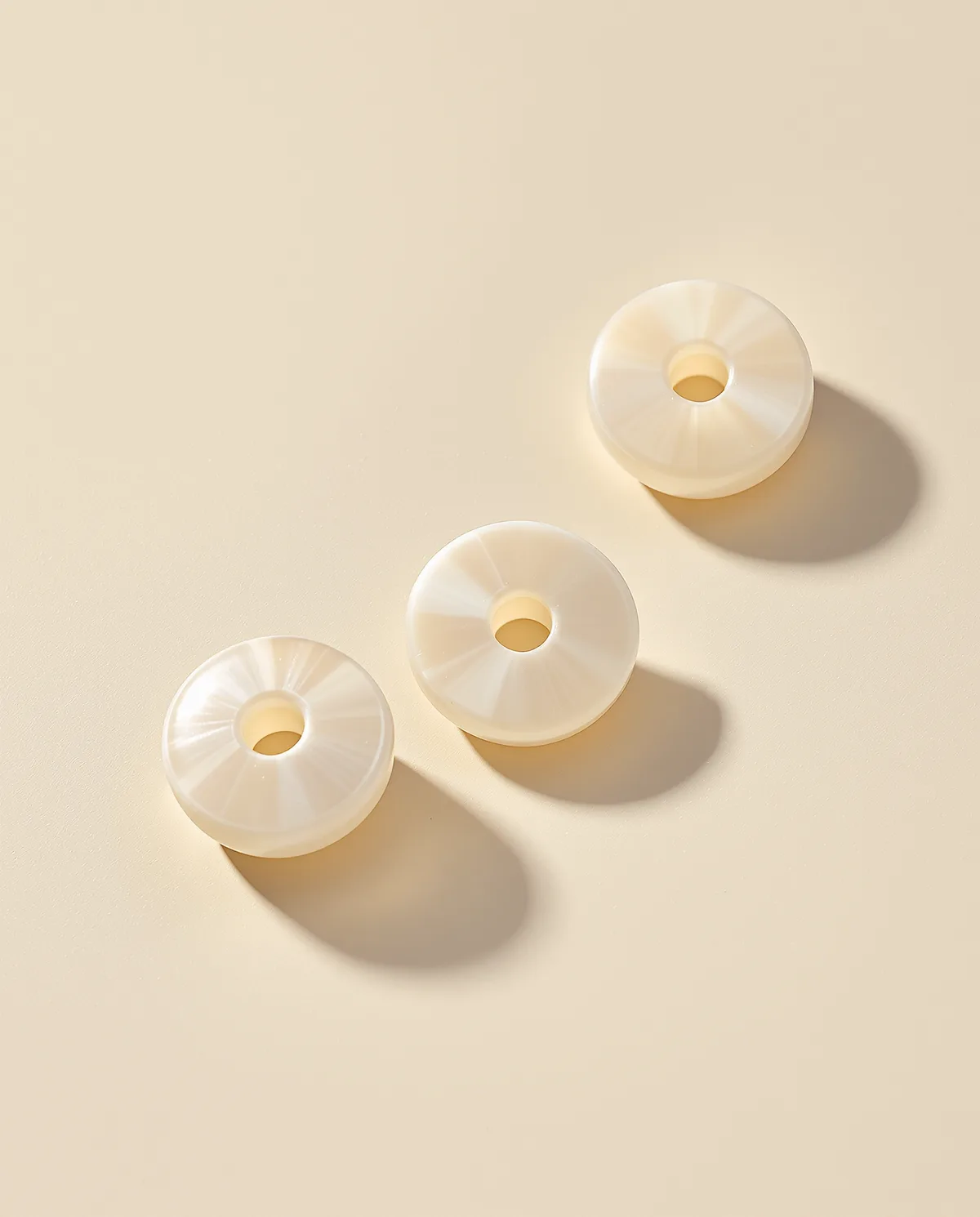
Real capiz is a shell. Faux capiz is an engineered material made to look like one — ours is cast resin, or dyed acrylic cut to shape.
That is the whole distinction, and the rest of this page is what follows from it: control against variation, matched colour against natural colour, and a disc that survives handling against one that chips at the edge.
Real capiz is the shell of a marine bivalve, Placuna placenta, cut and drilled into thin translucent discs. It has been used for centuries in screens, windows and lighting, and its appeal is exactly its unevenness: no two discs transmit light identically.
Faux capiz reproduces the look without the shell. Two production routes: resin cast to shape, or acrylic sheet dyed and then cut to shape, often laser cut. Both are then drilled or spaced so they can be strung or linked.
Descriptions elsewhere in the trade sometimes present faux capiz as a sheet product bonded up in layers. That is not what it is, and we will not repeat the wording. Cast resin, or dyed acrylic cut to shape, is the whole of it.
Because it decides waste, and waste decides what the material costs.
Casting resin to shape makes the disc in its final outline, so there is no offcut around a circle. Cutting discs out of square stock leaves the corners behind, and on a thin sheet those corners are most of the material. That is the reason we cast to shape where the design allows it, and the reason a cut-from-sheet disc is the more expensive route for a plain round.
Cutting comes into its own for shapes a mould would struggle with. A five-petal blossom is laser cut from sheet because the outline is the design.
| Specification | Real capiz shell | Faux capiz, engineered |
|---|---|---|
| What it is | A natural shell | Cast resin, or dyed acrylic cut to shape |
| Colour consistency | Varies piece to piece | Consistent across a run |
| Colour matching | Limited to what the shell is | Dyed to a colour reference |
| Translucency | Natural, uneven, prized for it | Even, specified |
| Thickness | Varies | Specified |
| Durability | Brittle at the edge | Better; the engineered advantage |
| Production route | Cut and drilled from shell | Cast to shape, or laser cut from sheet |
| Disc sizes in our record | — | 25 mm and 50 mm in the 2027 designs |
| Gemixx makes | No | Yes |
Neither is heavy; both are light compared with glass. What changes is behaviour rather than load: a disc is broad and thin, so it catches air and swings differently from a round bead, and a column of thin discs is light enough to drift in a draught.
That is why disc builds often need a weighting decision. A heavier end component, or beads mixed into the column, steadies it so it hangs straight rather than wandering into its neighbour.
The engineered disc, by a wide margin, because colour is specified rather than found. Dyed acrylic and dyed resin are matched to a Pantone reference or a physical chip and confirmed on the sample, and they repeat from one production run to the next.
Real shell has the colour the shell has. Within one batch, discs vary in translucency and tone; between batches they vary more. For a design where that variation is the intent, it is a feature. For a retail programme shipping a consistent product, it is the problem the engineered material was invented to solve.
Cost on a disc piece sits in the number of discs and in how they are joined, not in the material as such. The levers are the same as on any beadwork: disc size and material first, then construction, then spacing, then the mount, then height.
Disc diameter does most of the work. Our 2027 linked-disc designs use 25 mm and 50 mm discs, and a 50 mm disc covers four times the area of a 25 mm one, so it fills a given panel with a quarter as many pieces. Earlier sampling covered a wider span, from 10 to 30 mm, so a diameter between the two drawn sizes is a development rather than a selection from a chart.
The engineered disc, marginally, and for an unobvious reason: it breaks less. Freight cost on a disc piece is driven by volume rather than weight, because discs are bulky for their mass and a linked-disc hanging is not collapsible. What drives the real cost is replacement of pieces damaged in transit, and shell chips where resin does not.
Linked-disc hangings in our range run to 90 × 200 cm with 12 to 16 columns and between roughly 239 and 497 discs, depending on the disc diameter specified. At that scale, breakage in transit is a line item rather than an inconvenience.
Shell, at the cut edge, in handling. A thin natural disc is brittle at its thinnest point, which is the perimeter, and a chip at the edge is immediately visible because light comes through the disc.
The engineered disc's failure mode is different and gentler: the surface dulls if it is cleaned with anything abrasive, and a pearlised face marks. Neither is structural. Wipe with a soft damp cloth and dry; avoid abrasive cleaners, which dull the face permanently.
This is the detail that decides whether a disc piece works. A disc threaded on a cord slides, and a column of sliding discs stacks at the bottom and tangles.
The answer in our own builds is a spacer bead: a small bead at the centre of each disc, dyed to match it, which locks the disc in position on the cord and stops it sliding. On a five-petal blossom build the spacer sits at the flower's centre and reads as part of the design rather than as hardware. Two sample versions of that piece were made, with and without the spacer, and the spacer version is the one that works.
Engineered discs suit retail programmes, hospitality, anything repeating, and any palette brief. They take a colour reference, they repeat, and they survive being walked through.
Real shell suits a one-off interior where the variation is the point and the piece is out of reach. It is a legitimate material and a different proposition, and the position is that it is not what we make.
Cast resin discs, dyed to the palette, with a matched spacer bead at each centre, on a header appropriate to the piece — a turned dowel for a hanging, a stitched rod pocket where a fabric top suits the design.
The reasoning is consistency, durability and colour control, which are the three things an engineered material buys you. Saying it is an imitation is the strength rather than the caveat: it is an imitation designed to behave better than the thing it imitates.
Good to know
The engineered disc, clearly. Dyed resin and dyed acrylic are matched to a reference and confirmed on the sample, and they repeat from run to run. Real shell has the colour it has, and its variation is either the point of the material or a problem, depending on the design.
Shell, at the edge. A natural shell disc is brittle where it is thinnest and chips along the cut edge in handling. The engineered disc is the more robust of the two, which is the single strongest practical argument for it in a hanging piece that gets walked through.
We make the engineered version and not the shell. One live wall-hanging design is built from laser-cut five-petal blossoms in faux capiz with small spacer beads dyed to match at the centre of each — the dowel version carries between 155 and 170 blossoms and the rod-pocket version about 130, which gives a sense of the scale a disc build reaches.
The engineered disc for anything that has to repeat, match a palette, or survive handling. Real shell only where the variation is the design intent and the piece will be handled gently. For a doorway or a wall hanging in a commercial interior, the engineered disc is the answer every time.
They are different materials that happen to look alike. Shell is a natural material with natural variation; the engineered disc is a specified material with specified properties. Which is better depends entirely on whether you want variation or control.
It is possible and we would advise against it. Mixing them puts a consistent material next to an inconsistent one, which makes the natural variation read as a defect rather than as character. If a design wants variation, specify a range of dyed tones instead and keep the material constant.
Keep exploring
Material
Cast resin or dyed cut acrylic, finished to imitate capiz shell: what it gives that real shell cannot, and why thin discs tangle.
View the rangeGlossary
The flat translucent shell of the windowpane oyster — the natural material faux capiz discs imitate, and why we make the imitation.
See the detailGuides
One guide per question that arrives often enough to be worth answering properly.
See the detailGuide
What the trade means by crystal, how cutting changes a bead, and which of the two a brief actually needs.
Read the guideGuide
What chain genuinely does better, what it does not, and which of the two suits a given opening and budget.
Read the guideGuide
Weight, sound, behaviour when cut and damp tolerance — and why the wood route is turned, drilled and finished in our own factory.
How it is made
Start a conversation
Send a reference, a colour chip or a sketch. Minimums are set per design and confirmed per quote; sampling is quoted separately and usually runs 16 to 20 days from an agreed brief.