Material
Plated bead accents
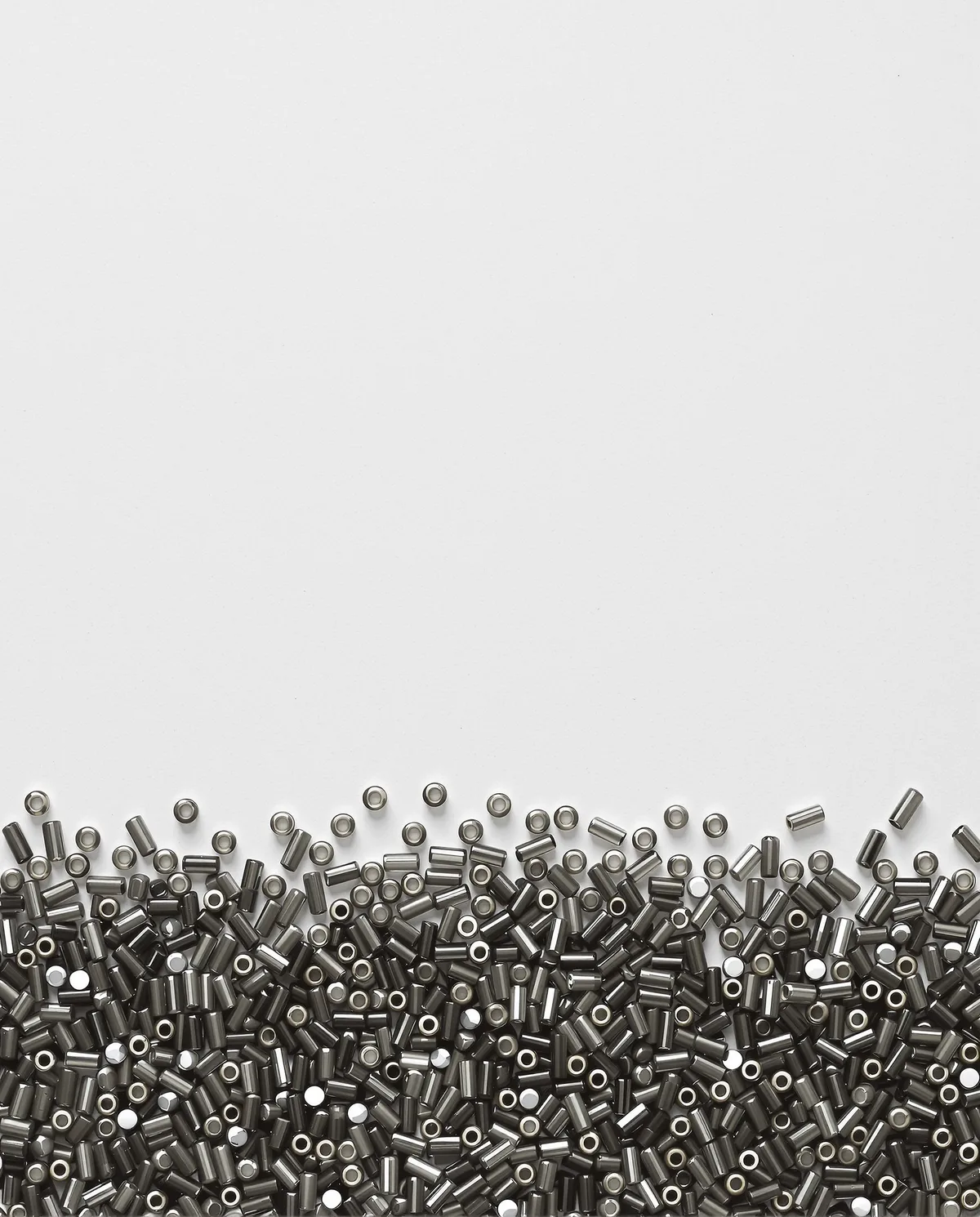
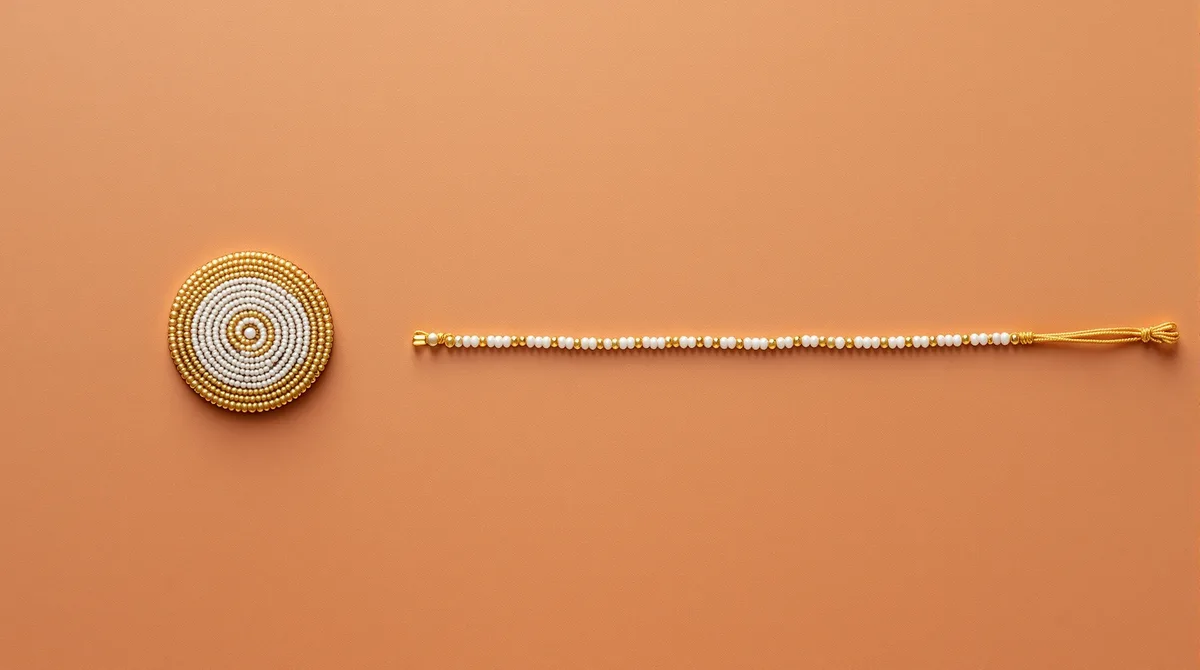
Finished and plated in our own metal plants: eight standard finishes, why metal reads as an accent rather than a field, and what plating does to wear.
See the detail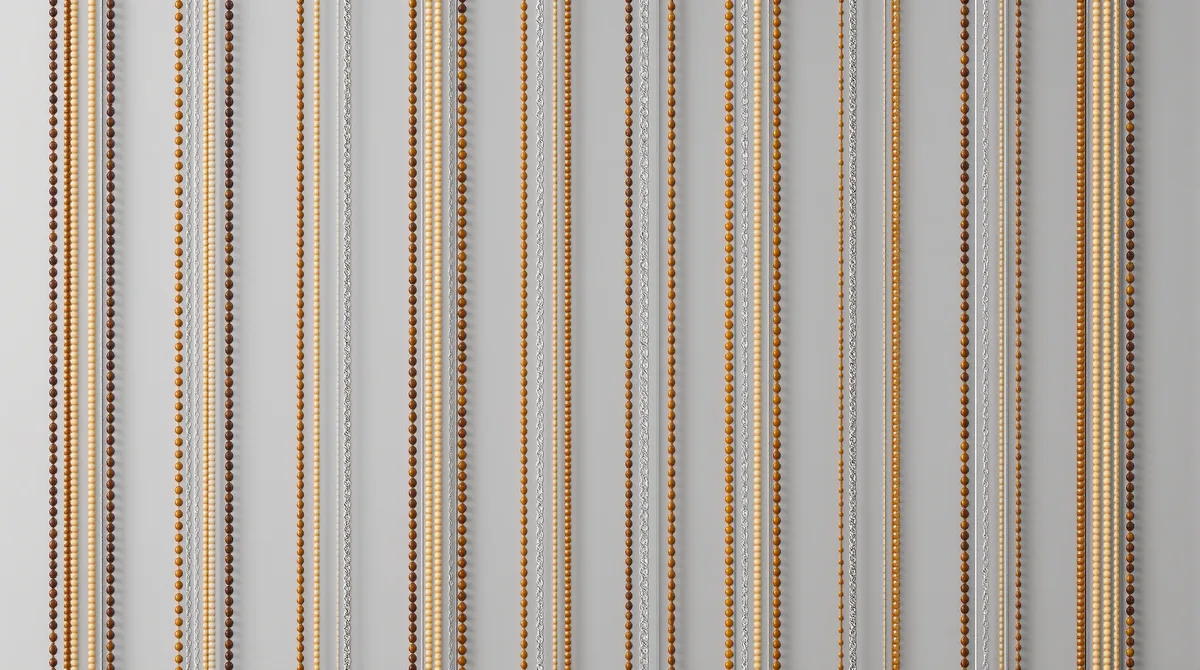
Guide · Comparison
Chain is having a moment, and some of the case for it is real. Here is the part that holds up and the part that does not.
Hand-strung amber and chocolate glass bead cords alternating one for one with lengths of fine polished aluminium ball chain at the same pitch, so the difference in mass reads…
A chain curtain is the better choice for a commercial opening that needs to survive constant traffic, washing down and a fire specification. A bead panel is the better choice wherever colour, pattern and light through the material are the point — chain has one colour family and no capacity to carry an image. They are different products with one shared silhouette.
Chain for abuse. Beads for design.
If the opening is a commercial threshold that will be walked through hundreds of times a day, hosed or wiped down, and signed off against a fire specification, chain is the sensible product and a bead panel is not. If the opening is a place where colour, pattern and light are doing the work, chain cannot do that job at all, because a chain curtain has no mechanism for carrying an image.
A chain curtain is a run of metal chain — usually aluminium or steel, plated or powder-coated — hung in parallel lengths from a rail. Every length is identical. The design variables are link size, link profile, finish and density, and that is the whole palette.
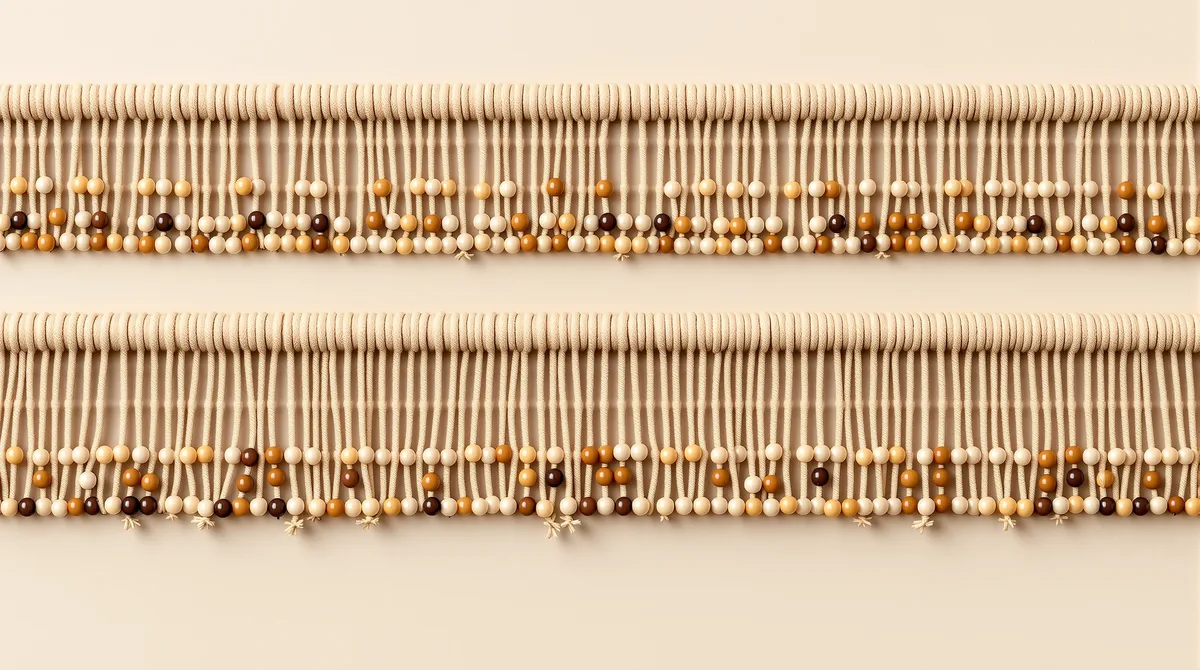
A bead panel is a set of independent strands of beads threaded onto cord. The design variables include every bead position on every strand. Thirty hand-strung strands on a single wooden dowel is our standard build; a densely patterned 90 × 200 cm curtain holds about 11,800 beads on our 2027 design-render basis, each placed by hand. Strand count, bead sizes and the hem shape are all specified rather than assumed.
That difference in the number of variables is the whole comparison.
| Bead panel | Chain curtain | |
|---|---|---|
| Pattern capability | Any pattern, placed bead by bead on a bead map | None beyond link size and finish |
| Colour method | Body colour in glass, or dyed to a Pantone reference | Plating or powder coat on metal |
| Light behaviour | Light passes through glass and acrylic; caustics on the floor | Reflected only; opaque links |
| Sound | Bright chime in glass, light click in acrylic, soft knock in wood | Metallic rattle, louder and harder |
| Robustness in traffic | Good; a parted strand is a local repair | Very high |
| Wash-down cleaning | Not suitable; keep the cord dry | Suitable |
| Fire specification | No rating tested or published for these builds | Non-combustible metal; specify the fixing |
| Weight on the fixing | High in glass, moderate in acrylic or wood | High |
| Where we have made it | Doorway portals, door curtains, café curtains, valances, wall hangings | Not made here |
Both are heavy enough to need a proper fixing, and both are routinely under-fixed.
A chain panel is dense metal and its load never changes. A glass bead panel is comparable in a full-length format and lighter in acrylic or wood. Either way, a full-height panel over a doorway belongs on a rod with brackets fixed into the frame or into structure behind the plaster, not on adhesive hooks.
The difference is what happens when the fixing is marginal. Chain will pull out a weak fixing in one go. A bead panel will usually sag first and give a warning. Either way the question is the panel weight against what will hold it, and that is settled before anything is drilled.
The bead panel, provided the bead is body-coloured glass. The colour is in the glass; nothing short of breaking the bead will change it.
Chain's colour is a finish on metal — plating or powder coat — and a doorway panel gets handled every day. Our own metal work gives a sense of the range available: eight standard finishes from matte black through to brilliant and antique silver, plus physical vapour deposition and gold plating for custom work, all finished and plated in our own Moradabad plants. They are durable finishes. They are still finishes, and they wear at the point of contact.
For a back-of-house threshold that gets hosed down and sits under a non-combustible requirement: chain, which we do not make, and we would say so rather than propose a bead panel that cannot meet the specification.
For everything else, a bead panel — and the specification decision that matters is density rather than material. A chain curtain's cost scales linearly with length because every link is identical. A bead panel's does not, because density is a free variable: a spaced 90 × 200 cm panel sits nearer 3,100 beads against about 11,800 for a densely patterned one of identical dimensions. That is a different product at a different price inside one set of measurements.
So the useful question is not "which is cheaper" but "at what density does a bead panel meet my budget" — answered on a rough cost sheet before any sample is made.
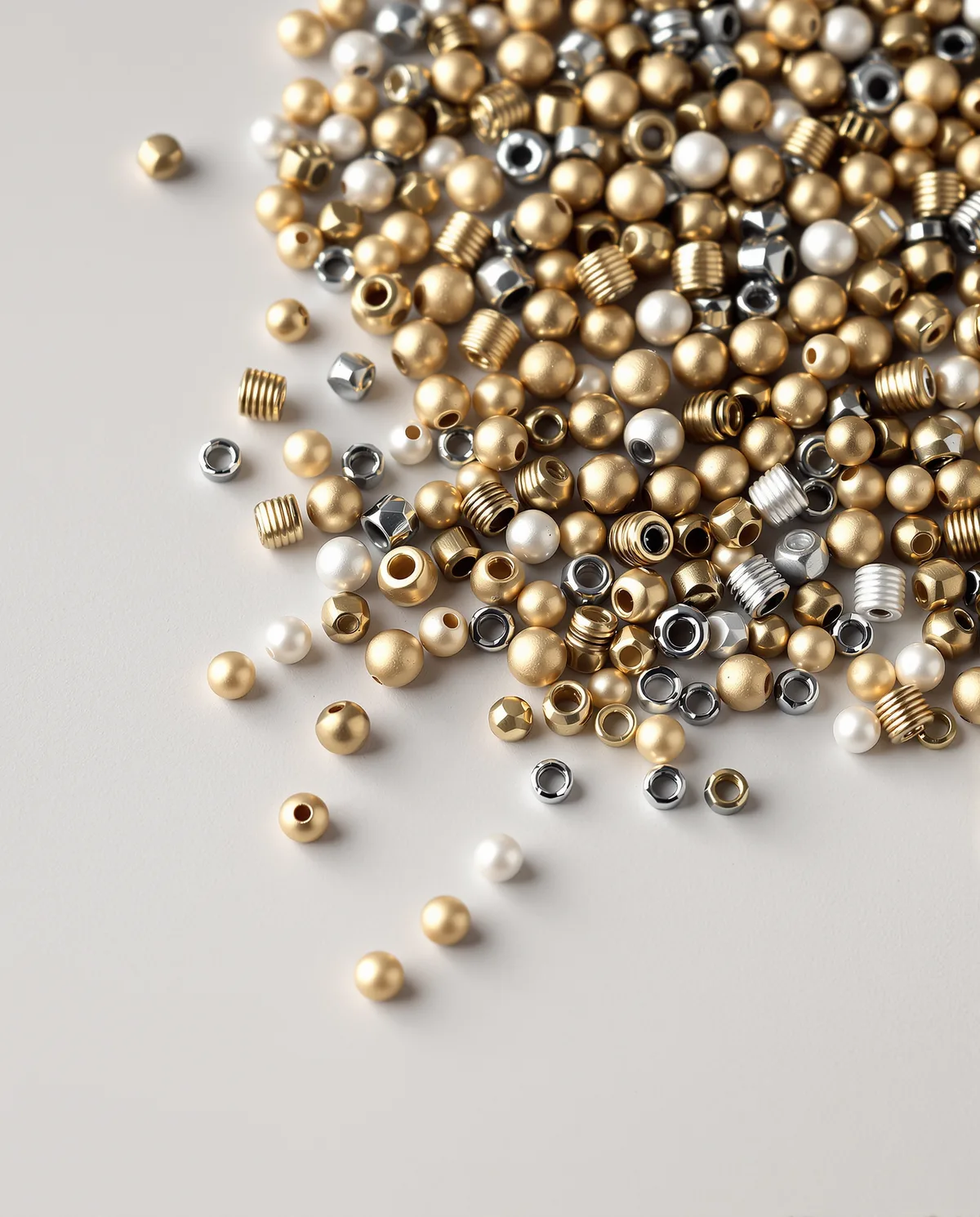
Where a brief wants a metal read with pattern capability, specify metal beads on cord: finished and plated in our own Moradabad plants, on the same bead map as the glass around them.
Chain, generally. It compresses, it cannot chip, and the carton is dense.
A bead panel has to travel with its strands in order so they do not tangle, and glass needs cushioning against bead-on-bead knocking. The carton is therefore large for the piece. Chain's counterweight is mass: on a long sea freight, dense metal is expensive to move, and the gap narrows.
Chain is extremely robust in the middle and no more forgiving than beadwork at the top. Its failure is almost always at the hanging ring or the head fixing, under a constant load that never lets up.
A bead panel fails at the cord, which abrades against the drill hole of every bead it passes through — the stringing medium and the hole are specified together for that reason. It fails locally — one strand — and that strand is a repair rather than a replacement, which is why spare beads are worth specifying with the order. Over a long service life in a domestic doorway, the glass itself will outlast the building work around it.
Chain: industrial and back-of-house thresholds, kitchens that get washed down, fly screens, anywhere a documented non-combustible specification is required, and retail fit-outs chasing a hard industrial look.
Beads: home retail, hospitality front-of-house, salons and spas, children's and teen ranges, event and display, and anything where the panel is supposed to be the thing people notice. On a motif, a gradient or a colour story, there is no chain equivalent.
Not in anything we have made, and we would not propose it. A chain and a corded strand have different weights, different movement and different stiffness, so on one header they fight each other, and the chain abrades the cord wherever the two touch.
The middle route is metal beads on cord. They give a metal read, a metal sound and a metal weight, in a construction that still accepts a pattern — and they sit on the same bead map as the glass or acrylic around them.
It shows strung beadwork, in volume, and no chain. We make doorway portals, door curtains, café curtains, valances and wall hangings, and that programme has been in continuous production.
It also shows where the hard-wearing argument actually gets settled in beadwork, which is in the bead rather than in the cord. On one Venetian-glass portal, beads were breaking in the panel; the fix was a change to the furnace process, annealing the larger feature beads, and revising the palette, because glass strength is colour-dependent and certain colours knocking together will chip. A bead annealed for strength is a different object from the same bead untreated. That is the sort of engineering a bead panel can have applied to it. A chain curtain has no equivalent conversation available, because there is nothing in it to tune.
Good to know
A bead panel fails at the cord, locally and usually after years: one strand parts and is re-strung in bead-map order. Chain fails at the hanging ring or the top fixing, because a metal panel is heavy and the load never varies. Chain is more robust in the middle and no more forgiving at the top.
Strung beadwork, which is why this comparison is written from the bead side and the chain column describes the product category. What we make in metal is the bead itself — finished and plated in our own Moradabad plants, and strung into a panel alongside glass.
Chain for a commercial threshold that gets washed down, takes heavy traffic and sits under a fire specification. A bead panel for anything where the design has to carry colour, a motif or a gradient. If the brief wants a metal read with pattern capability, specify metal beads on cord instead of chain.
Chain is better at being indestructible; beads are better at being a design. The version of the argument that chain is the grown-up option is that it survives abuse. The dishonest version is that it looks more considered — a chain panel has one idea in it, and a bead panel can have any number.
Not in anything we have made, and we would not propose it. Mixing a metal chain with a strung cord puts two very different weights and movements on one header, and the chain abrades the cord where they touch. Metal beads strung on cord give the same material mix without that conflict.
Chain, usually, because it compresses into a dense carton and nothing in it can chip. A bead panel keeps its strands in order and glass needs cushioning, so the carton is larger per piece. Against that, chain is heavy, so on a long sea freight the weight can close the gap.
A body-coloured glass bead, with no serious competition. The colour is inside the glass. A chain curtain's colour is a plated or powder-coated surface on metal, and a surface in a doorway gets touched several times a day. Our eight standard metal finishes are durable, but they are still finishes.
Keep exploring
Material
Finished and plated in our own metal plants: eight standard finishes, why metal reads as an accent rather than a field, and what plating does to wear.
See the detailGuides
One guide per question that arrives often enough to be worth answering properly.
Specs and sizesGuide
The real hours in a hand-strung panel, where a home build wins outright, and where the bead count makes it a bad idea.
Specs and sizesGuide
Round against tube: what the geometry changes about texture, direction, coverage and how fast thread wears.
Specs and sizesGuide
Beads on cord against beads couched on cloth: cost behaviour, failure mode and which products come from each.
See the detail
Start a conversation
Send a reference, a colour chip or a sketch. Minimums are set per design and confirmed per quote; sampling is quoted separately and usually runs 16 to 20 days from an agreed brief.