Manufacturing
Door portal beadwork
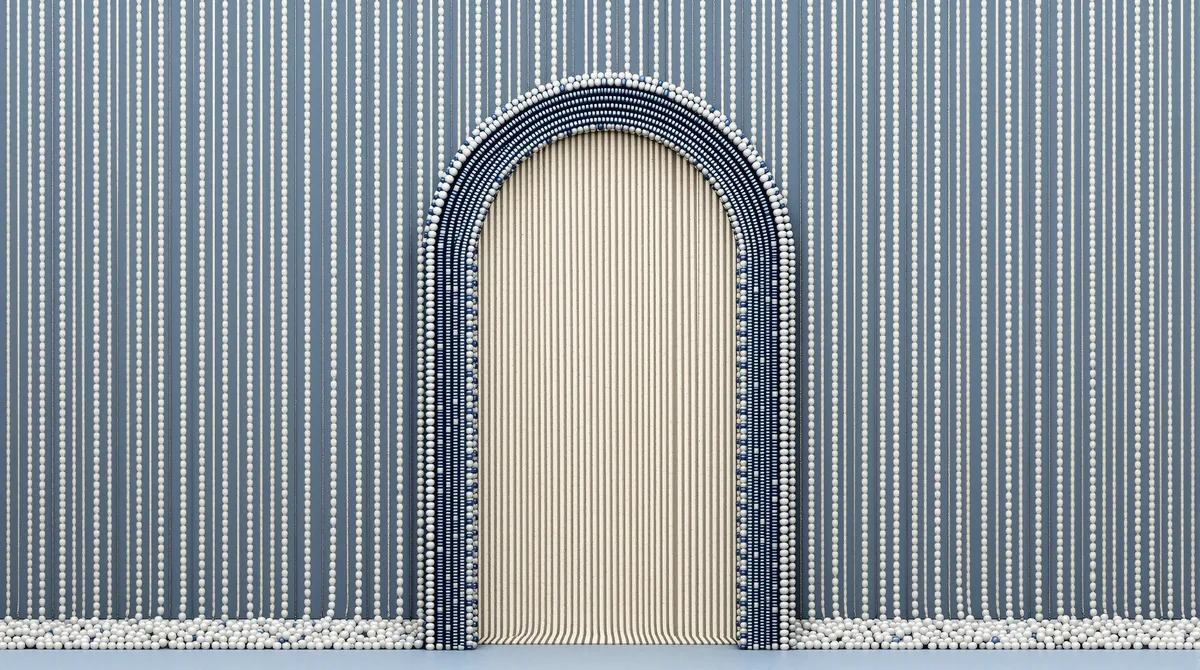
Strands that frame an opening and leave a clear walk-through: arched and inverted-V drops, built to order on a turned dowel or a stained rail.
View the range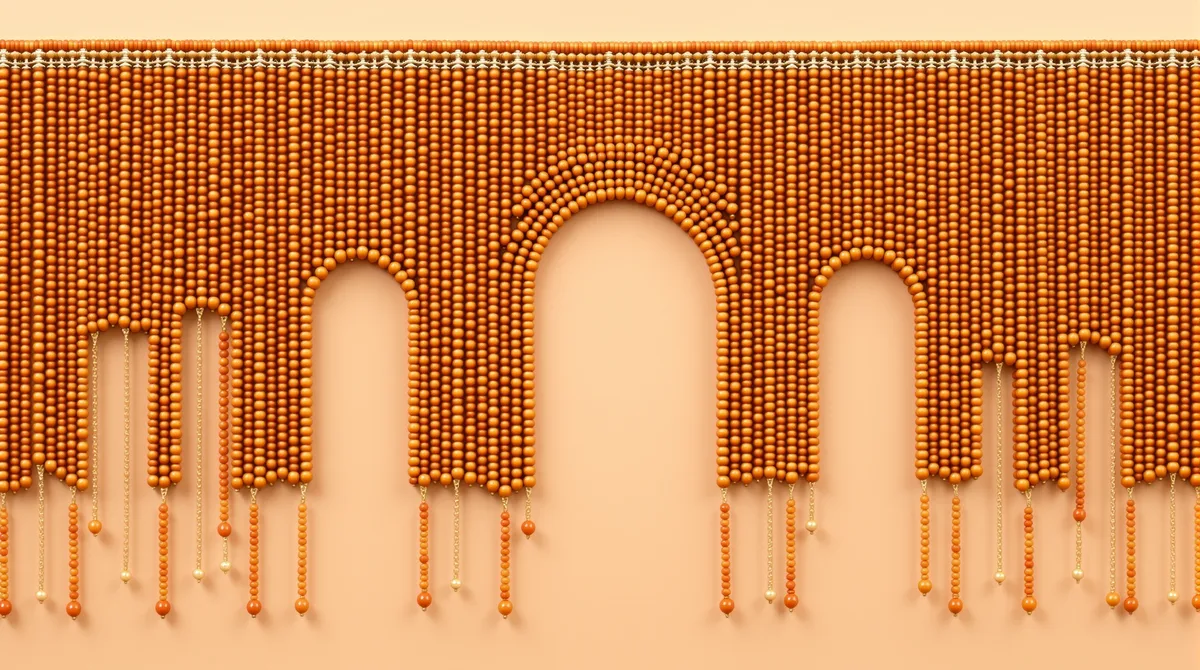
Guide · Comparison
The difference is a hole. What follows from that hole is lower wear, a lower bead count and a completely different relationship with the room beyond.
A beaded hanging with arched openings cut up into the beadwork from the hem, the strands falling full length on either side of each arch, in rust and burnt orange.
Choose a portal when the opening is walked through constantly and should stay visually open: the arched centre is cut away, so nothing is parted and nothing wears. Choose a full curtain when the job is to screen a sightline. The portal carries fewer beads for the same width, and the curtain is the only one of the two that actually screens.
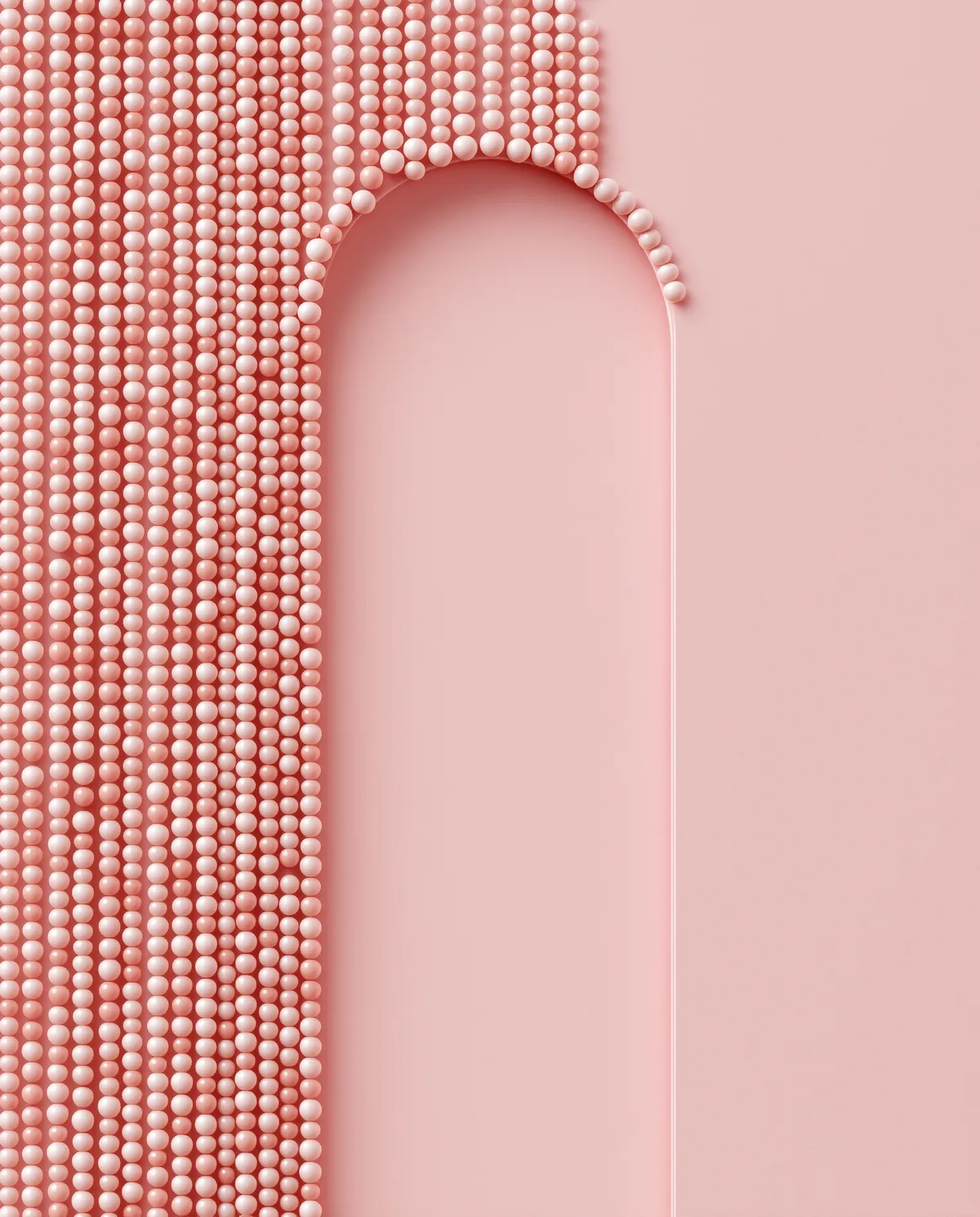
A portal if the opening is for walking through, a full curtain if it is for screening.
Everything else — cost, wear, weight, how the room reads — follows from that one distinction, because the two formats are built identically. Same hand-strung strands, same header, same beads. The portal just has its centre cut away.
A beaded portal frames a doorway and leaves a clear opening in the middle. The strands run down both sides and across the top, and the centre is an arch cut out of the drop by varying strand lengths. You walk through the hole, not through the beads.
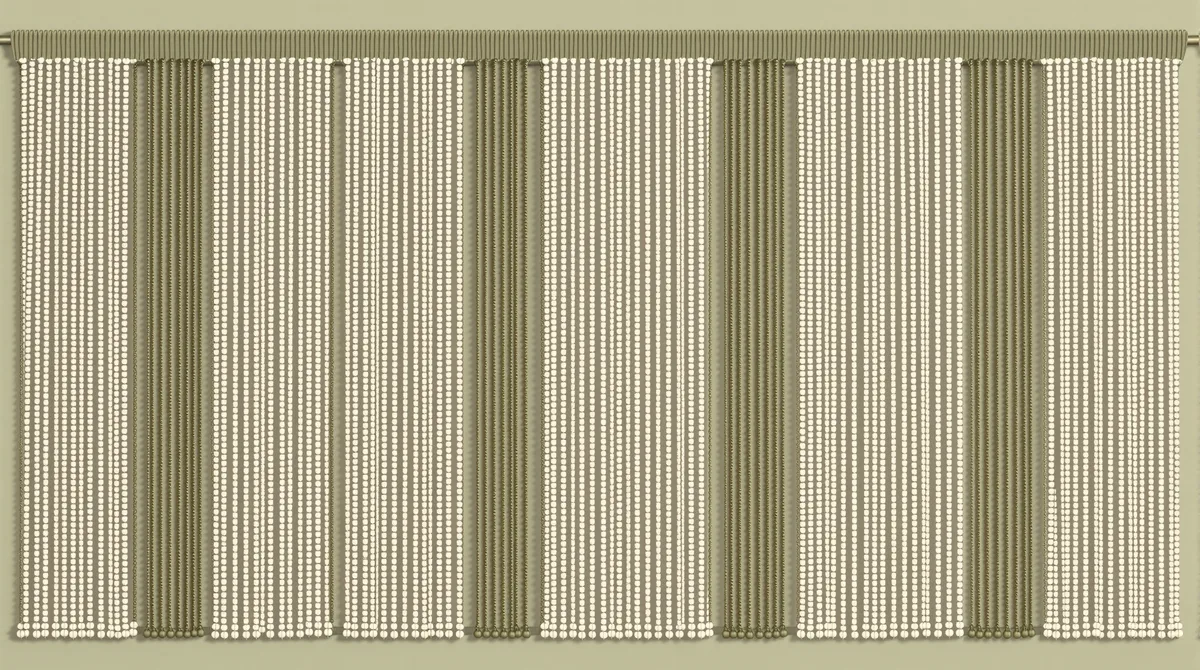
A full beaded curtain is strung across the whole opening at an even strand pitch. You part it to pass through, and it closes behind you. In the published formats that is about 90 × 200 cm, roughly 35 × 79 in, hung from a wooden dowel or rod.
A third construction sits between them: an arched-cut drop, where the centre is cut away at head height but strands continue below. It is a portal where you walk and a curtain where you look.
| Specification | Beaded portal | Full beaded curtain |
|---|---|---|
| Centre of the opening | Cut away in an arch | Fully strung |
| Screening | None — the centre is clear | Partial sightline break |
| Walk-through wear | Low: nothing is parted | Moderate: strands part on every pass |
| Beads for the same width | Fewer | More |
| Formats in the record | 76 × 140 cm, 90 × 200 cm, 90 × 67 cm | 90 × 200 cm, 120 × 200 cm |
| Strands on our live builds | 30 on a single dowel | 40 at 90 cm, 60 at 120 cm in the renders |
| Dense bead count at 90 × 200 cm | Lower than a full panel | About 11,800 on a dense pattern |
| Hem | Arched cut, often scalloped at the sides | Straight, scalloped, V-point or inverted-V |
| Best for | Busy doorways, shopfronts, framing a view | Screening, privacy, closing a room visually |
The full curtain, substantially, because the removed centre of a portal is where most of the strand length would have been. On a 90 cm opening the centre third of a full-length panel is a large fraction of the total bead count.
What that changes is the fixing. A full glass curtain is the case that needs a rod on brackets fixed into something structural; a portal of the same width in the same beads may sit happily on hooks. It also changes freight, since weight is what moves the cost of shipping beadwork.
The full curtain, and the cost sits in beads and stringing hours rather than in anything else. Cost on a beaded panel moves in a known order: bead size and material first, then construction — strand count and how tightly each strand is strung — then strand spacing, then the dowel and packing, then height.
A portal attacks the biggest two levers at once. It keeps the strand count across the width but removes beads per strand in the centre, which is why it is the cheaper format at equal quality rather than at reduced quality. For scale, a densely patterned full 90 × 200 cm curtain can hold about 11,800 beads, every one placed by hand.
The full curtain, in the middle, at hand height. Those strands are parted by hand or by shoulder on every single pass, which loads each header knot laterally and works cord against the drill hole of every bead it passes.
A portal has nothing there. Its wear is at the edges of the arch, where a sleeve occasionally catches, and it is far lower. That makes the portal the better specification for a commercial doorway regardless of look — a shopfront or a restaurant doorway is thousands of passes a month.
The portal, for the weight reason above. Both pack the same way: strands held in their order, protected against knocking in transit, packed to the buyer's carton and label specification.
The practical note for a retail programme is that neither is a stock item. There is no retail stock programme behind these formats; every beaded door curtain is made to order, so freight planning follows the production schedule of 40 to 60 days after sample approval.
Portals suit hospitality and retail doorways, shopfront windows, and any residential opening that is permanently in use. They also suit a brief where the point is to frame a view rather than to hide one.
Full curtains suit screening: a kitchen from a dining room, a changing area, a treatment room, a stockroom door. They also suit a buyer who wants the panel to be the room's main visual event, because a full field of beads reads as a surface and a portal reads as a frame.
Yes, and the arched-cut drop is the construction that does it. The centre strands are shortened so the opening is clear at head height and the strands continue below, which keeps a sightline break at waist level while leaving the walk-through clear.
Two of our live builds use an arched-cut drop, including a two-tone green curtain in lime glass seed-bead strands with spaced forest-green rounds at 76 × 140 cm, which is also the portal format in the design library. The hem shaping on that construction is a list of strand lengths rather than anything structural, which is why the arch costs planning and not material.
For a doorway in daily use: a portal, or an arched-cut drop if any screening is wanted. For a sightline problem: a full curtain, denser than instinct suggests, because partial screening is the most disappointed expectation in this category.
For a commercial doorway, a portal with end suspension loops at the header, so it can be hung level on a door or a wall rather than depending on a square frame — and because loops spread the load across more fixings than a rail does.
That both formats are real and the portal is the one that repeats. The current programme spans beaded portals, curtains, café curtains, valances and wall hangings, in continuous large-format production.
The portal designs in that set include a 30-strand translucent-bead build on a single wooden dowel, a faceted iridescent version, a neutral wood-tone version, and accented builds carrying moulded dotted ovals or glass mushroom beads scattered three or four to a strand and deliberately never aligned in a row. The lead portal has been reordered repeatedly, which is the clearest commercial signal in the whole category.
Good to know
If the opening is walked through many times a day and the point is to dress it, a portal. If the point is to break a sightline — a kitchen seen from a dining room, a stockroom door, a treatment room — a full curtain, because a portal does not screen anything. The question is never which looks better; it is what the opening is for.
They are different formats with the same construction. A portal is lower-wear, lighter and cheaper at equal quality; a full curtain is the only one that screens. Neither is a compromised version of the other, and both are built as hand-strung strands on a header.
Yes, and the mix is one of the better designs available. An arched-cut drop leaves a clear centre at head height and strands below it, so the piece frames the walk-through without abandoning the lower screening. Our arched-cut builds work exactly this way.
The portal, because it carries fewer beads for the same width and weight drives freight on beadwork. The gap is larger with glass than with acrylic, since glass is the heaviest bead family and the removed centre is where most of the strand length would have been.
Neither, as formats — colour behaviour follows the bead and how its colour is held, not the shape of the piece. The one indirect difference is exposure: a portal in a doorway leaves the centre of the opening clear, so a panel behind it is not shaded, and a full curtain partly shades whatever is behind it.
The full curtain, and at a predictable place: the strands in the middle, at hand height, which are parted on every pass. A portal has no strands there. On a full curtain that is the argument for a heavier bead and a well-seated header knot in the centre third.
Portals are the stronger part of the programme. The beaded range — portals, curtains, café curtains, valances and wall hangings — is in continuous large-format production, and the lead portal reorders season after season.
Keep exploring
Manufacturing
Strands that frame an opening and leave a clear walk-through: arched and inverted-V drops, built to order on a turned dowel or a stained rail.
View the rangeCraft topic
The portière, the screen and the divider — three different jobs that look alike in a photograph, and which of them we actually build.
Compare the optionsGuides
One guide per question that arrives often enough to be worth answering properly.
Open the referenceGuide
Beads on cord against beads couched on cloth: cost behaviour, failure mode and which products come from each.
Specs and sizesGuide
Weight and drape, sound, colour range, breakage, cost and freight, with a verdict by buyer type rather than a neutral shrug.
Read the guideGuide
A valance dresses the top of an opening; a short curtain covers part of it. The line sits near a third of the height.
Read the guide
Start a conversation
Send a reference, a colour chip or a sketch. Minimums are set per design and confirmed per quote; sampling is quoted separately and usually runs 16 to 20 days from an agreed brief.