Material
Glass seed beads: sizes, dye lots and cord
How seed beads are drawn, why dye lots are quoted per run, what the drill hole limits, and where seed-bead work earns its cost.
Specs and sizes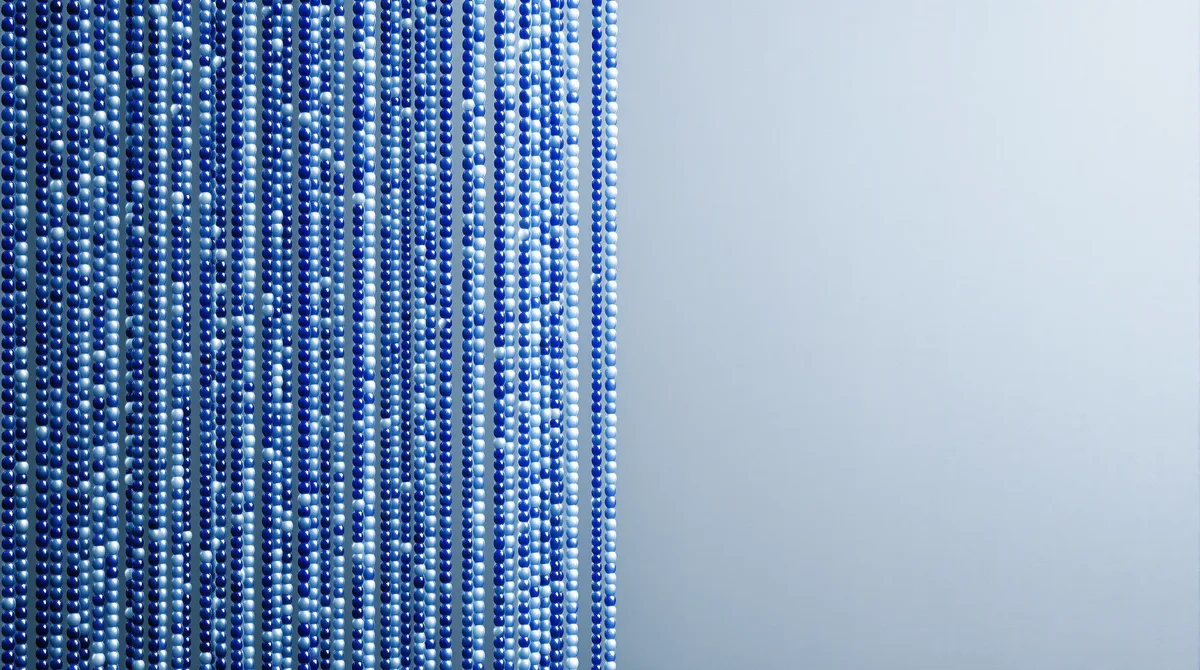
Process · Glass works
A drawn bead is not made one at a time. A single gather of molten glass becomes metres of hollow cane, and the cane becomes thousands of beads. Everything that is good and everything that is awkward about glass beads starts there.
A field of hand-strung glass bead strands in cobalt, sky and chalk white filling one side of the frame, every bead separately readable.
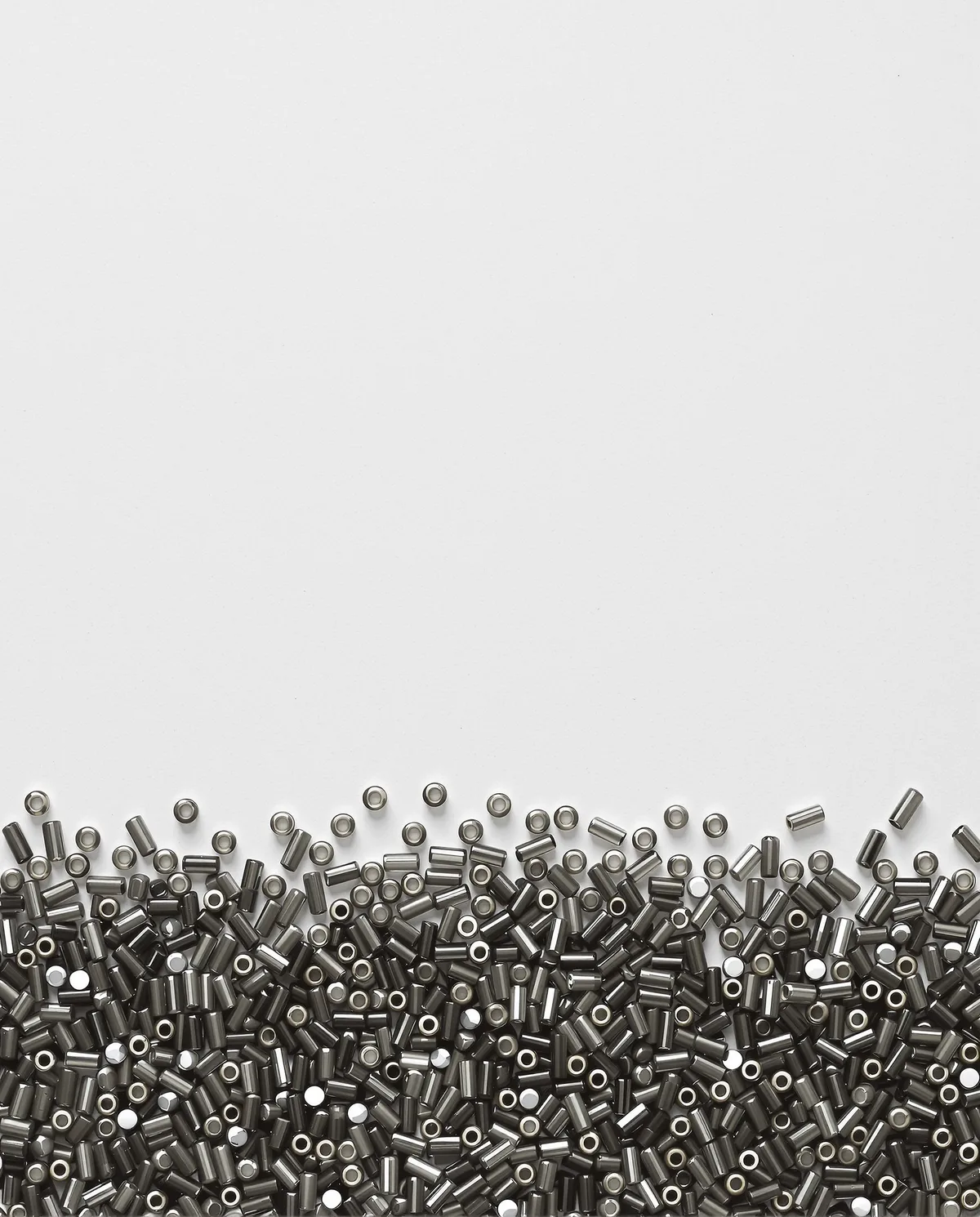
A drawn glass bead begins as a gather of molten glass with a bubble of air trapped inside it. Two workers pull the gather into a long hollow cane, so the bubble stretches into a continuous hole. The cane is cut to length, the cut ends are rounded by tumbling, and the beads are annealed. Colour is decided in the melt, before any bead exists.

Drawing is making a bead by making a tube first. A gather of molten glass is taken from the furnace and a bubble of air is introduced into the middle of it. Two workers then pull that gather out along a walkway — tens of metres of it — until the glass has thinned to the diameter the bead needs. The bubble stretches along with the glass and becomes a continuous bore running the full length.
The hole in a drawn bead is therefore not a drilled passage. It is a stretched air bubble, which is why it is perfectly smooth and why it is never quite in the centre.
Seven stages, and only one of them is about the individual bead. The melt sets colour. The gather and the draw make cane. The cut makes pieces. The tumble makes them beads. The anneal makes them stable. The sort makes them a usable run. Surface finishing, where specified, is last.
All of it happens in our own Firozabad glass works, whose published capability list covers mouth-blown soda-lime and borosilicate glass, mould-blown and pressed glass, colouring, frosting and ribbing, cutting and etching, and glass-bead drawing and hand-stringing.
Uniformity at a price nothing else reaches. Because the beads are cut off one cane, every bead in a run shares the same wall thickness, the same bore and the same colour. That is what lets a field of glass seed beads behave as a continuous material rather than as thousands of separate objects — and that behaviour is the precondition for bead and thread embroidery holding an image.
It is also the only route to a bead small enough to act as a pixel. A pressed bead has a minimum size set by the mould; a drawn cane can be pulled as fine as it will go.
By size, by hole and by colour, in that order. Size is checked by sieve and by eye against a retained sample, because an off-size bead in a strand of uniform ones is immediately visible. The hole is checked for blockage and for eccentricity. Colour is checked against the approved sample bead rather than against a reference print, because glass colour read on paper and glass colour read in glass are different things.
Anything that fails goes back before stringing, which is the cheap place to lose it.
Four things, and none of them is "glass beads". The bead size range. The hole diameter, which decides the cord for the whole build. The colour method — body colour, surface dye, or dyed to match an accent. And the surface finish: glossy, matte, frosted, ribbed or iridescent.
Bead sizes and stringing specifications is the sheet to send a designer before they draw, because the drill hole is the entry that stops a piece being assembled at all.
Most of them, at the base. A seed-bead ground carrying a larger accent is the standard construction: in our own record, a two-tone green curtain built on lime glass seed-bead strands with spaced forest-green rounds; a cream seed-bead base carrying glass mushroom accents; a dotted construction where the base seed beads are dyed to match the dot colour; and a valance built on irregular frosted beads of about four to five millimetres strung with seed beads.
Drawn glass is also what the all-seed-bead work is made of — the seed-bead café curtain on a sheer ground, and the white-on-white bead work on chiffon that was developed alongside it.
Nothing about drawing, and that distinction is worth holding. The drawing bench delivers a bead: a size, a bore, a colour, a finish. The colour-count sheet is a construction document written afterwards, recording bead by bead and strand by strand where that bead goes.
The two meet at one point only. If the drawn bead's bore is smaller than the cord the count sheet assumes, the sheet is wrong and nothing can be strung.
Glass, and only glass with a working range wide enough to be pulled. Our own works runs soda-lime and borosilicate, and the difference between them is not academic: a recent glass development trialled borosilicate against pot glass directly, because the two behave differently in the melt and in colour annealing.
Nothing else in the library is drawn. Acrylic and resin are moulded, wood is turned, ceramic is formed and fired, metal is stamped or cast.
The furnace and the kiln, not the bead. Melt time, draw time, cut rate, drum time and kiln cycle are all batch figures, so labour per bead falls as the run grows in a way it never does for hand-made lampwork glass.
Where hours do scale with the bead is at sorting and at surface finishing. A tight size tolerance means more sorting; each surface effect is another pass over the whole quantity.

Against a retained bead, not against a description. A sample bead from the approved run is kept, and production is measured against it for size, bore and colour. That is the only method that survives the one thing glass does reliably: a surface-dyed colour is a property of its batch, so two runs to the same reference sit slightly apart.
Where a programme reorders over time, the options are the ones the dye-lot discussion always reduces to — hold the lot for the programme, or write the acceptable variation into the specification. Bead dyeing and colourfastness sets out which finishes move and by how much.
An off-centre bore, from an uncentred bubble: the bead sits crooked on the cord for ever. A blocked hole. Unrounded cut ends, which abrade thread. Off-size pieces. And cracking on cooling, which is an annealing failure rather than a drawing one.
All are rejected at sort. The one that escapes sorting is latent stress in a heavier bead, which does not fail until months later — which is why annealing and colour strength is a separate page rather than a paragraph here.
Drawn glass is the cheapest glass per bead in the library and the most expensive per square centimetre of coverage, because it takes a great many beads to cover anything. Both halves of that sentence matter when costing a design.
The lever is therefore bead size, not bead price. Moving a flat field up one size step removes a large fraction of the units and almost none of the appearance at normal viewing distance. De-densifying an infill does the same thing, and on our own developments it is the change that has most often brought a piece to its target without altering what a buyer sees.
In our own Firozabad glass works: furnace, gathering iron, drawing walkway, cutting bench, tumbling drum, annealing kiln. Firozabad is a glass town, and bead drawing and hand-stringing are on that plant's published capability list alongside blown and pressed glass.
We own the network; we are not a sourcing office — and for glass specifically that reaches all the way back to the batch. We do not publish furnace counts or floor areas, and nothing here should be read as implying one.
Extractable data
| Stage | What drives the labour | What is rejected here |
|---|---|---|
| Melt to colour | Batch chemistry and furnace time; a new colour needs trials | Off-colour melt, before any bead is drawn |
| Gather and bubble | Skilled hands; the bubble has to be centred | An off-centre bubble, which gives an eccentric hole |
| Draw the cane | Two workers and the length of the walkway | Cane outside the diameter tolerance |
| Cut to length | Cut rate; length sets seed against bugle | Short, long and split pieces |
| Tumble | Drum time and media | Beads with unrounded or chipped ends |
| Anneal | Kiln cycle, longer for a heavier bead or a demanding colour | Beads that crack on cooling |
| Size and sort | Hand and mechanical sorting | Off-size, off-colour, blocked holes |
| Surface finish | One pass per effect — frosting, ribbing, dye | Uneven coverage |
Good to know
An off-centre hole, from a bubble that was not centred in the gather. A blocked hole. Unrounded cut ends, where tumbling was cut short. Off-size pieces, which show immediately in a strand. And cracking on cooling, which is an annealing fault. All five are caught at the sorting stage rather than at stringing.
Parts of it. The melt is a furnace process and cutting, tumbling and annealing all run on equipment. The gather and the draw are hand work, and the sorting that decides whether a run is usable is still largely done by eye and by sieve.
Drawing scales by quantity, not by bead size. A gather can become thousands of small beads very efficiently; it cannot become one large feature bead, because the process makes a tube and not a shape. A large bead is pressed in a mould or wound at the torch instead.
The wrong unit. A single draw produces metres of cane and thousands of beads, so the meaningful figures are the furnace cycle, the cut rate and the kiln cycle. That is exactly why drawn beads are the cheapest glass in the library per unit.
Glass only, and specifically glass with a working range wide enough to be drawn. Our own glass works runs soda-lime and borosilicate; borosilicate against pot glass has been trialled directly on a recent development. Acrylic and resin are moulded instead, and wood is turned.
No — a colour-count sheet is a construction document, not a bead one. It is the bead-by-bead plan for every strand in a finished piece. Drawing produces a bead with a size, a colour and a hole; the count sheet is written later, when a design decides where that bead goes.
Because glass colour is chemistry and acrylic colour is a dye bath. A metal-oxide loading that gives the right colour also changes how the glass works and how long it must anneal, so a new glass colour means furnace trials before any bead is drawn. A dyed acrylic bead can be confirmed in a short loop.
Keep exploring
Material
How seed beads are drawn, why dye lots are quoted per run, what the drill hole limits, and where seed-bead work earns its cost.
Specs and sizesProcess
What annealing relieves, why a colourant changes the glass it colours, and how a real breakage problem was solved by changing the furnace and the palette.
Compare the optionsMaterial
Cut long instead of short: how a tube gives beadwork direction, where it outperforms a round, and why the cut ends decide the thread.
How it is madeMaterial
Why a mould, not a draw: how a pressed shape repeats across a run, what the mould seam costs you, and where a feature bead earns its weight.
Open the referenceReference
Five craft families — strung, embroidered, wire-wrapped, knotted and wrapped fibre — and what each one is good for.
Read the guide
Start a conversation
Send a reference, a colour chip or a sketch. Minimums are set per design and confirmed per quote; sampling is quoted separately and usually runs 16 to 20 days from an agreed brief.