Reference
Briefing a bead order
The nine fields a beadwork brief has to carry, what each one is used for, and what happens when one is missing.
Specs and sizesOrdering · Templates
The template is published here as a sheet you can copy into your own document and send to anyone. It is deliberately not branded, because a brief that only works for one maker is not a brief.
The template is published on this page as a field sheet to copy, not as a file to download — no downloadable asset exists yet and the gap is marked rather than implied. It carries fourteen fields across product, construction, colour, fixing, packing and commercial terms, and it is written to be sent to any maker rather than only to us.
The fourteen-field sheet below is the brief we work from, published as a field sheet rather than as a download. Copy it straight into your own template or your own purchasing system, which is where it is more use than a branded PDF would be.
The sheet is unbranded deliberately. A request for quote that only works when it is sent to one maker is not a request for quote, it is a form. Send this to three plants and the three answers become comparable, which is the whole point of writing a brief down.
Copy the fourteen fields. Fill the nine that make a quote possible: product type, finished size, strand count or pitch, main bead, accent beads, colour, pattern, top fixing and quantity per colourway. Add the five that make answers comparable: packing, destination with the Incoterm you want quoted, market and testing requirements, dates, and your programme name so the thread stays findable.
Send it. Expect a reply within one business day on anything missing, and a formal quote within 48 hours of the sheet being complete. For a multi-SKU programme, expect a discovery call to be proposed first, because one call resolves faster than three rounds of email.
The two fields people fill in last: pattern and accent beads. Together they set the bead count, and bead count sets both material and stringing hours. A densely patterned panel at 90 by 200 cm can hold about 11,800 beads; a spaced panel at the same size holds a fraction of that and prices accordingly.
After those, the main bead material, then the header, then the packing. Height is a real lever but it bites last, which surprises buyers who assume a shorter piece is proportionally cheaper.
Nothing to use the sheet. Nothing for the rough cost sheet that comes back. Sampling is quoted separately from production. Testing is quoted per market. Tooling for a bead that has to be moulded to a new die is identified separately rather than folded into a unit price, so you can see it and decide whether to amortise it across the run.
Three fields, in order of damage done. Colour sent as a word. Quantity sent as a total instead of per colourway — a total split across colourways is not one run for minimum purposes, and treating it as one produces a quote nobody can use. And the Incoterm left unstated, which makes two quotes from two makers look different when they are the same.
A textile brief is complete with a size, a construction and a print reference. A bead brief is not complete until the counts are in it: how many strands, how many accents per strand, and whether accents are scattered or aligned. Scattered and aligned are different products to make even when they look similar in a photograph, because one can be strung to a rule and the other has to be mapped.
That is why the sheet asks for counts rather than adjectives, and why a reference photograph is genuinely useful: it carries density information that prose does not.
That the sheets which arrived complete moved to a sample inside the published 16-to-20-day window, and that the long cycles in our record were cost iterations rather than specification ones. Where a design needed six or seven passes, the passes were attempts to reach a target price using different bead sizes and densities — exactly the conversation the rough cost sheet is meant to have before sampling rather than during it.
Everything from the sheet, plus the approved sample reference by number and date, plus the inspection standard. The order should name the sealed sample as the quality reference; the sheet is what produced it, but the sample is what production is held to.
Where test reports are required, name the test and the market in the order rather than referring to compliance generally. A clause that says "must be compliant" is unenforceable; one that names the standard and who pays for the test is.
Out: the completed sheet, then colour chips, then approval of the sample photographs, then the purchase order, then packing and label artwork. In: the rough cost sheet, the formal quote, the sample photographs, the sample, the inspection report, and the shipping documents.
Test reports, where required, are commissioned against the approved sample after approval and before production is released.
The quote turnaround compresses to 48 hours once the sheet is complete, and the number of sampling rounds compresses to one if colour arrives as a physical reference. The production window compresses only by agreement, by running strand sets in parallel across the beadwork studios, and that is a per-programme conversation rather than a standing offer.
Nothing compresses glass colour development. Where a new glass colour is needed, annealing trials come before stringing, because glass strength is colour-dependent and a bead that cracks when it knocks against its neighbour is not a bead.
Three reference sheets make the fields unambiguous. Bead sizes and stringing specifications covers the drill hole and the cord. Standard formats and sizes covers the dimensions. Panel headers covers the top fixing. And the tech pack glossary entry explains what the finished document is called on the other side of the conversation.
Ask what the minimum is for the specification on the sheet, and ask what single change would move the price most. Those two answers, against your own numbers, tell you whether the programme exists. Everything else on this section of the property is downstream of them.
Extractable data
| Field | Format to use | Worked example |
|---|---|---|
| Programme name | Your internal name and season | Spring doorway programme, Q1 floor set |
| Product type | One of: portal, door curtain, café curtain, valance, window panel, wall hanging, flat tabletop piece | Door portal, arched centre opening |
| Finished size | Width × longest drop in cm or in; add shortest drop if the hem is shaped | 90 × 200 cm, hem straight |
| Strand count or pitch | A count, or a centre-to-centre spacing | 30 strands on a single dowel |
| Main bead | Material, shape, outside diameter, drill hole | Glass seed bead, round, 1–3 mm |
| Accent beads | Material, shape, size, and how many per strand | Pressed glass oval 13 × 22 mm, 3–4 per strand, scattered |
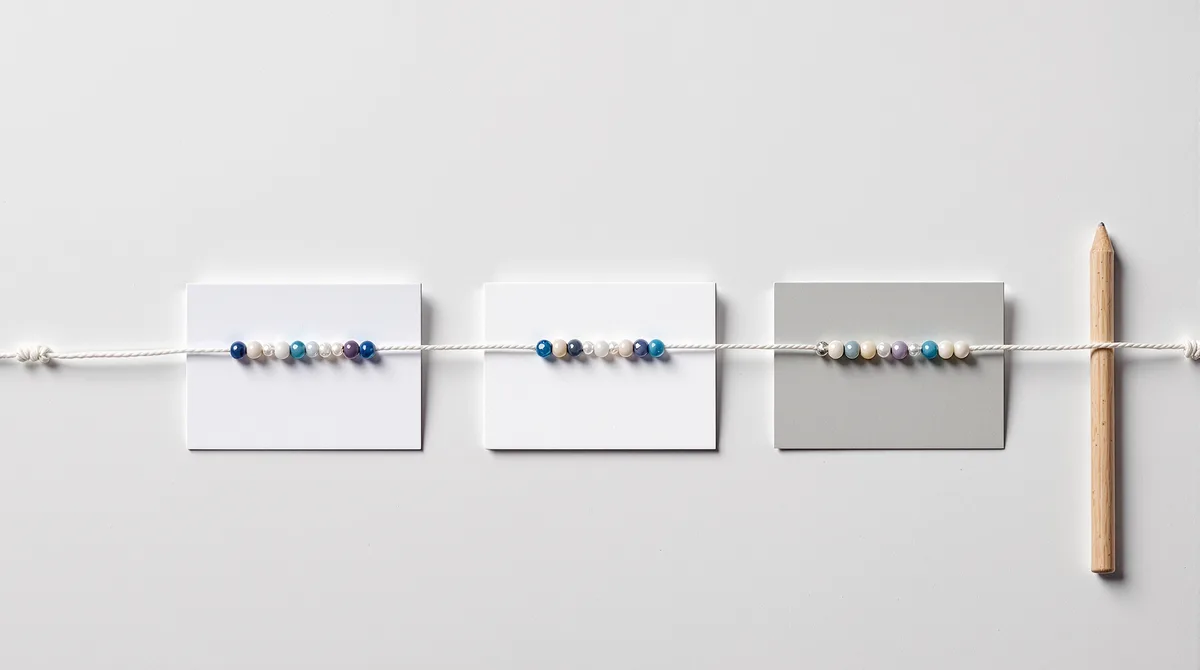
| Colour | A colour reference or physical chip per bead colour | One chip per colour, posted with the brief |
| Pattern | Artwork file, or a reference photograph of the density wanted | Reference photograph plus a note on repeat |
| Top fixing | Dowel, header rail, rod pocket on fabric, or suspension loops; give the length | Stained wooden header rail, 90 cm |
| Packing | Inner packing, master carton, labels, barcodes, retail-ready or bulk | Polybag per piece, 10 per master carton, retail ticket applied |
| Quantity | Units per colourway, and whether colourways may be consolidated | Stated per colourway, never as a single total |
| Destination | Port or warehouse, and the Incoterm you want quoted | Named US warehouse, quoted landed duty paid |
| Market and testing | Destination markets and any test reports required | US and UK; lead and flammability reports required |
| Dates | Floor-set date, and the latest acceptable arrival | Floor set in week 6; latest arrival four weeks before |
Good to know
Three fields change. Strand count becomes cord count with the knot family named, bead size becomes cord diameter in millimetres, and the dowel or hoop becomes a structural specification rather than a fixing. Knotted work also runs on the 60 to 90 day production window rather than the 40 to 60 day beadwork window, so the dates field matters more.
You can send the sheet with the colour field marked as chips to follow, and we will quote construction and give a cost position. You cannot compress the colour decision itself. Every programme in our record that tried to approve colour from a description went round a second sampling cycle.
Price, minimum, sampling charge, testing cost and tooling where a design needs a bead moulded to a new die. The sheet exists so those five come back as numbers against a specification instead of as ranges against an idea.
Resubmit the changed fields rather than the whole sheet, and say whether the approved sample still stands. A change to bead, pattern or size resets the cost sheet and may reset the production window; a change to packing or labelling usually does not.
A complete sheet is quoted within 48 hours. An incomplete one generates questions inside one business day, and the clock starts again when the answers arrive. That round trip is the single largest avoidable delay in the whole process.
Product type, finished size and colour references. With those three we can say whether the design is viable, and which cost levers it has in it, before you complete the rest of the sheet.
Keep exploring
Reference
The nine fields a beadwork brief has to carry, what each one is used for, and what happens when one is missing.
Specs and sizesPillar
Brief, rough cost sheet, colour match, sample, production, packing — the six stages with the real published timings.
Read moreReference
A plain origin comparison for beadwork: where hand labour wins, where tooling and volume win, and what decides it.
Specs and sizesReference
Minimums are set per design, and what sets one: bead availability, dye lots, tooling, and whether colourways can be consolidated.
Specs and sizesReference
16 to 20 days from an agreed brief, photographs approved before the sample ships, and why the sealed sample is the contract.
Read the guide
Start a conversation
Send a reference, a colour chip or a sketch. Minimums are set per design and confirmed per quote; sampling is quoted separately and usually runs 16 to 20 days from an agreed brief.