Design
The Daisy café build
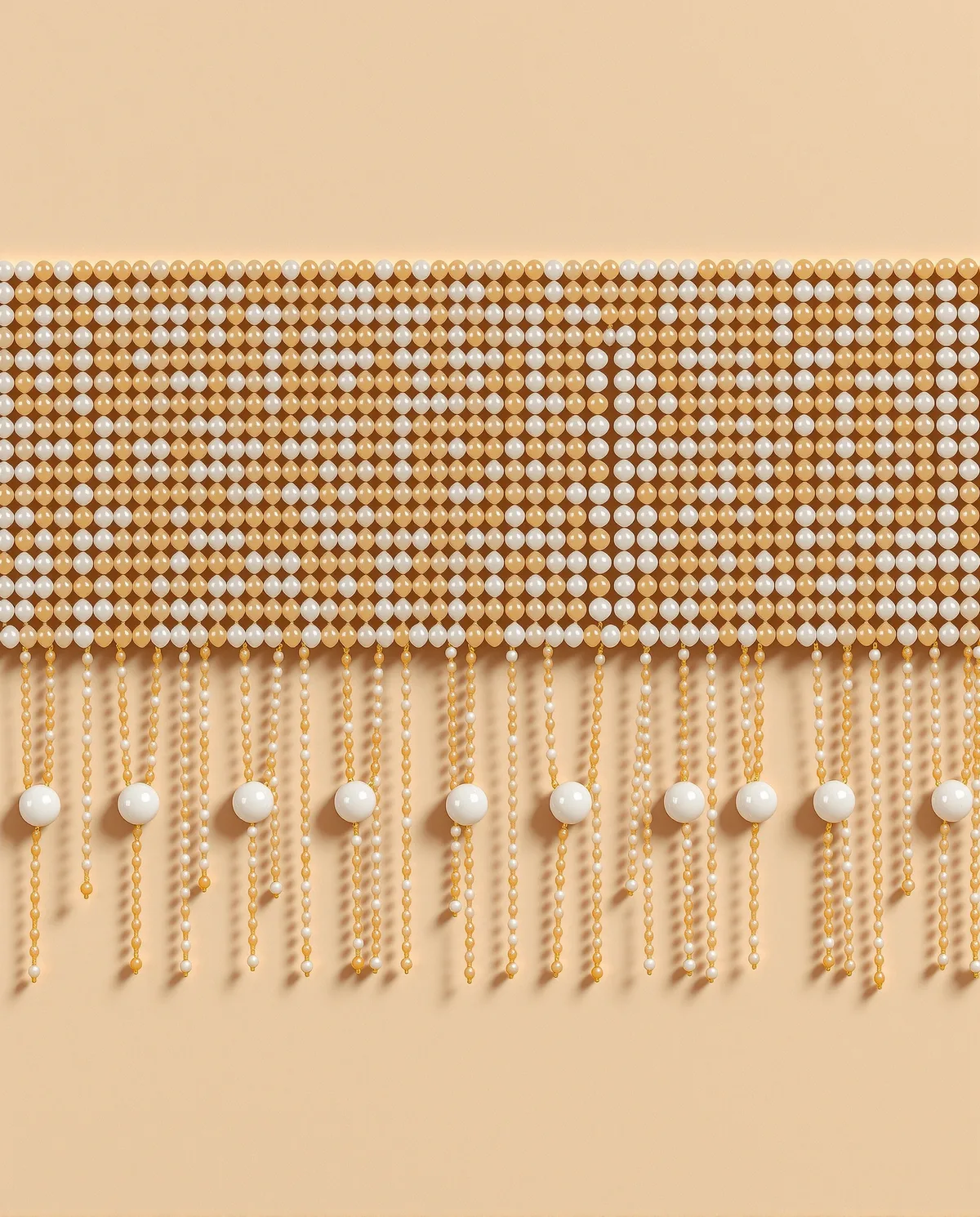
Six-inch daisies assembled from custom moulded almond beads, on a cotton header with a three-inch rod pocket and a scalloped chevron hem.
Specs and sizes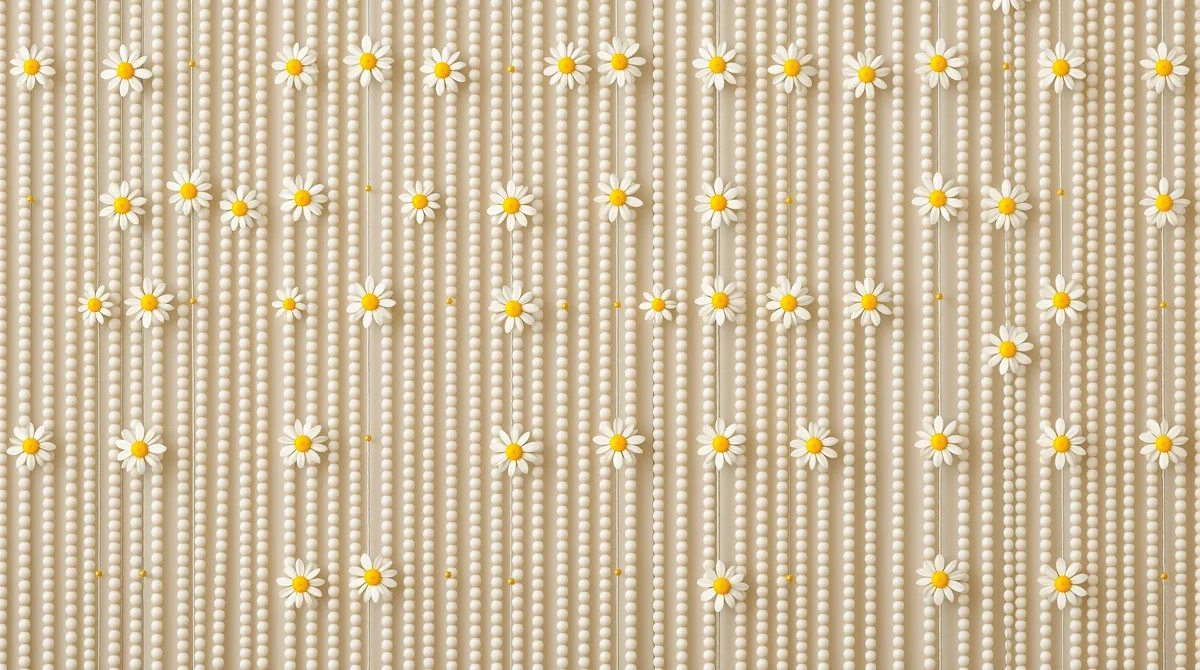
Style · Era
There is no surface to print on, so a flower has to be built. There are exactly three ways to build one, and choosing between them is a tooling decision, a sheet-yield decision or a labour decision.
A beaded panel of flat moulded daisy beads in chalk white with canary centres, grouped five at a time into flower heads repeating across plain white strands.
A flower in beadwork is assembled from shaped components rather than drawn. Three routes exist: a moulded connector bead that forms a whole flower head, a flat blossom laser-cut from sheet and locked on the cord by a spacer, or a flower built pixel by pixel from seed beads. Each is a different cost conversation.
Beaded flowers are older than any of the interior styles that use them. French beaded flowers — petals built on fine wire and assembled into stems — were a nineteenth-century funerary and millinery craft, and the wire-wrapped technique behind them is still one of the five craft families in our own reference. What arrives today as a floral beaded curtain descends from two separate traditions: that wire-built flower, and the much simpler idea of a flower-shaped bead threaded onto a strand like any other.
Petal proportion and a quiet ground. A bead flower reads as a flower when the petals are wider than they are long and there are five or six of them; make them narrow or add more and the eye reads a star or a snowflake instead. The second condition is a plain field around it. A flower on a busy ground does not read at all, which is why floral panels almost always use a single-colour base strand dyed to match the flower.
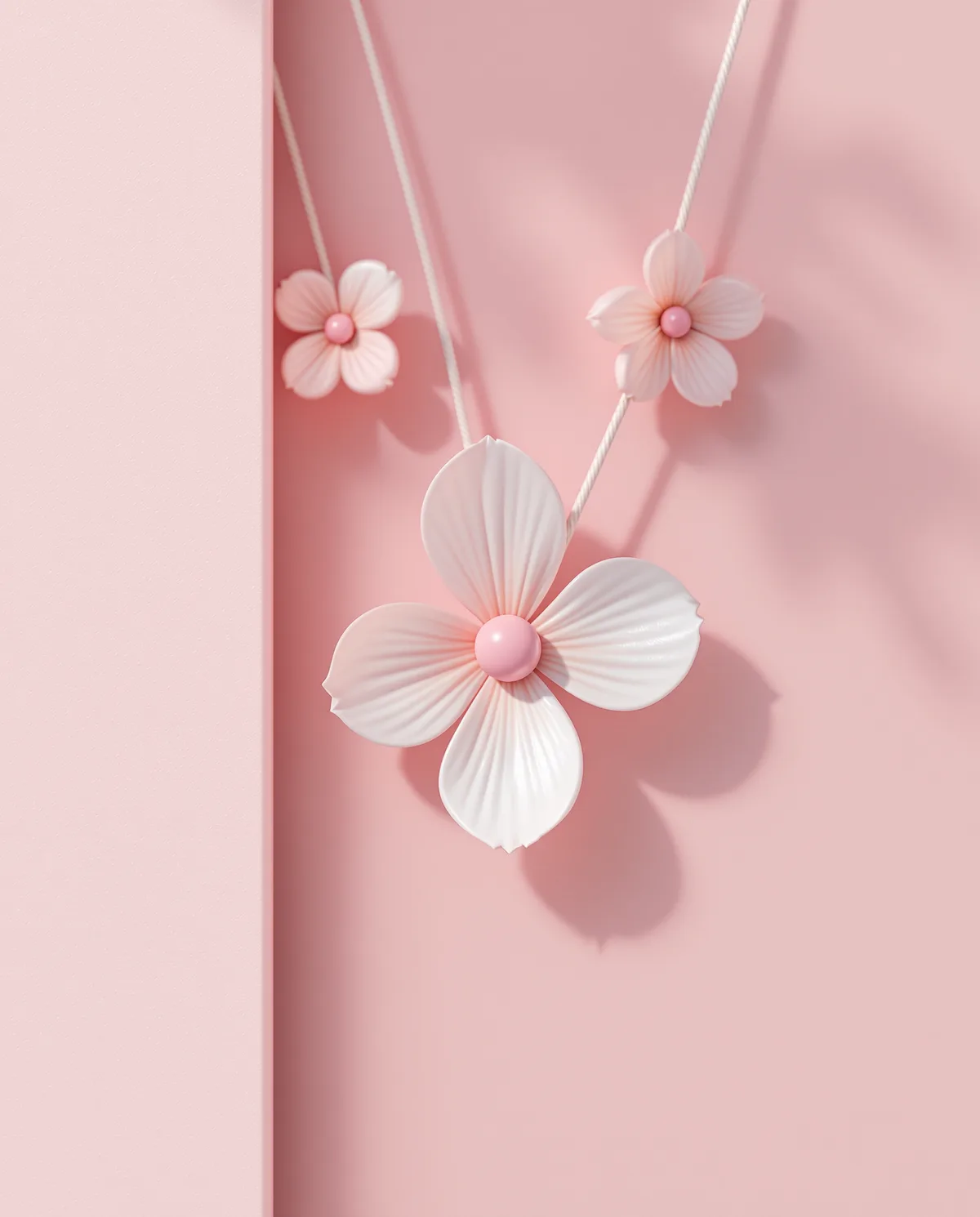
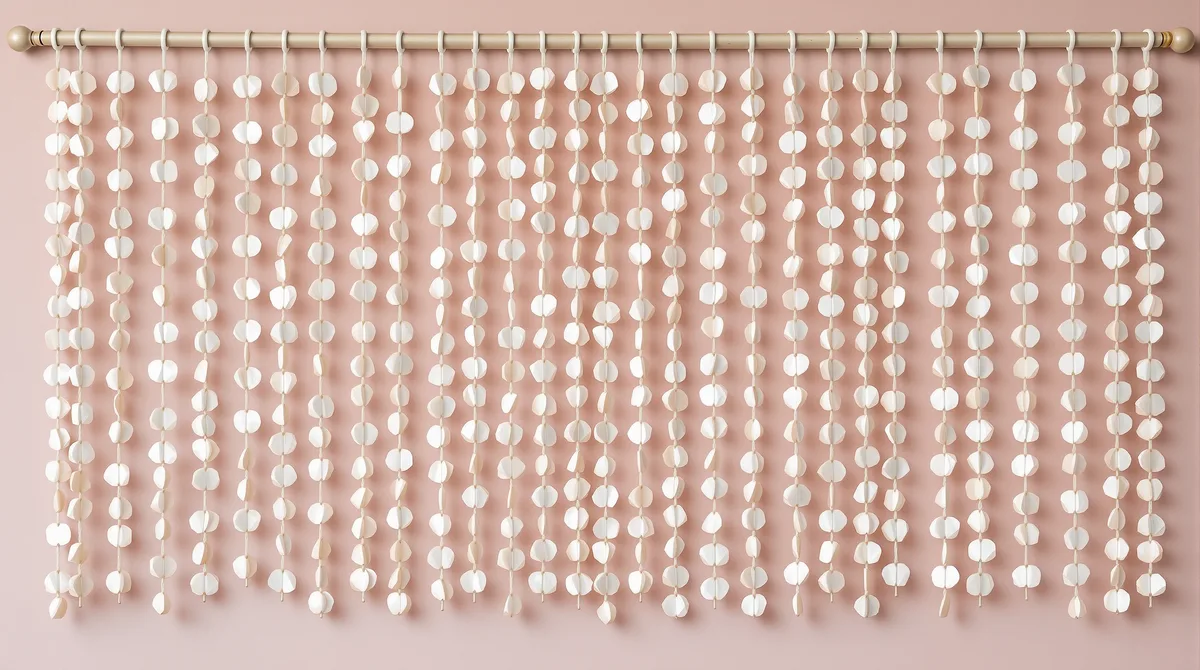
Three distinct component types. A custom moulded connector bead forms a whole flower head in one piece; we have funded our own dies for this, including three-inch almond beads used as daisy connectors making a six-inch daisy. A flat blossom laser-cut from faux capiz sheet gives a five-petal form, held at its centre by a small spacer bead dyed to match the petal. And glass seed beads draw a flower as a field, at the cost of hours. Hems are usually scalloped or chevroned, which echoes the petal curve.
Kitchens, bathrooms, children's and teenagers' rooms, cafés and florists. The look is domestic and daylit and it reads best at a window rather than a doorway. In hospitality it tends to arrive for a specific seasonal window dressing rather than as a permanent threshold piece.
Scale up and reduce the count. The contemporary version of a bead flower is large — a single six-inch daisy, or one blossom per strand — against a lot of empty ground, which is a very different object from the dense all-over floral of the 1970s. The other modernising move is to use the flower as an accent rather than as the subject: a band of blossoms near the header, with plain strands below.
A fixture with a moving motif. Florals never leave home décor; which flower is current does move. Daisy and cherry blossom are the two carrying it most recently, and both are adopted designs in continuous production. A range built on the technique rather than on the specific flower survives the rotation.
The original floral bead curtain used what existed: a pressed glass flower bead, threaded. The modern version can have a bead made for it. That is a genuine change in what is possible — a six-inch daisy formed from four moulded almond beads is not something you could buy off a bead card — and it is why the floral register has moved from small repeated motifs to large single statements.
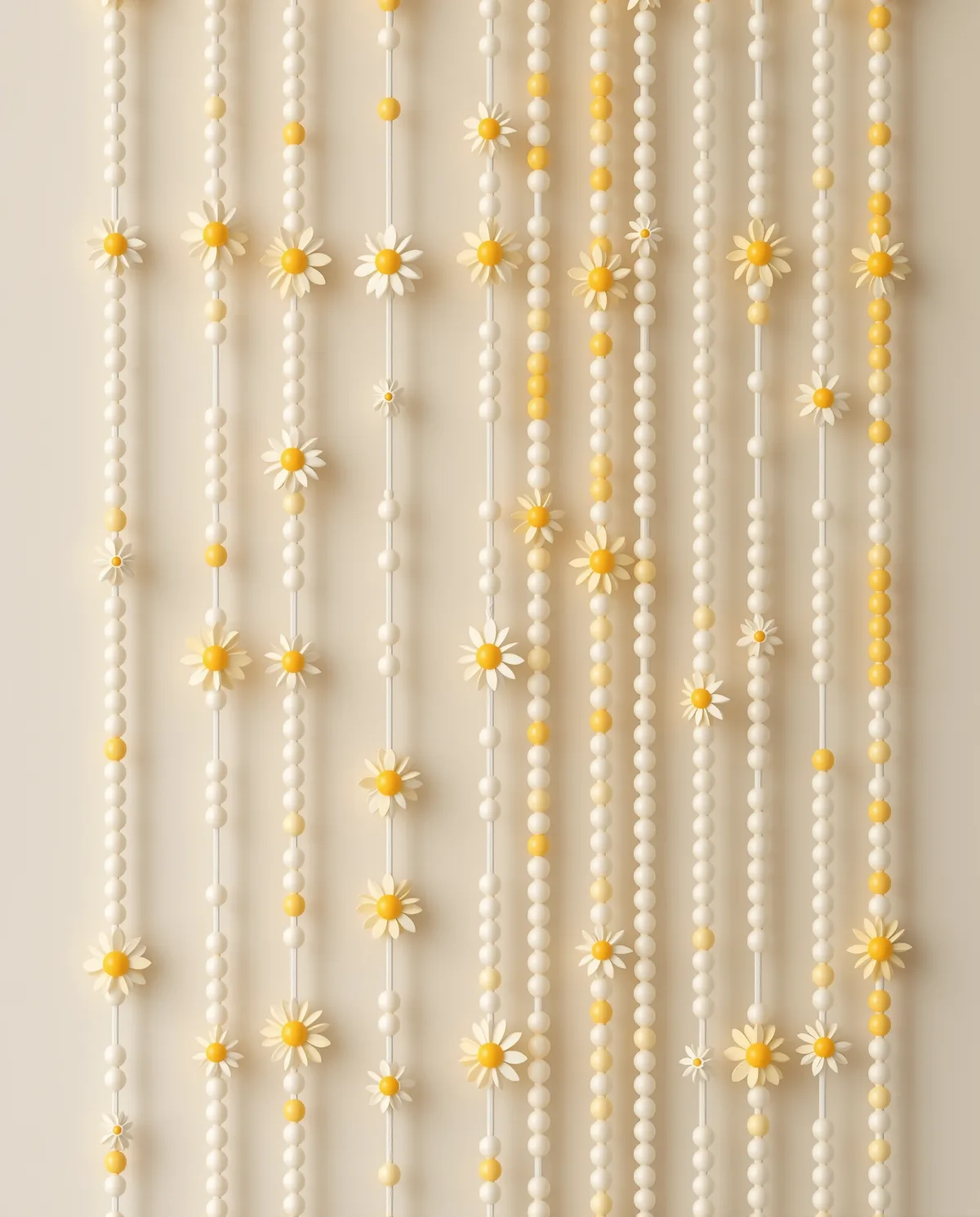
Daisy Daydream is the direct expression: chalk white with moulded canary-centred daisy connectors. Cherry Blossom works the laser-cut route — frosted pink hearts with ivory blossom ends on a forty-strand piece with an uneven hem. Rose Clay Garden gives the garden-border reading, with sun-baked rose, sage and butter yellow in matte and satin finishes.
It photographs extremely well, because a single blossom with a visible spacer bead at its centre is a self-explaining image — a viewer understands how it is made in one frame. It sells on that detail shot more than on a room scene. Commercially it is one of the stronger retail propositions in the medium, because the motif is instantly recognisable on a thumbnail.
Home and lifestyle retailers, brands buying under their own label for bedroom and children's ranges, and gift stores. The two adopted floral constructions are a café curtain with moulded daisy connectors on a cotton header, and a laser-cut blossom wall hanging — one built at twenty-four by thirty inches, the other at eighteen by thirty.
A flat printed flower on an acrylic disc. It fails because a printed petal has no edge: the whole appeal of a bead flower is that the petal is a separate physical thing with its own silhouette against the ground. Print removes the silhouette and you are left with a sticker. The other cheap failure is a blossom threaded without a spacer at its centre, which slides down the cord and ends up hanging sideways within weeks.
By counting blossoms and fixing their positions. A laser-cut blossom wall piece in our record runs between about one hundred and thirty and one hundred and seventy blossoms depending on whether it hangs from a dowel or a rod-pocket header — the count is part of the specification, not an outcome. Positions are written into the count sheet so the scatter repeats as a look without repeating as a sequence.
Significantly more, and the shape of the cost differs by route. Moulding is a step change up front and then cheap per piece. Laser cutting costs in material yield, because petals nest imperfectly on a sheet, plus a second operation to thread and lock each blossom. A drawn seed-bead flower has no tooling at all and the highest labour. The right question at briefing is which of those three cost shapes suits the programme.
Good to know
Use one flower at one scale and let the ground stay plain. Floral beadwork fails when three flower types, two scales and a leaf motif all appear on the same panel. One blossom, repeated, scattered rather than arranged in rows, with a quiet ground — that is the whole discipline.
Yes. The floral designs are adopted and in continuous production, reordering season after season.
For a whole flower head, a custom moulded connector bead. For a flat petal form, faux capiz or dyed acrylic cut from sheet. For a drawn flower, glass seed beads at one to three millimetres, because only a very small bead can hold a curve. Pressed glass sits in between, good for a simple five-petal rosette.
We match a reference's look, colours and bead sizes in new materials as an inspired design, and we do not reproduce another brand's protected design. With florals the thing worth matching from an old piece is the petal proportion, because that is what makes a bead flower read as a flower rather than as a star.
The flower carries the colour and the ground carries almost none. A tonal approach works best — a pink blossom on an ivory ground, a canary centre on chalk white — with the spacer bead at the blossom centre dyed to match the petal so the fixing disappears.
Yes, and the amount depends entirely on the route. A moulded flower carries a tooling conversation up front and then becomes cheap per unit. A laser-cut blossom costs in sheet yield and in the second operation that threads and locks it. A seed-bead flower costs in hours and nothing else.
Café curtains and wall hangings above all. A flower needs to be read at eye level and at close range, and a café length puts it there. On a full-height door curtain the flowers at ankle level do no work and cost the same as the ones at eye level.
Keep exploring
Design
Six-inch daisies assembled from custom moulded almond beads, on a cotton header with a three-inch rod pocket and a scalloped chevron hem.
Specs and sizesColour story
Five-petal faux capiz blossoms cut to shape, each held by a spacer bead dyed to match, in a sampled and approved build.
Open the referenceIndex
Twenty-four named looks, each described by the material, palette, pitch and hem that actually produce it.
Open the referenceStyle
Pale wood and chalk glass at a wide strand pitch — the register where spacing matters more than colour.
See the detailStyle
The scatter rule from a design in production, and why one aligned row ruins the whole panel.
See the detail
Start a conversation
Send a reference, a colour chip or a sketch. Minimums are set per design and confirmed per quote; sampling is quoted separately and usually runs 16 to 20 days from an agreed brief.