This guide is built for housewares brands, retailers, wholesalers, and product sourcing teams evaluating ceramic products or manufacturing partners. Understanding the process matters because it directly determines quality, durability, and how much design flexibility you actually have.
In most sourcing conversations, "ceramics" gets reduced to "it's fired in a kiln." That's technically true and almost useless as a sourcing insight. This article breaks down how the process actually works, what affects the outcome, and when ceramics is—or isn't—the right material choice.
Key Takeaways
- Ceramics manufacturing turns raw powders into hardened products via forming, drying, firing, and finishing
- Traditional ceramics (tableware, tiles) and advanced ceramics (electronics, medical, aerospace) follow distinct process paths
- Forming method (pressing, slip casting, extrusion, or injection molding) depends on shape complexity and volume
- Firing temperature and atmosphere control largely determine final strength and durability
- Handcrafted metal often suits high-impact or fast-turnaround needs better than ceramics
What Is the Ceramics Manufacturing Process?
Ceramics manufacturing is the fabrication of objects from inorganic, non-metallic raw materials through shaping and high-temperature treatment. The goal: a hardened, durable final form that raw clay or powder simply cannot achieve on its own.
The process is designed to produce a dense, stable product with specific mechanical, thermal, or aesthetic properties. A lump of wet clay has none of these qualities. Fired ceramic does.
How This Differs From Metal Forming
Ceramics undergo an irreversible chemical and physical transformation during firing. Once sintered, the material can't be reshaped, remelted, or reworked the way metal can after cooling. Metal casting and forging allow reheating and reshaping; ceramics offer one shot to get it right.
This is why process control matters so much more in ceramics than in metalworking. There's no fixing a warped piece after the kiln.
Why the Industry Relies on This Process
Manufacturers choose ceramics for housewares, industrial, and technical applications because of specific properties: heat resistance, chemical stability, hygiene, and design versatility. No other material class checks all these boxes simultaneously.
The scale of demand backs this up. The advanced-ceramics market alone was valued at $119.4 billion in 2025, with growth projected to $159.3 billion by 2033. That's advanced ceramics specifically (electronics, medical, industrial wear parts), not counting traditional tableware and tile.
What goes wrong without proper process control:
- Cracking from uneven drying or thermal shock
- Warping from inconsistent shrinkage
- Uneven glaze application or crawling
- Inconsistent density that weakens the final product
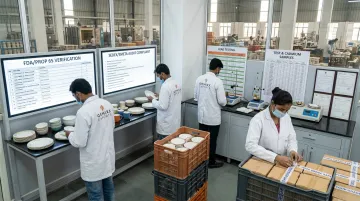
Quality and safety standards often make strict process control non-negotiable rather than optional. Food-grade compliance for tableware and ISO/ASTM standards for technical ceramics both trace back to how tightly manufacturers control the process. At Gemixx's Khurja ceramics facility, for instance, this control shows up as FDA and Prop 65 compliance on every food-contact piece, verified through SEDEX/SMETA audits.
How the Ceramics Manufacturing Process Works
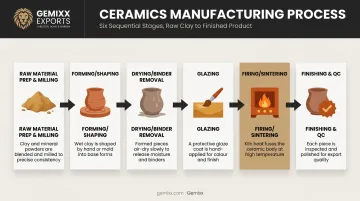
At a high level, the process runs through six stages: raw powder preparation, shaping, drying, optional glazing, firing, and finishing. Each stage sets up the next: skip a step or rush it, and defects show up later, often after the kiln.
Raw materials depend on the ceramic type:
- Traditional ceramics: clay, feldspar, silica
- Advanced ceramics: alumina, zirconia, silicon carbide
The core transformation happens during sintering, when particles fuse together at high temperature, permanently converting a soft, formed shape into a dense, hardened ceramic. This is where the actual "ceramic" gets made.
Control comes down to four variables: temperature profiles, firing atmosphere, pressure, and hold times. Change any one, and you change the final density, strength, and appearance.
Gemixx's own Khurja facility runs this same six-stage sequence for its handmade ceramics line, with artisans adjusting hold times and glaze formulas by hand for each batch.
Step 1: Raw Material Preparation & Milling
Raw materials get milled, sized, batched, and mixed to achieve uniform particle size and controlled moisture content. Inconsistent particle size here creates uneven shrinkage later, a problem you won't catch until the piece is already cracked.
Step 2: Forming or Shaping
The forming method depends on part complexity, wall thickness, and production volume:
| Method | Best fit |
|---|---|
| Dry/isostatic pressing | High-volume parts, uniform density |
| Slip casting | Complex hollow shapes (mugs, vases) |
| Extrusion | Continuous shapes (rods, tubes) |
| Injection molding | Complex, high-volume, near-net shapes |
| Tape casting | Thin electronic substrates |
CoorsTek's forming guidelines note dry pressing equipment spans 2 to 1,500 tons of capacity, covering everything from simple to intricate geometries.
Step 3: Drying and Binder Removal
Controlled drying removes moisture or binder material gradually. Rush this step and you get cracking or warping before the piece ever reaches the kiln. Industrial dryers exist specifically to manage this uniformity at scale, reducing residual water before firing begins.
Step 4: Glazing (Where Applicable)
Glazing adds a glassy, protective surface layer for aesthetics, moisture resistance, and food safety. This matters most for tableware and decorative housewares, where both appearance and food-contact safety are on the line.
Step 5: Firing/Sintering
Firing at controlled high temperatures densifies the material, eliminating porosity and locking in final hardness. Traditional ceramics use heat-work "cone" schedules. Orton's system spans cones 022 through 42, with most tableware falling between 022 and 10.
Advanced ceramics like silicon carbide often require controlled atmospheres and can fire above 1,600°C, since dense SiC is genuinely difficult to produce through heat alone.
Step 6: Finishing & Quality Control
Post-fire grinding, polishing, or machining brings pieces to final tolerance. QC checks confirm density, dimensional accuracy, and strength before anything ships.
Where the Ceramics Manufacturing Process Is Applied
Ceramics manufacturing shows up across a wide range of products and industries:
- Household tableware and tiles: dinnerware, mugs, floor and wall tile
- Industrial wear components: nozzles, seals, cutting tools
- Electronics substrates: insulators and circuit bases
- Medical implants: zirconia dental implants, alumina hip components
- Aerospace parts: sensor housings, thermal-protection components
The process gets applied at several lifecycle points: new product development, prototyping, small-batch artisan runs, and full-scale mass production. Common triggers include launching a new tableware line, converting a plastic or metal part to ceramic for heat resistance, or scaling from prototype to production volume.
Building Complete Tableware Collections
Housewares and home décor brands building complete tableware or kitchen collections rarely stop at dinnerware alone. Most pair ceramic pieces with complementary metal components (flatware, barware, cookware) to round out a retail-ready line.
This is where vertically integrated manufacturers offer a real advantage. Gemixx, for instance, operates a ceramics and terracotta factory in Khurja alongside a metalware factory in Moradabad, producing hammered copper cookware, PVD-finished flatware, and barware under the same private-label roof as its hand-decorated dinnerware.
A brand building a full tabletop program can source both the ceramic centerpiece and the metal accessories (cheese knives, cocktail shakers, serving pieces) without juggling separate vendors.
Key factors that affect outcomes across any ceramics program:
- Raw material purity and particle size
- Forming method selected
- Firing temperature and atmosphere control
- Production scale and throughput needs
- Food-grade certification and compliance requirements
Common Issues, Misconceptions, and When Ceramics May Not Be the Right Choice
Three Misconceptions That Trip Up Buyers
Buyers often carry assumptions about ceramics that don't hold up under scrutiny:
- "Ceramic means fragile": Technical ceramics like silicon carbide retain their properties above 1,400°C and hold a Young's modulus above 400 GPa, stiffer than most steels. Traditional glazed tableware, though, remains genuinely vulnerable to chipping and impact.
- Forming method determines final strength: Wrong. Slip-casting, pressing, and extrusion only set the shape. Sintering and firing conditions determine density and strength, so two identically shaped pieces can vary wildly in durability based on firing temperature and atmosphere alone.
- All "ceramics" follow one process: Tableware pottery and engineered technical ceramics involve entirely different materials, tooling, and firing cycles. Comparing a stoneware mug's production to a zirconia dental implant's isn't apples to apples. It's barely the same fruit family.
Where Metal Outperforms Ceramics in Commercial Settings
High-impact commercial environments (restaurants, hospitality, travel retail) carry real breakage risk with ceramic tableware. This is precisely the scenario where buyers often turn to durable handcrafted metal alternatives instead.
Gemixx's stainless steel flatware and barware, for example, are built through forging, casting, and hand-hammering: construction methods that create dense forms without the stress fractures common in fired ceramic. Dual-wall construction and PVD coating add further resistance to dents and scratching under repeated commercial use. Where a dropped ceramic mug shatters, a forged steel tumbler dents at worst.
Durability aside, tooling investment offers another signal: when tooling costs and lead times don't match your production volume, ceramics may be used by default rather than by need.
- Custom ceramic tooling: a few weeks for simple, machinable parts up to more than 20 weeks for complex custom molds requiring extensive qualification
- Gemixx metal flatware lines: 40–60 days post-sample approval
- Gemixx ceramics line: 60–90 days post-sample approval
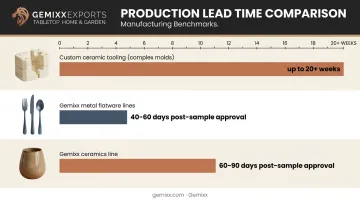
Weigh these lead times against your actual volume needs before committing to ceramic tooling.
Conclusion
Ceramics manufacturing is a multi-stage process: preparation, forming, drying, optional glazing, firing, and finishing. Each stage transforms raw powder into a hardened, application-specific product, but only if every step gets proper control.
For housewares brands, retailers, and industrial buyers, understanding these steps isn't academic. It shapes sourcing decisions, quality expectations, and realistic timelines.
Match the process and material to the application, rather than defaulting to ceramics because it's familiar. For brands building complete collections, working with a vertically integrated manufacturer like Gemixx, which produces ceramics, metal, and glass under one roof, often makes more sense than piecing together a supply chain vendor by vendor.
Frequently Asked Questions
What is ceramic manufacturing?
Ceramic manufacturing is the process of shaping inorganic, non-metallic raw materials and hardening them through controlled drying and high-temperature firing. The result is a durable, dense finished product that raw clay or powder can't achieve alone.
What are 5 products made from ceramics?
Common examples include dinnerware and tableware, floor and wall tiles, electrical insulators, dental implants, and cutting tools or wear-resistant industrial components. Each uses a different ceramic formulation and firing process suited to its application.
What is the difference between traditional and advanced ceramics?
Traditional ceramics use natural clay-based materials like feldspar and silica, mainly for tableware and tiles. Advanced ceramics use engineered compounds like alumina and zirconia for high-performance industrial, medical, and electronic applications.
What are the main steps in the ceramic manufacturing process?
The core stages are raw material preparation, forming or shaping, drying, glazing (when applicable), firing/sintering, and finishing. Quality control checks happen throughout, but especially after firing.
How long does it take to manufacture ceramic products?
Lead times vary widely: simple, machinable, or small-batch parts can ship in a couple of weeks, while products needing new tooling or custom molds take several months. Complex programs with mold development and qualification testing can exceed 20 weeks.
What raw materials are used in ceramic manufacturing?
Material choice comes down to end use: clay and silica-based bodies suit everyday tableware and tiles, while alumina, zirconia, and silicon carbide get selected for their hardness, wear resistance, or heat tolerance in technical parts.