Collectors and dealers often argue over whether a handle is forged, wrought, or cast, and the confusion is understandable. All three look like "old iron" at a glance. But each one was made using completely different technology, tied to a specific window of time.
This guide breaks down how each handle type was made, how to spot it by sight, and how to use that information to date and evaluate a piece of copper cookware with real confidence.
Key Takeaways
- Iron handles fall into three main types: forged, wrought, and cast, each tied to a distinct historical era of ironworking.
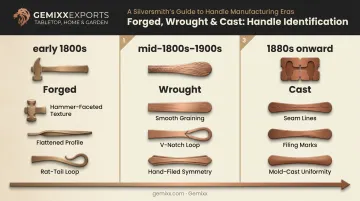
- Forged (early-1800s), wrought (mid-1800s–1900s), and cast (1880s onward) reflect distinct manufacturing eras.
- Graining, rat-tail loops, mold seams, and filing marks reveal how each handle type was originally made.
- Handle style is just one dating clue — stamps, rivets, and the compass dot must also line up correctly.
- Reading handle construction correctly adds real value whether you're buying, selling, or appraising a family heirloom piece.
What Are Iron Handles on Copper Pots, and Why Do They Matter?
Iron handles are the riveted metal grips attached to a copper pot's body. They're made separately from the pot itself, and there's a practical reason for that: copper and iron can't easily be soldered or welded together. Rivets have always been the joining method of choice.
That separation turns out to be useful for collectors. Because handles were manufactured using whatever ironworking technology existed at the time, their construction method works like a built-in timestamp. A hammered handle and a mold-cast handle didn't come from the same decade, let alone the same workshop.
Handle style also reflects a much bigger story:
- Village blacksmiths forged handles in small batches from bloomery iron.
- Industrial foundries scaled production using blast furnaces.
- Cookware manufacturers standardized handle production industry-wide.
Miss this context and the mistakes pile up fast. Sellers mis-date pieces. Collectors overpay for a "primitive" pot that's actually a later reproduction with a filed handle. Worse, a genuinely rare hand-forged piece gets mislabeled as ordinary and sold for a fraction of its worth.
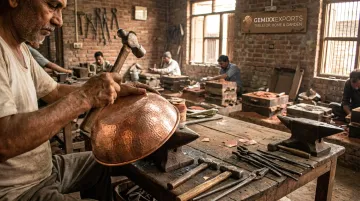
This same respect for hand-craftsmanship isn't just a museum topic. Gemixx Exports, which has produced handmade metal housewares for more than 40 years out of its Moradabad, India factory, still relies on hand-hammering, blacksmithing, and sand-casting. These techniques echo the same processes that shaped early forged and wrought ironwork. The tools have modernized, but the hand-finishing philosophy hasn't disappeared — it just moved.
Types of Iron Handles on Copper Pots
The three handle types weren't stylistic preferences. They were direct reflections of the ironworking technology available at the moment a piece was made. Each method left behind distinct manufacturing signatures that are visible to the naked eye, making hands-on identification possible without any lab equipment.
Forged Handles
Forged handles were shaped entirely through compression. A smith heated a bar of low-carbon wrought iron and struck it against an anvil, spreading, thinning, and shaping the metal blow by blow. This predates mechanized handle production entirely and was typically the work of a local blacksmith rather than a specialized cookware maker.
Look for these signatures:
- Flattened profiles running across the handle's length
- Spread baseplates, with flanges sliced apart to create extra rivet surface
- "Rat tail" hanging loops, formed by thinning the iron's end to a point and curling it back on itself
Forged handles show up on the earliest surviving French copper, unusually shaped pans, and hand-repaired pieces, since forging let a smith custom-fit a handle to almost any pot shape. That's exactly why collectors prize them: every forged handle is a one-of-a-kind object, complete with the asymmetry and heavier hammer marks that come from freehand work.
The trade-off is dating precision. Because countless independent smiths made these handles with no standardization, pinning down an exact year is difficult. Collector research from Vintage French Copper places forged handles mainly in the early 1800s, with wrought styles largely replacing them by the 1850s.
Wrought Handles
Wrought handles were shaped under tension rather than compression. The smith heated the iron until pliable, then stretched, bent, and curved it using hand tools instead of hammering it into shape. The result is a smoother, flowing profile with none of the surface texture that hammer blows leave behind.
Key identifiers include:
- Smooth, rounded contours with soft transitions
- Visible "graining" — fine dark streaks from trapped slag, most obvious where the metal was bent or stretched
- Punched or rat-tail hanging loops, often with a telltale V-notch where the punch was rocked out
This style marks what many collectors call the "golden age" of French copper, roughly 1860 to 1880, often paired with thicker-gauge copper as the industry matured alongside Belle Époque-era French cuisine. A wrought handle on a thick, well-made pan is a strong quality signal — it suggests the piece predates the cost-cutting that came with industrial casting.
One documented case from Vintage French Copper studied five roughly 3mm-thick Dehillerin saucepans with wrought handles, forge-welded T-shaped construction, and hand-curled tails. The stamp referenced an address Dehillerin acquired in 1890, meaning wrought handles were still very much in use well past the "golden age" window.
That overlap explains why well-finished cast handles can closely mimic wrought ones, causing misidentification. Experienced collectors cross-reference maker's marks against documented stamp-era ranges to avoid this trap rather than trusting the handle alone.
Cast Iron Handles
Cast handles were made by pouring molten iron into a two-piece mold and letting it solidify. This replaced labor-intensive handwork with repeatable factory production, becoming economical once blast furnace technology allowed high-carbon pig iron to be melted and molded at scale.
The National Park Service's guide to historic cast iron confirms that mold lines, flashing, and casting flaws are standard byproducts of this process, later cleaned up through filing.
You can spot cast construction by looking for:
- Mold seams, or "mismatch" lines, running along the baseplate, shaft, and hanging loop
- Filing or grinding marks left over from post-casting cleanup
- Flattened, machined-looking planes on the baseplate surface
These handles appear on French copper from the 1880s onward and became the standard for nearly all factory-made cookware by 1900. The economics were simple: a foundry could cast hundreds of identical handles per day, at a fraction of the labor cost of forging or wrought-work.
That consistency and durability made well-built copper cookware accessible to far more households. But it also created a problem for today's collectors: some cast handles were deliberately filed and notched to imitate the earlier wrought look, which can mislead anyone trying to date a piece by handle style alone.
How to Use Handle Type to Date and Evaluate a Copper Pot
Handle type is a genuinely useful dating clue. It's not a standalone verdict, though. The right conclusion depends on weighing it alongside other physical evidence on the piece.
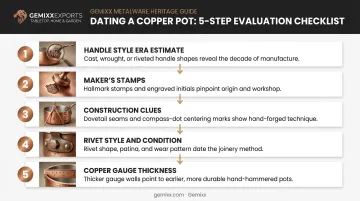
Here's what to check, in order of usefulness:
- The era estimate the handle style suggests — forged points to early-to-mid 1800s, wrought to mid-1800s through early 1900s, cast to 1880s onward
- Maker's stamps, since documented stamp-era ranges can confirm or contradict what the handle alone suggests
- Construction clues like a compass dot on the base or dovetail seams, which tend to align with earlier, hand-formed pieces
- Rivet style and condition, since replaced or mismatched rivets can signal repairs that complicate a simple handle-based age estimate
- Copper gauge, since thicker copper paired with a wrought handle (the roughly 1860s-1880s "sweet spot") signals both age and quality
A double-stamped Vanneuss-Pommier saucepan shows this layered approach in action. The 1880-1901 date range came from the two businesses' documented overlap. Dovetails, beveling, rivets, and a cast handle bearing what may be a mold serial number underneath all confirmed it — no single clue did the work alone.
What you're trying to accomplish shapes how much verification effort makes sense. Confirming authenticity before a purchase justifies checking every clue above. Simply satisfying curiosity about a family piece might only need a quick visual scan of the handle and stamp.
Common Mistakes to Avoid When Identifying Handle Types
Even experienced buyers fall into a few predictable traps when identifying handle construction:
- Assuming surface texture always means wrought iron. Filed cast handles can produce similar-looking fine scratches, so check the hanging loop and baseplate seam for casting evidence too.
- Dating a piece by handle type alone. Check whether the stamp, rivets, and handle style all tell a consistent story. Mismatched elements can signal a later repair or replaced handle.
- Overlooking intentional imitation. Some makers designed cast handles with a V-notch loop to evoke the earlier wrought-iron look, inflating a piece's perceived age beyond its actual manufacturing date.
The fix for all three is the same: never rely on one clue. Cross-check handle construction against rivets, stamps, and seams before drawing a conclusion.
Conclusion
The iron handle on a copper pot is more than a functional grip. It's a physical record of the ironworking technology available at the moment that piece left the workshop.
Forged, wrought, and cast handles each carry distinct, recognizable signatures — flattened hammer work, flowing graining and V-notch loops, or mold seams and filing marks. Learning to read them turns any buyer into a more confident judge of age and quality, no lab equipment required.
That same respect for hand-craftsmanship once carried by village blacksmiths hasn't disappeared. It lives on in manufacturers who still choose the slower, handmade path over mass production.
Some are 19th-century French foundries. Others are modern workshops like Gemixx's Moradabad factory, where artisans still hand-hammer and cast metal one piece at a time.
Frequently Asked Questions
Is copper compatible with cast iron?
Yes, copper and cast iron can be safely combined, as seen in cast-handled copper cookware. The two metals just can't be soldered directly together, so rivets have always been the joining method.
How can I tell if a handle is wrought iron or cast iron?
Wrought iron shows smooth, flowing contours and fine "graining" streaks from trapped slag. Cast iron shows visible mold seams, filing marks, and flattened, machined-looking planes on the baseplate.
What is the oldest type of iron handle found on copper pots?
Forged handles are the oldest style, shaped by hammer on an anvil rather than poured or stretched. They generally date from the early to mid-1800s, before wrought handles became more common.
Does the type of handle affect the value of an antique copper pot?
Handle type is one of several factors collectors weigh. Rare forged or well-made wrought handles often draw extra interest, though condition and maker's marks matter just as much for overall value.
Why were iron handles used on copper pots instead of copper or brass?
Iron stays cooler to the touch than copper, is more affordable, and was widely available. That combination made it the practical choice for hardworking kitchen cookware.
Can a cast iron handle be mistaken for a wrought iron handle?
Yes, especially on well-finished pieces. Some makers filed and notched cast handles specifically to mimic the wrought-iron look, so checking multiple clues together is the only reliable approach.