The broader kitchenware category reflects that shift. The global kitchenware market is projected to grow from $68.23 billion in 2023 to $95.95 billion by 2029, according to a 2024 Research and Markets kitchenware report. That figure covers glass containers broadly rather than borosilicate specifically, but it signals real momentum toward transparent, chemical-free kitchen materials.
Here's the problem: two dishes can look identical on a shelf, one true borosilicate and one ordinary tempered soda-lime glass, with a label that doesn't clarify which is which. That confusion leads to broken dishes for consumers and returns for retailers.
This guide covers what borosilicate glass actually is, whether it's safe, how it compares to metal and ceramic cookware, and what to check before buying or stocking it.
Key Takeaways
- Borosilicate combines silica and boron trioxide for superior thermal shock resistance versus soda-lime glass.
- Genuine borosilicate is chemically inert and free of lead and cadmium when properly manufactured.
- Not every "glass cookware" label means true borosilicate, so verify specs, not packaging claims.
- This glass is incompatible with induction cooktops and conducts heat less evenly than metal.
- Verify FDA and Prop 65 compliance, wall thickness, and origin before bulk purchasing.
What Is Borosilicate Glass? Composition, History & How It's Made
The Science Behind Silica and Boron
Borosilicate glass is built from two network-forming ingredients: silicon oxide and boron oxide, with small amounts of alumina and soda or potash added for stability. Corning's well-known Code 7740 formulation runs approximately 80.6% SiO2, 13.0% B2O3, 4.1% Na2O, and 2.3% Al2O3, according to Corning's glass selection guide.
Standard soda-lime glass, by contrast, relies mostly on silica and soda ash without the boron oxide. That single ingredient changes everything about how the glass handles heat.
The boron content lowers the glass's coefficient of thermal expansion, meaning it expands and contracts far less when temperatures shift. Less expansion means less internal stress, and less stress means fewer cracks when a hot dish meets a cold surface.
Chemist Otto Schott developed this formula in 1887, and Jena laboratory glassware built on it reached commercial use by 1893. Corning brought the material into home kitchens in 1915 with the original Pyrex line, according to the Corning Museum of Glass.
How It's Manufactured
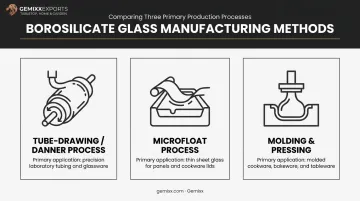
Producers melt silica, boron oxide, soda ash, and alumina at extremely high temperatures, then shape the molten glass using one of a few methods:
- Tube-drawing (the Danner process), where molten glass wraps around a rotating mandrel
- Microfloat, guiding molten glass across a bed of molten tin
- Molding or pressing, common for cookware and vessel shapes
Gemixx Exports, a vertically integrated manufacturer that operates its own glass factory in Firozabad, India, produces both soda-lime and borosilicate glass using hand-blown and pressed methods. This approach keeps quality control in-house from melt to finished piece rather than outsourced across multiple vendors.
The Modern Pyrex Confusion
Here's where things get tricky. Many US-made Pyrex products transitioned to tempered soda-lime glass decades ago, while much of the Pyrex sold in Europe remains true borosilicate. The takeaway: don't assume a trademark or logo tells you the composition. Check the product specs.
Recognizable borosilicate trade names to look for while shopping:
| Trade Name | Verified Scope |
|---|---|
| Borosil | Marketed as 100% borosilicate glass for cookware and casseroles |
| Duran | Primarily laboratory-grade borosilicate 3.3 glassware |
| Simax | Borosilicate 3.3 glass used in household cookware and technical glass |
Is Borosilicate Glass Cookware Safe? Key Benefits Explained
Thermal Shock Resistance in Real Numbers
Corning rates a standard 3.2mm annealed borosilicate plate to withstand roughly 160°C (288°F) of temperature differential before fracturing, though that number drops with thicker pieces. Thickness, geometry, and surface condition all affect the actual limit, so treat any single number as a benchmark rather than a guarantee.
Consumer Reports tested this directly, moving dishes from a 450°F oven onto a wet granite counter. All ten soda-lime dishes tested shattered, while European borosilicate samples survived the same test at 450°F, though most failed once the oven temperature rose to 500°F.
The gap between materials is real, but neither is indestructible.
Chemically Inert and Non-Porous
Borosilicate doesn't react with acidic or alkaline foods, meaning tomato sauce, citrus, and vinegar-based dishes won't leach compounds the way some plastics or worn nonstick coatings can. Its non-porous surface also:
- Resists absorbing food odors and stains
- Doesn't harbor bacteria in surface scratches the way porous materials can
- Cleans up faster with less scrubbing
Built to Food-Safety Standards, If Sourced Right
Chemical durability in the base glass isn't the same as a certified, lead-free, cadmium-free finished product. Decorative coatings, lids, and colorants can introduce metals that the base glass itself never would.
Manufacturers building food-contact products, including Gemixx Exports across its food-safe lines, work to FDA guidelines and California Proposition 65 requirements. That's the baseline buyers should expect from any supplier, glass or otherwise.
That baseline also covers how the cookware performs day to day: quality borosilicate typically handles oven, microwave, freezer, and dishwasher use within manufacturer-specified limits, though always check the individual product's rated temperature range before assuming it covers every use case.
The verdict: borosilicate glass ranks among the safer cookware materials on the market, provided it comes from a manufacturer that actually tests for heavy metals rather than relying on the word "glass" to do the marketing.
Borosilicate Glass vs Other Cookware Materials: Pros, Cons & Limitations
| Material | Thermal Shock Handling | Best For | Key Limitation |
|---|---|---|---|
| Borosilicate glass | High | Baking, casseroles, slow-cook dishes | Poor heat conductivity, no induction |
| Soda-lime "Pyrex-style" glass | Low | Cold storage, light baking | Cracks under rapid temperature swings |
| Stainless steel / cast iron | Varies | Searing, stovetop cooking | Can react with acidic foods (uncoated) |
| Ceramic | Moderate | Even, slow heat retention | Chips can compromise glaze |
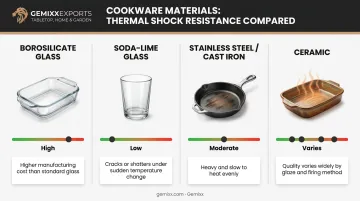
Borosilicate's biggest edge over standard tempered soda-lime glass is straightforward: it tolerates far greater temperature swings without cracking, which is exactly why lab glassware and Pyrex started there in the first place.
Against metal and ceramic, glass conducts heat less evenly. That makes it a better fit for casseroles, gratins, and slow-baked dishes than high-heat searing, where metal's fast, even heat transfer wins.
One hard limitation: glass doesn't conduct electricity or interact with a magnetic field, so it simply won't work on an induction cooktop. Use caution on electric coil stovetops too, since uneven heating can stress the glass.
Beyond these material trade-offs, sourcing quality varies just as much as the material itself. Not every product labeled "borosilicate" undergoes rigorous lead and cadmium testing, particularly among lower-cost imports.
Before selecting a supplier, verify:
- Third-party lab testing for lead and cadmium migration
- FDA and Prop 65 compliance documentation for US-bound shipments
- Factory audits such as SEDEX or SMETA certification
A missing report shifts the verification burden onto the buyer.
How to Choose High-Quality Borosilicate Glass Cookware (A Buyer's Guide)
What to Check Before You Buy
Start with the physical specs:
- Wall thickness and glass grade: thicker, well-tempered borosilicate handles thermal and mechanical stress better than thin-walled pieces
- Lead-free, cadmium-free, and BPA-free testing: ask for documentation, don't take packaging claims at face value
- FDA and California Prop 65 compliance: recognized markers of food-safety diligence built into production standards, not an afterthought
- Oven-safe temperature ratings: confirm whether a piece is stovetop-rated or strictly bakeware before use
For Retailers, Wholesalers, and Private-Label Brands
These checks matter for any single purchase, but sourcing borosilicate glass at scale carries even more risk. A specification misread between a designer and a factory, or inconsistent handling in a third-party warehouse, can introduce defects that are hard to trace back to their source.
That's the value of partnering with a vertically integrated manufacturer that handles prototyping, manufacturing, importing, and warehousing under one roof. Gemixx Exports operates this way, owning its Firozabad glass factory directly and managing landed delivery to US warehouses.
This structure keeps material decisions like borosilicate versus soda-lime locked in at the prototype stage, rather than discovered as a defect in a finished production run. Brands exploring a private-label glassware program can request a quote directly to confirm mold options, finishes, and lead times.
Before committing to a bulk order, also:
- Check verified customer reviews specifically for durability and shatter-resistance feedback
- Confirm minimum order quantities and lead times align with your rollout timeline
- Request sample units to test in real kitchen conditions before a full production run
Caring for and Using Your Borosilicate Glass Cookware Safely
Borosilicate resists thermal shock far better than regular glass, but that's not an invitation to test its limits. Avoid extreme, sudden swings, like plunging a dish straight from a hot oven into ice water. That resistance provides a safety margin for accidental temperature swings; deliberately pushing past it can still crack or shatter the glass.
A few habits extend the life of any piece:
- Hand wash gently, even on dishwasher-safe pieces, using non-abrasive tools to preserve surface clarity over years of use
- Store with padding between pieces to prevent chips, since even small chips can weaken structural integrity and raise breakage risk later
- Inspect before heating, because a hairline crack or chip is often where thermal stress fractures start
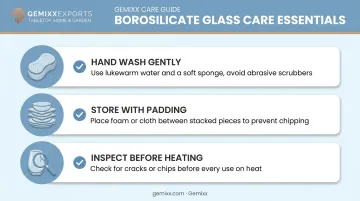
These small habits matter more than the glass's rated tolerance. Most breakage traces back to mishandling — a dropped lid, a scraped chip, a skipped inspection — not the material failing on its own.
Frequently Asked Questions
Is borosilicate glass cookware safe?
Properly manufactured, certified borosilicate glass is non-toxic, chemically inert, and free of heavy metals like lead and cadmium. It's one of the safer cookware materials available when sourced from a tested, reputable manufacturer.
Can you pour boiling water into borosilicate glass?
Borosilicate handles boiling water and sudden temperature changes far better than regular glass. Still, avoid extreme shifts, like pouring boiling water onto ice-cold glass, since that can exceed even borosilicate's thermal shock tolerance.
Is all Pyrex made of borosilicate glass?
No. Pyrex started as borosilicate, but many modern US product lines switched to tempered soda-lime glass, while European Pyrex often remains borosilicate. Always check the product specs rather than assuming from the name.
Can borosilicate glass cookware be used on an induction stovetop?
No. Glass doesn't conduct electricity or interact with magnetic induction fields, so plain borosilicate cookware cannot work on induction cooktops.
How do you know if glass cookware is genuine borosilicate?
Check manufacturer specifications and look for recognized names or certifications rather than judging by appearance. Ask suppliers for lead- and cadmium-free testing documentation before assuming a "borosilicate" label is accurate.
Is borosilicate glass cookware microwave and dishwasher safe?
Most borosilicate cookware is microwave-safe and dishwasher-safe, but hand washing helps preserve surface clarity long-term. Manufacturer guidelines still take priority, so confirm the specifics before use.