Introduction
Picture a dinner guest asking for "the silverware," while the host reaches for what she calls "cutlery", both meaning the same set of forks and spoons on the table. Now picture that same mix-up happening in a purchase order between a US retailer and an overseas factory.
That's where the confusion stops being harmless.
For global buyers and wholesalers, using "cutlery" when you mean a full utensil set, or vice versa, can trigger sourcing errors, mismatched SKUs, and shipment delays.
This guide breaks down what these terms actually mean, where each dominates, and how to use the right one with confidence in both everyday conversation and trade documentation.
Key Takeaways
- Cutlery is the everyday term for cutting tools in the UK, Australia, and India
- Flatware is the American retail and manufacturing term for forks, spoons, and knives combined
- Silverware is a legacy US term, now used casually even for stainless steel sets
- All cutlery technically qualifies as flatware, but not every flatware piece counts as cutlery
- Getting the term right matters most in B2B sourcing — listings, RFQs, and import paperwork
Cutlery vs Flatware: Quick Comparison
The fastest way to see the split is side by side.
| Category | Cutlery | Flatware |
|---|---|---|
| Core definition | Knives, historically; broadened to forks/spoons in UK/India usage | Forks, spoons, and knives as a full eating utensil set |
| Dominant regions | UK, Australia, India, Ireland | United States (retail, manufacturing, wholesale) |
| Typical components | Table knives, steak knives; sometimes full sets | Dinner forks, spoons, knives, dessert pieces, servers |
| Trade usage | Preferred in UK/Australian POs and specs | Preferred in US wholesale and manufacturing specs |
| Common materials | Stainless steel, carbon steel blades, disposable plastic/wood | 18/0, 18/8, 18/10 stainless steel; sterling silver; EPNS |
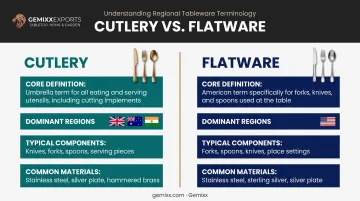
Notice the overlap: both terms can describe the same physical set of utensils. The difference is regional convention, not a fixed rulebook.
What Is Cutlery?
The word traces back to Old French coutelerie, from coutel, meaning "knife." Its collective sense, covering knives and cutting utensils generally, dates to the 1830s.
That knife-focused root still shapes how the term is used in the UK, India, and Australia today. It's the everyday word for anything at the table you'd use to eat with, not just blades.
Using precise cutlery terminology matters most when specifying knife-only orders versus full utensil sets in cross-border sourcing. A purchase order that says "cutlery" without clarification can mean very different things depending on which side of the Atlantic it lands on.
Materials and Common Variations
Cutlery spans a wider material range than most people assume:
- Table and steak knives: stainless or carbon steel blades, often with separate handle materials
- Disposable cutlery: plastic, wood, bamboo, and even edible options gaining ground under sustainability rules
- Hybrid sets: stainless steel bodies with wood, bone, or resin handles for hospitality use
- Specialty cutlery: cheese knives, fish servers, and other single-purpose tools common in premium tabletop collections
Regulation is reshaping this segment fast. England's single-use plastic cutlery ban, in force since October 2023, targeted an estimated 2.7 billion single-use cutlery items used annually before the restriction took effect.
Government modeling projected plastic's share of the disposable cutlery market would fall sharply as wood substitutes gained ground, a shift retailers sourcing disposables need to track closely.
Use Cases of Cutlery
The term dominates in hospitality, catering, and export catalogs across the UK, India, and Australia. You'll see it used consistently in:
- Hotel and restaurant supply catalogs across South Asia and Europe
- Cutlery sets marketed on e-commerce platforms serving these regions
- Export documentation between UK and Commonwealth trading partners
Sheffield, England, is worth knowing here. The Company of Cutlers in Hallamshire was chartered in 1624 to regulate the local trade, and by the 18th century, Sheffield had become an international center for cutlery production.
That history still echoes in the "Made in Sheffield" trademark and in how deeply the word "cutlery" is embedded in British trade language.
What Is Flatware?
Flatware is the American technical and retail classification for flat eating utensils — forks, spoons, and (in common usage) knives. It exists as a manufacturing category distinct from holloware, which covers three-dimensional pieces like bowls, pitchers, and cups.
Strict trade classification separates knives out as "cutlery" and groups only forks and spoons as flatware. US retail floors, though, have long since blended the three together under one label.
Using "flatware" correctly in specs and purchase orders keeps production, packing lists, and category assignments clean. It prevents a common and costly error: serving pieces getting mixed into eating utensil counts, or vice versa.
Everyday vs. Premium Flatware
Not all flatware is built the same. Utility-grade sets are mass-produced with standard stainless finishes, priced for volume, while premium, design-oriented flatware relies on handmade construction, mixed-material handles, and specialty finishes.
Gemixx Exports operates squarely in that second tier. Its premium flatware lines — spanning Modern, Contemporary, and Classic silhouettes — go through forging, casting, grinding, polishing, and plating, with each piece touched by an average of 16 skilled artisans before it reaches a client's warehouse.
Handles come in wood, bone, marble, resin, or enamel, and finishes range from Gold PVD to brushed stainless. That variety helps explain why demand for higher-grade flatware is climbing globally.
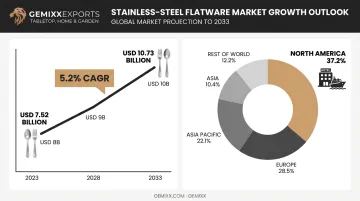
According to a 2026 market analysis from Coherent Market Insights, the stainless-steel flatware market was valued at USD 7.52 billion, with growth projected to USD 10.73 billion by 2033, a 5.2% CAGR. North America holds roughly 37.2% of that market, driven largely by commercial hospitality: hotels, cruise lines, and upscale dining.
Use Cases of Flatware
"Flatware" is the term you'll find across:
- US department store listings and wedding registries
- E-commerce catalogs and wholesale purchase orders
- Interior design and home decor sourcing briefs
- Hospitality table-setting programs for hotels and restaurants
The 18/10 stainless steel standard is the modern benchmark for quality here, meaning 18% chromium and 10% nickel content. Chromium forms a thin, self-repairing protective oxide layer that resists corrosion; nickel stabilizes the alloy's structure for better toughness and durability.
The shine itself comes from mechanical polishing, not from the metal composition alone. It's a detail that's easy to overstate, but worth getting right in a spec sheet.
Cutlery vs Flatware: Which Term Should You Use?
Three factors decide which word belongs in your listing or PO:
- Target region: cutlery for UK, Australian, or Indian buyers; flatware for US audiences
- Formality of the buyer: retail consumers tolerate either term, but wholesale procurement teams expect trade-standard language
- Documentation precision: cross-border shipping and customs paperwork benefit from unambiguous terms
Quick guidance:
| Use This Term | When |
|---|---|
| Cutlery | Marketing to UK, Australian, or Indian shoppers, or writing knife-focused specs |
| Flatware | Drafting US retail listings, wholesale POs, or premium/handmade utensil lines |
Getting this wrong on a listing costs you search visibility. Getting it wrong on a PO costs you a shipment.
Real-World Example: Getting Terminology Right in Global Sourcing
Consider a common scenario in premium tableware sourcing: a US-based retailer sends an overseas factory a spec sheet requesting "cutlery" for a new dining collection, assuming the term covers a full place setting.
The factory, reading the word through a different regional lens, produces knives only. The retailer now faces a revised spec, a second sample cycle, and a delayed shelf date.
This is exactly the kind of gap a vertically integrated manufacturer is built to close. Gemixx Exports has spent 40+ years producing handmade flatware, cookware, and tabletop goods for 250+ global retail and wholesale partners, running prototyping, manufacturing, importing, and warehousing under one roof, with no third-party contract shops involved.
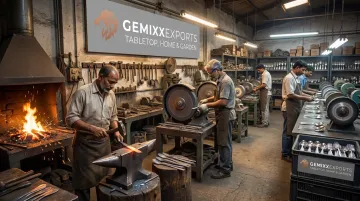
That structure matters here because:
- Prototyping locks in terminology before production starts. Sketches, renders, or samples go through collaborative iteration before production starts, so "flatware" means the same thing on both ends by the time a PO is signed.
- One organization owns the whole chain. A spec agreed upon in New Jersey is executed by the same team in Moradabad and delivered DDP to the client's warehouse — nothing gets reinterpreted by an unfamiliar middleman.
- Response times keep questions from turning into mistakes. Gemixx commits to answering inquiries within 24 hours and delivering formal quotes within 48 hours, so terminology questions get resolved before they become production mistakes.
Precise terminology directly affects production accuracy, shipping timelines, and how much a client trusts their supplier going forward. If you're sourcing premium, design-oriented flatware for your next line, look at how a vertically integrated manufacturer like Gemixx handles that alignment from the first sketch onward.
Conclusion
There's no single "correct" word here. Cutlery, flatware, and silverware are all valid — they're just anchored to different regions and different contexts. Clarity comes from knowing your audience: a US retail listing calls for different language than a UK export catalog or an Indian wholesale order.
For manufacturers, retailers, and wholesalers, that clarity has a real payoff. Using the right term reduces costly sourcing errors and builds trust across borders. Gemixx applies this same principle every day, aligning terminology with client expectations across its 250+ global retail and wholesale partners.
Frequently Asked Questions
Are flatware and cutlery the same?
Not quite. Cutlery traditionally means cutting tools like knives, while flatware is the broader American term covering forks, spoons, and knives together. All cutlery counts as flatware, but not all flatware counts as cutlery.
What are the five cutlery names?
Standard five-piece sets typically include a dinner knife, dinner fork, dinner or soup spoon, dessert fork, and dessert spoon. Exact naming varies by brand — some label the smaller pieces "salad fork" or "coffee spoon" instead.
Do Americans say cutlery or silverware?
Americans commonly say "silverware" in everyday speech and "flatware" in retail or industry settings. Most understand "cutlery," but few use it casually in the US.
What is the difference between flatware and silverware?
Silverware historically referred to sterling silver utensils specifically. Flatware is material-neutral and technical. Today, Americans often use "silverware" loosely for any utensil set, regardless of what it's made from.
What is the highest quality material for flatware or cutlery?
18/10 stainless steel (18% chromium, 10% nickel) is the modern premium standard for durability and shine. Sterling silver remains the traditional luxury choice for those wanting a heritage material.
Should retailers use "cutlery" or "flatware" in product listings?
Match your terminology to your market: "flatware" for US e-commerce and wholesale listings, "cutlery" for UK, Australian, or Indian audiences. This improves search visibility and cuts down on buyer confusion.