U.S. tableware sales hit $8.65 billion in 2022, with flatware as one core segment, according to Grand View Research. Yet actual domestic manufacturing capacity is surprisingly thin.
For retailers, wholesalers, and hospitality buyers, picking the wrong flatware partner means inconsistent quality, blown lead times, and margin-crushing reorder costs. This guide breaks down the manufacturers actually worth your attention, and why each one earned a spot.
Key Takeaways
- Only one company still makes flatware entirely on U.S. soil; most others design here but source overseas
- 18/10 vs. 18/0 stainless grade, certifications, and vertical integration separate reliable partners from risky ones
- Heritage brands like Oneida and Lenox win on recognition; specialty manufacturers win on customization and speed
- Buyers should weigh production capacity and total landed cost— not just sample quality or brand name
Overview of Flatware Manufacturing in the US Market
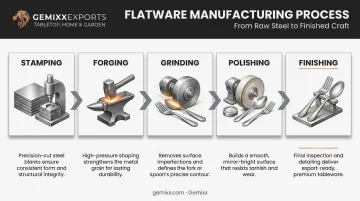
Flatware manufacturing covers the full production chain: stamping steel blanks, forging them into shape, then grinding, polishing, and finishing forks, knives, and spoons into a finished product. For B2B buyers, understanding this process matters because each stage affects durability, weight, and finish consistency across a program.
The category sits inside the broader tableware market, which TechSci Research values at $12.84 billion in 2025, growing to $17.93 billion by 2031. Flatware is tracked as its own line item within that figure, alongside dinnerware and stemware.
Here's the part most sourcing teams miss: American flatware manufacturing has consolidated dramatically since the early 2000s.
Oneida closed its Sherrill, New York plant in 2005 after determining that fully finished Asian flatware cost less than the raw steel alone in the U.S.
Independent industry coverage confirms Sherrill Manufacturing is now the country's last flatware maker, operating out of that same former Oneida facility.
Most surviving "American" flatware brands now operate as design-and-distribution companies, not factories.
That consolidation is exactly why this list matters. It covers the rare domestic manufacturer and the global manufacturing partners with genuine U.S. market presence. Buyers can source with clear eyes instead of relying on vague "Made in USA" marketing.
Top Flatware Manufacturers in the United States
We evaluated each manufacturer on manufacturing capability, material quality, certifications, client base, and reliability for B2B ordering. Here's how the field breaks down.
Liberty Tabletop (Sherrill Manufacturing)
Sherrill Manufacturing runs the only fully vertically integrated flatware factory left in the United States. The company acquired Oneida Limited's flatware assets in 2005, when former Oneida executives Greg Owens and Matt Roberts bought the historic Sherrill, NY plant rather than let it close.
What sets Liberty Tabletop apart:
- Uses U.S.-sourced steel throughout production, not just final assembly
- Holds a federal GSA contract (GS-07F-0485V) and has supplied U.S. military branches since 2009
- Offers 40+ patterns with decades of institutional etching and craftsmanship expertise
| Attribute | Details |
|---|---|
| Location & Founded | Sherrill, New York; relaunched under current ownership in 2005 |
| Specialty | Fully American-made stainless flatware, 40+ patterns |
| Best Suited For | Buyers prioritizing verified "Made in USA" claims and government/institutional supply |
Oneida
Oneida built its reputation as the world's largest flatware manufacturer, once running its Sherrill plant with roughly 2,000 employees producing over 3 million pieces weekly at peak capacity. That manufacturing era ended in 2005.
Today, Oneida operates as a brand under Lenox ownership (acquired 2021), distributing through thousands of department stores, mass merchants, and warehouse clubs. It operates today as a design-and-distribution business, with manufacturing fully outsourced.
- Extensive pattern catalog spanning decades of American design history
- Strong household name recognition for both retail and foodservice buyers
- Wide distribution network already established across major retail channels
| Attribute | Details |
|---|---|
| Location & Founded | Originally Sherrill, NY; founded in 1880 |
| Specialty | Wide range of stainless flatware for retail and foodservice |
| Best Suited For | Retailers wanting an established, widely recognized American heritage brand |
Lenox
Lenox has anchored American formal dining and gifting since 1889, now headquartered in Bristol, Pennsylvania. The brand pairs flatware collections directly with its dinnerware lines, a combination that plays well in bridal registries.
Lenox's flatware catalog leans heavily into large set formats:
- 65-piece and larger sets designed for full-service formal dining
- Coordinated patterns matched specifically to Lenox dinnerware collections
- Featured placement in wedding registry programs, including partnerships with major retail registries
| Attribute | Details |
|---|---|
| Location & Founded | Headquartered in Bristol, Pennsylvania; founded in 1889 |
| Specialty | Large flatware sets (65+ pieces) paired with dinnerware collections |
| Best Suited For | Retailers targeting bridal, gifting, and formal dining segments |
Mikasa
Mikasa traces back to 1948, when George Aratani founded American Commercial Inc. in California; the Mikasa brand name followed in 1957. Lifetime Brands acquired the company in 2008 and now operates it as a division from its Garden City, New York headquarters.
Mikasa's flatware strength lies in accessibility and broad retail reach:
- Traditional and gold-accented designs sold through department stores, big-box chains, and e-commerce
- Value-oriented price points that move volume in mass retail settings
- A dedicated Gold Accented Flatware collection spanning traditional and modern styling
| Attribute | Details |
|---|---|
| Location & Founded | Parent company (Lifetime Brands) headquartered in Garden City, NY |
| Specialty | Traditional and ornate flatware sets, including gold-accent finishes |
| Best Suited For | Retailers seeking classic, value-oriented flatware lines |
Gemixx Exports
Gemixx has manufactured handcrafted metalware since 1982, when Vineet Dargar left his career as an executive chef to rebuild his family's struggling metal finishings shop, later building the company's flatware specialization. That kitchen background still shapes how the company designs flatware today, building pieces meant for everyday use by chefs and hosts.
The company now serves 250+ global retailers, wholesalers, and hospitality brands through a fully vertically integrated model spanning manufacturing in India, importing, and warehousing, coordinated through its U.S. office in New York/New Jersey.
What makes Gemixx different from a typical overseas vendor:
- 100% handmade production at its own Moradabad, India metalware factory, with an average of 16 skilled artisans touching each piece
- Six standard finishes (Gold PVD, Champagne Gold PVD, Black PVD, Copper, Brushed Stainless, Polished Stainless), plus custom finish development including hand-battered textures and large-grain sand casting
- FDA-compliant and Prop 65-compliant stainless steel across the entire flatware line
- Same-business-day inquiry response and 48-hour formal quotes, with production running 40-60 days after sample approval
- Mixed-material handle options in FSC-certified wood, bone, marble, resin, and enamel for coordinated collections
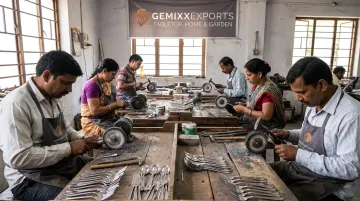
Because Gemixx owns its factory outright, with no third-party contract shops in the mix, buyers deal with one accountable partner from prototype through delivery, DDP to a U.S. warehouse.
| Attribute | Details |
|---|---|
| Location & Founded | HQ in New Delhi, India; U.S. office in New York/New Jersey supporting American clients |
| Specialty | Handmade premium flatware, barware, and cookware with custom finish development |
| Best Suited For | Retailers, wholesalers, and hospitality brands wanting design-led, private-label flatware backed by U.S.-based support |
How We Chose the Best Flatware Manufacturers
Buyers make two mistakes constantly: chasing the lowest quoted price, and trusting "Made in USA" language without confirming where the actual production happens. Both lead to expensive surprises after the first reorder.
We instead weighed manufacturers against factors that predict real business outcomes:
- Material certifications - 18/10 stainless steel composition, FDA compliance, and Prop 65 adherence reduce defect rates and legal exposure
- Production capacity - Factories with proven scale handle volume reorders without slipping deadlines
- Vertical integration - Manufacturers that also import and warehouse eliminate extra vendor handoffs, which cuts miscommunication and delays
- Client portfolio - A deep roster of retail and hospitality partners signals proven reliability under real-world pressure
- Responsiveness - Fast quote turnaround (24-48 hours, in Gemixx's case) directly shortens program launch timelines
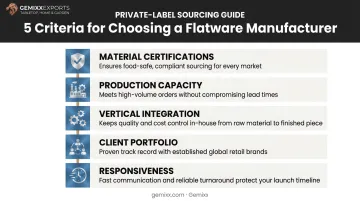
Each factor ties back to something measurable: fewer defects, faster reorders, or better program scalability. Reputation alone doesn't guarantee any of that.
Conclusion
There's no single "best" flatware manufacturer, only the best fit for your specific program:
- Brands chasing a "Made in USA" story should look toward Liberty Tabletop.
- Retailers wanting instant shelf recognition can lean on Oneida or Lenox.
- Hospitality brands and private-label retailers building something distinctive need design flexibility and custom finish work most heritage brands don't offer.
Once you've narrowed the field, evaluate ongoing performance and total landed cost, not just how the first sample looks.
If your program calls for handmade craftsmanship, custom finishes, and a single accountable partner from prototype to U.S. warehouse delivery, Gemixx's team is ready to talk. Reach the New York/New Jersey office at +1 201 201 0070 or forks@gemixx.com for a quote within 48 hours.
Frequently Asked Questions
Is any flatware still made entirely in the USA?
Yes. Sherrill Manufacturing (Liberty Tabletop) in Sherrill, NY, is the only remaining fully vertically integrated American flatware factory, using U.S.-sourced steel throughout production.
What is the difference between flatware and silverware?
Flatware is the general term for eating utensils, most commonly stainless steel today. Silverware technically refers to items made of or plated with actual silver, though many people use the terms interchangeably.
What is 18/10 stainless steel and why does it matter in manufacturing?
It refers to steel containing roughly 18% chromium and 10% nickel, which improves rust resistance and durability. Per the British Stainless Steel Association, 18/10 and 18/8 are practically the same grade — a solid quality baseline, not proof of superiority.
How do I choose the right flatware manufacturer for my retail or hospitality business?
Evaluate certifications, minimum order quantities, customization capability, and vertical integration together. Fewer vendors in your supply chain means fewer points of failure.
Can retailers get custom or private-label flatware manufactured?
Yes. Several manufacturers offer this, including Gemixx, which develops custom finishes, mixed-material handles, and private-label packaging as standard parts of its service model.
What certifications should a flatware manufacturer have for U.S. import compliance?
Look for FDA food-contact compliance and adherence to California Proposition 65 warning requirements. Both are essential for legally selling flatware in U.S. markets.