Introduction
You search for a new flatware set, click through ten listings, and every single one says "imported" with no country named. Sound familiar?
That vague labeling isn't an accident. Most mainstream silverware brands source from China, even when their marketing suggests otherwise. Buyers are pushing back for real reasons: rusting complaints, inconsistent stainless steel grades, and shell brands running fabricated reviews on Amazon.
This guide breaks down why that shift is happening and how to read a stainless steel grade stamp. It also covers which countries, including India, offer credible, verifiable alternatives for consumers and sourcing businesses alike.
Key Takeaways
- Vague "imported" labels often hide an undisclosed China origin
- 18/10 stainless steel offers the best rust resistance and longevity
- Liberty Tabletop is the only flatware brand made entirely in the USA
- India's artisan factories, like Gemixx, offer a design-forward alternative
- Physical stamps on utensils are harder to falsify than packaging claims
Why Global Brands and Consumers Are Moving Away from China-Made Flatware
Flatware has long been treated as a commodity. Forks and spoons don't carry the brand cachet of, say, cookware or knives, so for decades, manufacturers chased the lowest production cost. China offered exactly that: massive scale, cheap labor, and established metalworking infrastructure. It made financial sense for a long time.
That math is starting to look different.
The counterfeit problem is real and growing. Amazon reported identifying and disposing of more than 7 million counterfeit products worldwide in 2023. Flatware isn't immune. Shell brands with generic names and fabricated five-star reviews routinely mimic established silverware designs, then undercut legitimate manufacturers on price while quietly disappearing after a wave of complaints.
Other pressure points buyers cite:
- Inconsistent quality control — online reviews frequently mention rusting or pitting well before the expected product lifespan, though standardized public data by origin is limited
- Chemical handling questions — US regulators classify cutlery and flatware manufacturing as an industry category with potential trichloroethylene (TCE) vapor degreasing exposure, raising scrutiny of factory safety standards
- Raw material sourcing gaps — some suppliers substitute lower-nickel steel while marketing it under premium grade names
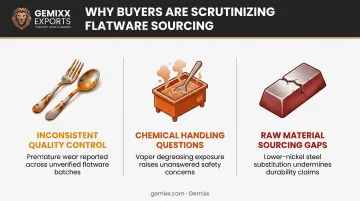
These quality, safety, and sourcing concerns are pushing country-of-origin transparency into a real purchasing factor, and established retailers are responding. Williams-Sonoma and Crate & Barrel now list Vietnam or Italy directly on product pages, while others are testing Indonesia and India. Retailers aren't abandoning China overnight; they're diversifying deliberately, one supplier country at a time.
Decoding Stainless Steel Grades: What 18/10, 18/8, and 18/0 Really Mean
Those grade numbers aren't marketing fluff. They tell you the approximate percentage of chromium to nickel in the alloy, and that ratio directly determines how well your flatware resists rust over years of dishwasher cycles.
According to the British Stainless Steel Association, these labels correspond to specific composition ranges rather than exact lab measurements:
| Grade | Typical Composition | Performance |
|---|---|---|
| 18/10 | ~18% chromium, ~10% nickel | Premium corrosion resistance, mirror finish, longest lifespan |
| 18/8 | ~18% chromium, ~8% nickel | Often the same base alloy (type 304) as 18/10; solid rust resistance |
| 18/0 | ~16-18% chromium, minimal nickel | Magnetic, more prone to staining, better for nickel-sensitive users |
18/10 is the benchmark most premium brands chase. It resists pitting, holds a polish, and typically outlasts cheaper alternatives by years. 18/0, by contrast, uses a different steel type (ferritic 430) with little to no nickel. It's a reasonable choice if you have a nickel allergy, but expect to replace it sooner.
There's also a manufacturing distinction that matters as much as the grade stamp:
| Method | Process | Result |
|---|---|---|
| Forged | Single thick piece of steel, heated and shaped under pressure | Heavier, sturdier, and better balanced in the hand |
| Stamped | Cut from rolled sheet metal | Lighter, more flexible, and cheaper to produce |
Both methods work well depending on your use case, but forged pieces generally hold up better to daily wear. Before buying, check for a grade stamp on the utensil itself. A listing that just says "stainless steel" with no grade or origin disclosed deserves a second look.
Where Is Flatware Made Instead of China? A Country-by-Country Look
United States
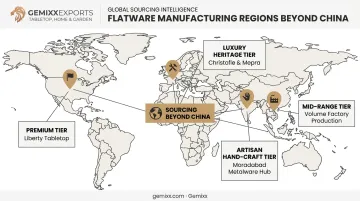
Only one flatware manufacturer currently produces entirely on American soil: Liberty Tabletop, made by Sherrill Manufacturing in Sherrill, New York, the same town where Oneida once ran its historic factory. When Oneida shifted production overseas, former employees purchased the facility and relaunched it under new ownership.
This distinction matters because "Made in USA" claims on flatware haven't always held up. In 2016, Senator Charles Schumer pushed the General Services Administration to investigate flatware listed as domestically made on GSA Advantage. The review led to the removal of 11 vendors falsely listing overseas products as American-made.
Europe (France & Italy)
Heritage brands like Christofle (France, founded 1830) and Mepra (Italy, founded 1947) built their reputations through generations of craftsmanship. Forge de Laguiole produces its distinctive knives and tableware in its own French workshop. These brands trade on craftsmanship history, though buyers should still confirm SKU-level origin rather than assuming brand heritage guarantees a specific factory location.
Vietnam and Indonesia
Several familiar retail names have shifted stamped and forged production here. Crate & Barrel's Boulder Mirror set and Williams-Sonoma's Tenley collection both currently list Vietnam as the country of manufacture. Indonesia has emerged as another option, with brands like Ricci Argentieri producing semi-handmade 18/10 flatware there. Quality reports on both countries are generally positive.
India
India represents a less obvious but increasingly credible option, anchored by established artisan hubs like Moradabad, a metalworking center with generations of hand-finishing expertise. Manufacturers such as Gemixx Exports have produced handmade flatware there since 1982, supplying more than 250 retailers and wholesalers worldwide. India still isn't a household name in flatware sourcing the way Italy or Vietnam are, but it offers artisan craftsmanship at a more accessible price point than European heritage manufacturers.
Best Flatware Brands and Sets Not Made in China
If you're shopping across price tiers, here's how the credible non-China options tend to break down:
- Budget to mid-range: Liberty Tabletop (USA-made, 18/10 American-sourced steel)
- Mid-range: Crate & Barrel and Williams-Sonoma private-label lines produced in Vietnam and Indonesia, some designed by Robert Welch
- Mid-range to premium: Handmade Indian flatware from manufacturers like Gemixx, which has supplied private-label stainless designs to 250+ global retailers for over 40 years
- Premium: Christofle (France) and Mepra (Italy), trading on decades of tableware craftsmanship
Williams-Sonoma and Crate & Barrel deserve credit here. They're among the few major retailers that clearly state country of origin directly on product pages, something most Amazon third-party listings avoid entirely.
Treat any listing using vague terms like "imported" as an invitation to dig further, not a green light to buy. That single word can mean anywhere from France to a factory with no traceable safety record.
Why India's Artisan Manufacturing Model Is a Compelling Alternative for Brands and Retailers
India's manufacturing capability expanded significantly after trade deregulation in the early 1980s opened the door for export-focused industrial growth. That shift created room for a different kind of flatware producer, one built around artisan skill rather than automated volume.
Gemixx Exports provides a compelling case study. The company started in 1982 as a struggling metal-finishing operation. In the early 1990s, Managing Director Vineet Dargar, a former executive chef, left his culinary career to rebuild his father's business. Rather than investing in automation to cut costs, a common industry move, he took the opposite bet.
His approach reshaped the company by the late 1990s into a design-oriented premium flatware manufacturer:
- Premium pricing over automation — SKU prices more than doubled while artisan compensation tripled, a deliberate trade-off favoring craft over machines
- Zero-interest artisan lending — one of the flatware industry's first private credit programs, funding experimentation, training, and safety for entrepreneurial artisans
- Dozens of independent production units — created through that lending program, 100% owned by historically disadvantaged artisan groups previously excluded from the formal economy
Gemixx's model is vertically integrated from end to end. Flatware is forged, cast, polished, and finished at the company's own Moradabad factory, with quality control and packaging handled at its Noida headquarters. No third-party contract shops are involved, and each piece passes through roughly 16 skilled artisans.
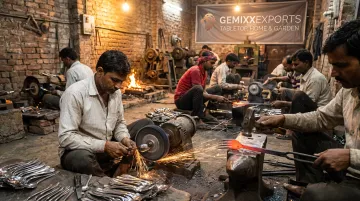
This hands-on approach is matched by rigorous safety standards. The flatware line is food-grade compliant with FDA and California Proposition 65 requirements, addressing the core safety concerns that push buyers away from unverified suppliers.
The company’s Moradabad facility is also SEDEX member-audited under SMETA standards, which cover labor rights, health and safety, and environmental practices.
This positions Gemixx less as a direct-to-consumer alternative and more as a sourcing partner for retailers, e-commerce brands, and home decor businesses looking to diversify supply chains without sacrificing design quality or compliance documentation.
How to Verify Country of Origin Before You Buy or Source Flatware
Packaging claims are easy to print. Physical stamps on the utensil itself are much harder to falsify, so start there.
For individual consumers:
- Flip the fork or spoon over and look for a grade stamp and country marking
- Email or call the brand directly if the website doesn't disclose origin
- Stay skeptical of any listing that only says "imported" with no further detail
For business buyers evaluating a manufacturing partner:
- Request compliance certifications (FDA, Prop 65, or equivalent for your market)
- Ask for factory audit documentation, such as SEDEX or SMETA reports
- Get references from other brands the manufacturer has worked with
- Confirm whether production happens in-house or through subcontracted third parties
A manufacturer that hesitates to share this information, or can't produce it quickly, is a red flag. Gemixx provides SEDEX/SMETA audit reports and FDA/Prop 65 compliance documentation upfront for exactly this reason.
Frequently Asked Questions
Is any flatware made in the USA?
Yes. Liberty Tabletop, manufactured by Sherrill Manufacturing in Sherrill, New York, is currently the only flatware brand producing entirely domestically. Sherrill operates out of Oneida's original factory location.
What is 18/10 stainless steel flatware?
It's a grade with roughly 18% chromium and 10% nickel content. That combination gives it the best rust resistance and finish retention among common flatware grades.
Is Chinese-made flatware safe to use?
Quality varies widely by factory and supplier. Check for grade stamps and compliance certifications regardless of where the product is made, since origin alone doesn't guarantee safety.
What countries make high-quality flatware besides the USA and China?
Italy, France, Vietnam, Indonesia, and India all have recognized manufacturing capability, spanning heritage craftsmanship to more accessible mid-range production. Indian manufacturers like Gemixx, which has produced handmade flatware for over 40 years, supply flatware and cutlery to more than 250 global retail brands.
How can I tell if flatware is really not made in China?
Check the physical stamp on the utensil, not just the box. Avoid vague "imported" labeling and favor retailers, like Williams-Sonoma or Crate & Barrel, that disclose origin directly on product pages.
Why do some brands have inconsistent country-of-origin labeling across products?
Manufacturers often shift production between factories or countries over time to manage cost and capacity. Check each specific product or batch rather than assuming the whole brand sources consistently.