Introduction
Ceramic and enamel cookware have become the two go-to alternatives to Teflon nonstick and bare cast iron, showing up everywhere from wedding registries to wholesale cookware catalogs. Both promise a PFOA/PTFE-free cooking surface, but they get there through completely different manufacturing processes.
That difference matters more than most buyers realize. For home cooks, it affects cleaning routines, heat performance, and how long a pan actually lasts.
For retailers and wholesalers, it shapes sourcing cost, shipping weight, return rates, and how a product line gets positioned on shelf.
The stakes are rising, too. According to a 2025 industry analysis by Grand View Research, the global nonstick cookware market is valued at $20.6 billion and is projected to reach $32.5 billion by 2033. That's a 5.9% CAGR, largely driven by consumers moving away from traditional PFAS-based coatings.
This guide breaks down what each material actually is, where it performs best, and how to choose between them.
Key Takeaways
- Ceramic: a metal base with a thin sol-gel coating for fast heat-up and easy release.
- Enamel: cast iron or steel fused with a glass-like glaze for superior heat retention.
- Ceramic wins on weight and cleanup; enamel wins on scratch resistance and searing.
- Neither is automatically "healthier" — coating quality and certification matter most.
- The right pick depends on end use: daily convenience versus heirloom durability.
Ceramic vs Enamel: Quick Comparison
Before digging into the details, here's how the two stack up across the factors that matter most to buyers.
| Factor | Ceramic | Enamel |
|---|---|---|
| Typical price (set) | $80–$450 | $150–$600+ |
| Base material | Aluminum or stainless steel | Cast iron or steel |
| Coating process | Sol-gel coating cured around 200–300°C | Vitreous glaze fired at 750–890°C |
| Heat ceiling | 350–550°F (model-dependent) | Up to 500°F (model-dependent) |
| Cleaning | Hand wash, non-metal utensils | More utensil-tolerant, hand wash recommended |
Cost and Composition
Ceramic sets typically start lower because aluminum bases are lighter and cheaper to produce — a 16-piece GreenLife set runs around $79.99. Enamel starts heavier: a basic Lodge Dutch oven starter kit lists near $159.95, while premium enameled cast iron from brands like Le Creuset climbs past $850 for a full set.
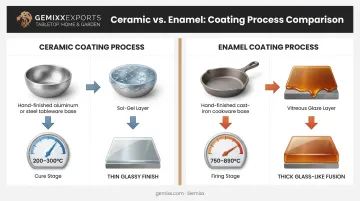
The coating processes aren't interchangeable, either: ceramic uses a sol-gel layer cured at a relatively low 200–300°C and applied to an aluminum or steel shell, while enamel is fired onto steel at 750–890°C for just a few minutes, creating a hard, glass-like surface bonded directly to the metal.
Durability and Heat Retention
That firing process directly shapes how each material holds up over time. Enamel's glaze can reach hardness levels up to 450 HV, according to a materials science review of porcelain enamel coatings, but that same hardness makes it prone to chipping if dropped or knocked against a hard edge. Ceramic coatings wear differently: performance depends heavily on the specific sol-gel system and how the pan is treated, not a fixed timeline.
Enamel's thermal mass also makes it a better fit for slow braises and long simmers, while ceramic heats and cools quickly, better suited to fast sautéing.
What Is Ceramic Cookware?
Ceramic cookware is a metal cookware body, usually aluminum, coated with an inorganic sol-gel layer cured at high heat to create a nonstick surface free of PFOA and PTFE. The coating itself is thin, glassy, and applied in a factory process distinct from traditional nonstick manufacturing.
There are two subtypes worth knowing:
- Fully ceramic solid-body cookware (like Xtrema): no metal core, denser and heavier than coated versions.
- Metal-core ceramic-coated cookware (like Caraway or GreenPan): lighter, more affordable, and far more common on retail shelves.
The operational upside for retailers is straightforward: lighter weight means lower shipping costs, and PFAS-free positioning appeals directly to health-conscious buyers avoiding so-called "forever chemicals."
That marketing appeal only holds up if the coating performs over time. Coating quality matters more than most buyers assume. A 2025 peer-reviewed study testing five commercial sol-gel systems found dramatic variation in wear resistance — one coating stripped after just 4 seconds of impact testing, while others held up for 8 minutes in shear-wear tests. Not all ceramic coatings are built the same, even when marketed identically.
Use Cases of Ceramic Cookware
Ceramic fits naturally into eco-conscious, design-forward product lines, such as direct-to-consumer cookware brands built around Instagram-friendly colors and minimalist aesthetics. It's also the material of choice for:
- Delicate cooking tasks like eggs, fish, and light sauces
- Home decor retailers pairing cookware with lifestyle branding
- Budget-conscious buyers who want a PFAS-free option without the enamel price tag
Independent testing backs up ceramic's nonstick reputation. America's Test Kitchen's ceramic skillet evaluation fried up to 50 eggs per pan across initial and post-abuse rounds, and ceramic-coated pans have taken the top three spots in Consumer Reports' recent nonstick frying pan tests. That's a real, repeatable performance edge, not just marketing.
What Is Enamel Cookware?
Enamel cookware is cast iron or steel fused with a vitreous porcelain enamel coating, baked at extremely high temperatures to create a glass-like, non-porous surface that's naturally nonstick once seasoned into the cooking routine. Unlike ceramic, the coating isn't a thin applied layer. It's fused directly into the metal surface.
Two subtypes serve different segments:
- Enameled cast iron: Dutch ovens, braisers, and skillets built for heavy-duty, long-term use.
- Enamel-coated steel: Lighter camp and travel cookware, trading some durability for portability.
The operational benefit for retailers is durability: fewer returns, fewer replacements, and a natural fit for the premium, heirloom-quality segment. Enamel's thickness and glaze quality directly determine chip resistance, which is why sourcing from a manufacturer with verified food-grade compliance matters.
Compliance isn't the same as certification. FDA regulations prohibit lead as a color or food additive in cookware, and California's Proposition 65 requires clear warnings when products expose users to listed chemicals like lead or cadmium. Neither is a blanket safety stamp. Both represent a baseline that B2B buyers should require documentation for, not assume.
Use Cases of Enamel Cookware
Enamel dominates premium retail lines, gift and wedding registries, and any brand emphasizing heirloom quality or slow-cooking. It also shows up heavily in:
- High-end housewares brands positioning around durability and legacy
- Hospitality kitchens doing sustained braising and baking
- Outdoor and camping cookware lines (enamel-coated steel specifically)
Weight is the trade-off. Consumer Reports measured an enameled cast-iron Dutch oven from Made In at 12.86 lbs, and its cookware buying guide specifically recommends enameled cast iron for searing, browning, sautéing, and frying, tasks where sustained heat matters more than quick heat-up.
Ceramic vs Enamel: What's Better?
There's no universal winner here. The right choice depends on a few concrete factors:
| Factor | Ceramic | Enamel |
|---|---|---|
| Price positioning | Undercuts enamel at entry-level tiers | Commands premium pricing |
| Target customer | Eco-conscious, design-forward buyers | Heirloom and gifting buyers |
| Cooking style | Best for quick, delicate cooking | Best for high-heat searing |
| Shipping and logistics | Lighter weight cuts freight costs at scale | Heavier, higher per-pallet freight costs |
Choose ceramic for lightweight, budget-friendly lines aimed at everyday, health-conscious cooks. Choose enamel for premium-positioned, heirloom-durability lines where customers expect the product to last decades, not years.
Retailers building a diversified catalog don't have to pick one. Gemixx manufactures both ceramic and enamelware cookware in-house, letting you private-label multiple price tiers and customer segments from a single vertically integrated supplier, without forcing a single narrative onto your entire cookware line.
Real-World Sourcing Example
Picture a mid-sized housewares wholesaler trying to expand into coated cookware. They're juggling one overseas factory for prototyping, another for production, and a separate import agent for customs and freight. Every handoff adds delay, and quality control gets harder to verify with each new vendor added to the chain.
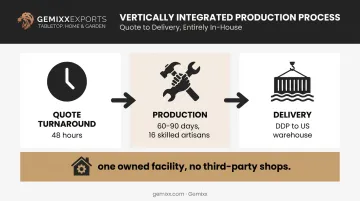
This is a common bottleneck, and it's exactly the problem vertically integrated manufacturing solves. At Gemixx, cookware (including cast-iron skillets, Dutch ovens, and hammered copper lines) moves through prototyping, manufacturing, and export from a single owned facility in Moradabad, India, with no third-party contract shops in the mix.
Here's what that consolidation looks like in practice:
- Quote turnaround: 48 hours from initial inquiry, with same-business-day acknowledgment
- Production lead time: 60–90 days after sample approval, covering the full handmade process (each piece typically passes through 16 skilled artisans)
- Delivery: Landed Duty Paid (DDP) shipping straight to the client's US warehouse, removing the need for separate customs brokers or freight forwarders
This consolidation cuts more than paperwork. It leaves fewer points where quality can slip, fewer vendors to manage, and one accountable partner from sketch to shelf. Food-grade compliance gets built into material sourcing from the start, not added on afterward.
Whatever material you're sourcing (ceramic, enamel, or cast iron), consolidating your vendor chain reduces risk and speeds time-to-shelf. If you're evaluating cookware suppliers, Gemixx responds to inquiries within 24 hours and delivers formal quotes within 48. Reach the team at forks@gemixx.com or +1 201 201 0070.
Conclusion
There's no universal winner between ceramic and enamel cookware. The right choice comes down to end use: a home cook weighing weight and cleanup ease against long-term durability, or a retail buyer weighing cost-per-unit against premium positioning.
For home cooks, the decision is personal — daily convenience versus heirloom investment. For B2B buyers, it comes down to matching material to customer segment while making sure your manufacturing partner can back up food-grade compliance claims with real documentation, such as SEDEX/SMETA audits and FDA/Prop 65 certifications, not just a label.
Frequently Asked Questions
Which is healthier, ceramic or enamel cookware?
Both can be free of PFOA and PTFE when manufactured to food-grade standards. Coating quality and certification matter more than which material you choose.
What's the difference between ceramic and enamel cookware?
Ceramic is a thin, sol-gel nonstick coating applied over an aluminum or steel base. Enamel is a thicker, glass-like glaze fused onto cast iron or steel at much higher temperatures.
What is the healthiest cookware you can use?
Uncoated stainless steel or cast iron are generally considered the safest baseline. High-quality, certified ceramic or enamel cookware is a safe PFOA/PTFE-free alternative.
Does ceramic or enamel cookware last longer?
Enamel typically outlasts ceramic thanks to its thicker, more scratch-resistant glaze. Both can chip or crack if dropped or mishandled, regardless of price point.
Can enamel cookware go in the dishwasher?
Many enamel pieces are labeled dishwasher-safe, but hand-washing is recommended to preserve the glaze's shine and prevent dulling over time.
Is ceramic or enamel cookware better for high-heat searing?
Enamel, especially enameled cast iron, handles sustained high heat and searing better than most ceramic-coated cookware, which performs best at low to medium heat.