Introduction
Cutlery manufacturing turns flat sheets of steel, silver, wood, or other materials into the knives, forks, and spoons that sit in kitchen drawers and restaurant table settings.
The process runs through cutting, forming, and finishing stages. Each stage shapes raw metal into a tool people trust to touch their food every day.
This breakdown is for retailers, wholesalers, hospitality buyers, home decor brands, and anyone curious about what happens before flatware reaches a table. Understanding the manufacturing process helps you evaluate a supplier's quality claims and confirm food safety compliance before you commit to a bulk order.
That evaluation starts with understanding the basics. Billions of people use cutlery daily, yet few ever ask how a spoon becomes a spoon. That's the gap this article closes. We'll walk through each production step, the factors separating premium flatware from bargain sets, and how mass production compares to handmade craftsmanship.
Key Takeaways
- Cutlery starts as steel coil, then moves through blanking, rolling, stamping, and polishing
- Two paths dominate: high-volume stamping and forging, or handmade craftsmanship
- Steel grade, die precision, and finishing technique determine long-term durability
- FDA and Prop 65 compliance are mandatory for flatware entering the US market
- Handmade production trades speed for character no machine can replicate
What Is the Cutlery Manufacturing Process?
Cutlery manufacturing is the sequence of metalworking operations that convert flat metal blanks into shaped, finished eating utensils. Raw stainless steel coil enters one end of the line; a fork, knife, or spoon ready for a dishwasher exits the other.
The goal at every stage stays the same: produce a utensil that's food-safe, corrosion-resistant, and correctly weighted and balanced in the hand. A fork that flexes under pressure or a spoon with an uneven bowl fails that goal, no matter how polished it looks.
Meeting that standard requires manufacturing methods built specifically for cutlery, not the general metal stamping or forging used in other industries. Cutlery requires precision dies built for knife, fork, and spoon geometries:
- Fork tines need exact spacing and depth for even flexing
- Spoon bowls need a particular curve and thickness for balance
- Knife handles often require separate joining steps to attach the blade
A manufacturer producing brackets or automotive parts works from entirely different tooling logic.
Flatware manufacturers control bowl depth, tine spacing, and handle relief through dies dedicated to each utensil. That specificity separates a functional eating tool from a piece of stamped scrap metal.
Why the Manufacturing Process Matters for Quality and Safety
Bulk hospitality and retail orders demand uniformity. A hotel ordering 5,000 place settings needs every fork to weigh the same, balance the same, and shine the same. Inconsistent manufacturing shows up fast when hundreds of pieces sit side by side on a banquet table.
The foodservice and retail industry expects flatware to:
- Resist corrosion and pitting through thousands of wash cycles
- Stay non-reactive with acidic or salty foods
- Hold structural strength in thin components like fork tines and knife blades
- Survive repeated commercial dishwasher cycles without discoloring
The FDA Food Code requires multiuse utensils and food-contact surfaces to be safe, durable, corrosion-resistant, nonabsorbent, and resistant to pitting, chipping, scratching, and distortion. That standard exists because poorly manufactured flatware fails in predictable ways.
Common failure points without proper process control:
- Pitting or discoloration from low-grade steel or inadequate polishing
- Weak fork tines that bend under normal use
- Inconsistent bowl or blade thickness within the same batch
- Rough edges between tines that trap food residue
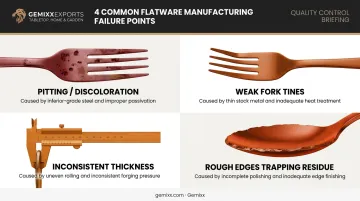
These failure points explain why food-grade compliance isn't optional for US-bound flatware. FDA food-contact requirements and California's Proposition 65 (which flags nickel compounds for potential health warnings depending on exposure levels) are regulatory checkpoints. Gemixx builds these checks into sourcing and production for every SKU, not as afterthoughts addressed at final inspection.
How Cutlery Is Made: Step-by-Step Manufacturing Process
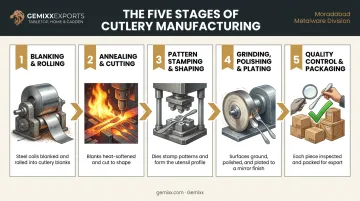
At a high level, raw steel coil moves through blanking, rolling, annealing, stamping, shaping, joining, finishing, and inspection before it reaches packaging. Each stage pushes the metal further from flat sheet toward finished utensil.
The core inputs are graded stainless steel (commonly 18/8 or 18/10), hardened steel dies built for each utensil's exact geometry, and calibrated hydraulic presses. Flat metal gets progressively cut, thinned, and pressed into three-dimensional shapes using heat and force.
What controls the outcome:
- Annealing temperature determines how workable the metal is during shaping
- Press tonnage affects how crisply patterns and details transfer
- Die alignment determines dimensional accuracy across thousands of identical pieces
By the end of this sequence, a flat, soft blank has become a hardened, precisely shaped, food-ready utensil.
Step 1: Blanking and Rolling
Flat blanks get punched from steel coils in the rough outline of a fork, knife, or spoon. This blanking stage sets the utensil's basic footprint before any detail work begins.
Rolling comes next. Each blank passes through rollers crosswise and lengthwise, establishing the thickness and balance specific to that utensil type. A spoon needs weight distributed differently than a knife blade. Rolling is where that gets built in, long before the piece looks anything like a finished product.
Step 2: Annealing and Cutting to Outline
Cold-rolled steel work-hardens and becomes brittle, which makes it a poor candidate for further shaping. Annealing solves that: controlled heat treatment softens the metal, restoring the flexibility needed for pattern stamping.
Once annealed, excess material gets trimmed to the precise outline the finished piece requires. This cutting stage removes rough edges from blanking and leaves a clean profile ready for pattern application. Skipping this step shows up later as uneven edges or distorted proportions.
Step 3: Pattern Stamping and Piece-Specific Shaping
Hydraulic drop hammers emboss decorative patterns using hardened dies. This is also where each utensil type branches into its own process:
- Knife handles: Components are soldered and bonded together, often joining a separate handle piece to the blade
- Spoon bowls: Pressed into shape across two separate hammer strikes to achieve correct depth and curve
- Fork tines: Pierced and separated from the blank, then individually shaped for even spacing and strength
Die precision matters most here. A misaligned die produces tines with uneven spacing or a bowl that sits crooked against the handle: flaws no amount of polishing fixes later.
Step 4: Grinding, Polishing, and Optional Plating
Pieces move to grinding wheels and buffing stations, where rough edges from stamping get smoothed away. From there, polishing produces the finish a buyer actually sees: mirror, satin, or brushed.
Flatware destined for silver plating gets an added step: electroplating deposits a layer of silver onto the base metal, followed by another polishing pass to bring out shine and improve tarnish resistance. This plating cycle adds time and cost but changes both the look and the price point.
Step 5: Quality Control and Packaging
Before anything ships, inspectors check each piece for scratches, discoloration, and rough spots, particularly between fork tines, where debris and burrs like to hide.
Approved pieces get cleaned to remove polishing compound residue, then packed in protective materials suited to bulk shipment. For hospitality and retail orders, this stage is where a manufacturer either catches a defective batch or lets one slip through to a client's loading dock.
Mass Production vs. Handmade Craftsmanship: Where the Process Differs
Metal stamping dominates high-volume flatware production. Retail chains, hotel groups, and restaurant suppliers need thousands of identical place settings at a price point that supports thin margins, and stamping delivers that consistency at scale.
Forging takes a different approach. Rather than cutting flat sheet, forged flatware Handmade craftsmanship sits in a third category entirely. Skilled artisans individually hammer, shape, and finish each piece, a process no automated press can replicate. Each piece carries its own character instead of uniform output.
At Gemixx Exports, that philosophy has driven production since the early 1990s. Every flatware piece passes through an average of 16 skilled artisans across forging, casting, grinding, polishing, plating, and finishing. Managing Director Vineet Dargar built the company around a deliberate rejection of full automation:
"I knew that the economic benefits of the machine mass-produced product would soon make the design-oriented flatware industry eventually hit an artistic plateau. With big machines and millions invested in them, the incentive to change those processes would be too low. This had to be bad for design."
The result is what Gemixx calls "desirable imperfections": hand-hammered texture, subtle tonal variation in PVD-plated finishes, and organic surface irregularities marking a piece as genuinely handmade rather than machine-stamped.
Full automation isn't the right fit for every order. Consider handmade or forged production when:
- Order volume is low and custom, not mass retail
- The brand wants a luxury or bespoke finish
- Storytelling around artisan craftsmanship matters to the target customer
Stamping still wins on cost and speed for standardized programs. For brands building a premium identity, though, the slower, hands-on route often justifies its price.
Key Factors That Affect Cutlery Quality
Not all stainless steel flatware is created equal, even when it looks similar on a shelf. A handful of variables determine whether a piece survives ten years of commercial use or starts pitting within months.
Steel Grade Drives Corrosion Resistance
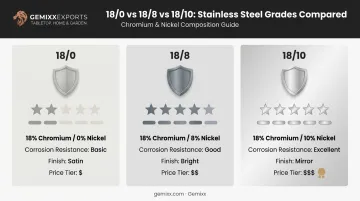
The numbers on a flatware label (18/0, 18/8, 18/10) refer to chromium and nickel content. Chromium stays constant at 18%; the second number is nickel.
According to the British Stainless Steel Association, nickel improves corrosion resistance in austenitic stainless steel, which is why nickel-free 18/0 costs less but resists corrosion less effectively than nickel-bearing 18/8 or 18/10 grades. Higher nickel content also tends to produce a brighter finish.
Practical impact for buyers:
- 18/0: Budget-friendly, magnetic, lower corrosion resistance
- 18/8: Standard commercial grade, solid corrosion resistance
- 18/10: Premium grade, best shine and longevity
Die Precision and Press Control
Pattern consistency depends on die alignment and press tonnage. A worn or misaligned die produces tines that splay unevenly or bowls that sit slightly off-center, defects that become obvious once dozens of pieces sit together on a table. Manufacturers catch these flaws by inspecting sample runs against a master pattern before full production begins, rejecting batches that fall outside tolerance.
Finishing Method Affects Wear, Not Just Looks
Mirror, satin, and brushed finishes each change how a piece ages:
- Mirror: High shine, shows scratches most visibly over time
- Satin: Lower sheen, disguises minor scratching better
- Brushed: Textured, directional finish that hides wear patterns
Two Common Misconceptions
"Shinier means better quality." Finish and base metal grade are independent variables. A brilliantly polished 18/0 piece will still corrode faster than a satin-finished 18/10 piece.
"Handmade means inconsistent." This assumption doesn't hold up. Skilled artisan processes, properly managed, meet the same functional tolerances as machine production while adding character machines can't produce.
At Gemixx, a collaborative prototyping process establishes an approved sample standard before scaling, with quality monitored by artisan expertise at every stage rather than left to a single automated checkpoint.
Frequently Asked Questions
What do you call someone who makes cutlery?
A person who makes or sells cutlery is traditionally called a "cutler," a trade term dating back centuries to cities like Sheffield, England. The word derives from the Latin "cutellarius" through Old French.
What is the best material for cutlery manufacturing?
Stainless steel, particularly 18/8 or 18/10 grades, is the industry standard. It balances corrosion resistance, durability, and cost better than alternatives like silver plate or carbon steel.
What's the difference between stamped and forged cutlery?
Stamped cutlery is cut from flat sheet metal for efficient mass production, resulting in thinner, lighter pieces. Forged cutlery is heated and shaped, producing heavier, more durable utensils at a higher cost.
How long does it take to manufacture a set of cutlery?
Timelines vary widely by method. Mass-stamped production moves fastest, while handmade or artisanal flatware can take 40 to 60 days after sample approval due to manual shaping and finishing.
Why does the stainless steel grade (18/8 vs. 18/10) matter?
The second number represents nickel content, which improves corrosion resistance and shine. That makes 18/10 slightly more premium than 18/8, though both perform well commercially.
Is handmade cutlery better quality than machine-made cutlery?
Machine-made cutlery wins on scale and consistency, making it well-suited for high-volume, budget-driven lines. Handmade cutlery carries unique character and craftsmanship that commands premium pricing in boutique and luxury markets.