Introduction
Flatware sets the tone before the first course even arrives. A Michelin-starred dining room, a five-star hotel banquet, or a Sunday family table all send a message through the weight and shine of the fork in your hand.
Buyers today have more options than ever—and more risk of getting it wrong. Choosing between a heritage French silversmith and a mid-range American stainless brand isn't just about looks.
It affects durability, cost per setting, and how a hospitality or retail brand signals quality to guests and customers.
This guide breaks down the world's top flatware brands by region and craftsmanship style. It also explains how to judge quality before you buy, and what to consider if you're building your own private-label line instead.
TL;DR
- Top flatware brands cluster in France, Italy, Germany, Japan, and the USA, each with a distinct style
- 18/10 stainless steel and sterling silver remain the top materials for shine and durability
- Evaluate brands on material grade, weight, craftsmanship heritage, and after-sales support
- Private-label manufacturing offers retailers a growing path to margin and differentiation
Overview of the Global Flatware Market
Flatware refers to the forks, knives, and spoons used at the table. Technically, "flatware" covers spoons and forks while knives fall under cutlery, but American usage lumps all three together.
Silverware, by contrast, is a material-specific term. The FTC requires products labeled "sterling" or "silver" to contain at least 92.5% pure silver. Stainless flatware, no matter how premium, is never technically "silverware."
The category is growing steadily. One 2026 estimate puts the global stainless-steel flatware market at $7.52 billion, climbing toward $10.73 billion by 2033. Other industry estimates run higher depending on scope, but the direction is consistent: demand for both everyday and premium tableware continues to rise.
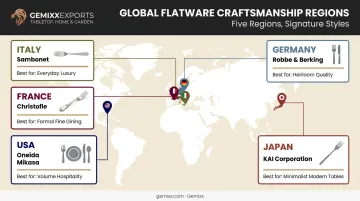
Five regions dominate production, each with its own manufacturing philosophy:
- France: artisan silversmithing rooted in royal-court heritage, favoring formal patterns
- Italy: design-led minimalism built for hospitality and retail
- Germany: precision engineering applied across both silver and steel
- USA: high-volume, durable stainless flatware for everyday and gift markets
- Japan: steel craftsmanship that shapes global tableware design trends
These regional identities set up the brand roundup below.
Top 10 Best Flatware Brands in the World
This list weighs heritage, material quality, craftsmanship, and market presence across both luxury and everyday-use segments.
Christofle (France)
Founded in 1830, Christofle became the standard for European royal courts and remains a fixture in luxury hotels today. Its silver-plated finishes and Art Deco-inspired Malmaison pattern define French sculptural tableware.
| Origin | Signature Material/Style | Best For |
|---|---|---|
| France | Silver-plated, sculptural modern designs | Luxury hospitality, formal dining |
Puiforcat (France)
A century-old Parisian silversmith known for bold, geometric minimalism rooted in Art Deco. Its Cannes and Elysée patterns have graced diplomatic receptions, including the Elysée Palace itself.
| Origin | Signature Material/Style | Best For |
|---|---|---|
| France | Sterling silver, geometric minimalism | Diplomatic settings, collectors |
Robbe & Berking (Germany)
Handcrafted since 1874 in Flensburg, Robbe & Berking applies German precision engineering to sterling and heavy silver-plate flatware. Design purists favor its understated Riva and Art Deco lines for yachts and refined residences.
| Origin | Signature Material/Style | Best For |
|---|---|---|
| Germany | Sterling silver and silver-plate, precision balance | Residential and yacht/hospitality use |
Sambonet (Italy)
An Italian design powerhouse since 1856, Sambonet built its reputation on engineering-level precision in stainless steel. Sleek, well-proportioned collections show up across boutique hotels, restaurants, and upscale catering.
| Origin | Signature Material/Style | Best For |
|---|---|---|
| Italy | Stainless steel, sculptural minimalism | Hotels, restaurants, and home use |
Mepra (Italy)
Since entering stainless flatware in 1950, Mepra has pushed innovation with colored finishes, resin handles, and mirror polishes. Durable mixed-material construction gives its pieces a playful, modern edge.
| Origin | Signature Material/Style | Best For |
|---|---|---|
| Italy | Stainless steel with resin/colored accents | Contemporary home and boutique hospitality |
Oneida (USA)
America's largest flatware manufacturer, operating since 1880, built its name on breadth. Oneida's open-stock catalog spans simple everyday patterns to decorative designs, all in 18/10 or 18/0 stainless steel.
| Origin | Signature Material/Style | Best For |
|---|---|---|
| USA | 18/10 & 18/0 stainless steel | Everyday, value-conscious buyers |
Reed & Barton (USA)
Dating to 1824, Reed & Barton blends traditional silversmith techniques with modern production. The intricate Francis I pattern remains a wedding-registry staple and heirloom gift.
| Origin | Signature Material/Style | Best For |
|---|---|---|
| USA | Sterling silver and premium stainless steel | Heirloom gifting, formal dining |
Lenox (USA)
Leveraging over a century of fine china expertise, Lenox extends that legacy into flatware with patterns like Portola. Balanced heft and smooth, mirror-polished finishes pair naturally with its dinnerware.
| Origin | Signature Material/Style | Best For |
|---|---|---|
| USA | 18/10 stainless steel, subtle detailing | Everyday-to-formal versatility |
Zwilling / J.A. Henckels (Germany)
Zwilling built its name on knife-making since 1731 and then extended that precision into flatware lines like Opus and Provence. Consistently balanced and dishwasher-durable, these sets hit accessible mid-range price points.
| Origin | Signature Material/Style | Best For |
|---|---|---|
| Germany | 18/10 stainless steel, European styling | Mid-range everyday and gifting |
Mikasa (Japan/USA)
Founded in 1948, Mikasa became a household name through coordinated dinnerware, glassware, and flatware collections. Its range stretches from the minimal Barrett pattern to the gold-accented Regent Bead, all at approachable prices.
| Origin | Signature Material/Style | Best For |
|---|---|---|
| Japan-founded, US-based | 18/10 stainless steel, decorative accents | Traditional and formal home dining |
How to Evaluate Flatware Quality and Choose the Right Brand
Understanding the 18/10 vs. 18/8 vs. 18/0 Debate
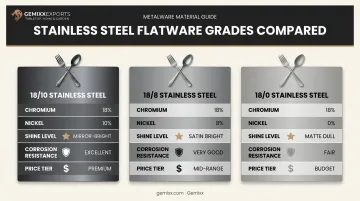
The numbers stamped on stainless flatware refer to chromium and nickel content. According to the British Stainless Steel Association, 18/8 and 18/10 are generally the same 304-family alloy, both roughly 18% chromium with 8-10% nickel. 18/0 is a nickel-free ferritic grade, lower in shine and corrosion resistance, but often cheaper for high-volume programs.
Chromium builds the corrosion-resistant surface; nickel adds shine and flexibility during forming. Neither number alone guarantees a well-made piece.
Weight, Balance, and Craftsmanship Signals
A heavier, well-balanced piece feels sturdier and holds up better in daily or commercial use. Beyond the spec sheet, look for:
- Hand-finishing on edges, tines, and bowls rather than raw stamped edges
- Limited production runs or designer collaborations, which usually signal tighter quality control
- Consistent gauge (thickness) across an entire set, not just the hero pieces
Practical Buying Factors for Businesses
For retailers and hospitality buyers, brand prestige matters less than supply reliability:
- Open-stock availability: can you reorder a single fork five years from now?
- Warranty coverage: what happens when a piece fails under normal use?
- Consistency of supply: does the manufacturer control production, or rely on subcontractors?
Vertically integrated manufacturers control this directly. Gemixx, for example, runs its own factories across India rather than subcontracting production, which keeps lead times and quality consistent across reorders.
Common mistake: Buyers often prioritize looks over functional grip, spoon depth, and dishwasher durability. A stunning finish that chips after 200 wash cycles isn't a bargain. Weigh design and performance together before committing to volume.
Private Label & Custom Flatware Manufacturing: An Alternative to Established Brands
Reselling an established name isn't the only path anymore. Many retailers, hospitality groups, and home décor brands now build their own branded flatware lines for better margins, real differentiation, and a product no competitor can stock.
Doing this well requires a manufacturing partner offering vertical integration: prototyping, production, importing, and warehousing under one roof. Juggling a separate designer, factory, freight forwarder, customs broker, and 3PL warehouse introduces delays and quality gaps at every handoff.
This is the model Gemixx Exports operates on. A 40+ year handmade flatware manufacturer working with 250+ global retailers and wholesalers, Gemixx runs its own Moradabad metalware factory in India, with no third-party contract shops. Each flatware piece passes through an average of 16 skilled artisans across forging, casting, grinding, polishing, plating, and finishing.
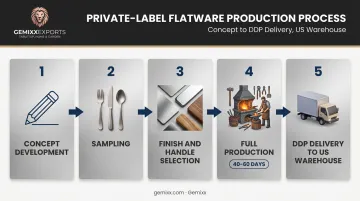
For retailers exploring a private-label line, the process typically looks like:
- Concept development — starting from a sketch, render, or even a competitor sample
- Sampling — physical prototypes produced for sign-off, quoted separately from production
- Finish and handle selection: options include Gold PVD, Black PVD, Champagne Gold PVD, brushed or polished stainless, plus handles in FSC-certified wood, bone, marble, resin, or enamel
- Full production — 40-60 days after sample approval
- DDP delivery: landed duty paid, straight to a US warehouse
Turnaround matters as much as craftsmanship. Gemixx commits to a same-business-day inquiry response and formal quotes within 48 hours, with MOQs set per silhouette, finish, and packaging rather than a rigid universal minimum. That flexibility supports both boutique capsule collections and high-volume programs.
Conclusion
The "best" flatware brand depends entirely on your context. A luxury hotel group needs Christofle-level formality, while a growing retail chain leans on Oneida-style durability at scale. Brand owners chasing differentiation often need something no shelf brand can offer.
Before committing to any brand or manufacturing partner, weigh material grade, craftsmanship, and supply reliability, not just name recognition.
If you're a retailer or wholesaler exploring a custom or private-label flatware line, Gemixx Exports can walk you through prototyping, sampling, and production. Reach the team at forks@gemixx.com or +1 201 201 0070 for a quote within 48 hours.
Frequently Asked Questions
What is a good quality flatware brand?
Accessible options like Oneida and Lenox deliver reliable 18/10 stainless for everyday use, while Christofle and Robbe & Berking represent premium sterling craftsmanship. "Good quality" ultimately depends on steel grade and finishing, not just brand name.
What is the best grade of flatware?
18/10 stainless steel (18% chromium, 10% nickel) stands as the top grade for shine, durability, corrosion resistance, and long-term value. It's technically close to 18/8, so also check the piece's weight and finish for overall construction quality.
What is the difference between flatware and silverware?
Silverware must contain at least 92.5% real silver to legally use that name in the US. Flatware is the broader term, covering forks, knives, spoons, and serving pieces made from any material, including stainless steel.
Which country makes the best flatware?
France and Italy lead in luxury and artisan flatware traditions, while Germany and the USA dominate durable, mid-range everyday production. There's no single "best" country—each region brings a different design philosophy.
How do I source or manufacture private label flatware for my retail brand?
Look for a vertically integrated manufacturer offering prototyping, production, and warehousing under one roof, such as Gemixx Exports. This avoids juggling separate designers, factories, and freight partners.
Is expensive flatware always better quality?
Not always. Price often reflects craftsmanship and heritage, but a well-made mid-range 18/10 stainless set can rival luxury brands in daily durability and dishwasher performance.