Introduction
Walk into any kitchen supply aisle and you'll find two cookware philosophies at war: ceramic's promise of easy, worry-free cooking versus copper's obsession with precision heat control. One is the go-to for health-conscious home cooks. The other still rules professional kitchens.
This isn't just a matter of taste. The material you choose affects how food cooks, what leaches into it, and how much time you'll spend maintaining your pans.
51% of women now prioritize non-toxic cookware, according to Mintel's 2025 US Cookware Market Report. That shift is reshaping what home cooks buy and what retailers choose to stock.
Whether you're outfitting your own kitchen or sourcing a private-label cookware line, here's what actually separates ceramic from copper.
Key Takeaways
- Ceramic cookware is non-reactive and low-maintenance, ideal for everyday, health-conscious cooking
- Copper delivers unmatched heat responsiveness, favored in professional kitchens for precision work
- Cost and upkeep differ sharply: copper demands more money and more care
- The "better" material depends on your cooking style, budget, and safety priorities
Ceramic vs Copper Cookware: Quick Comparison
Here's how the two materials stack up across the factors that matter most to buyers.
| Factor | Ceramic | Copper |
|---|---|---|
| Cost | Budget-friendly to premium handcrafted | Premium, driven by raw material and labor cost |
| Composition | Clay/mineral body or sol-gel coating over metal | Copper body, typically lined with tin or stainless steel |
| Heat conductivity | Heats and cools gradually | Fastest-heating common cookware metal |
| Durability | Can chip or crack; no polishing needed | Long-lasting with care; needs periodic re-tinning |
| Health & safety | Non-reactive; verify PFAS/PTFE-free claims | Reactive with acidic foods unless lined |
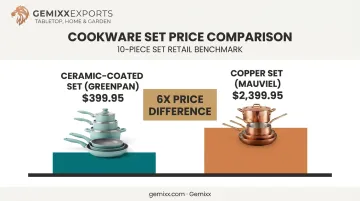
Two real retail examples show the price gap directly: a 10-piece ceramic-coated set from GreenPan retails around $399.95, while a comparable 10-piece stainless-lined copper set from Mauviel runs $2,399.95.
That's roughly a sixfold difference for the same piece count.
On the safety side, "ceramic" and "copper" aren't single, uniform categories. Pure ceramic differs from ceramic-coated metal. Lined copper differs from unlined copper. The distinctions matter more than the material name alone.
What is Ceramic Cookware?
Ceramic cookware comes in two forms, and buyers often confuse them.
Pure ceramic is fired clay or stone, shaped into a cooking vessel much like pottery.
Ceramic-coated cookware is different: a sol-gel coating (silica, metal oxides, and binders) sprayed onto an aluminum or steel base and cured at roughly 400–800°F. The American Ceramic Society calls this second category "quasi-ceramic" since it's a coating applied to metal, fired at a fraction of the temperature of true ceramics, not a solid clay body.
That distinction affects everything from durability to price:
- Pure ceramic offers a genuinely non-reactive cooking surface with no chemical leaching risk, but it's heavier and prone to cracking from sudden temperature shifts.
- Ceramic-coated cookware is lighter, more affordable, and heats faster than pure ceramic, but coating performance depends on care and manufacturing quality.
Consumer Reports tested two ceramic-coated pans and found zero PFAS compounds out of a 96-chemical test panel, while a tested PTFE pan contained 16. That's a promising result, but it applies only to the specific pans tested, not to every "non-toxic" label on the shelf.
Use Cases of Ceramic Cookware
Ceramic fits best in these situations:
- Everyday stovetop cooking where gentle, even heat matters more than instant temperature swings
- Oven-safe baking dishes, since pure ceramic tolerates sustained oven heat well
- Health-focused households actively avoiding synthetic nonstick coatings
Brands like Caraway and GreenPan dominate the ceramic-coated nonstick segment, while Xtrema represents the fully clay-based category. The HomePage News/IHA 2023 Consumer Outlook survey found 44% of respondents selected ceramic nonstick coating as their preference. That's a clear signal of where retail demand is heading, though it's not proof of a mass migration away from traditional nonstick.
What is Copper Cookware?
Copper cookware is built for one thing: speed of temperature change. A copper body, almost always lined with tin or stainless steel, conducts heat far faster than any other common cookware metal.
The numbers back this up. Copper (C110 alloy) conducts heat at 399 W/m-K, aluminum manages 222 W/m-K, and stainless steel trails at just 14.4 W/m-K, according to published engineering reference data.
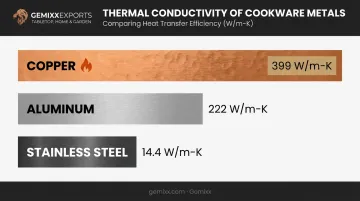
That gap means copper responds almost instantly to burner adjustments. It's exactly why chefs reach for it during sauce reductions and candy-making, where a few seconds of overheating ruins the dish.
Lined vs. unlined matters enormously here. Unlined copper exposes food directly to the metal, which the FDA restricts for anything with a pH below 6.0, meaning vinegar, wine, and most fruit-based dishes. Lined copper solves this:
- Tin lining is traditional and slightly better for heat transfer, but it wears down over time and eventually needs re-tinning
- Stainless steel lining is far more durable and skips the re-tinning requirement, though it dampens copper's responsiveness slightly since the steel layer adds a thin thermal barrier
- Unlined copper works only for non-acidic cooking or decorative use, since FDA rules restrict direct food contact below pH 6.0
Use Cases of Copper Cookware
Copper earns its keep in specific settings:
- Fine-dining pastry and sauce stations, where second-by-second heat control affects the final product
- Culinary schools teaching precision technique
- High-end home cook collections for buyers who prioritize performance over convenience
Restaurant kitchens use copper far more often than home kitchens do, largely because of its price and maintenance demands rather than any lack of performance.
Ceramic vs Copper: Which Should You Buy?
There's no universal winner here. The right answer depends on four factors:
- Cooking style and skill level — do you need instant temperature response, or is gradual, even heat good enough?
- Budget — ceramic sets start well under $100; copper sets routinely run into four figures
- Maintenance tolerance — are you willing to hand-wash, polish, and eventually re-tin, or do you want low-effort care?
- Safety priorities — do you want a guaranteed non-reactive surface, or are you comfortable managing lined copper's acidic-food limits?
Choose ceramic if: you cook everyday meals, bake often, want low-maintenance care, and prioritize a non-reactive surface without babying your pans.
Choose copper if: precision matters more than cost, you're comfortable with polishing and periodic re-tinning, and you cook techniques where temperature response makes or breaks the dish.
Real-World Example: Sourcing Cookware Materials for Retail
Retailers building a cookware line face a different version of this question. Instead of picking one material for their own kitchen, they need to decide which materials to stock — copper, cast iron, ceramic-coated, or stainless.
That decision usually means juggling separate vendors for each material. Each vendor has different lead times, quality standards, and communication styles, which adds friction before a single unit ships.
This is where a vertically integrated manufacturer changes the math. Gemixx Exports, a 40-year family-run manufacturer with company-owned factories across India, produces hammered copper dual-wall cookware at its Moradabad facility, complete with FDA-compliant stainless steel interiors.
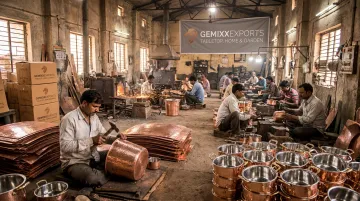
The same Moradabad facility also runs cast-iron and deep-draw cookware lines, while its Khurja factory handles hand-decorated ceramics and dinnerware, useful for pairing tableware programs with a cookware line.
That consolidation matters in practice. Gemixx's model delivers concrete operational benefits:
- Eliminates third-party contract shops between the client and the production floor
- Standardizes production lead times at 60–90 days after sample approval across categories
- Delivers quotes within 48 hours of inquiry
For a retailer coordinating copper cookware, cast-iron pieces, and ceramic tableware separately, folding all three into one partner cuts the number of vendor relationships to manage down to one.
Retailers and wholesalers evaluating cookware materials for a private-label program benefit from a manufacturing partner with hands-on experience across metals and ceramics. If you're weighing which materials to stock, reach out to Gemixx to discuss your program.
Conclusion
Ceramic and copper solve different problems. Ceramic gives everyday cooks a non-reactive, low-maintenance surface that works well for baking and daily meals. Copper gives professionals and serious home cooks the fastest, most precise heat response available in cookware, at a real cost in both dollars and upkeep.
Neither one makes the other obsolete. The decision comes down to what you're actually cooking and how much maintenance you're willing to accept in exchange for performance. For retailers, the calculation adds sourcing efficiency to the mix. Partnering with a manufacturer like Gemixx, which produces both hammered copper and ceramic cookware under one roof, eliminates the need to juggle separate vendors. It simplifies building a line that covers multiple price points and cooking styles.
Frequently Asked Questions
What is the healthiest cookware you can use?
Pure ceramic, cast iron, carbon steel, and properly lined copper are generally considered safe choices. Verified PFAS-free ceramic coatings are also popular for daily health-conscious cooking, so check the coating's test documentation before buying.
What are the advantages and disadvantages of copper cookware?
Copper's advantage is unmatched heat conductivity and precision temperature control, ideal for delicate techniques. Its disadvantages include high cost, reactivity with acidic foods when unlined, and ongoing maintenance like polishing and periodic re-tinning.
What is the downside of ceramic pans?
Ceramic pans can chip or crack, especially with sudden temperature changes or rough handling. Nonstick performance also fades gradually with use, and "non-toxic" claims vary in quality since they aren't strictly regulated across brands.
Is ceramic cookware better than copper?
Neither is universally "better." Ceramic suits everyday, low-maintenance, health-focused cooking, while copper suits professional-level precision work where cost and upkeep matter less than performance.
How long does copper cookware last compared to ceramic?
Well-maintained copper can last decades with periodic re-tinning as the lining wears. Quality ceramic can also last for years if handled gently, though both materials degrade faster under rough, careless use.
Can you use metal utensils on ceramic or copper cookware?
Avoid metal utensils on ceramic, since they risk chipping the surface or coating over time. Lined copper also calls for wooden or silicone utensils to protect the tin or stainless steel lining underneath.