Introduction
Walk down any cookware aisle and you'll see the same word everywhere: ceramic. It's marketed as the healthier, nonstick, PFAS-free answer to Teflon, wrapped in colors that make stainless steel look boring.
Ask ten shoppers how long a ceramic pan actually lasts, though, and you'll get ten different answers.
That confusion isn't accidental. Most buyers don't realize "ceramic cookware" describes two very different products with wildly different lifespans. One might survive a single cooking season. The other could outlast a kitchen remodel.
This guide breaks down both categories, what actually shortens their lifespan, the real pros and cons, and the care habits that determine whether your ceramic cookware lasts one year or twenty.
Key Takeaways
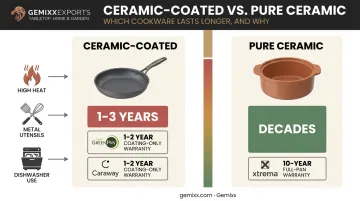
- Ceramic-coated pans lose nonstick performance within 1-3 years; pure ceramic lasts decades with proper care
- Heat, metal utensils, and dishwasher cycles cause most coating failures
- Ceramic contains no PFAS/PTFE and won't react with acidic foods like tomatoes or wine
- Pro kitchens favor ceramic for eggs and delicate proteins, not high-volume searing
Types of Ceramic Cookware: Coated vs. 100% Pure Ceramic
Two entirely different products get sold under the same "ceramic" label, and mixing them up is the biggest reason shoppers feel misled by lifespan claims.
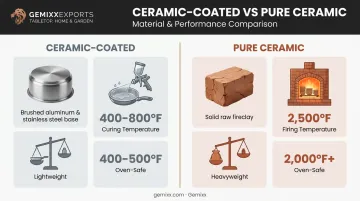
Ceramic-coated cookware starts as an aluminum or stainless-steel pan. Manufacturers spray a silica-based sol-gel coating onto the metal, then cure it at roughly 400-800°F. This coating creates the nonstick surface and glossy color, but it's still just a thin layer sitting over metal.
Pure ceramic cookware contains no metal at all. Pieces are hand-formed from fireclay, water, and natural minerals, then fired in a kiln at around 2,500°F, more than triple the curing temperature of a coated pan. Xtrema, one of the best-known pure-ceramic brands, builds its entire durability claim around this structural difference.
Does Coating Layer Count Actually Matter?
Cookware marketing loves to tout "multi-layer" or "reinforced" ceramic coatings, but the evidence here is thinner than the coatings themselves. America's Test Kitchen's ceramic skillet testing found that only three of the pans evaluated passed its durability test, and even the winner still scratched under a knife blade. That's product-level variation, not proof that extra layers automatically buy more years.
A Quick Checklist Before You Buy
- Material description: Does the listing say "ceramic-coated" or "100% ceramic"? The wording matters more than the photo
- Weight: Pure ceramic pieces feel noticeably heavier and denser than coated aluminum
- Price point: Coated pans typically run lower; solid ceramic commands a premium
- Oven-safe temperature: Coated pans often cap out around 400-500°F; pure ceramic frequently handles 2,000°F+
How Long Does Ceramic Cookware Last?
The honest answer depends entirely on which category you bought.
Ceramic-coated pans have the shorter, more variable lifespan. Wirecutter's testing found that ceramic nonstick coatings can lose their release properties in about one year, sometimes sooner with heavy use.
GreenPan backs its Thermolon coating with a 2-year warranty, while Caraway markets 3-5+ years of performance with proper care, though its actual limited warranty covers only one year. None of these numbers is a universal guarantee; they're brand-specific benchmarks.
Pure ceramic cookware tells a different story. Xtrema offers a 10-year limited warranty and claims decades of service life when cared for properly. That's a stronger structural claim, though no independent, population-wide lifespan study currently backs the "decades" figure.
What Shortens the Lifespan
- High-heat cooking that stresses the coating or causes thermal shock
- Metal utensils that scratch the surface
- Aerosol cooking sprays that leave residue and impair release
- Abrasive scrubbing pads and harsh detergents
- Dishwasher cycles, which many brands explicitly warn against
Signs It's Time to Replace
For ceramic-coated pans: persistent food sticking, visible staining, chipping, or exposed metal underneath the coating.
For pure ceramic: hairline cracks (often from thermal shock) or chips from an impact against a hard surface.
For comparison, well-maintained cast iron can last generations, and a quality tri-ply stainless steel set is often considered a lifetime purchase. Coated ceramic simply can't match that timeline, though pure ceramic narrows the gap considerably.
Construction quality plays a role too. Reinforced rims, fully encapsulated bases, and multi-layer or forged construction help resist warping over repeated heat cycles.
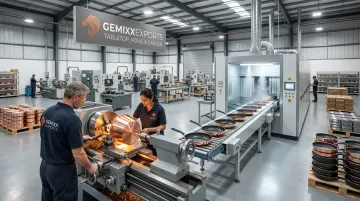
This same engineering shows up across premium cookware manufacturing, including the multi-layer spun-metal and dual-wall copper techniques Gemixx uses in the private-label cookware it builds for retail and wholesale brands. When comparing ceramic cookware brands, check whether the warranty covers the coating specifically or the entire pan. A coating-only warranty of one or two years often signals less confidence than a full-pan warranty stretching a decade.
Pros and Cons of Ceramic Cookware
Pros of Ceramic Cookware
Ceramic's biggest selling point is what it leaves out.
- No PFAS or PTFE: Ceramic coatings skip the synthetic chemicals found in traditional nonstick, a major draw for health-conscious cooks
- Verify label claims: Consumer Reports warns that "non-toxic" labeling doesn't guarantee every PFAS compound is absent, so check each brand's specifics
- Non-reactive surface: Acidic ingredients like tomatoes, citrus, and wine won't pit the surface or pick up metallic flavors, unlike bare cast iron or lower-grade aluminum
- Design versatility: Ceramic takes color and glaze beautifully, which is exactly why home decor brands and retailers favor it for differentiated product lines, from matte pastels to glossy jewel tones
Cons of Ceramic Cookware
The trade-offs are just as real.
- Shorter usable life: Coated versions generally can't match the multi-decade lifespan of stainless steel or cast iron
- Care sensitivity: No metal utensils, no high heat, hand-washing only, a level of babying that stainless steel and cast iron simply don't demand
- Fragility in pure ceramic: Solid ceramic can chip or crack from a hard-floor drop or sudden temperature swings, like adding cold liquid to a hot pan, despite its long-term durability edge
How to Extend the Lifespan of Your Ceramic Cookware
The right habits add years to the life of either type of ceramic cookware.
Manage heat carefully. Preheat on low-to-medium heat (350°F or below) rather than blasting high heat from the start. Match your pan size to the burner, since an oversized flame licking up the sides creates hot spots that break down coatings faster than consistent, even heating.
Choose the right tools. Stick to wood, silicone, or plastic utensils. Hand-wash with a soft sponge and mild soap, and skip the dishwasher and abrasive scrubbing pads, both of which strip coatings and dull glazes over time.
Store with protection. Use felt or fabric pan protectors between stacked cookware, and avoid piling heavy pots directly on top of a coated skillet. Small scratches from careless stacking add up faster than most people expect.
Do Professional Chefs Use Ceramic Cookware?
Selectively, yes. Professional kitchens reach for ceramic when cooking eggs, delicate fish, or other proteins that demand gentle, low-to-medium heat and a forgiving release. For tougher jobs, most kitchens still turn to materials built to survive a 12-hour shift:
- Stainless steel for everyday durability and even heating
- Carbon steel for fast temperature response during high-heat searing
- Cast iron for heat retention through high-volume line work
A newer category of pro-grade ceramic is trying to close that gap: heavier gauges, reinforced coatings, and sturdier bases designed to survive commercial conditions while keeping the health and nonstick benefits intact.
Gemixx's leadership understands that gap firsthand. Managing Director Vineet Dargar spent over a decade as an Executive Chef in international kitchens before moving into manufacturing.
That kitchen-floor experience shapes how Gemixx builds cookware today. Knowing exactly how a pan needs to perform under pressure now informs the craftsmanship standards applied across the company's cookware and housewares lines for retail and hospitality clients worldwide.
Frequently Asked Questions
How long do ceramic pans usually last?
Ceramic-coated pans typically perform well for 1-3 years with normal use before nonstick release declines. Pure ceramic cookware can last decades with proper care, backed by warranties as long as 10 years.
Do professional chefs use ceramic pans?
Yes, but selectively, mainly for eggs, fish, and other delicate, low-heat cooking. Heavier-duty materials like stainless steel and cast iron remain standard for high-volume commercial work.
Is ceramic cookware actually safe to cook with?
Yes. Ceramic cookware avoids PFAS and PTFE chemicals and is safe when it meets food-grade compliance standards such as FDA guidelines and California's Prop 65 requirements.
What's the real difference between ceramic and ceramic-coated cookware?
Ceramic-coated cookware has a metal base (usually aluminum or stainless steel) with a thin ceramic nonstick layer sprayed on top. Pure ceramic cookware is solid, kiln-fired clay with no metal core at all.
Can you use metal utensils on ceramic cookware?
Avoid metal utensils on ceramic-coated pans since they scratch the coating and speed up wear. Pure ceramic resists scratching better, but wood or silicone tools remain the safer choice.
How do I know when it's time to replace my ceramic cookware?
Watch for persistent food sticking, visible chipping, or exposed metal on coated pans. For pure ceramic, hairline cracks or impact chips are the clear signals it's time for a replacement.