
Despite being one of humanity's oldest manufactured materials, glass remains widely misunderstood. Most people know it starts as "melted sand," but few understand the precise stages, temperatures, and controls required to turn raw silica into a finished product.
The industry backing this material is enormous. The global glass manufacturing market was valued at $127.4 billion in 2025, according to a Grand View Research industry report, spanning container, flat, fiber, and specialty glass production.
This guide breaks down exactly how glass is made — stage by stage, from raw batch to finished form — and clears up a few persistent myths along the way.
Key Takeaways
- Silica sand, soda ash, and limestone melt into glass at temperatures near 1,540°C (2,800°F)
- Four stages define the process: batching, melting/forming, annealing, and finishing
- Annealing prevents internal stress that causes glass to crack or shatter unexpectedly
- Hand-blown and machine-made glass differ mainly in scale, speed, and artisan involvement
- The material remains scientifically classified as an amorphous solid, not a slow-flowing liquid
What Is Glass?
Glass is an amorphous solid — a material formed when molten raw ingredients cool too quickly to arrange themselves into an ordered crystal structure. Unlike metals or minerals, its atoms freeze in a disordered, liquid-like arrangement even though the material behaves as a rigid solid.
That same disordered structure is what makes glass so versatile: transparent, moldable, and non-porous. Ancient civilizations valued it precisely because ceramics and metals couldn't match those qualities for storage, optics, and décor.
Debunking the "Liquid Glass" Myth
You've probably heard that old cathedral windows are thicker at the bottom because glass "flows" like a liquid over centuries. It's a nice story, but it's not true.
The American Ceramic Society's viscosity calculations found that medieval glass would deform by roughly one nanometer over one billion years at room temperature. Those uneven old panes reflect inconsistent manual manufacturing, not gravity at work.
Why Glass Still Matters
Plastics and composites have replaced glass in plenty of applications, but glass remains irreplaceable for one simple reason: it doesn't react with what's inside it. That chemical inertness, paired with full recyclability and unmatched optical clarity, keeps glass essential for food storage, pharmaceuticals, and premium tableware.
Not all glass is the same, either. The base recipe shifts depending on the application:
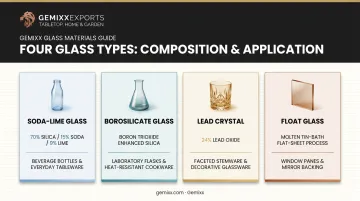
- Soda-lime glass: roughly 70% silica, 15% soda, 9% lime — the standard for bottles, jars, and everyday glassware
- Borosilicate glass: swaps in boron trioxide for heat resistance, used in lab equipment and cookware
- Lead crystal: contains at least 24% lead oxide by EU standard, prized for brilliance and weight
- Float glass: soda-lime glass formed via a specific flat-sheet process, used in architecture and vehicles
How Does Glass Making Work?
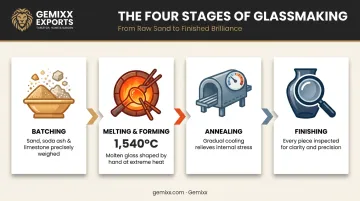
Glassmaking follows a defined sequence , from raw batch to finished product, where each stage directly determines the strength, clarity, and durability of the final piece. Skip a step, or rush it, and the flaws show up later.
Batching the Raw Materials
Every batch starts with three core ingredients: silica sand, soda ash (sodium carbonate), and limestone. Silica forms the glass network itself; soda ash lowers the melting point so furnaces don't need to work as hard; limestone adds durability and chemical stability. Recycled glass, or cullet, often joins the mix too: container glass can include up to 70% recycled content.
Industrial batching runs through silos, conveyors, and automated scales for precision at volume. Artisan studios, by contrast, often measure and mix by hand in smaller batches.
One recurring bottleneck: iron impurities in raw sand cause an unwanted green tint. Glassmakers have addressed this for centuries using manganese dioxide, historically called the "glassmaker's soap," to balance out the discoloration. Modern automated bottle production largely switched to selenium for this job by the 1920s.
Melting and Forming
Once batched, the mixture feeds into a furnace and heats until it becomes a molten, honey-like liquid. According to a U.S. Department of Energy industry profile, soda-lime glass melts and refines at approximately 2,800°F (1,540°C) before moving into lower-temperature fining and conditioning stages.
From there, the molten "gob" gets shaped through one of several methods:
- Blow-and-blow: air forms the container's finish first, then a counterblow shapes the hollow body (standard for bottles)
- Press-and-blow: a metal plunger presses the gob into shape before final blowing (common for jars)
- Float process: molten glass flows onto a bed of molten tin, spreading into a flat, level ribbon (the method behind virtually all architectural glass)
- Hand-blown: a craftsperson gathers molten glass on a blowpipe, inflates and shapes it through repeated reheating. Gemixx's Firozabad artisans use this exact technique for hand-blown glass vessels and candle holders
Gob weight, temperature consistency, and forming speed all affect the final piece. Too much variation in any of these, and you get uneven wall thickness or optical distortion.
Annealing: The Step Most People Skip Talking About
Freshly formed glass carries internal stress from uneven cooling. Left alone, that stress makes the piece dangerously fragile. Annealing solves this by holding the glass at a controlled temperature in an annealing lehr, then gradually reducing that temperature over a set period.
This gives the glass time to relax internally before it fully hardens. According to Lehigh University's glass processing research, cooling too quickly through the critical temperature range locks permanent residual stress into the material. That stress later triggers cracking from even minor thermal or physical shocks.
Annealing is the difference between a durable piece and a hazard waiting to happen. It's easy to overlook because it doesn't change how the glass looks. It changes whether the glass survives its first drop, temperature swing, or shipment.
Finishing and Quality Control
Once annealed, glass moves into finishing: inspection for cracks and bubbles, protective coatings, cutting to size, and packaging. Industrial float lines run automated optical inspection at a staggering scale: Pilkington reports over 100 million measurements per second on a single line, catching unmelted sand grains and distortions before they reach customers.
Container plants take a more hands-on approach too. Industry manuals recommend pulling a sample container from each mold roughly every 20 minutes for manual inspection, checking across categories like finish, neck, shoulder, and base defects. Defect rates vary widely by plant and product. One 2022 study of a container plant found glass-material defects in the 5-7% range during short-term operation, though this reflects one facility's conditions rather than an industry-wide standard.
Where Glass Is Used
Glass manufacturing spans two very different worlds. High-volume industrial production churns out bottles, windows, and fiber optics by the million. Small-batch artisan studios, meanwhile, produce one-of-a-kind decorative pieces and premium tableware.
Each forming method suits a different job:
- Float glass for flat architectural panels and vehicle glazing
- Blow-and-blow for mass-produced bottles and containers
- Hand-blowing for art glass, sculptural pieces, and premium glassware
Gemixx Exports operates squarely in this space at its Firozabad glass facility. The team uses a combination of hand-blown and pressed manufacturing to produce candle vessels, hurricanes, decanters, tumblers, vases, and cloches in soda-lime and borosilicate glass. Custom mold development lets clients commission original silhouettes from a sketch or competitor sample, finished in clear, frosted, colored, cut, or etched surfaces.
Glass barware and decorative pieces rarely exist in isolation on a retail shelf. They pair with flatware, cookware, and tabletop accents — an area where multi-specialty housewares manufacturers like Gemixx apply the same artisan-first philosophy across metal and glass alike, all under one vertically integrated roof.
Conclusion
From raw sand to finished form, every stage of glassmaking — batching, melting, forming, and annealing — contributes to the strength, clarity, and beauty of the final piece. Skip or rush any one of them, and the flaws surface eventually, whether as a cloudy finish or a piece that shatters under stress it should have survived.
Whether it's a mass-produced float glass panel or a hand-blown vase, quality glass demands the same respect for material and process. That respect for craft drives Gemixx's artisan-empowerment approach at its Firozabad facility, where skilled glassblowers apply generations of technique to every hand-formed piece.
Frequently Asked Questions
What is glassmaking called?
The industry broadly calls this craft glassmaking, or glassblowing when artisans shape glass by breathing through a pipe. Manufacturers typically call industrial-scale versions glass manufacturing or glass production.
What is the process of making glass?
Glass production follows four core stages: batching raw materials, melting them into a molten state, forming/shaping the glass, and annealing to relieve internal stress.
What are the three main ingredients in glass?
Most commercial glass starts with silica sand, soda ash, and limestone. Manufacturers often blend in recycled glass (cullet) as well, sometimes making it a significant share of the batch.
Is glass a liquid or a solid?
Scientists classify glass as an amorphous solid. Viscosity research debunks the popular myth that it flows like a liquid over time, showing negligible movement over billions of years.
Why is annealing important in glassmaking?
Annealing slowly cools glass to relieve internal stress created during forming. Without it, glass becomes structurally unreliable and prone to cracking or shattering from minor stress.
What is the difference between hand-blown and machine-made glass?
An artisan shapes hand-blown glass through breath and tools, producing unique, one-of-a-kind pieces. Machine-made glass uses molds and automation for speed and consistency at high volume.